

Cartier Watches
Cartier’s pioneering designs, like the Tank and Santos, have defined luxury watchmaking since 1847. Known for precision, elegance, and cultural impact, Cartier watches are true icons. Grand Caliber offers a trusted selection of new & preowned Cartier watches, authenticated for quality and ready for collectors and style enthusiasts seeking timeless craftsmanship and status.
Cartier Watches at Grand Caliber
Cartier watches command a unique position in the modern horological landscape, operating simultaneously as the definitive Parisian jeweler and as a foundational pillar of watchmaking history. While other Swiss manufactures spent the early twentieth century refining the pocket watch, Cartier invented the men's wristwatch. The brand established the vocabulary of case design long before the concept of a sports watch or a dress watch even existed. Today, Cartier watches represent a masterclass in form over function, where the architecture of the case dictates the engineering of the movement rather than the other way around. Grand Caliber stocks Cartier watches across the full spectrum of their vast catalogue, serving serious collectors and first time buyers nationally. Our inventory spans the modern in house era, the historically significant Collection Privee Cartier Paris pieces, and the definitive quartz references that defined the 1980s and 1990s. From the integrated architecture of the Santos de Cartier to the pure geometry of the Tank Louis Cartier, every piece is authenticated in house, priced transparently, and ready for immediate delivery.
The King of Jewelers and the Parisian Founding
The narrative of Cartier watches cannot be separated from the brand's origin as the premier jeweler to European royalty. Louis Francois Cartier founded the house in 1847 when he took over the workshop of his master Adolphe Picard in Paris. The company spent its first fifty years building a reputation for exquisite diamond work and platinum settings, eventually moving to the prestigious Rue de la Paix in 1899. It was the founder's three grandsons, Louis, Pierre, and Jacques, who transformed a successful Parisian workshop into a global luxury empire with distinct branches in Paris, London, and New York. King Edward VII of Great Britain famously declared Cartier the jeweler of kings and the king of jewelers, granting the house a royal warrant in 1904.
This jewelry foundation profoundly influenced how Cartier approached timekeeping. When Louis Cartier began focusing heavily on watches at the Paris branch, he did not view them as scientific instruments housed in metal boxes. He viewed them as functional jewelry. He established the core aesthetic signatures that define Cartier watches to this day, including the Roman numerals, the railway minute track, the blued steel sword shaped hands, and the sapphire cabochon set into the winding crown. Because the house was not a movement manufacture in the nineteenth century, Louis Cartier partnered with Edmond Jaeger in 1907, signing an exclusive contract for Jaeger to supply ultra thin movements to Cartier. This partnership allowed Cartier to focus entirely on the exterior architecture of their timepieces, setting a precedent for case design dominance that remains the central philosophy of Cartier watches today.
The Birth of the Mens Wristwatch
The historical weight of Cartier watches rests heavily on a single event in 1904. Alberto Santos Dumont, a Brazilian aviation pioneer and a prominent figure in Parisian high society, complained to his friend Louis Cartier about the difficulty of checking his pocket watch while operating the controls of his early flying machines. In response, Louis Cartier designed a flat, square watch with a pronounced bezel and integrated wire lugs intended to be strapped to the wrist with leather. This was a radical departure from the norm. At the time, wristwatches were almost exclusively worn by women as delicate jewelry pieces, while men relied on robust pocket watches.
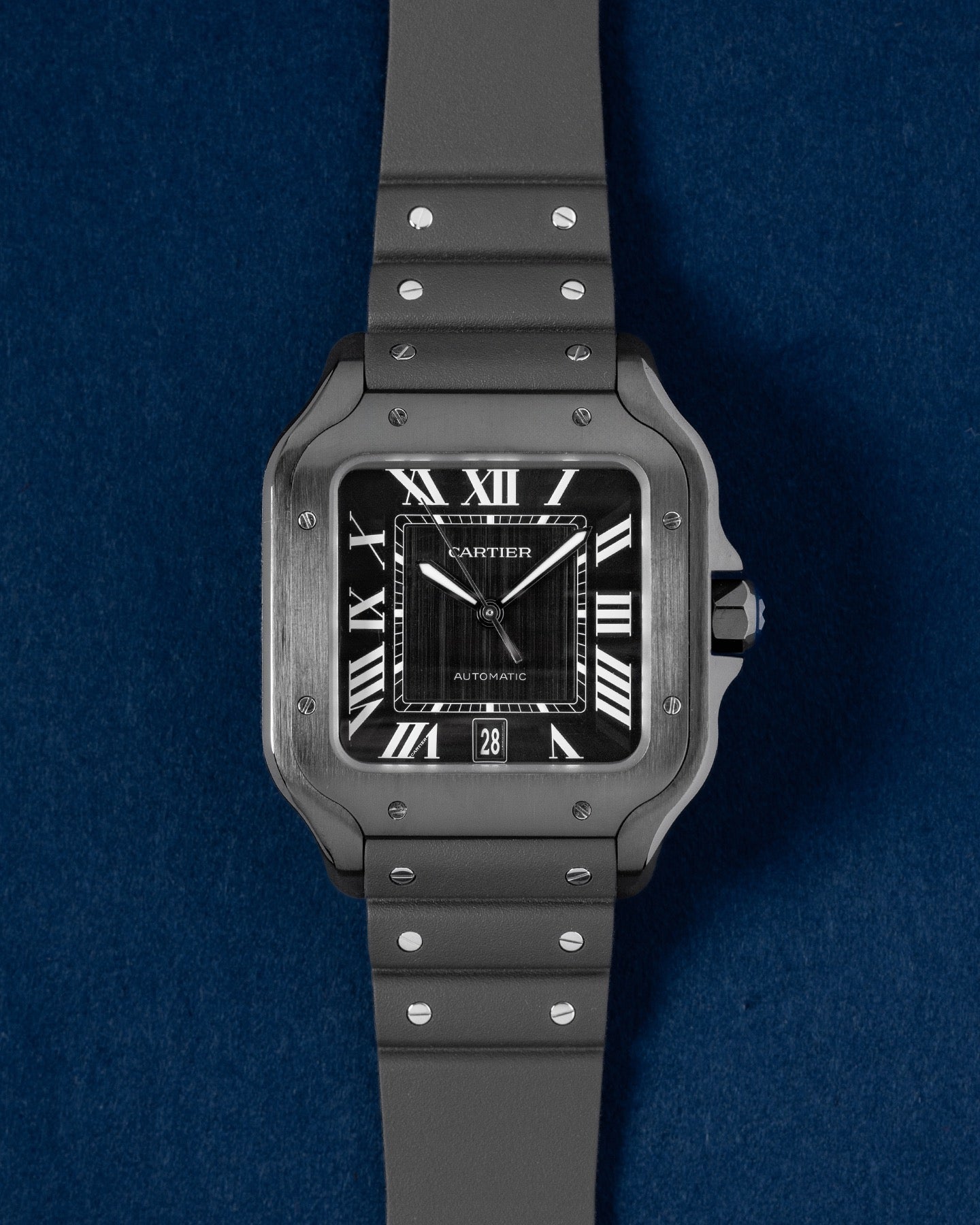
The watch Cartier delivered to his friend solved the aviator's problem and inadvertently birthed the modern men's wristwatch. When Santos Dumont wore the watch while piloting his 14 bis aircraft in 1906, the public took notice of the practical, masculine design strapped to his wrist. Cartier commercialized the model in 1911 in partnership with Edmond Jaeger, officially calling it the Santos watch. It was characterized by its square shape with rounded corners, the seamless curve of the lugs extending from the case, and the eight exposed screws on the bezel which were inspired by the rivets of the Eiffel Tower. This singular release established Cartier watches as the pioneer of men's wristwear, proving that a watch could be both a highly practical tool for a specific profession and an object of profound design merit.
The Santos de Cartier Collection
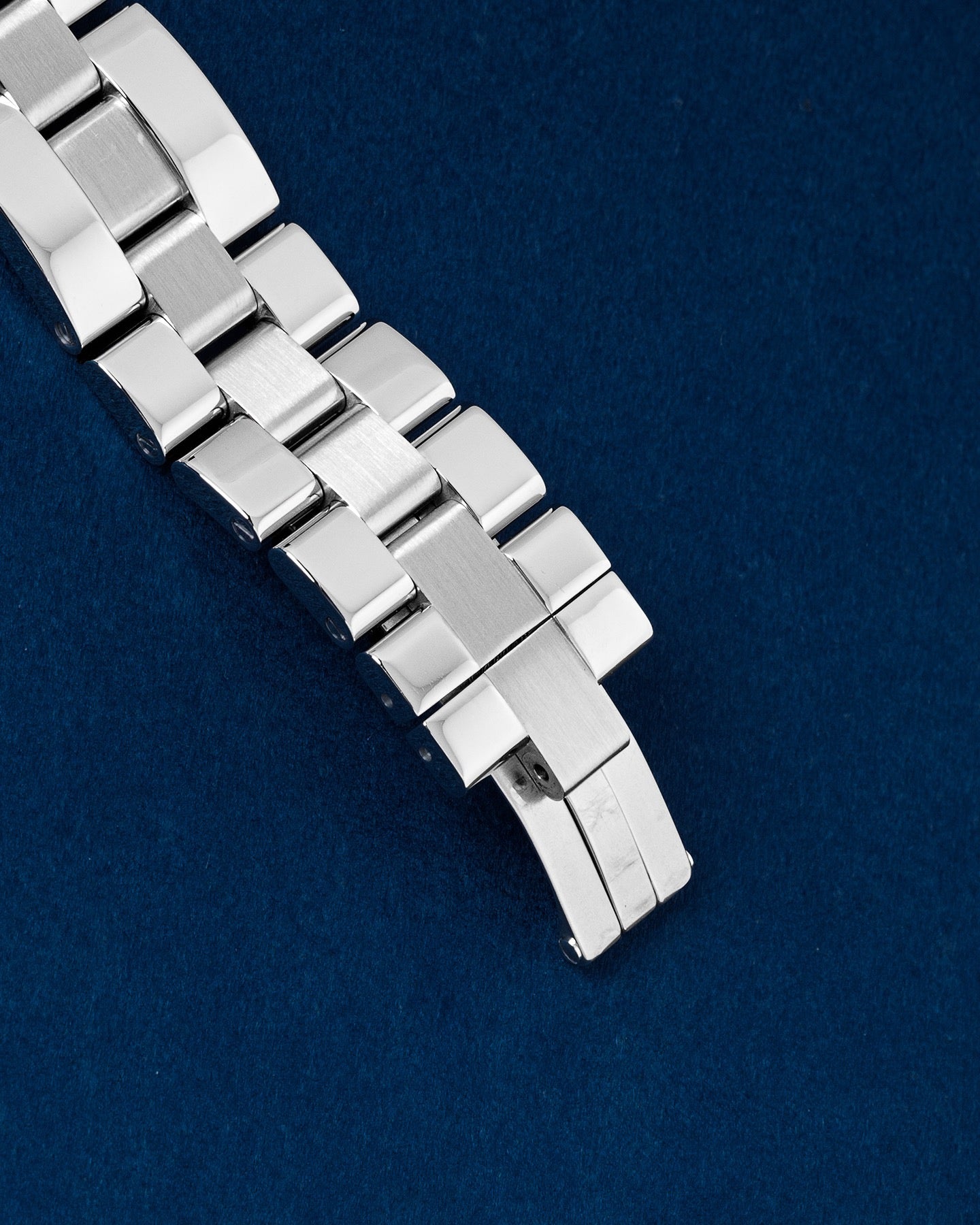
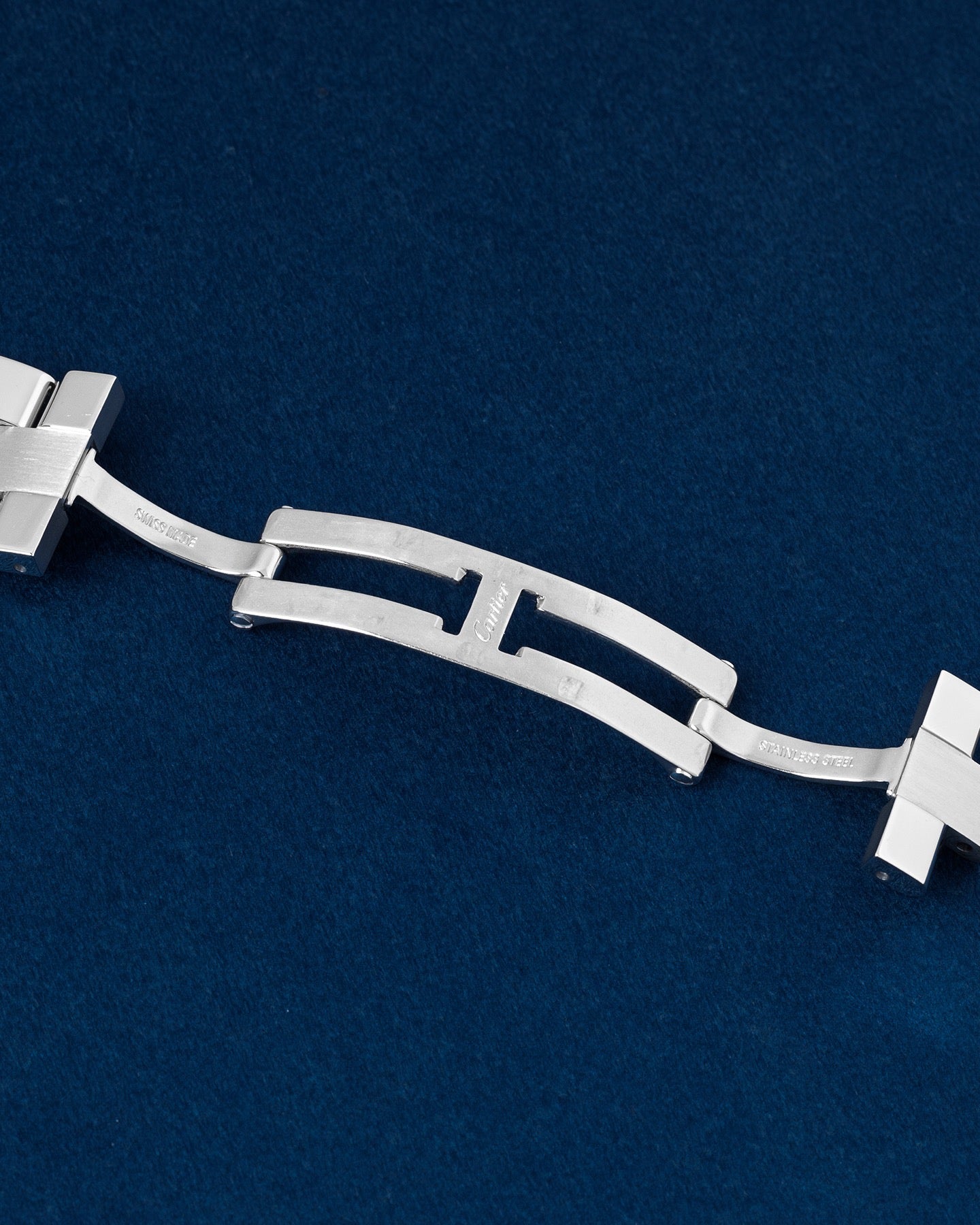
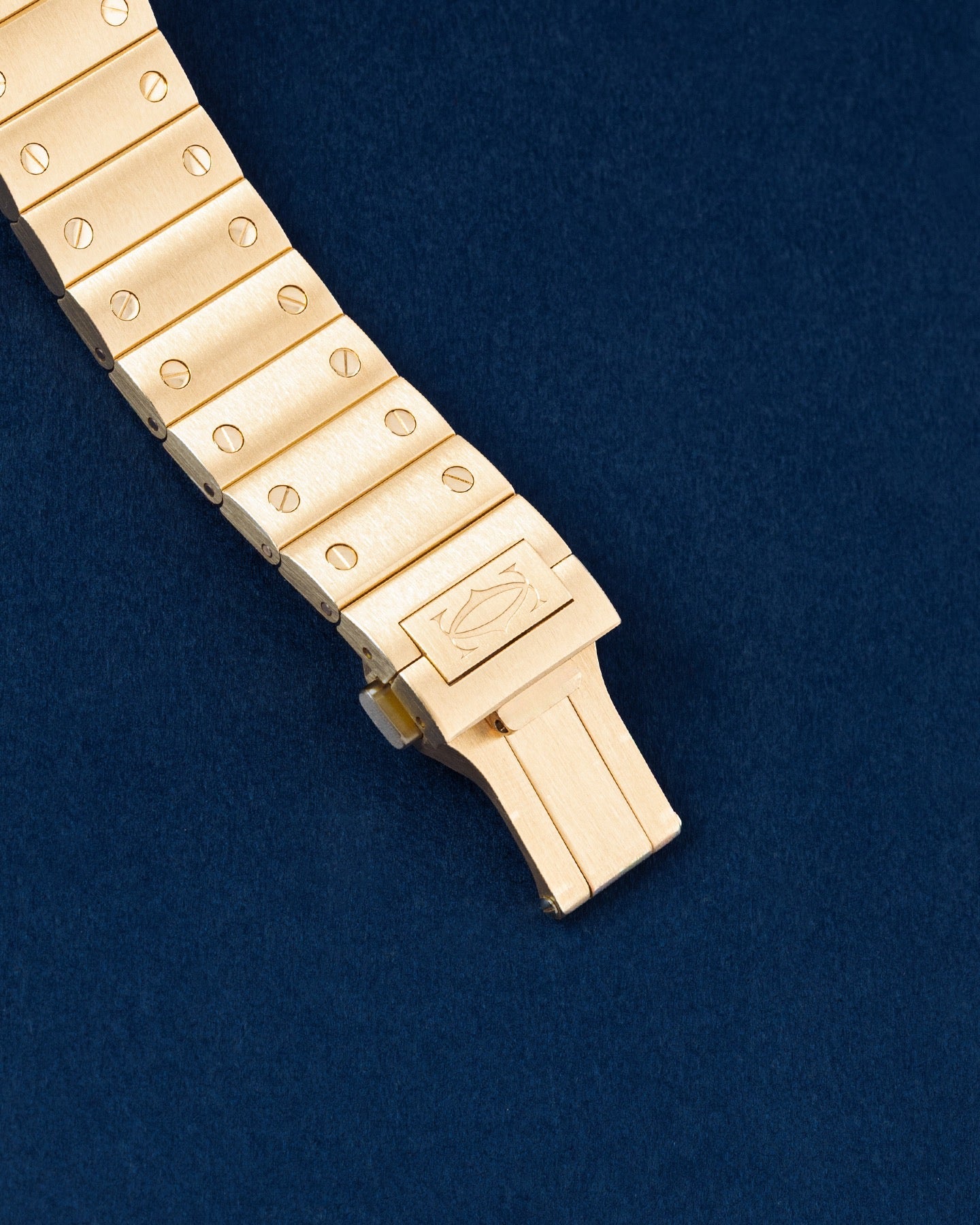
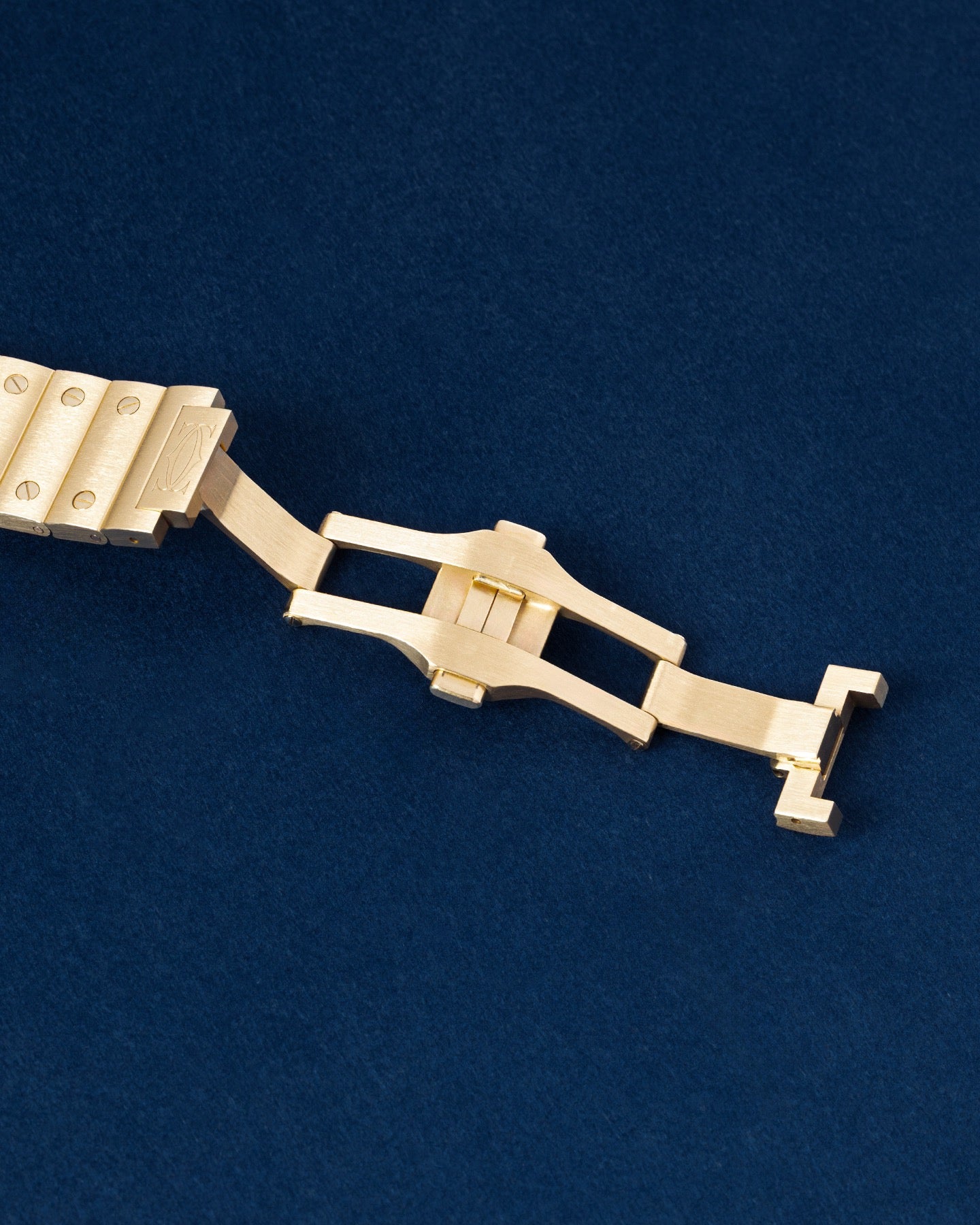
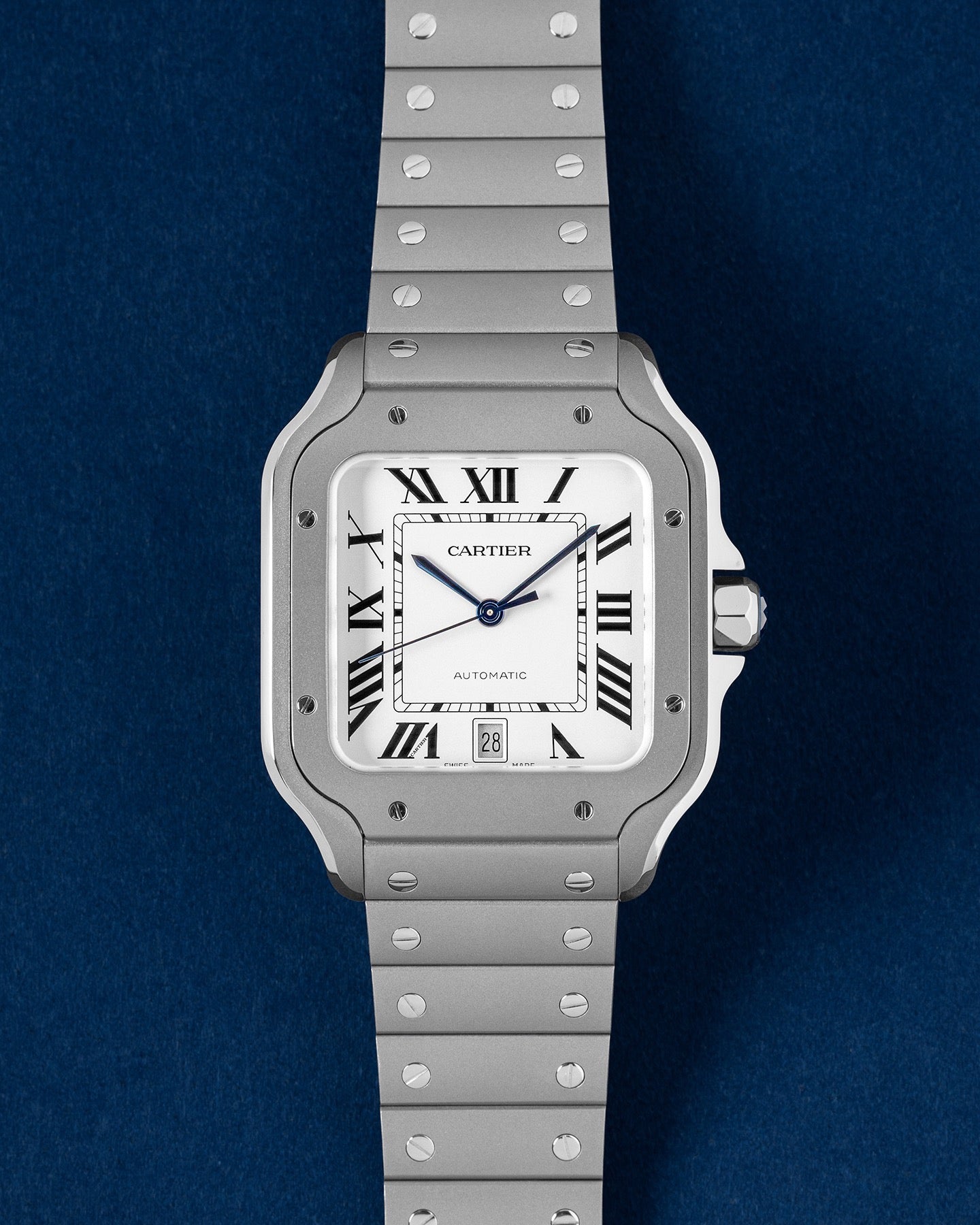
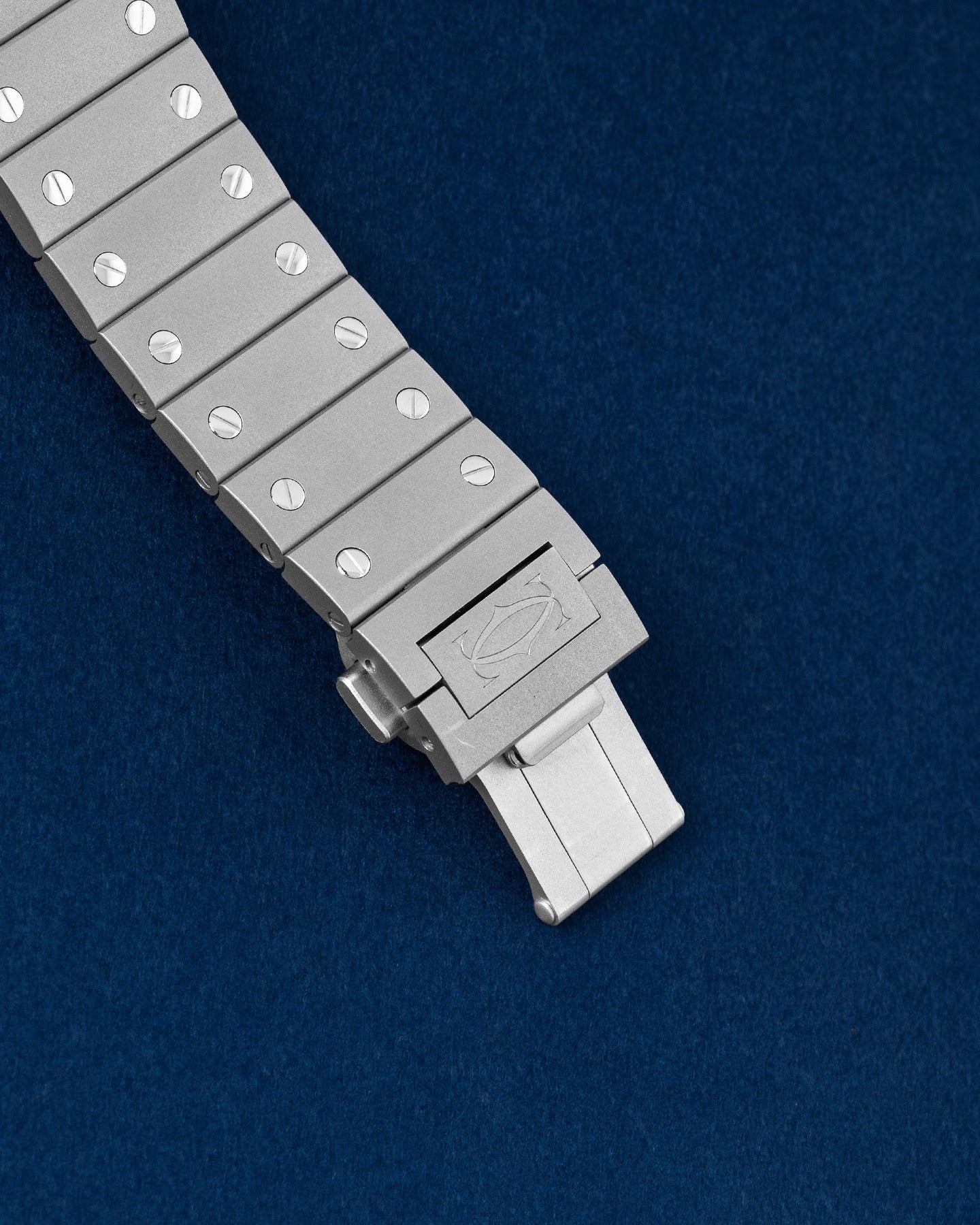
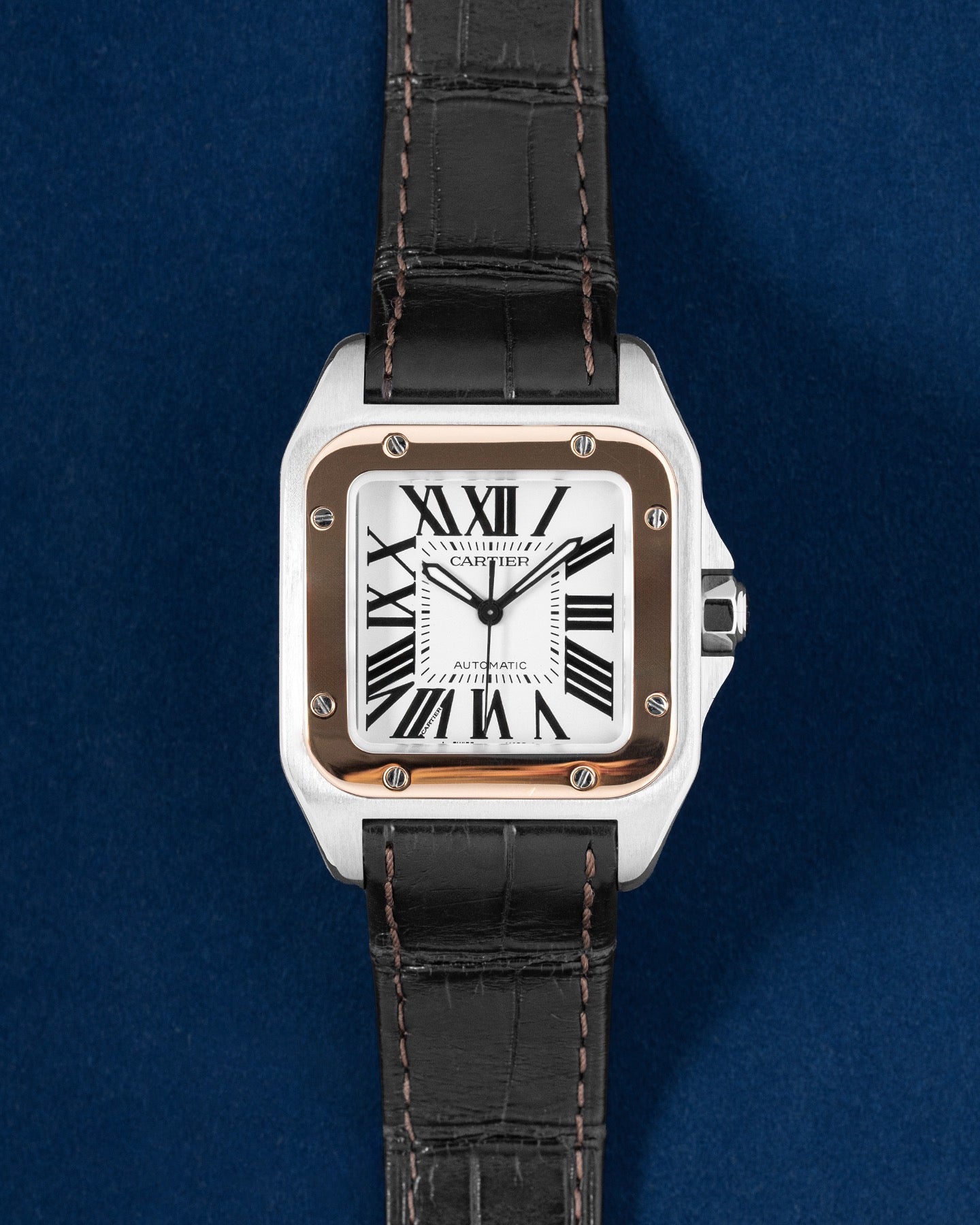
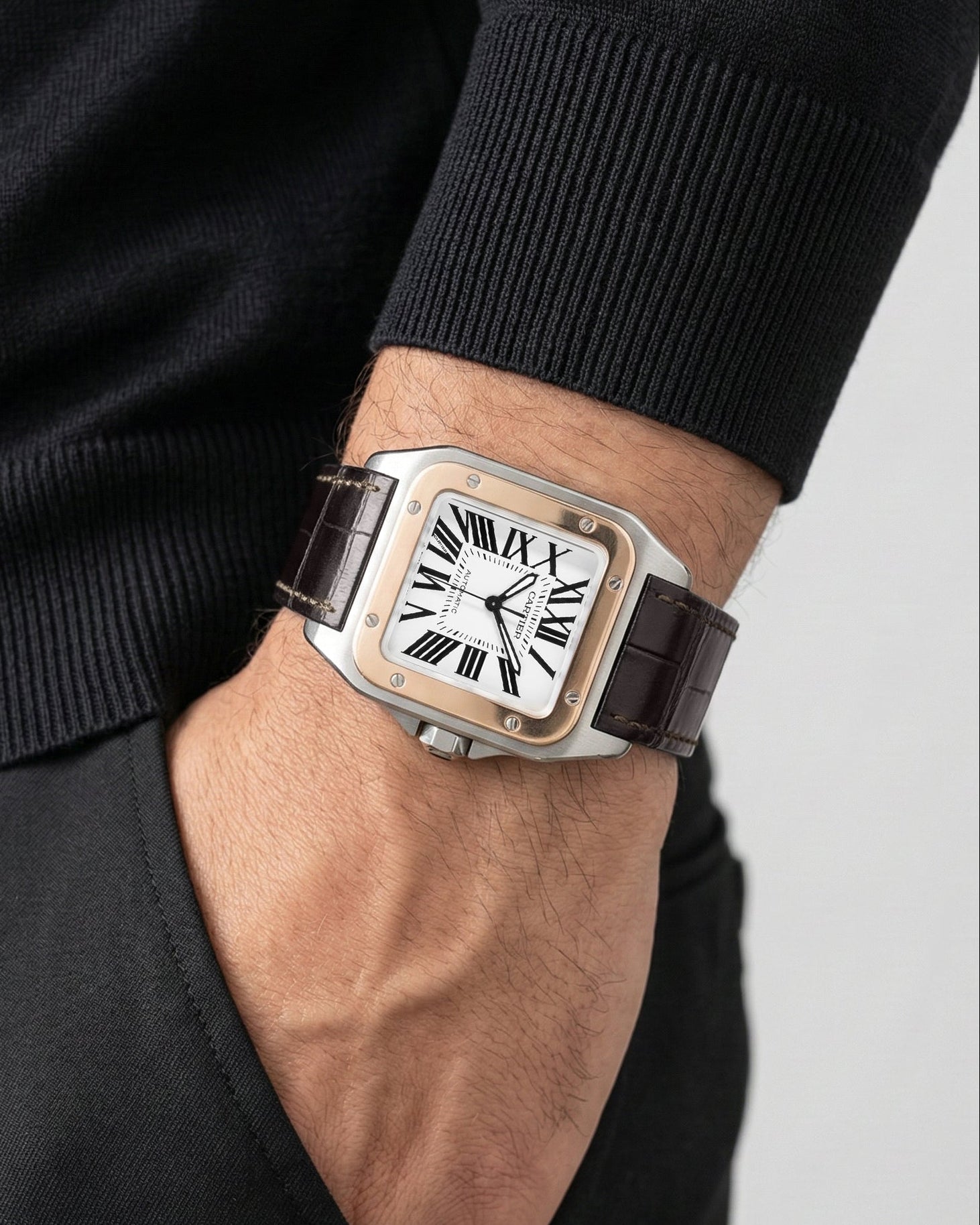
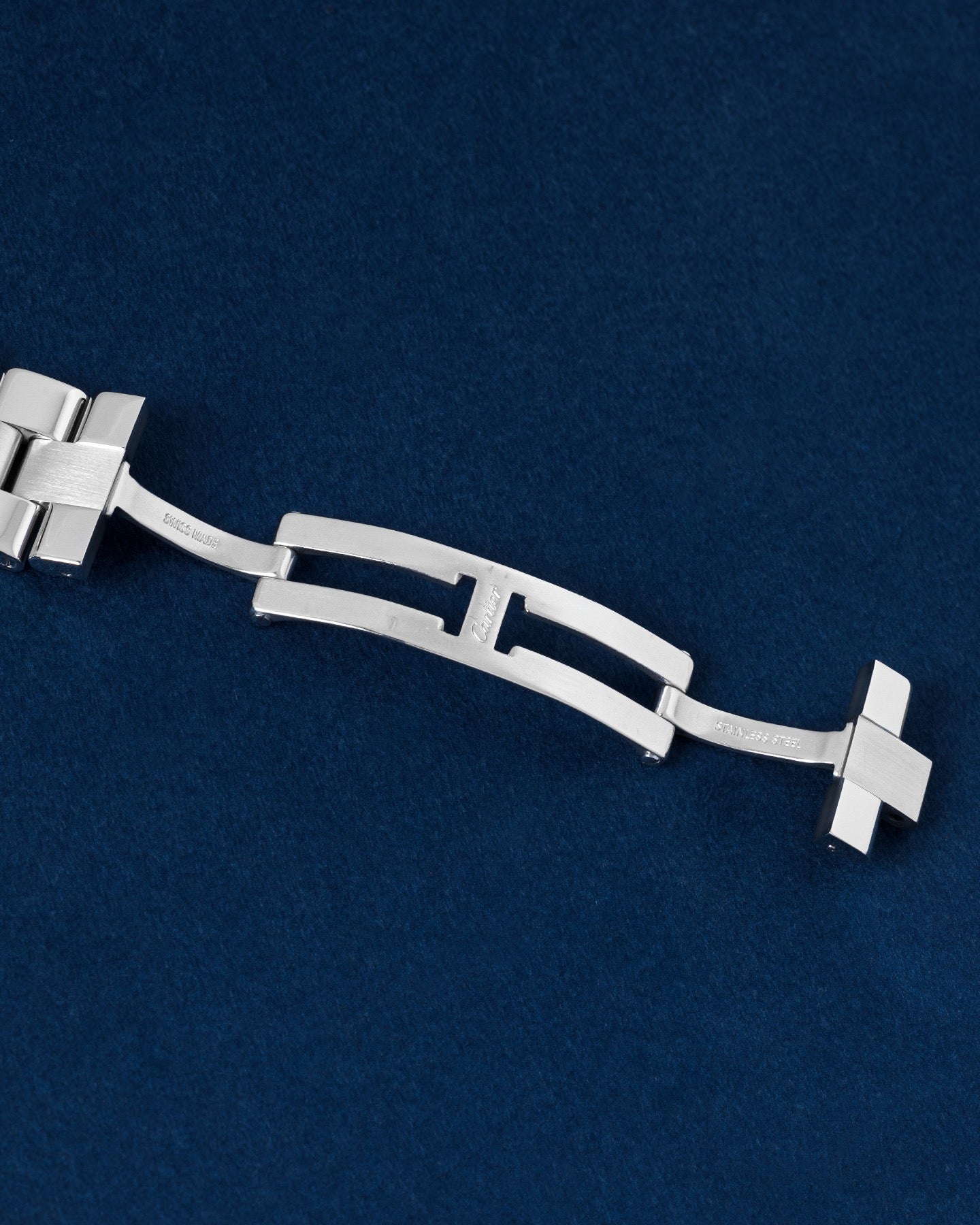
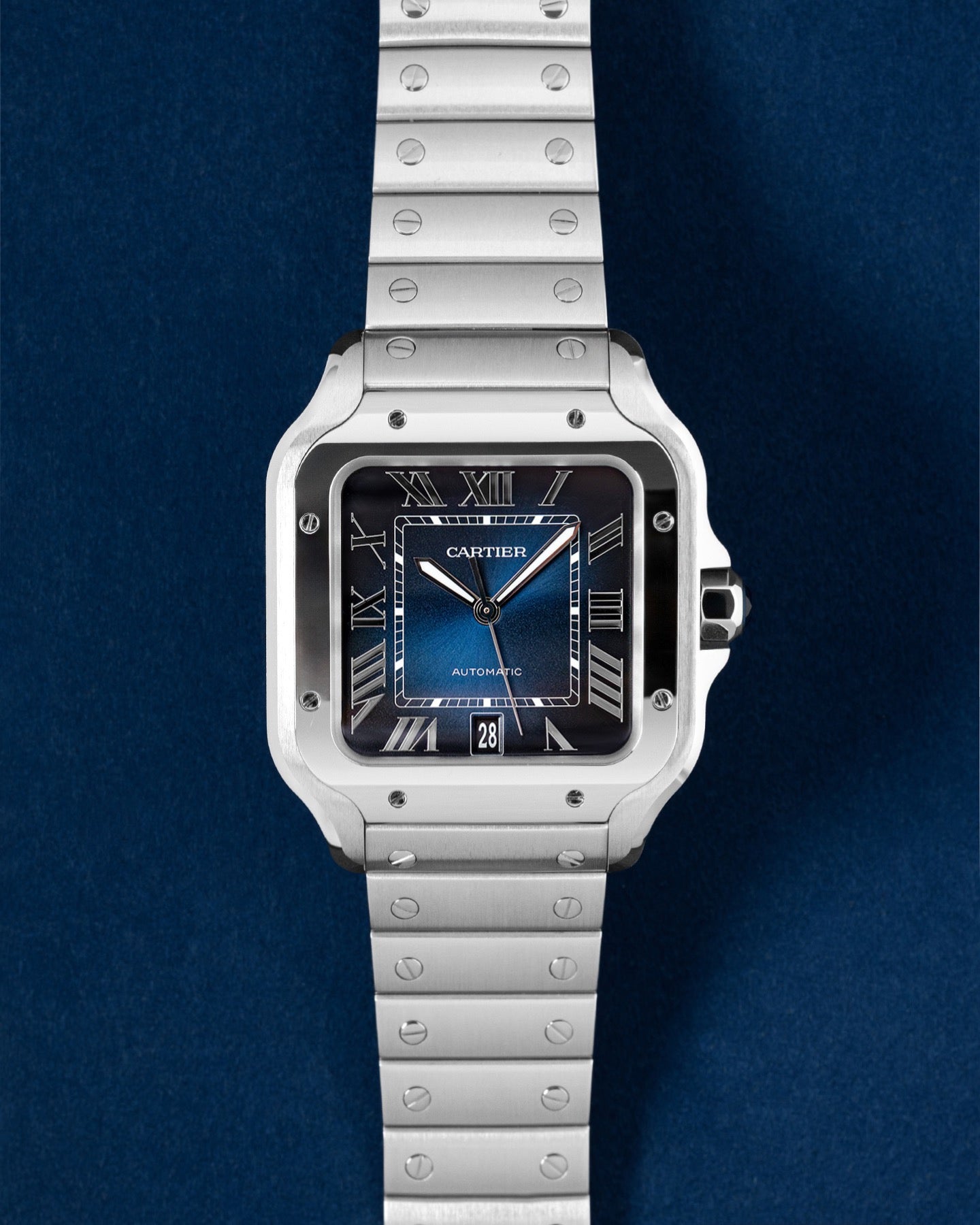
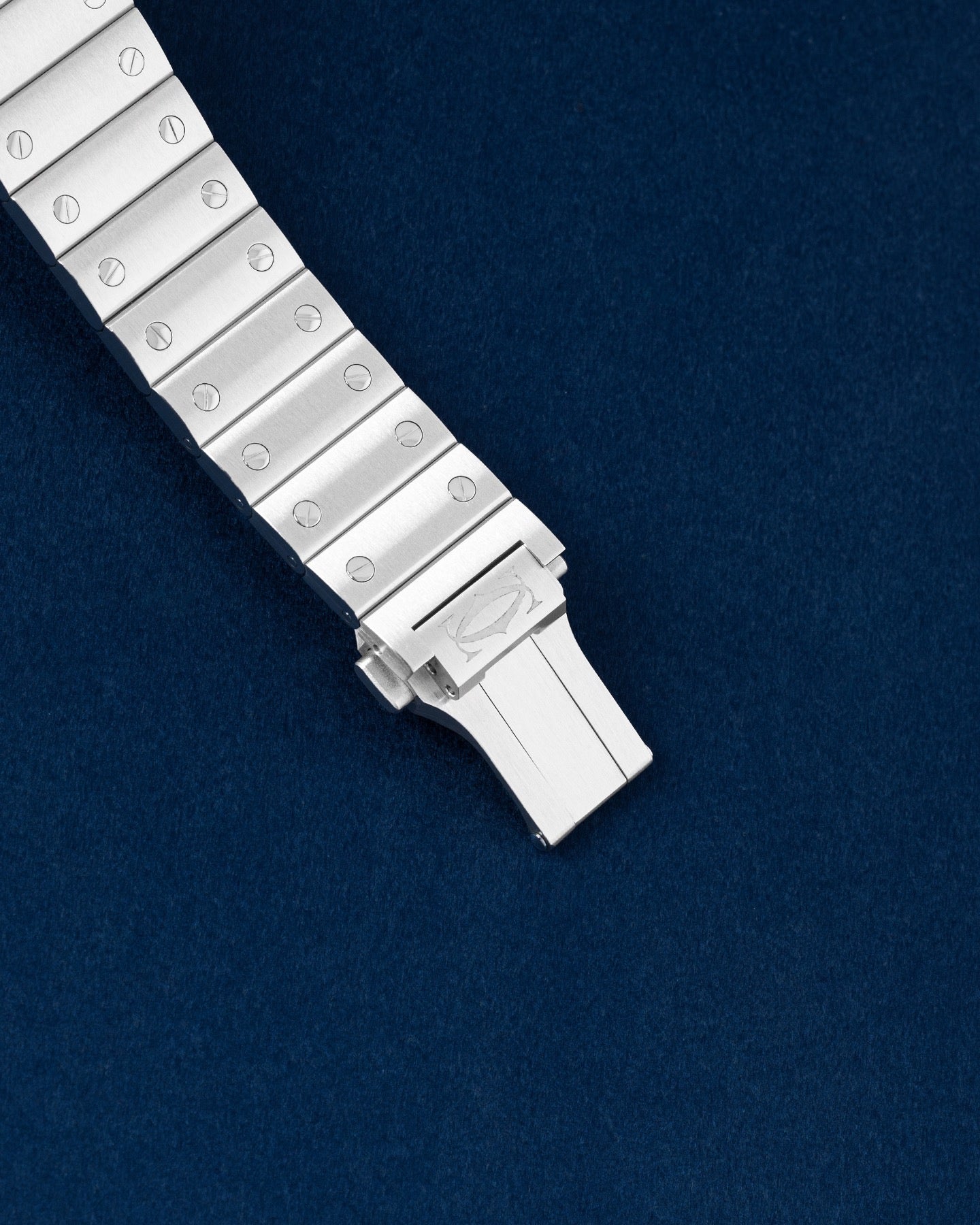
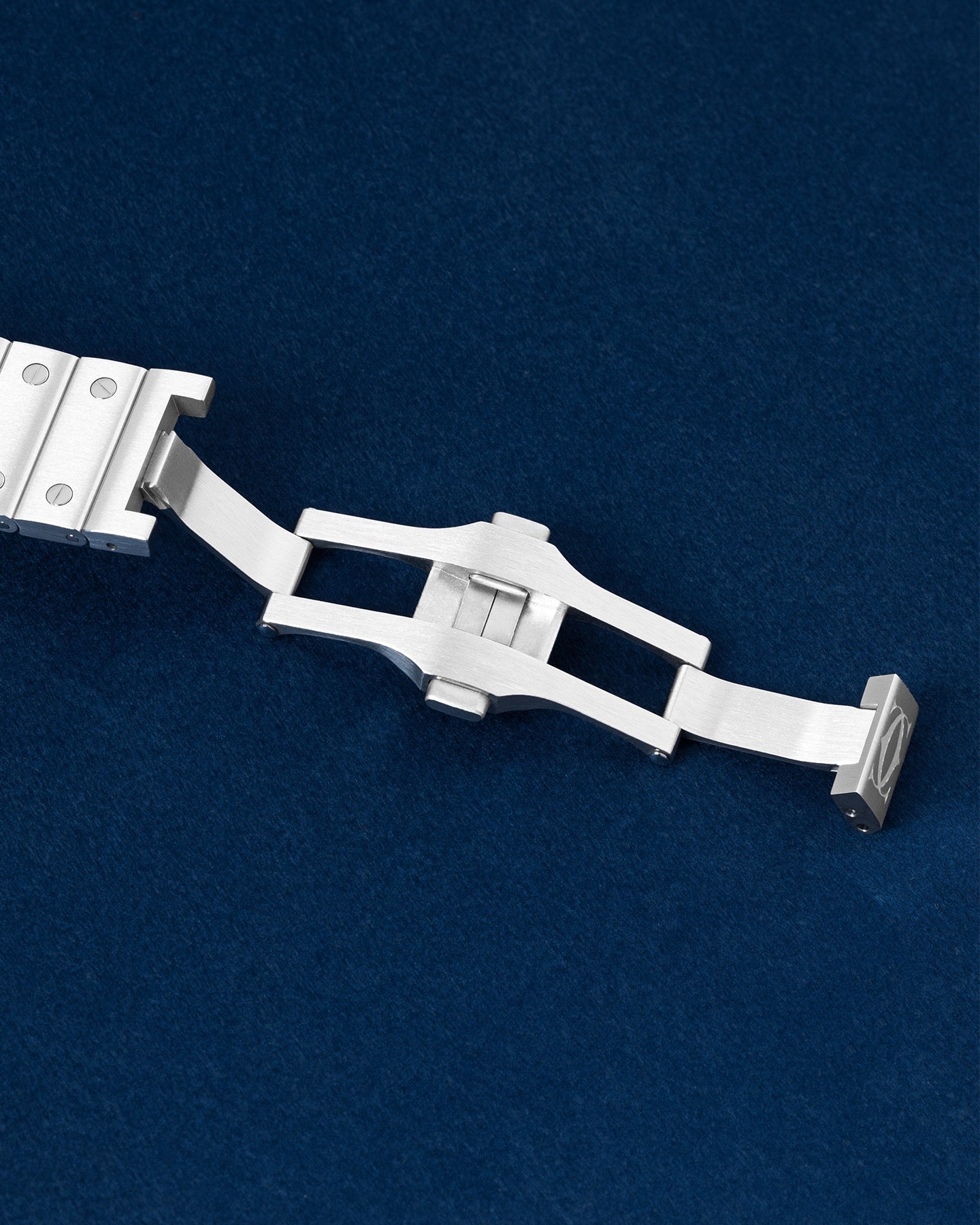
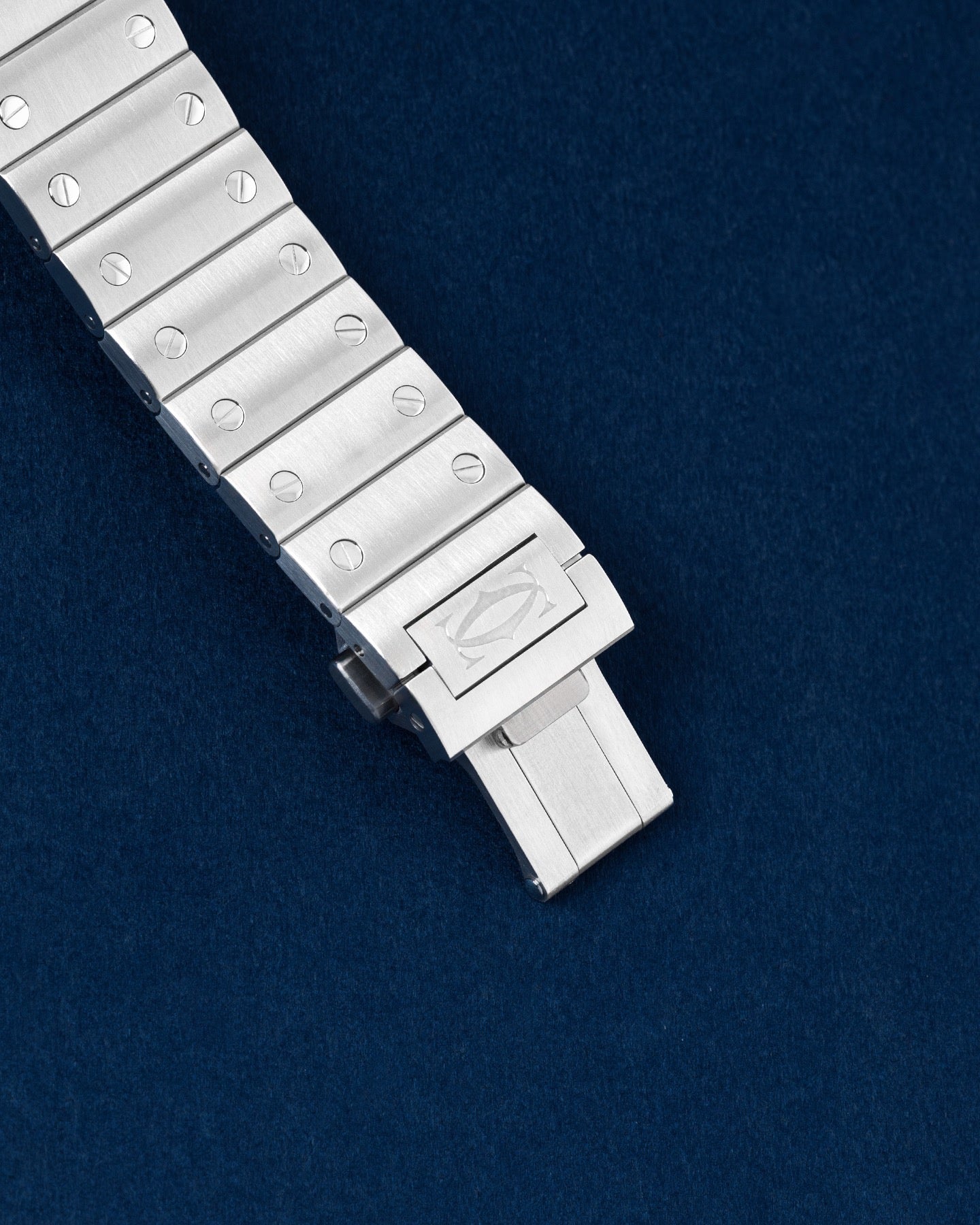
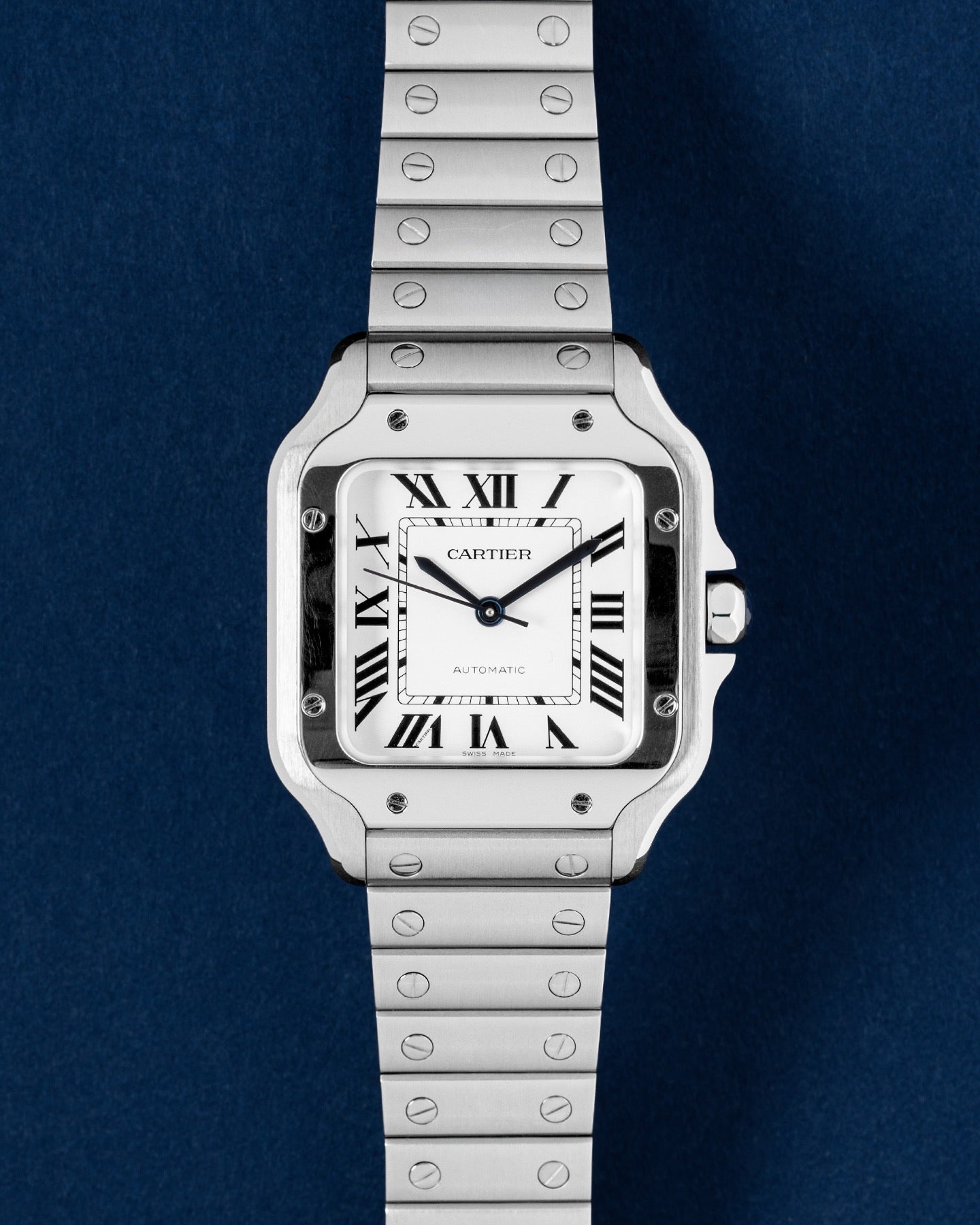
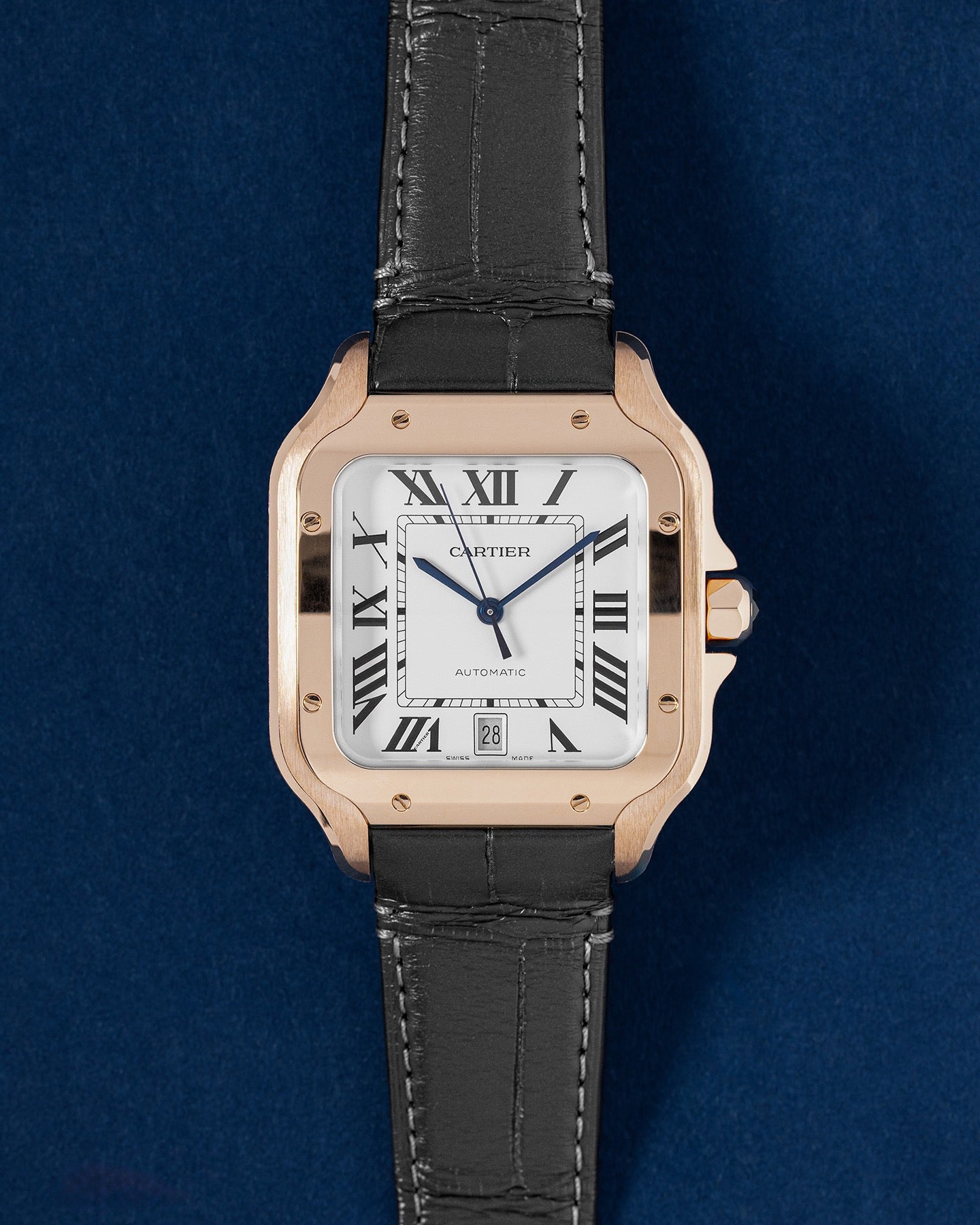
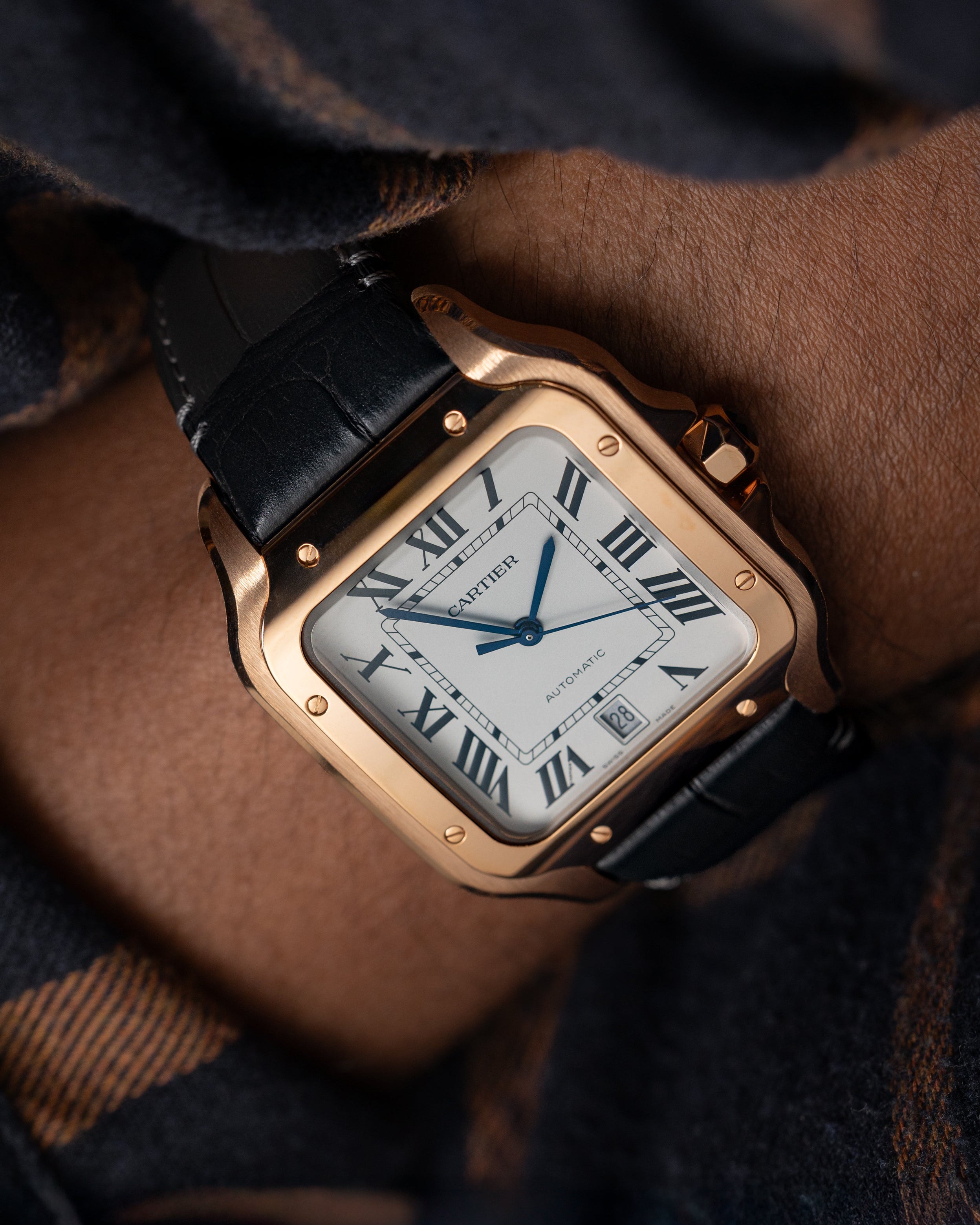
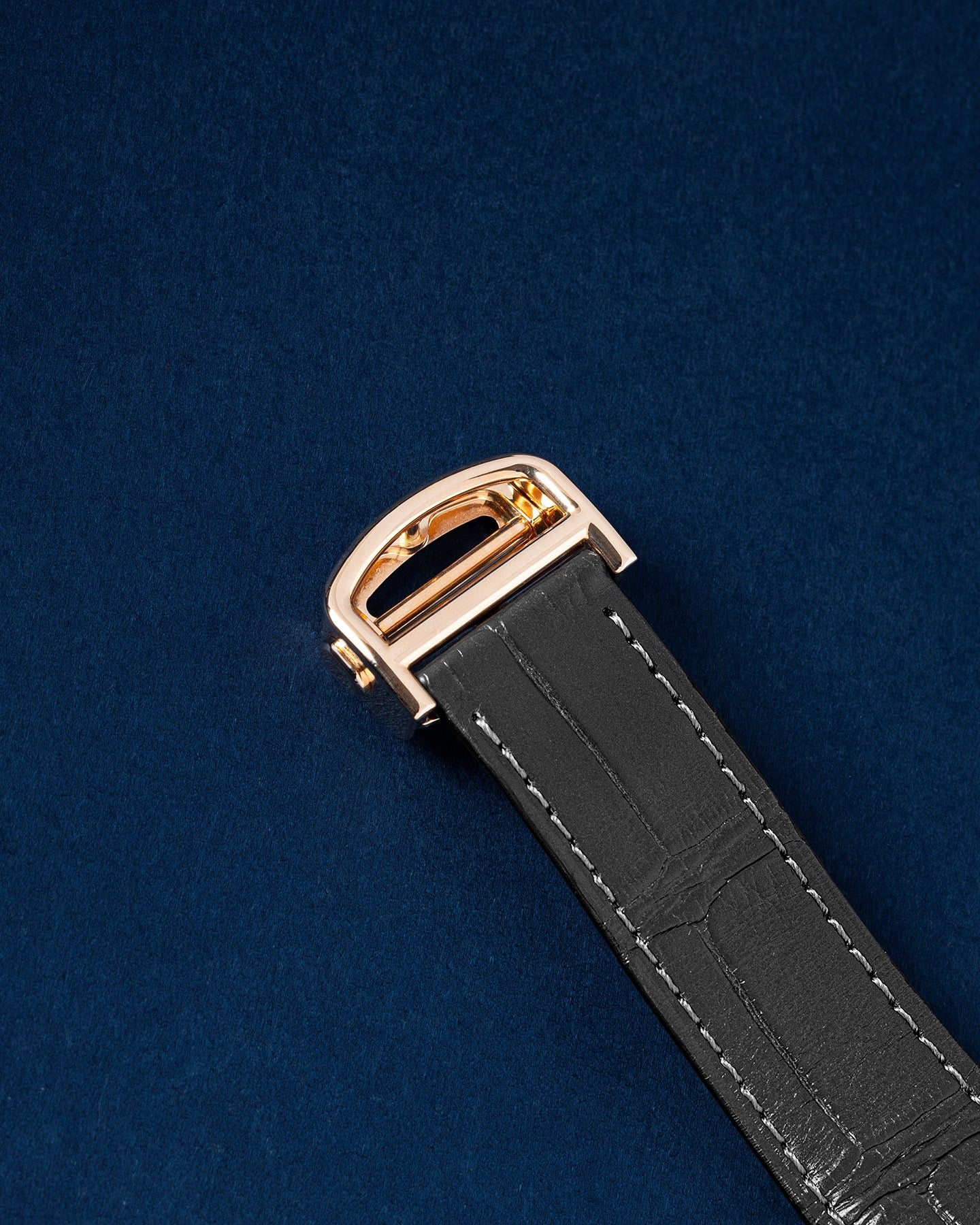
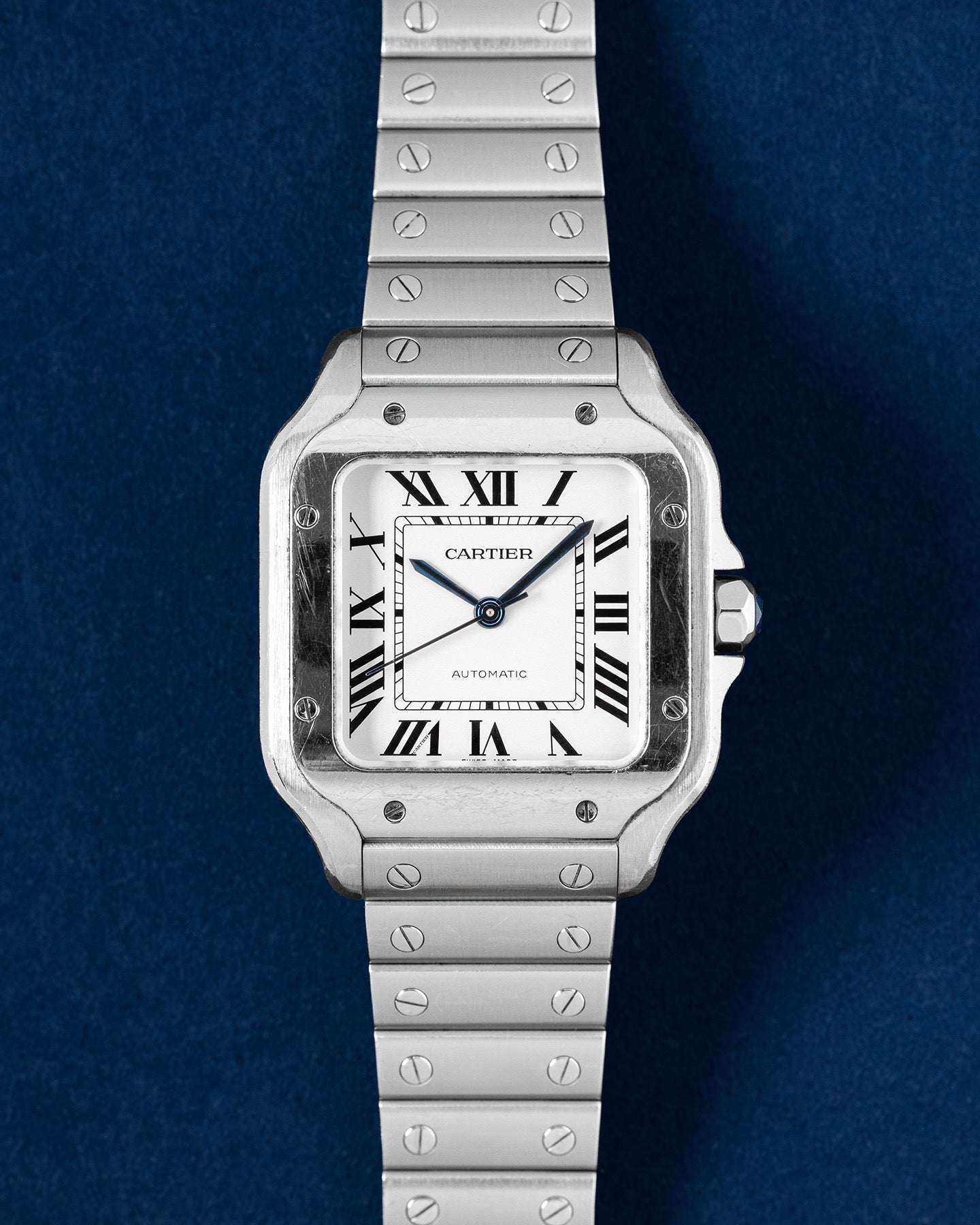
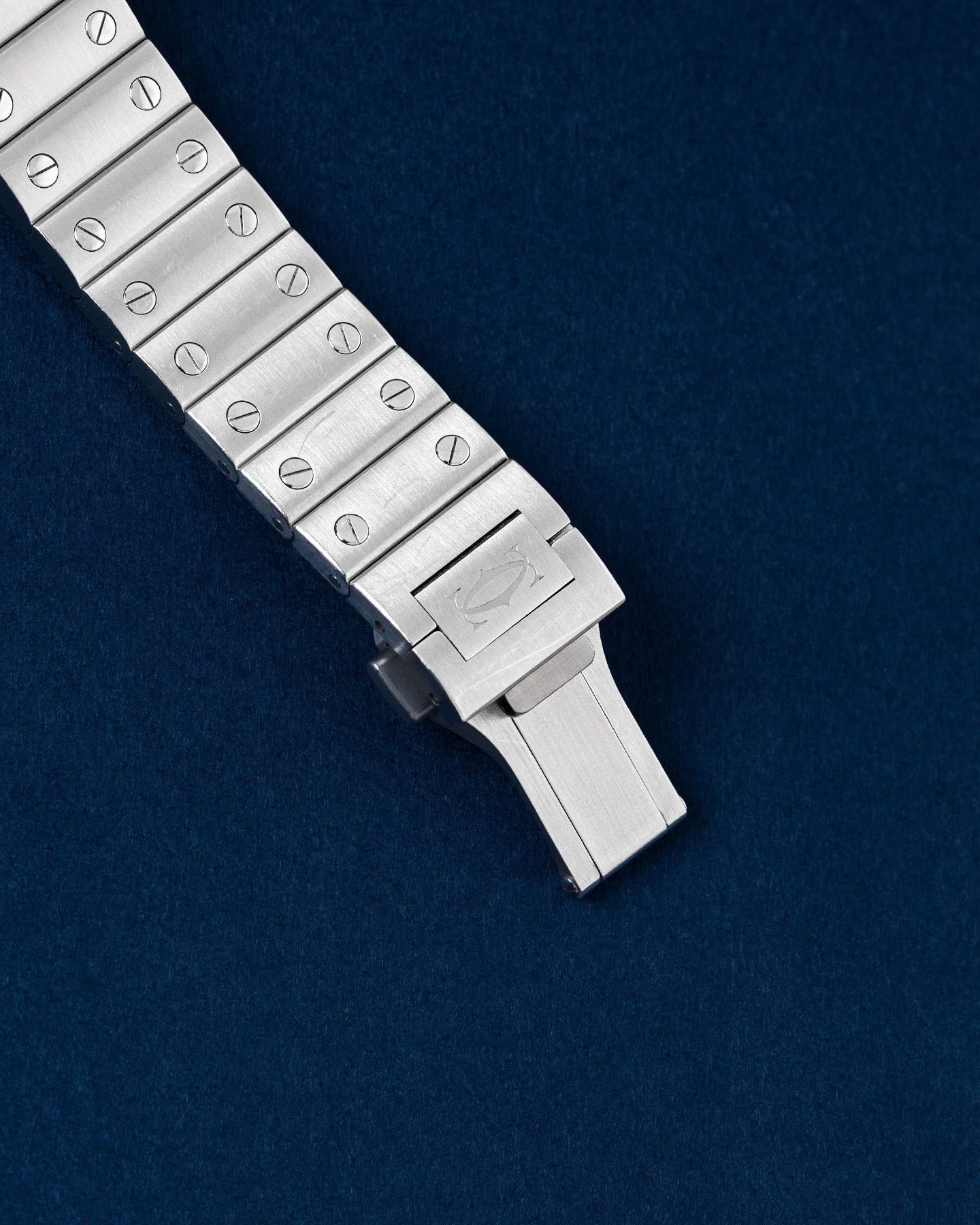
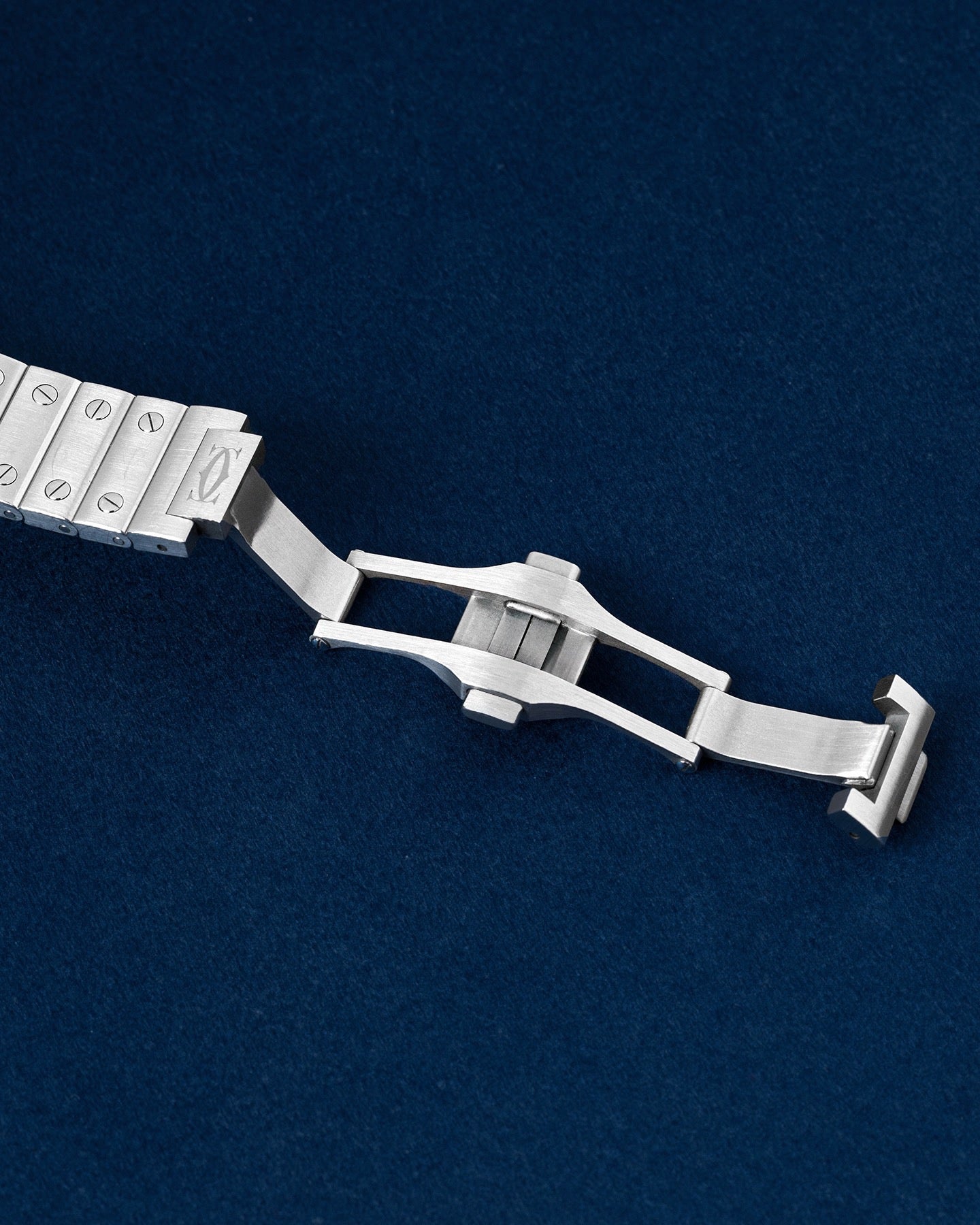
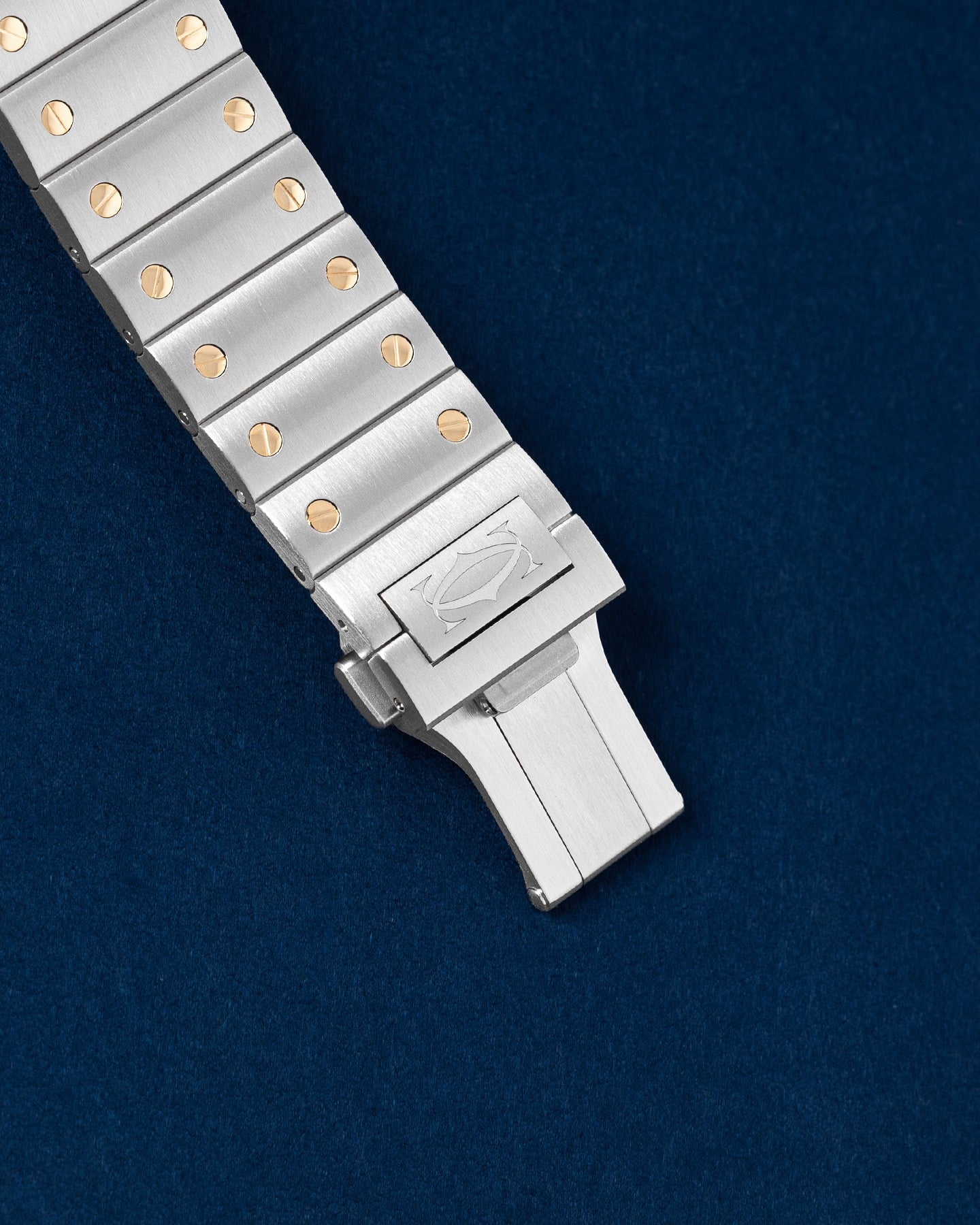
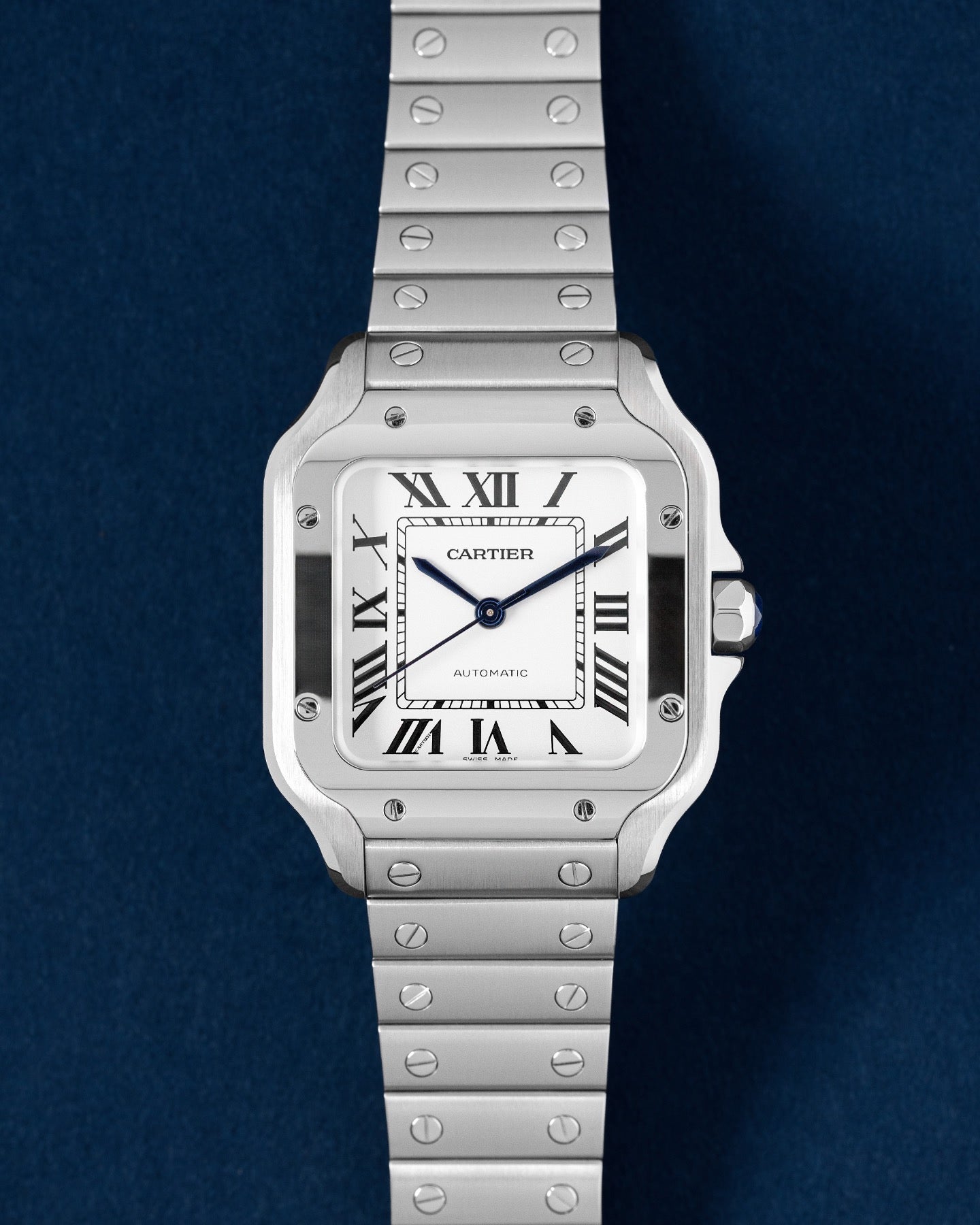
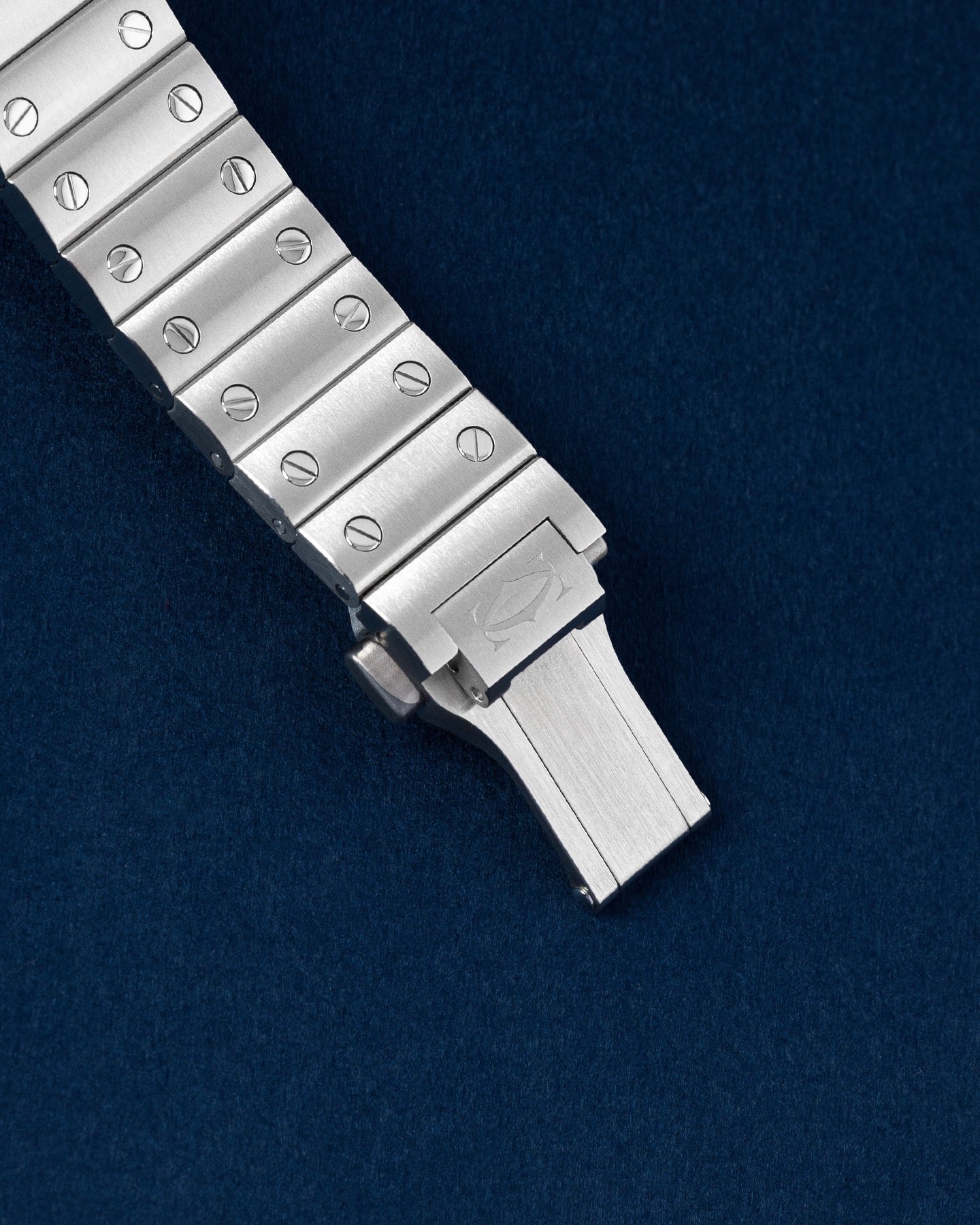
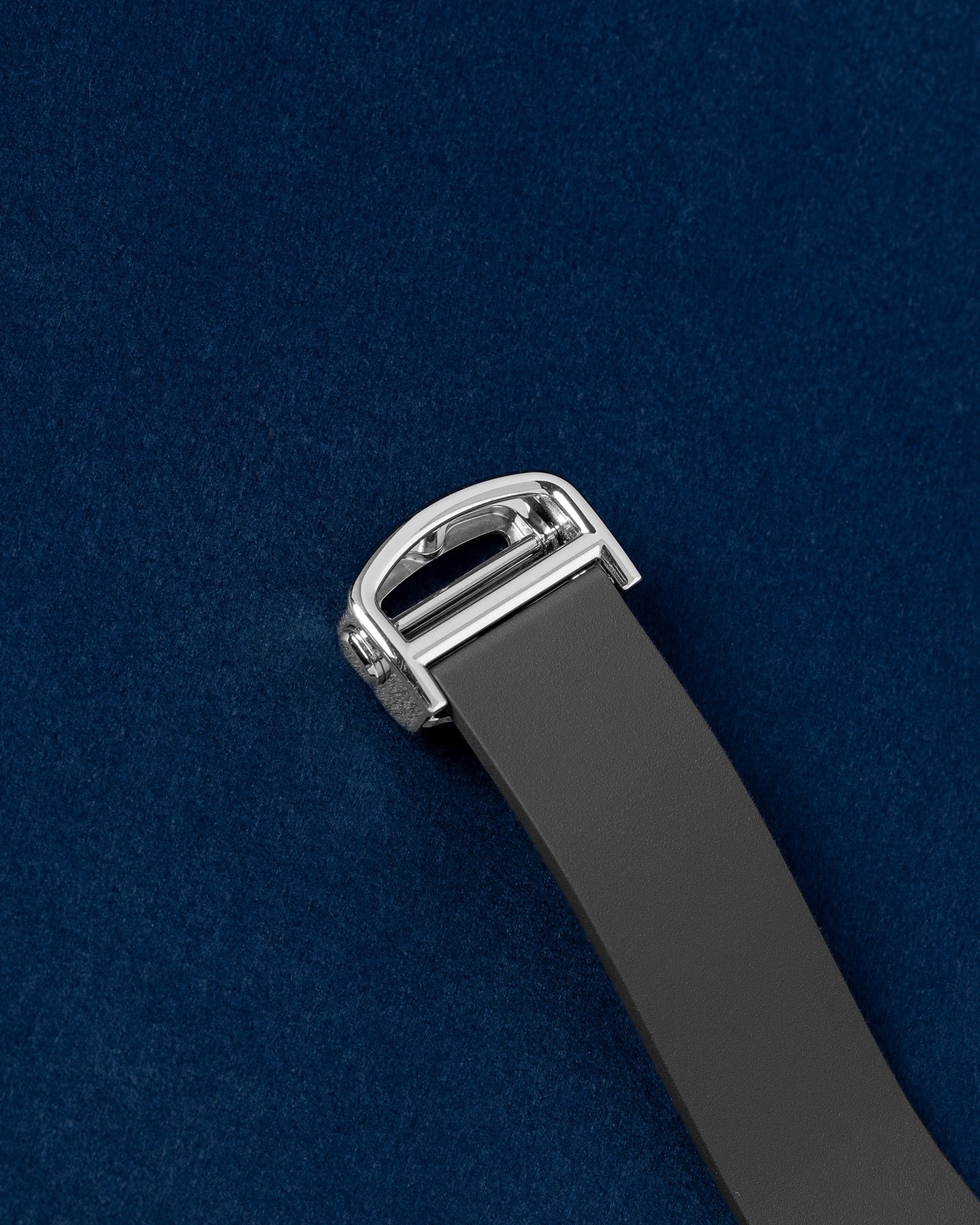
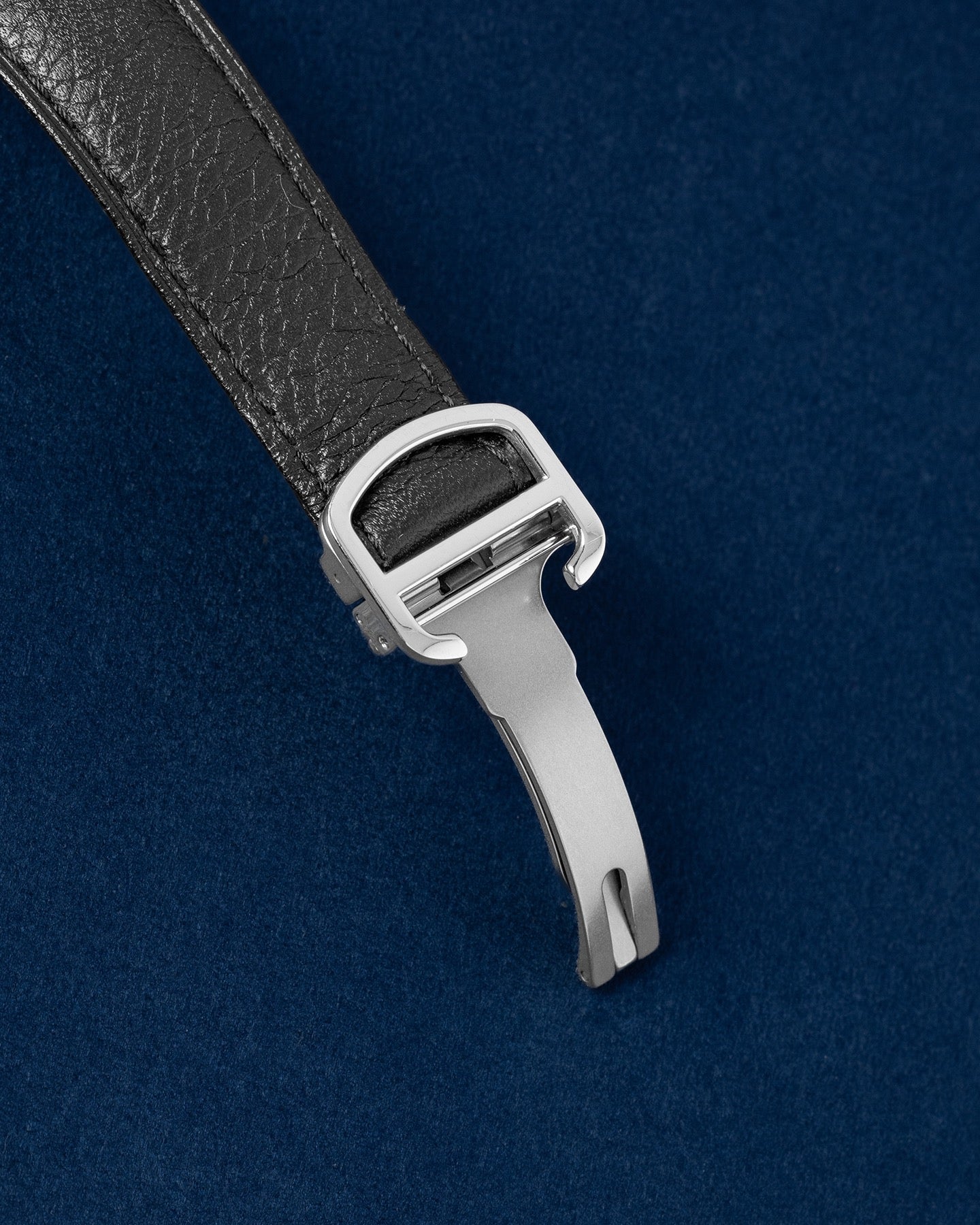
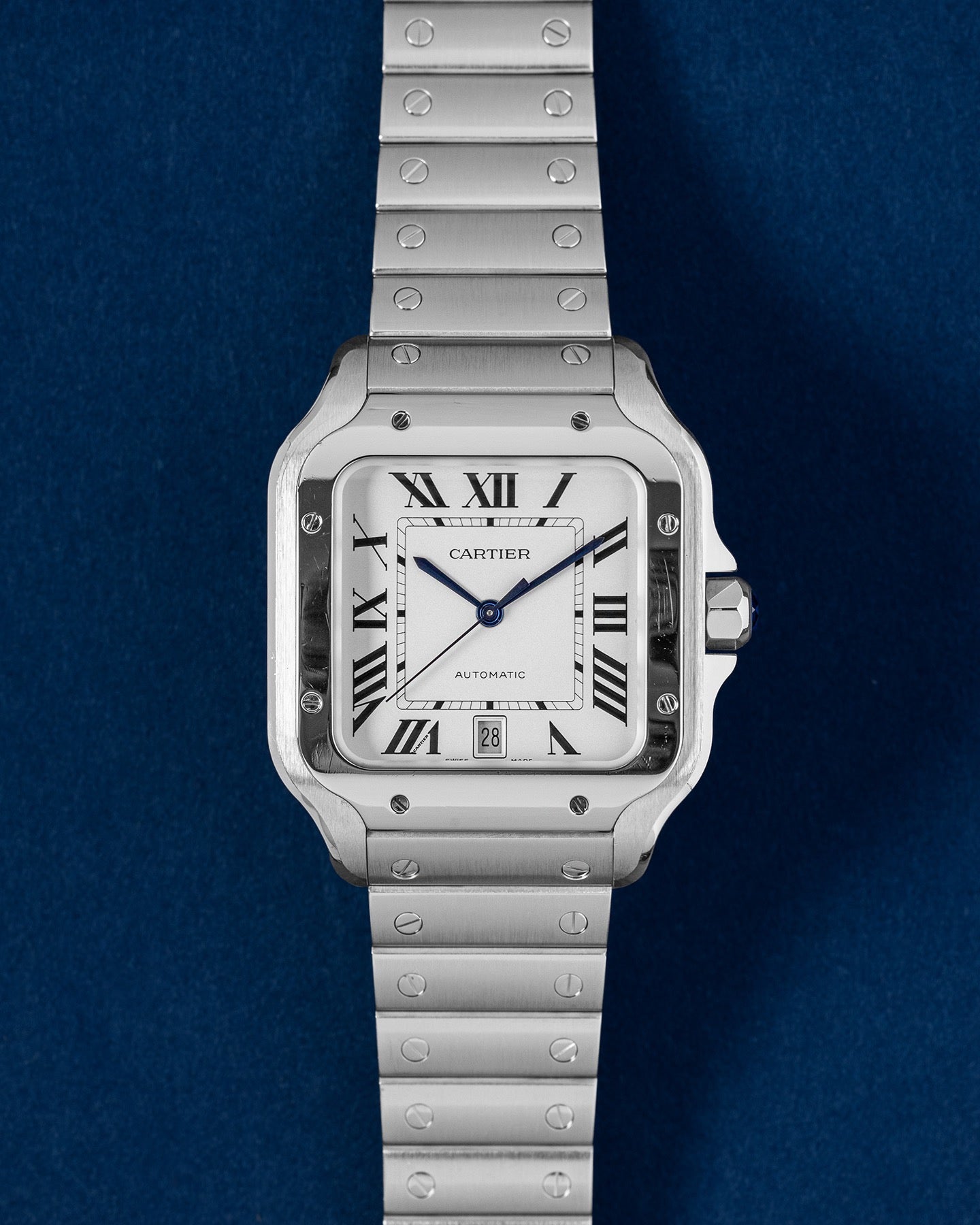
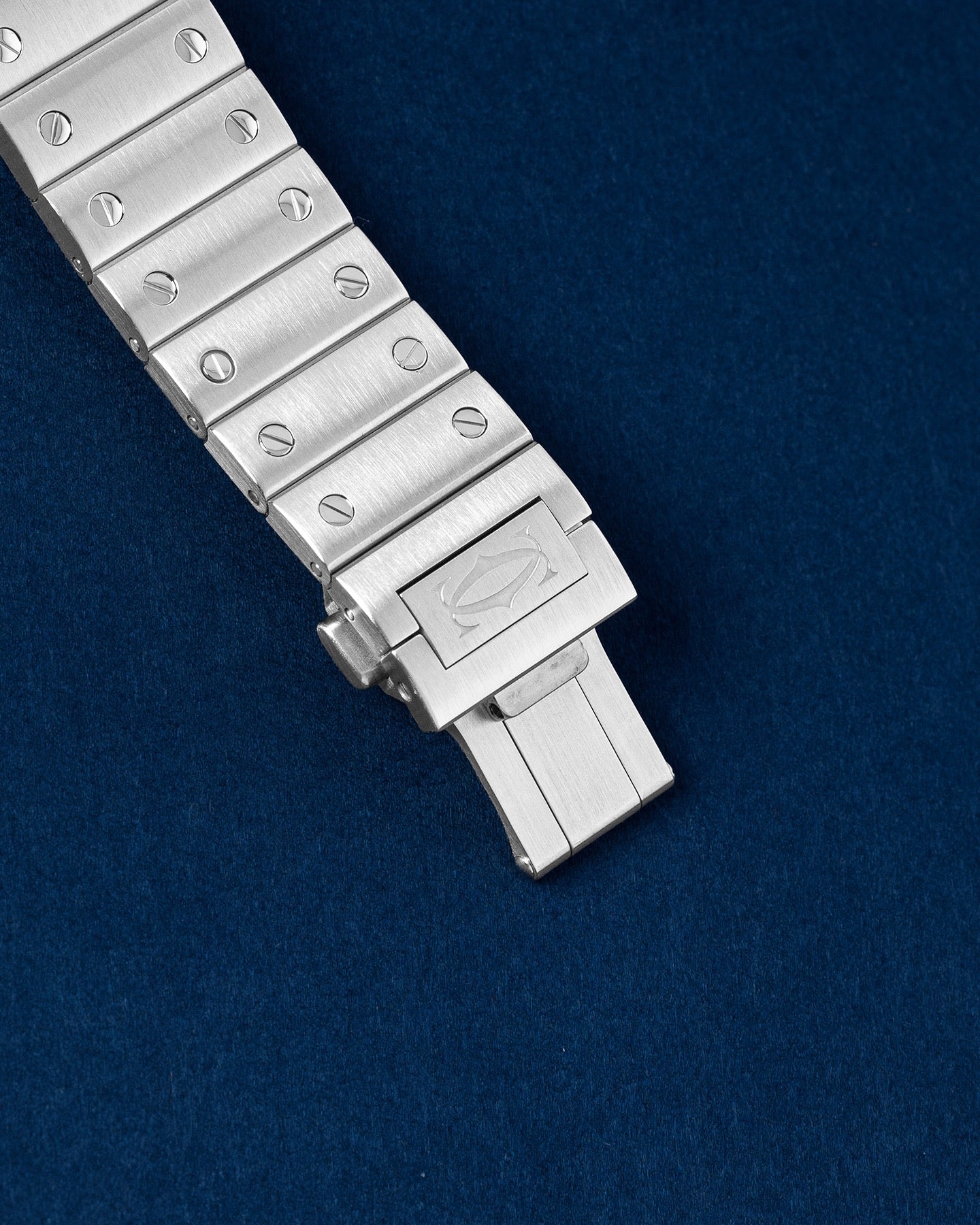
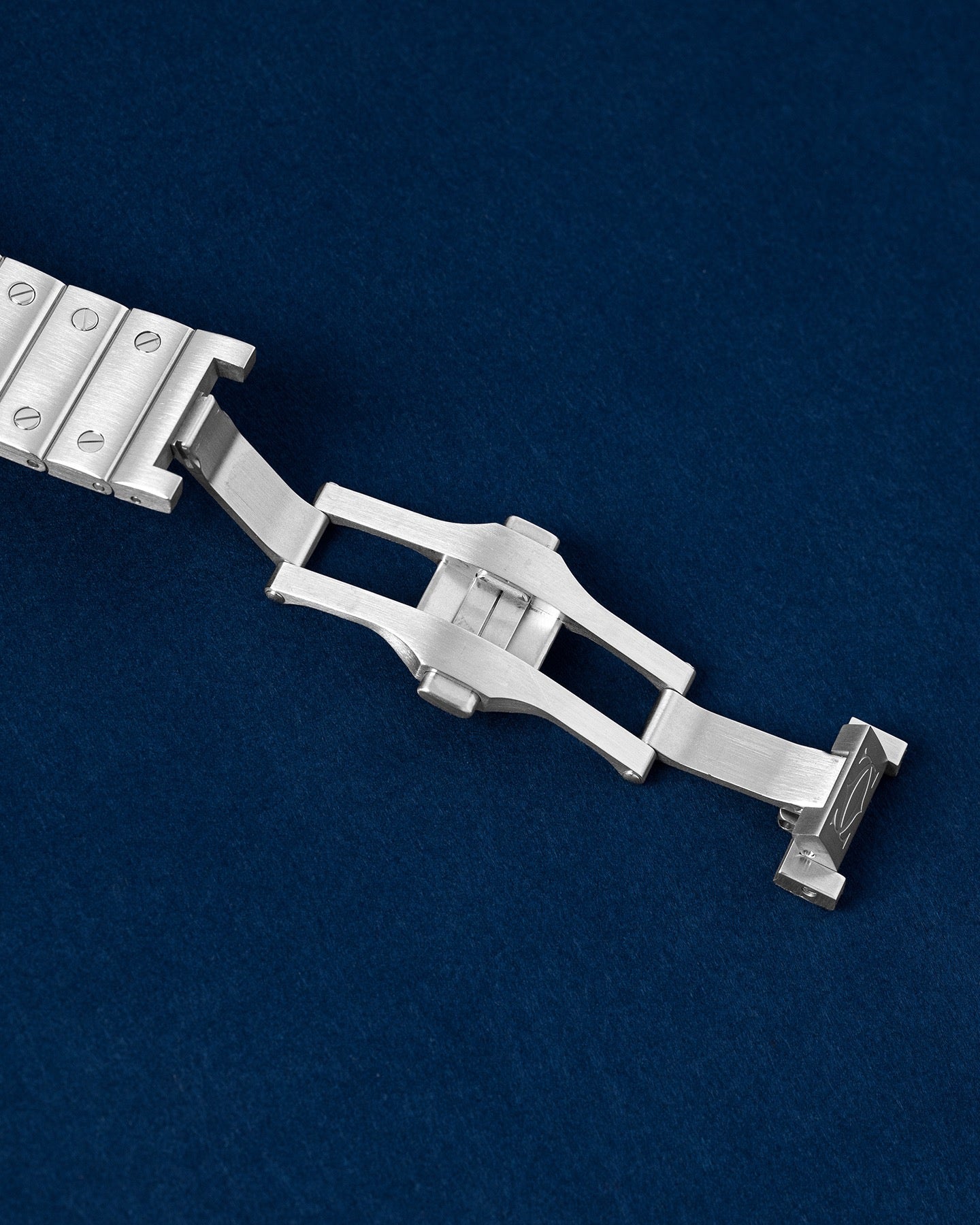
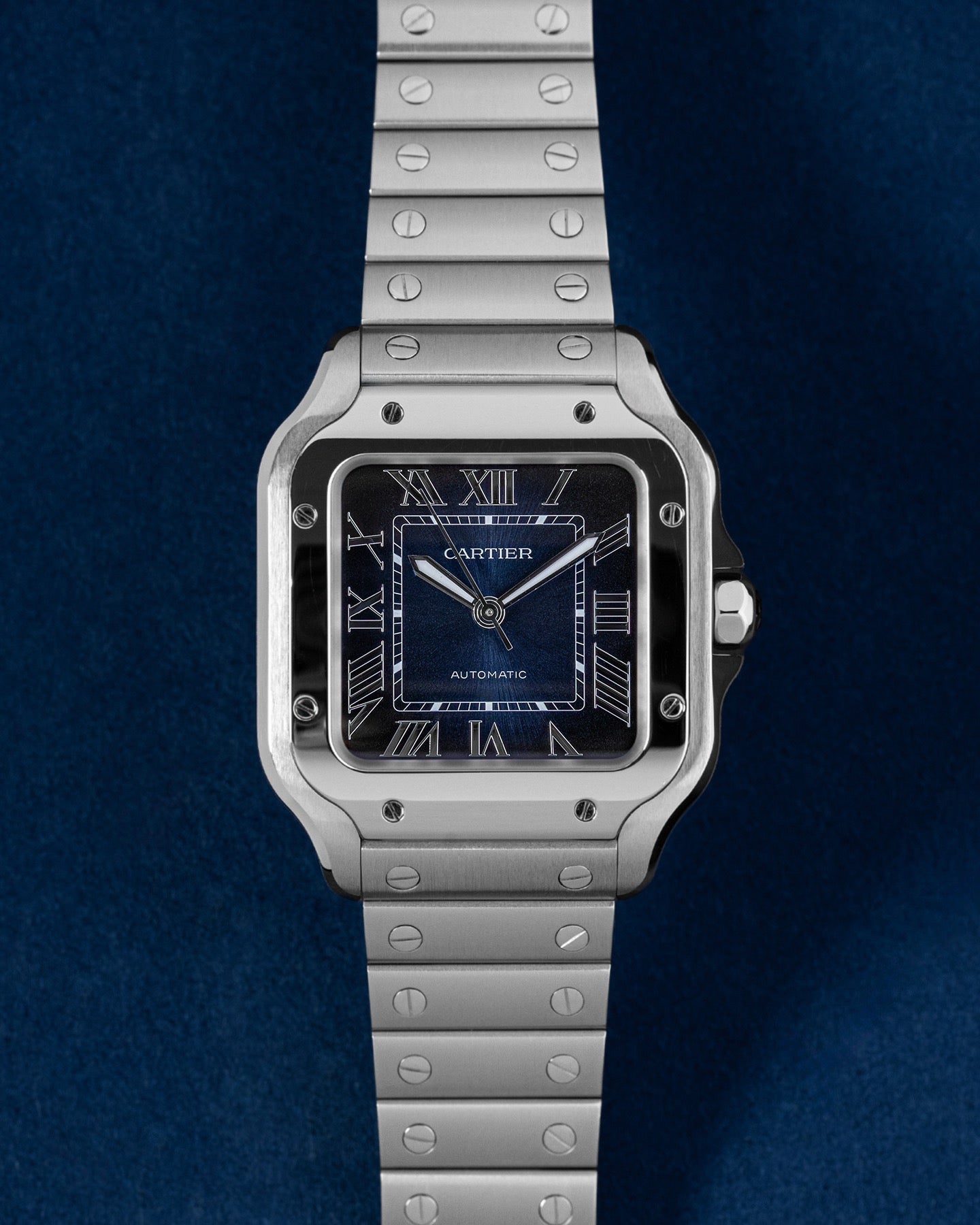
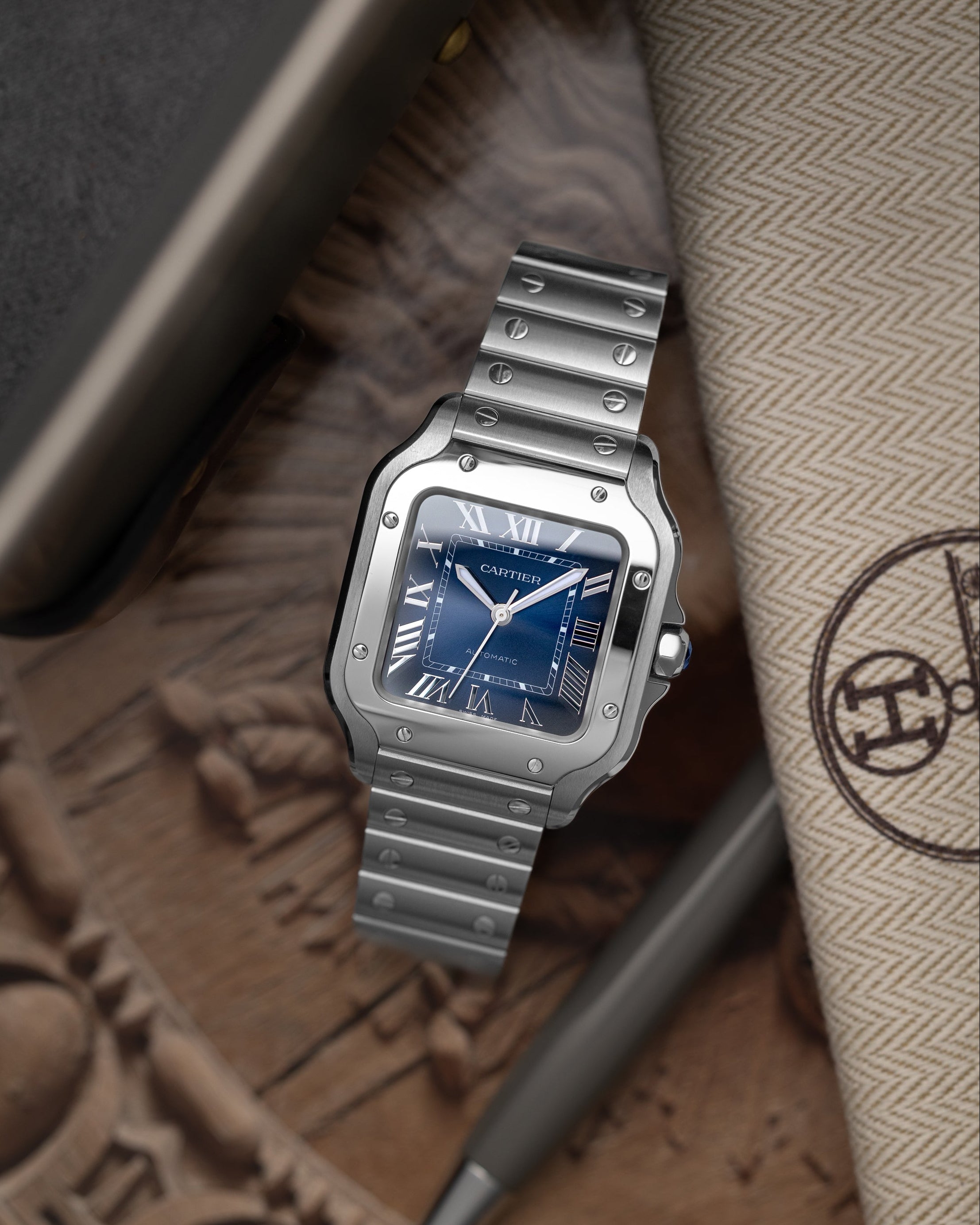
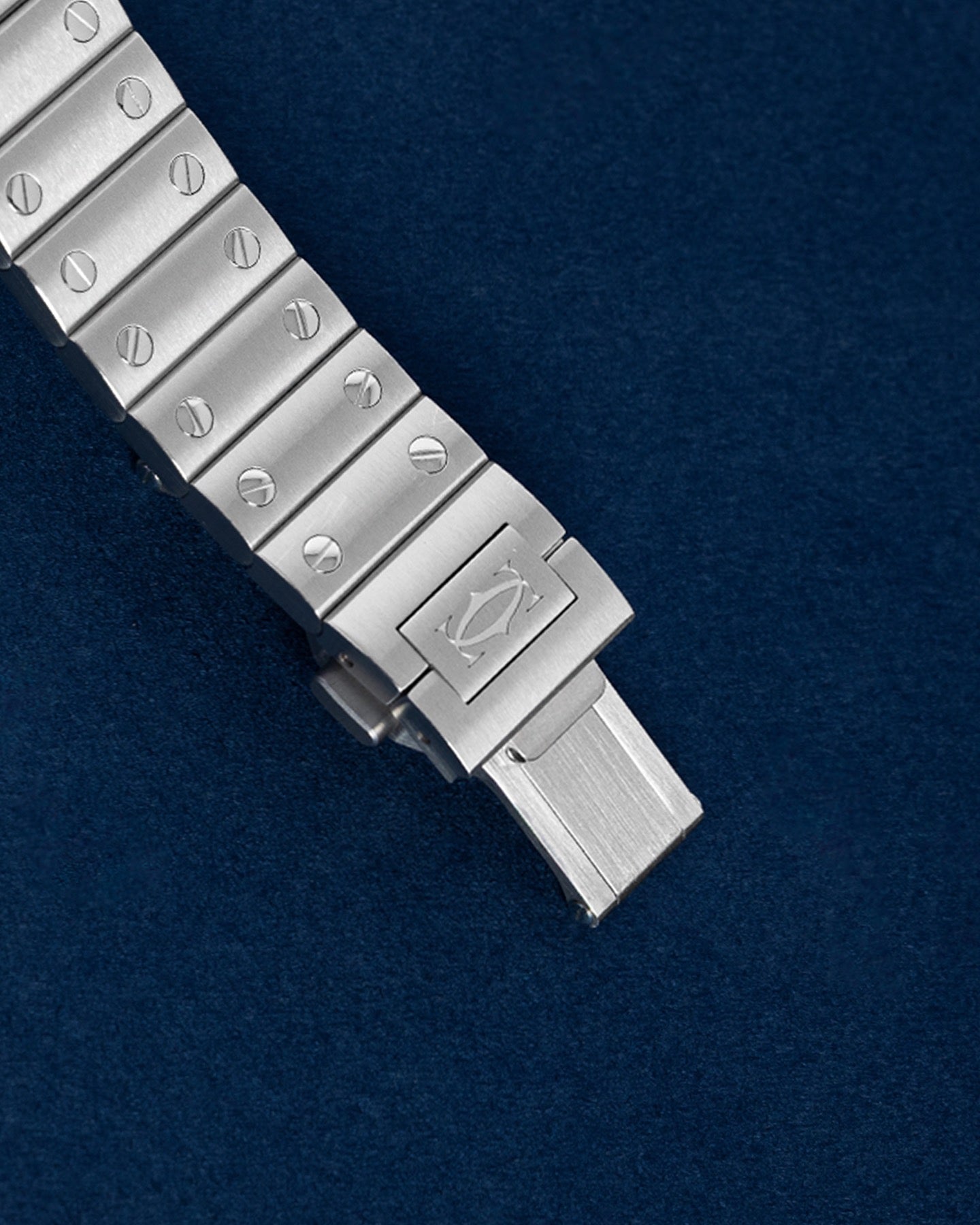
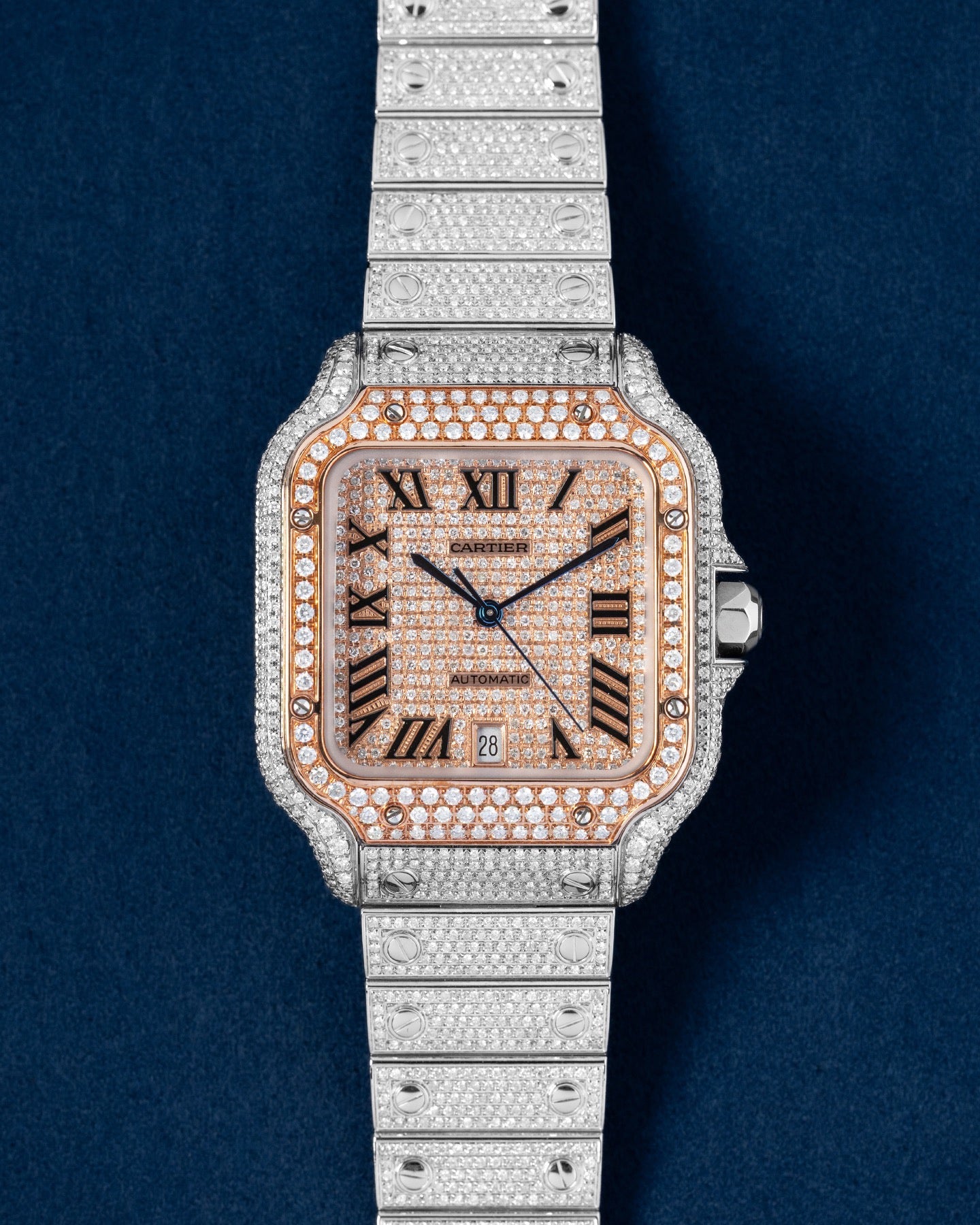
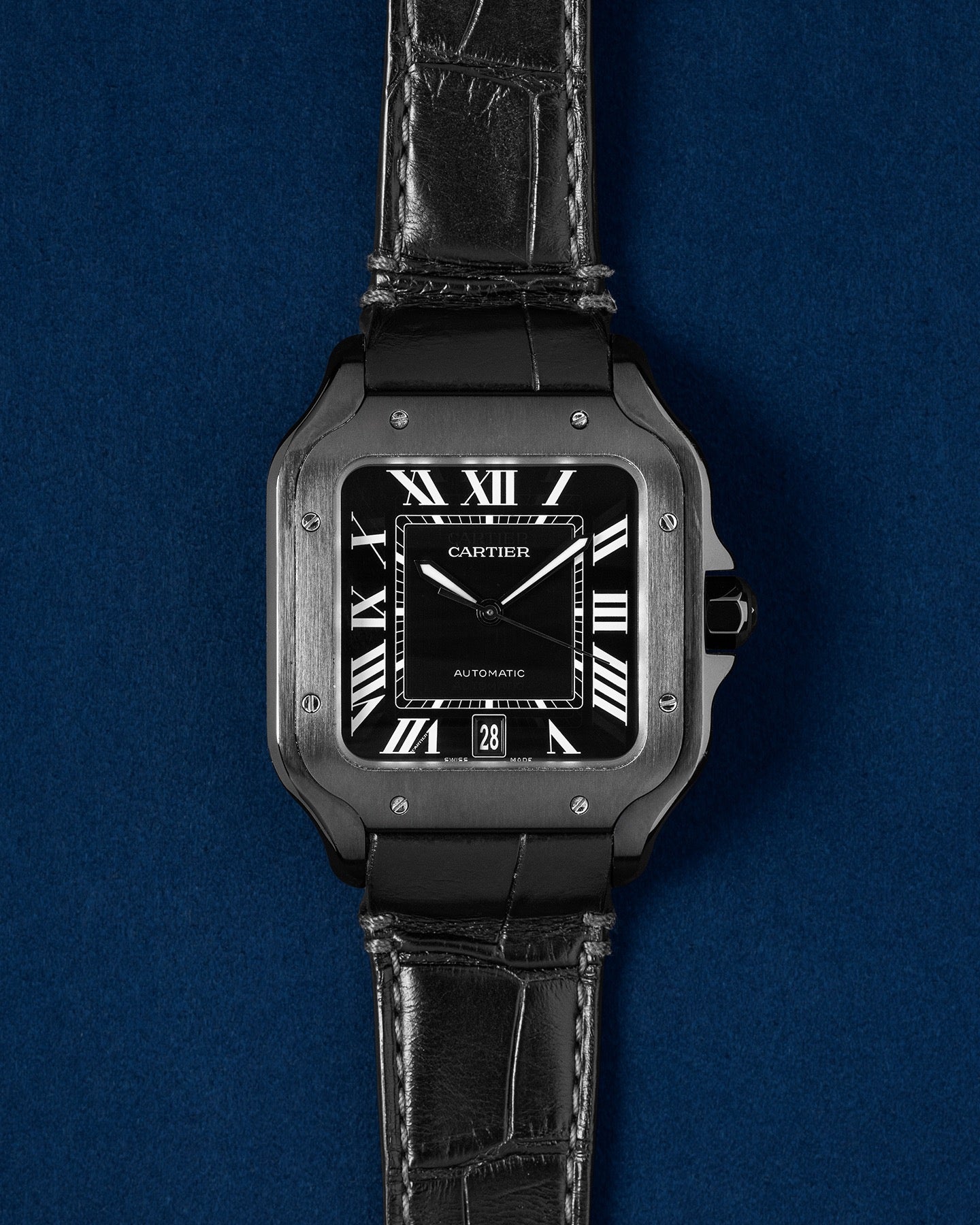
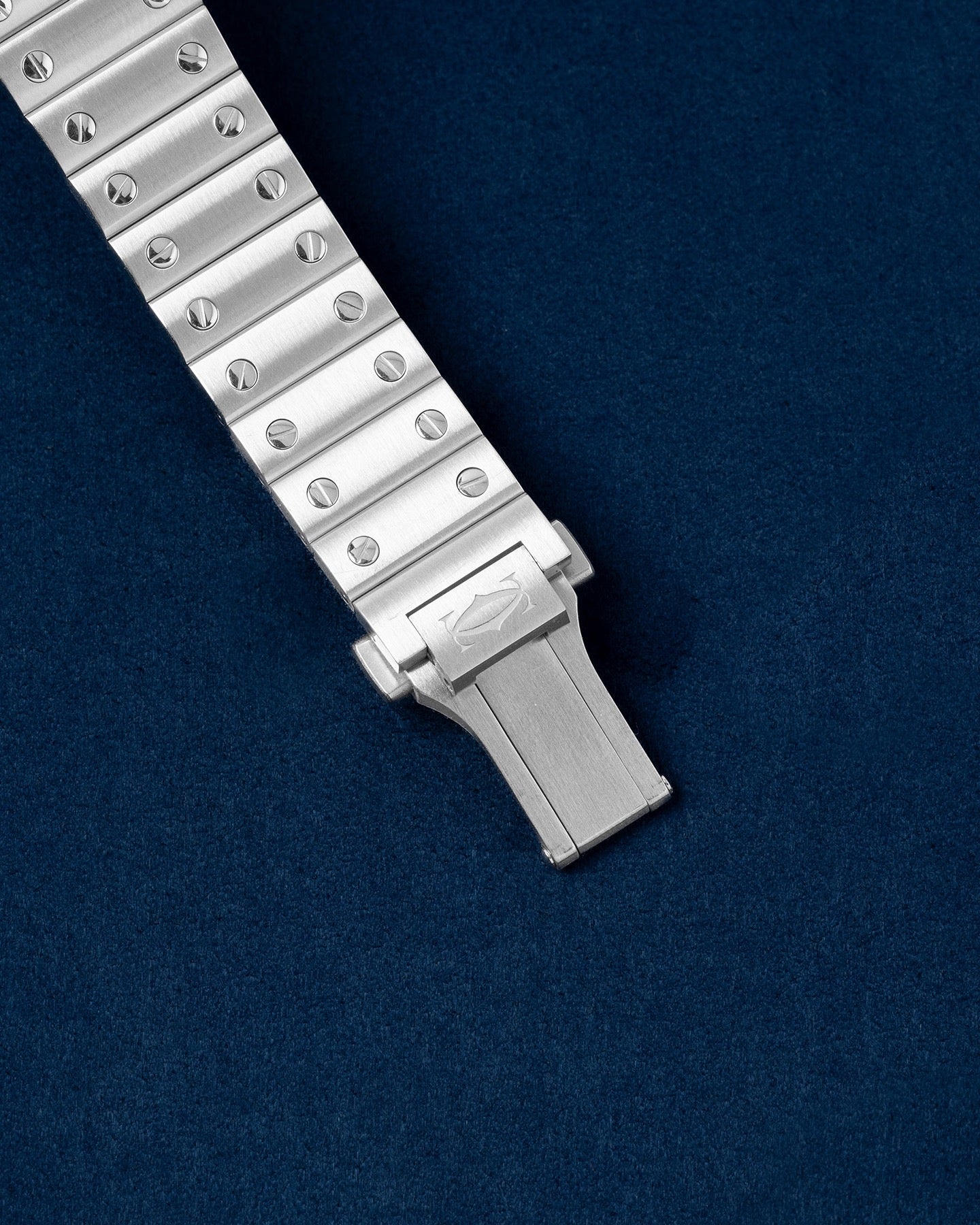
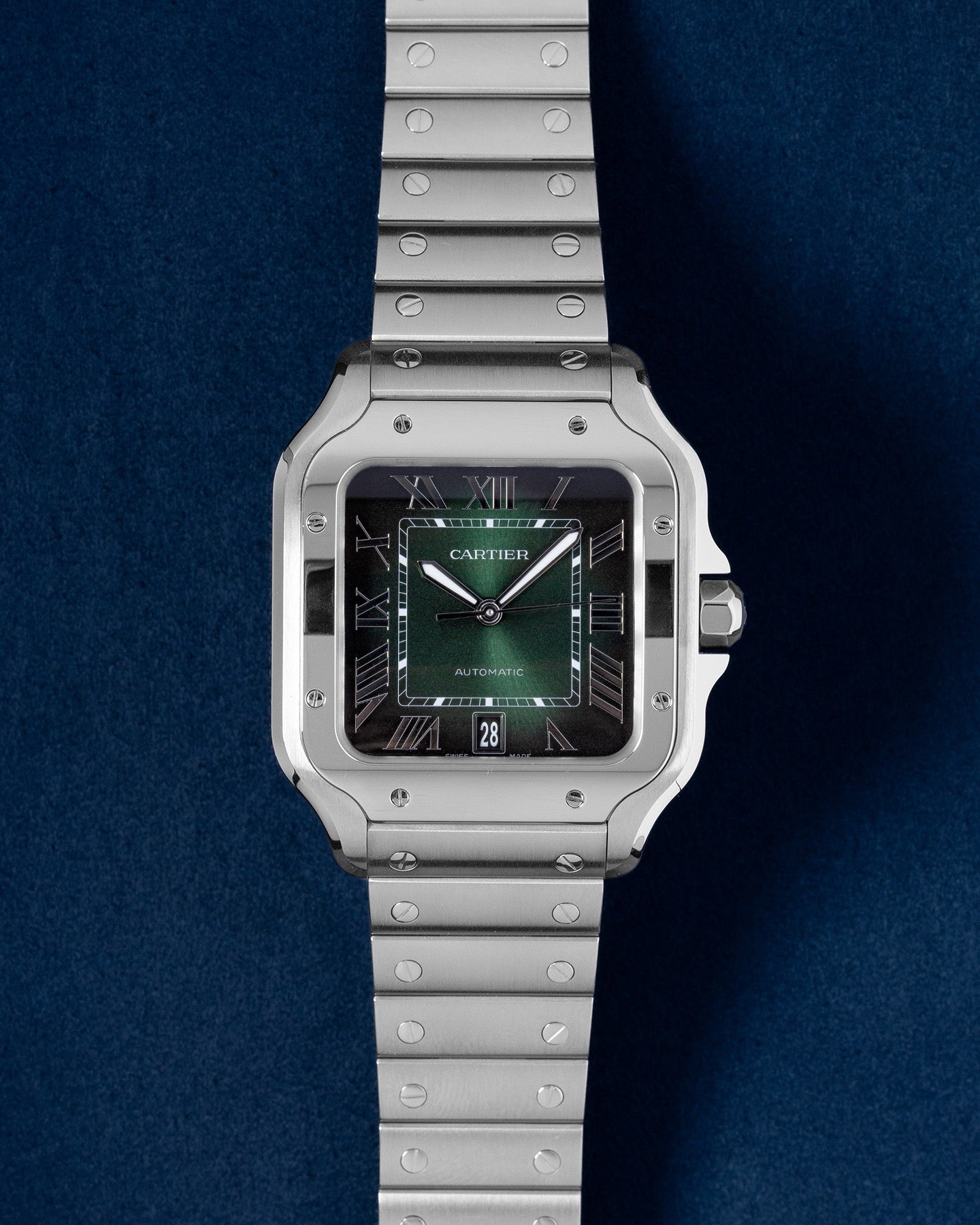
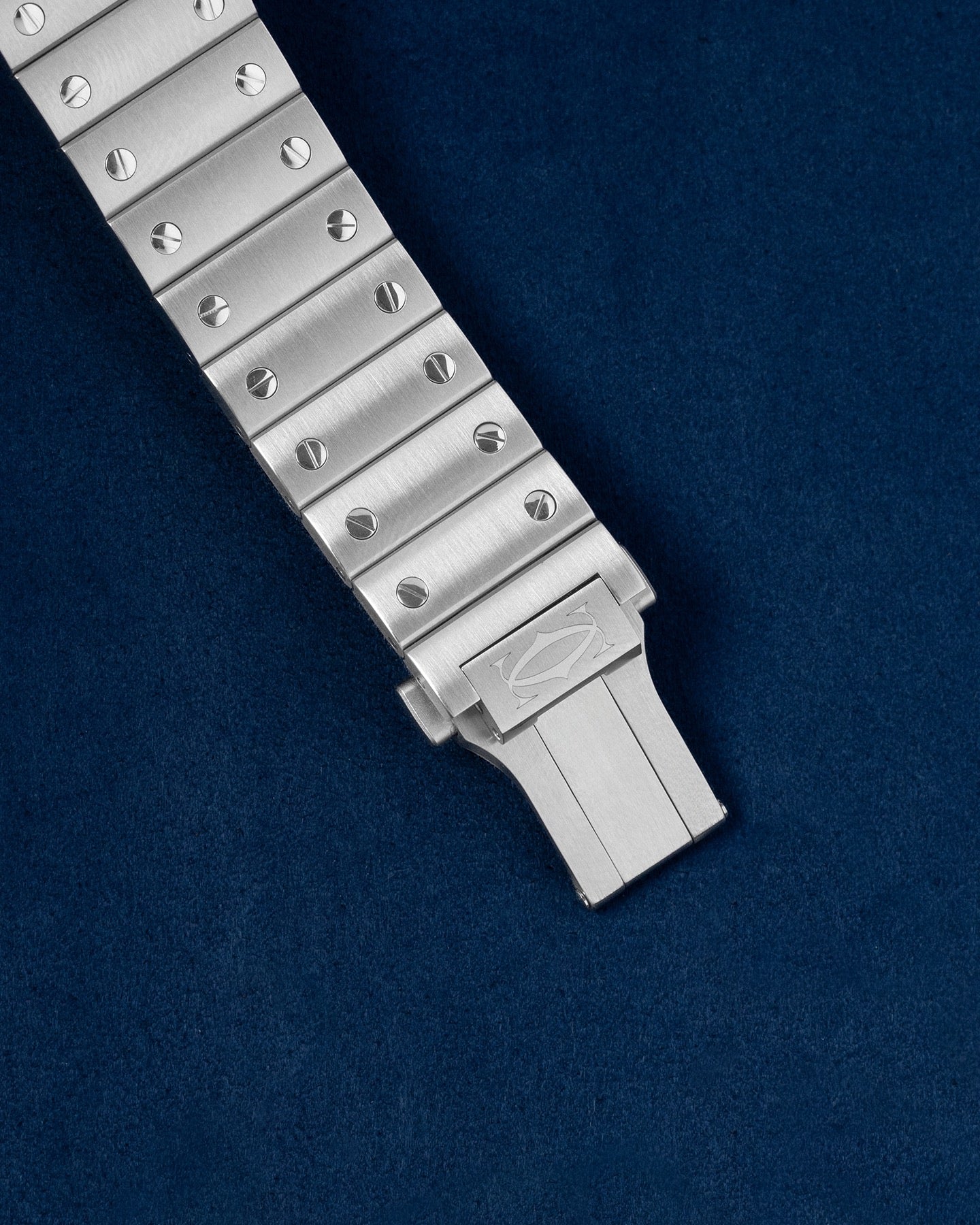
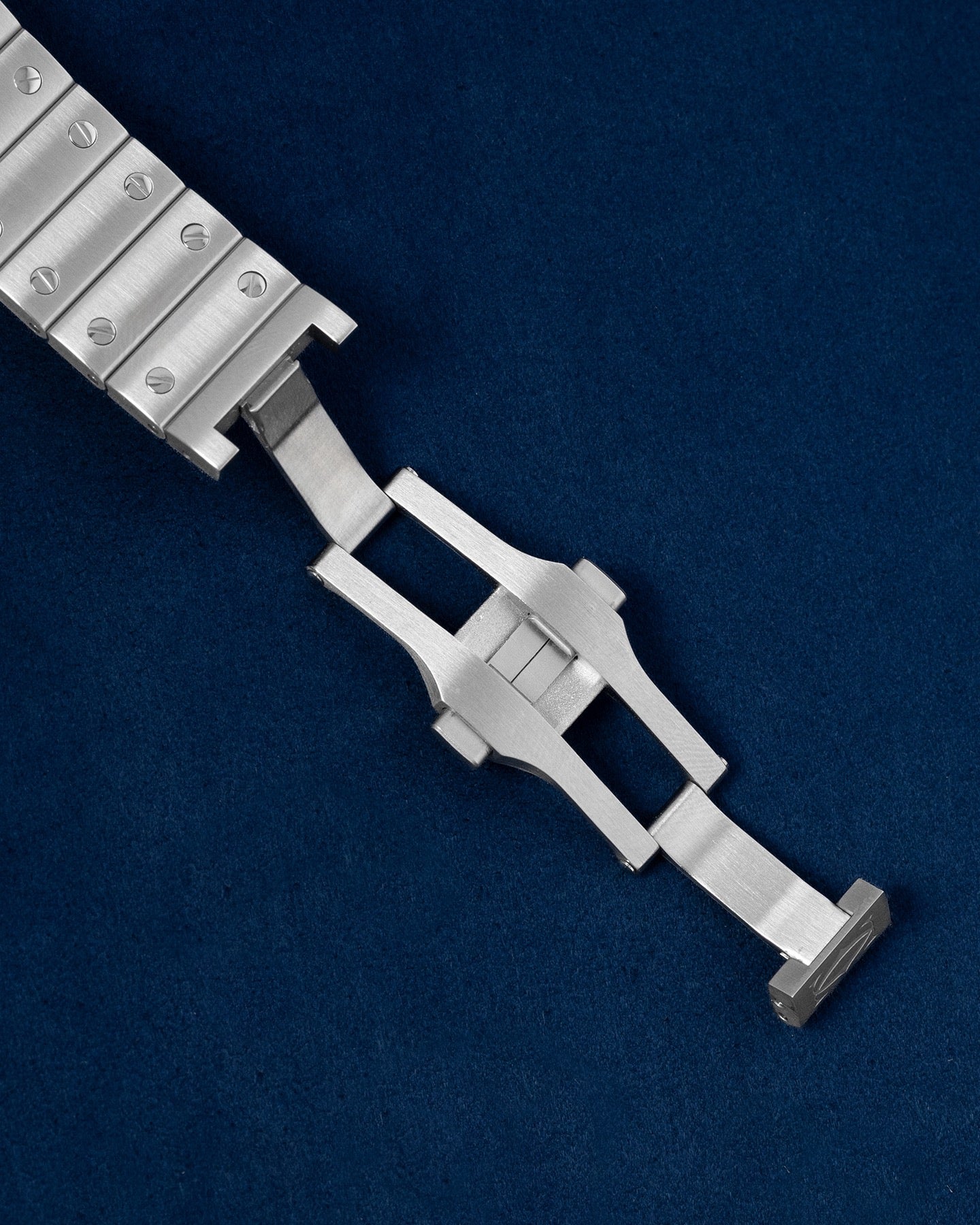
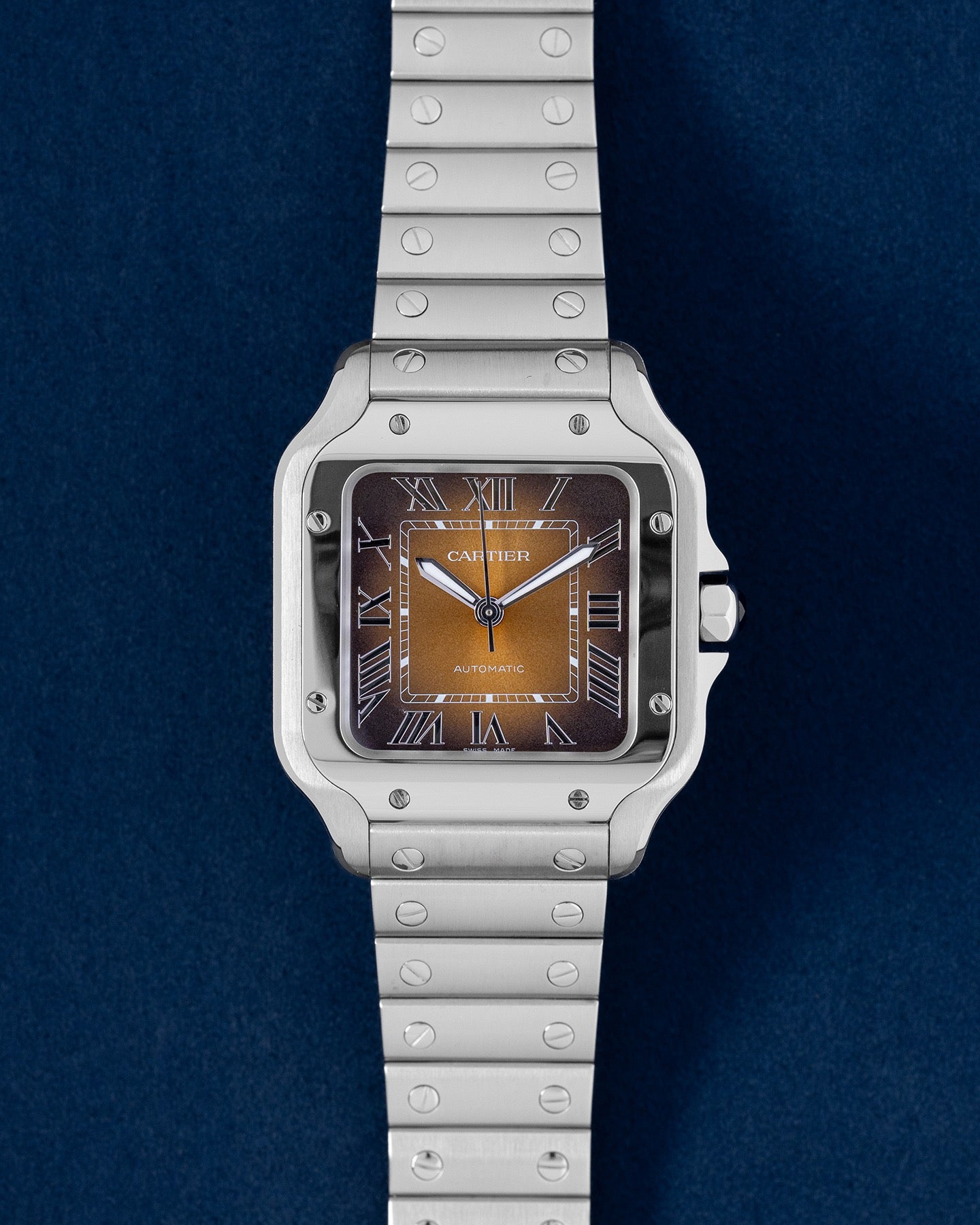
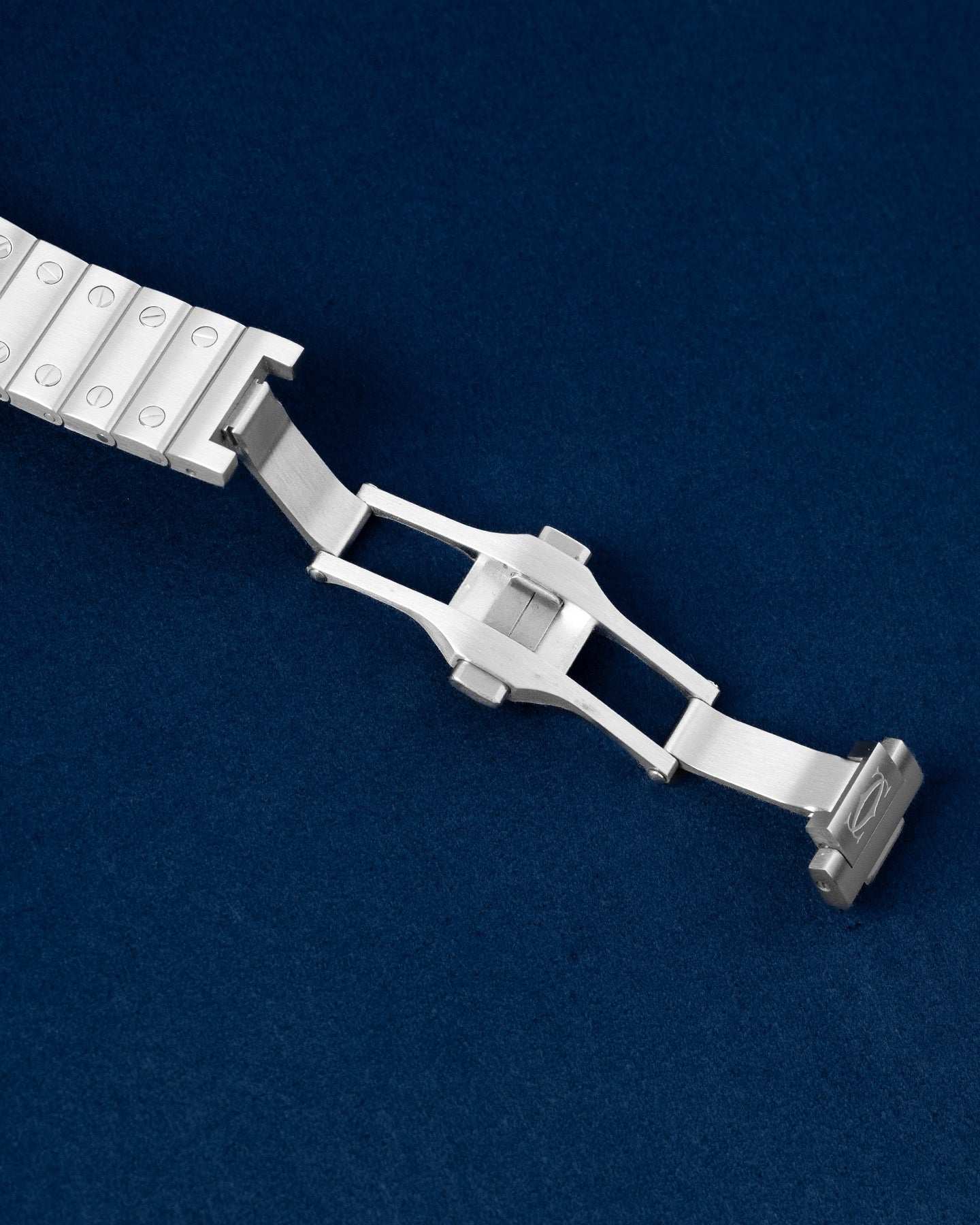
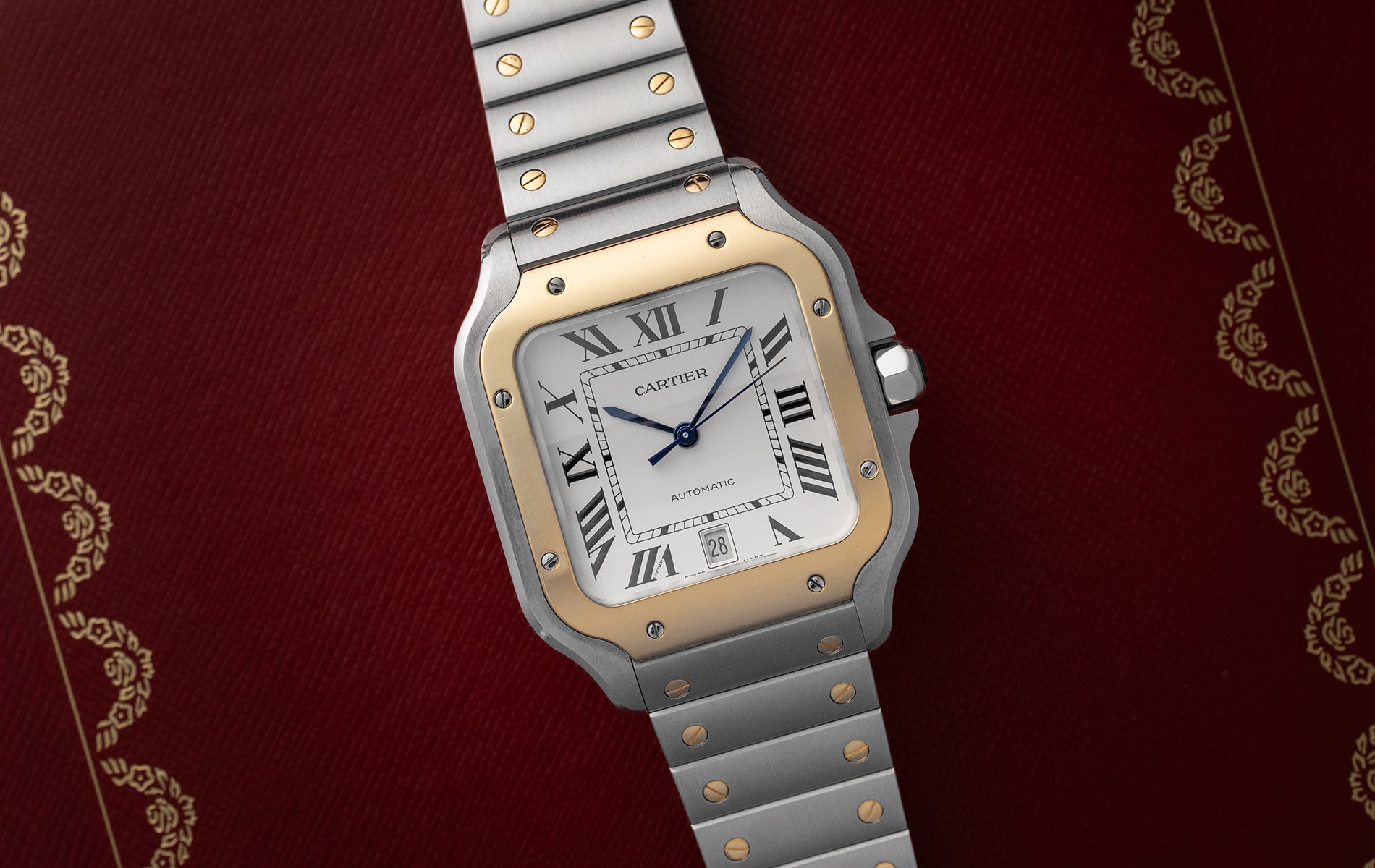
The Santos family has evolved significantly since 1904, but it remains the most recognizable sports model among all Cartier watches. The modern era of the Santos began in 1978 when Cartier made the controversial decision to release the watch in stainless steel with yellow gold accents, creating an accessible luxury sports watch that competed directly with the integrated bracelet models emerging from Switzerland. The design integrated the bracelet directly into the case, carrying the exposed bezel screws down through the bracelet links. In 2018, Cartier completely revamped the Santos de Cartier collection, refining the case lines to flow more seamlessly into the bracelet and introducing the QuickSwitch and SmartLink systems. QuickSwitch allows the wearer to release the bracelet or strap from the case with a single push of a button hidden under the lug, while SmartLink allows links to be added or removed without tools using a push piece integrated into each link.
Santos de Cartier Large and Medium
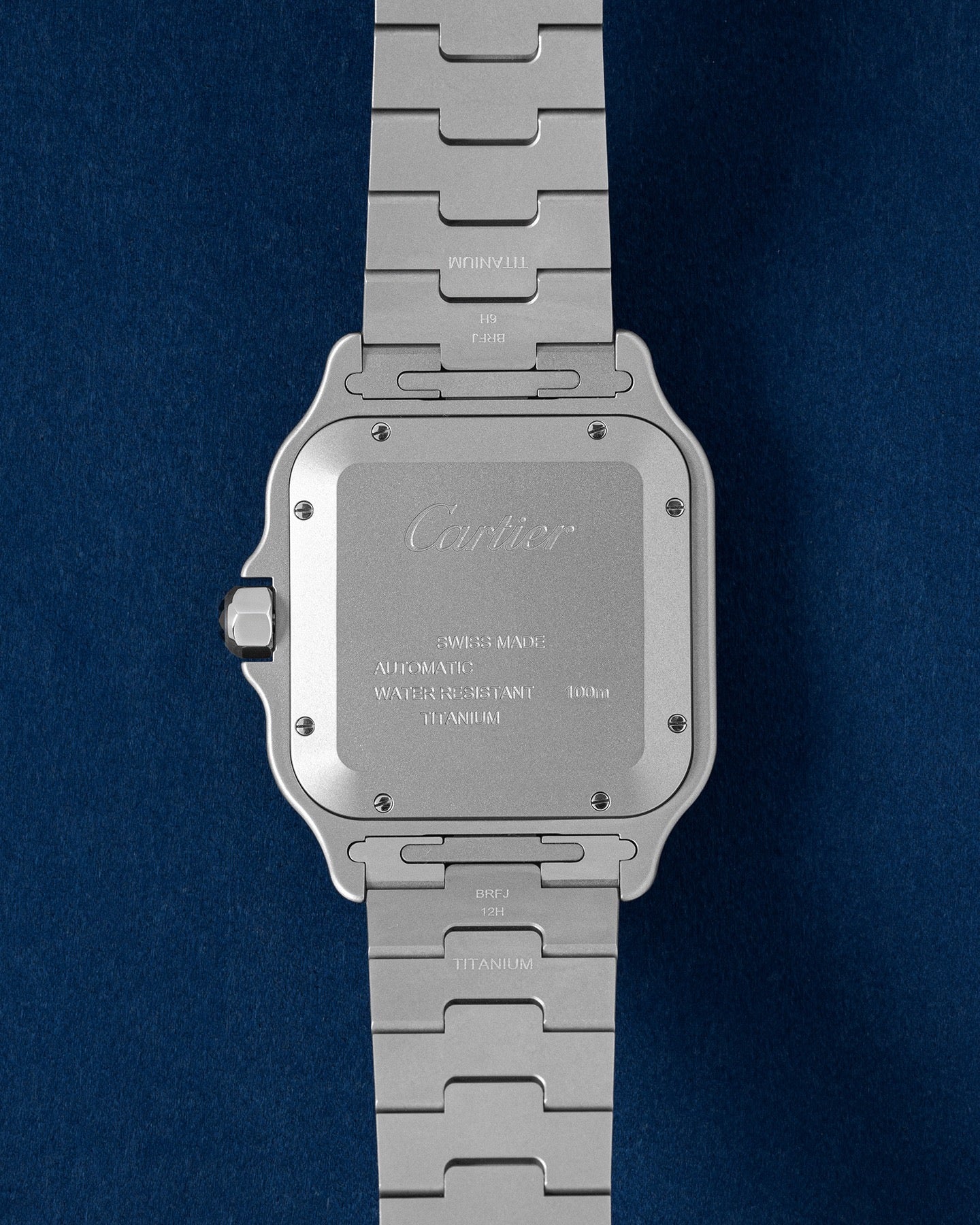
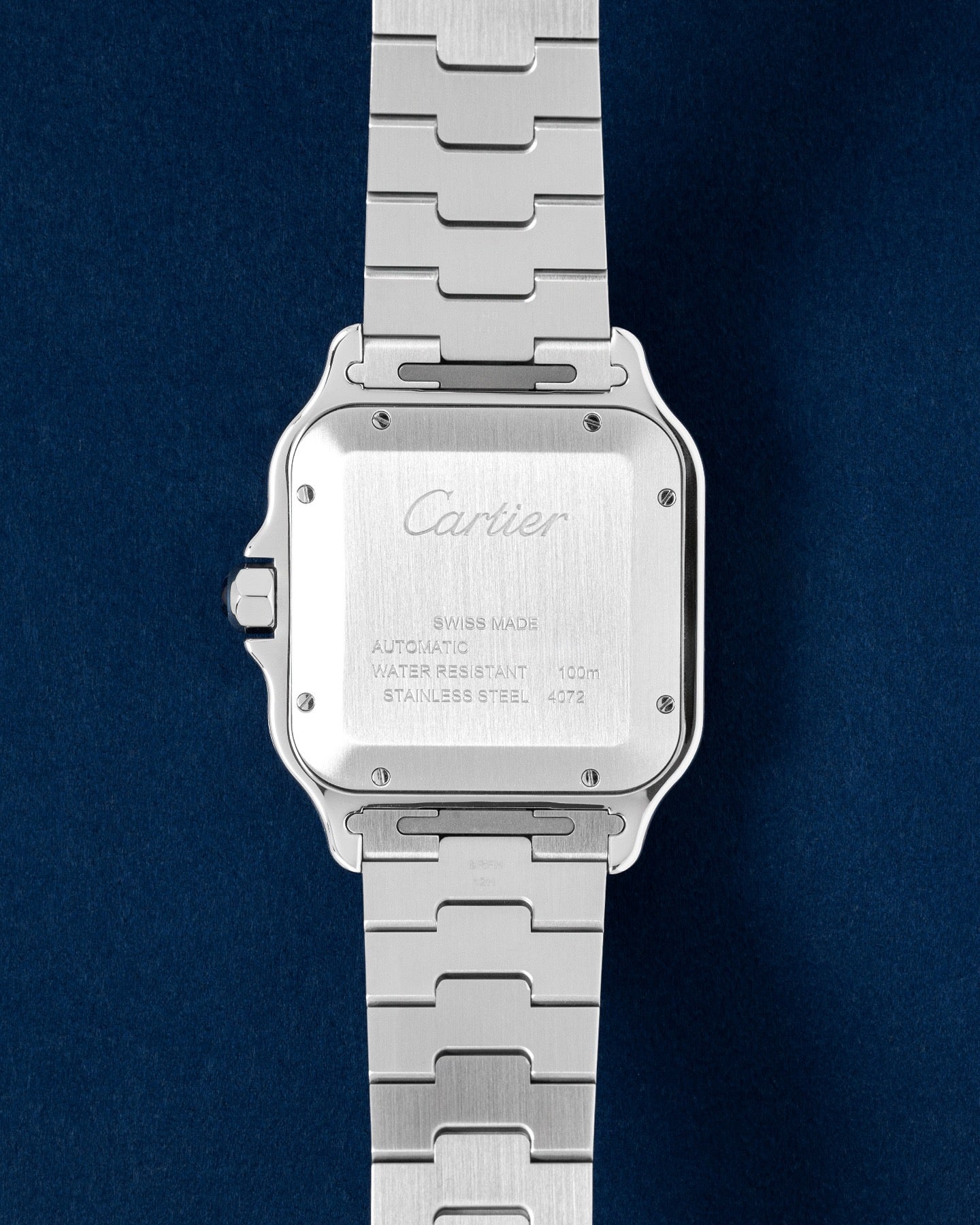
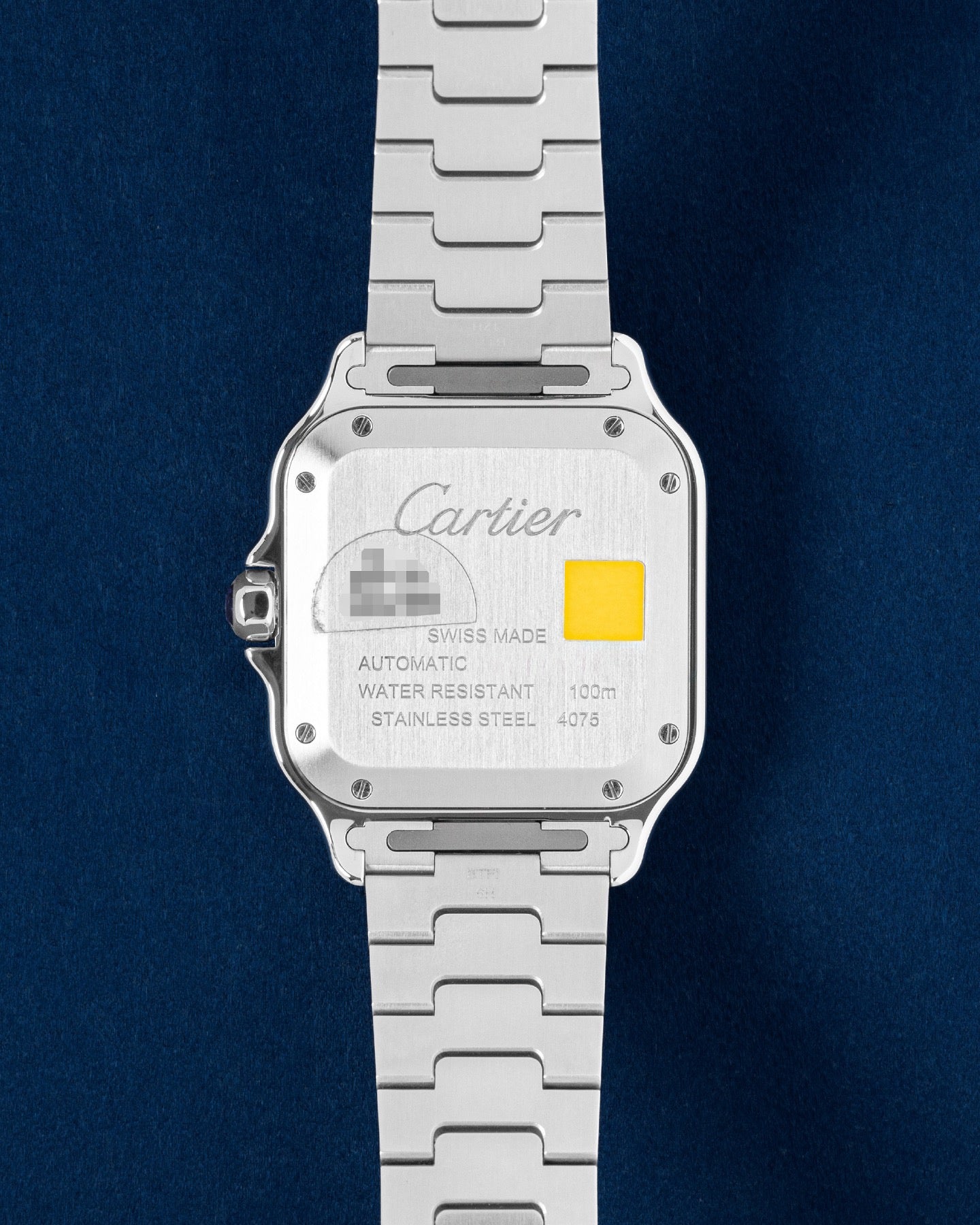
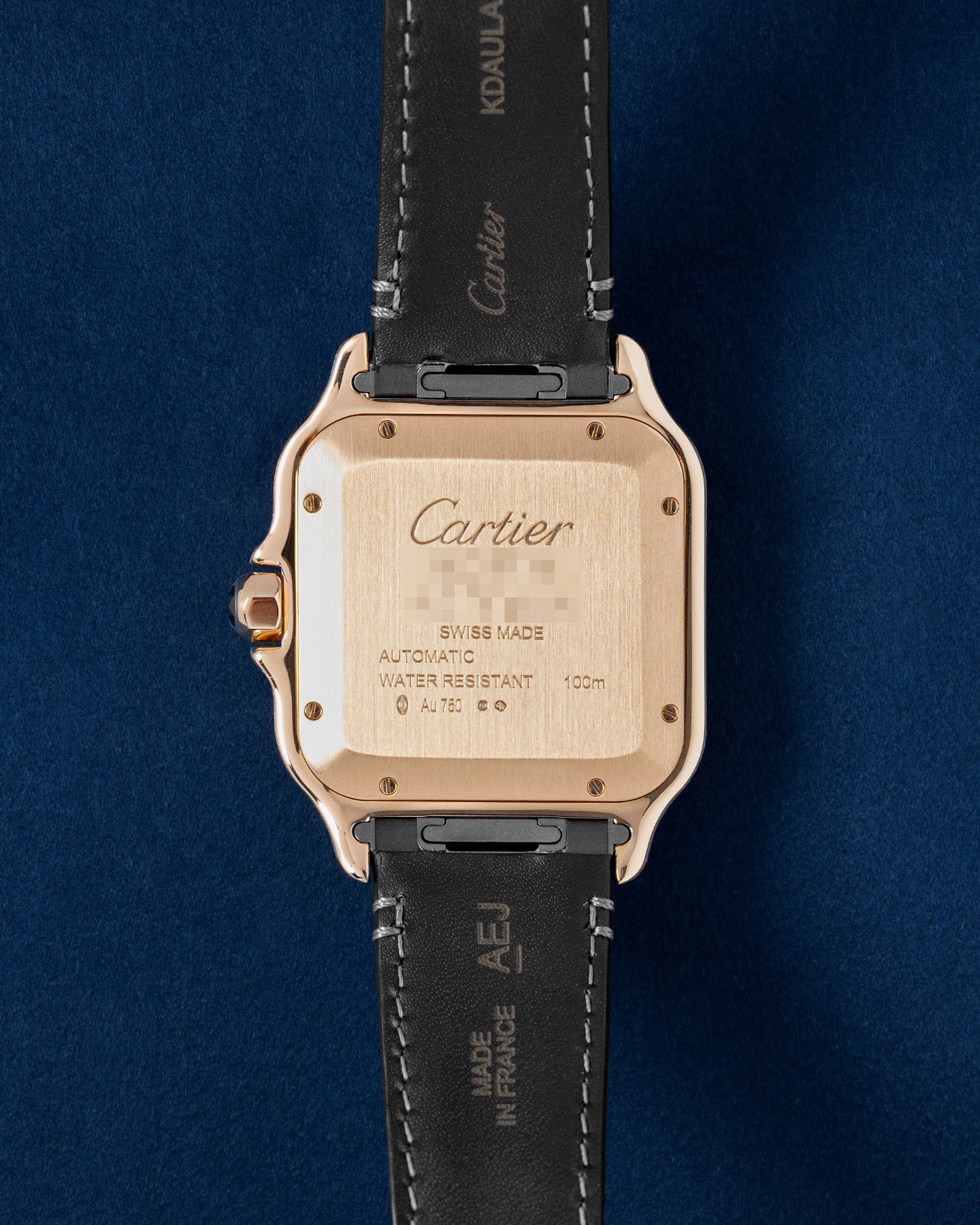
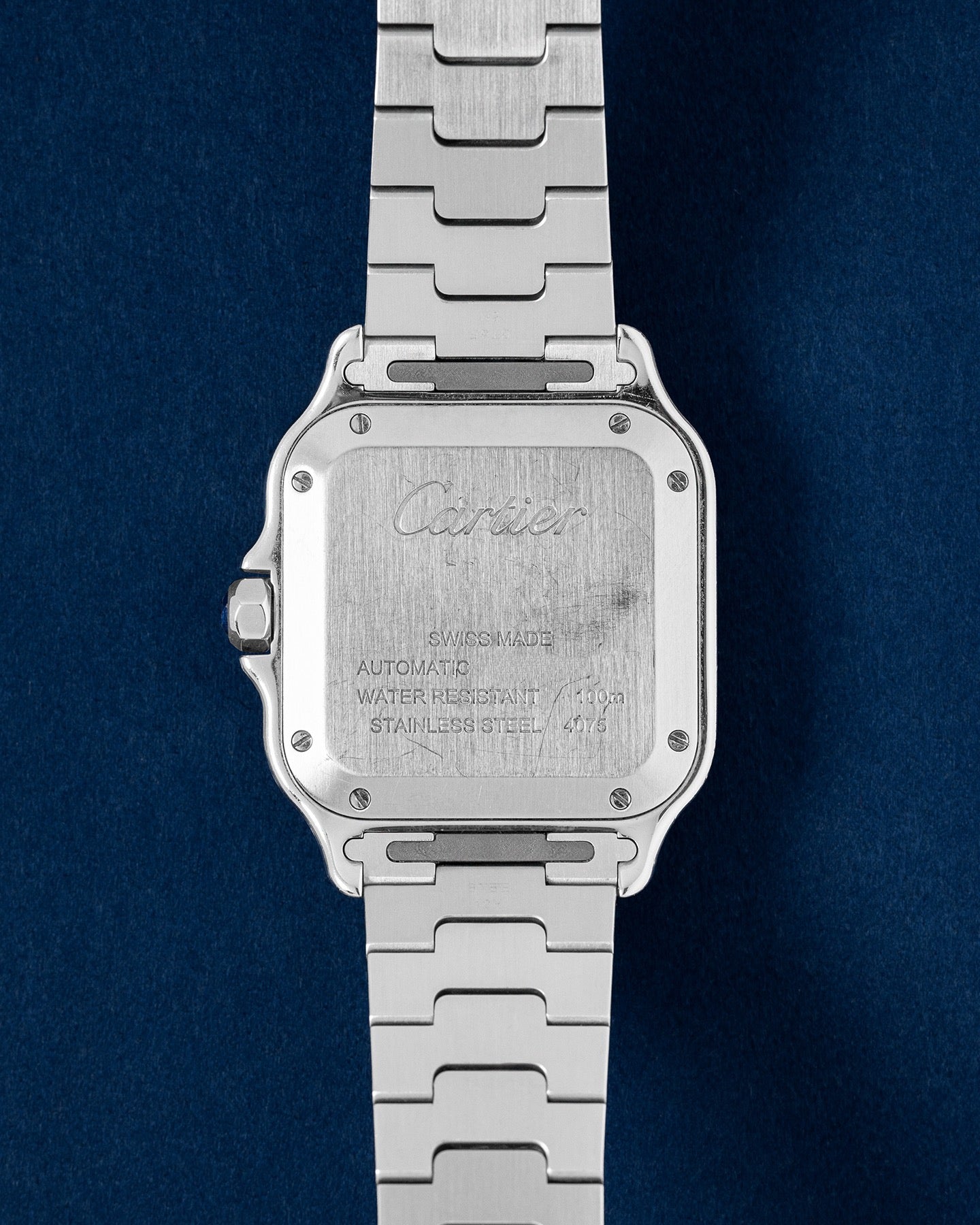
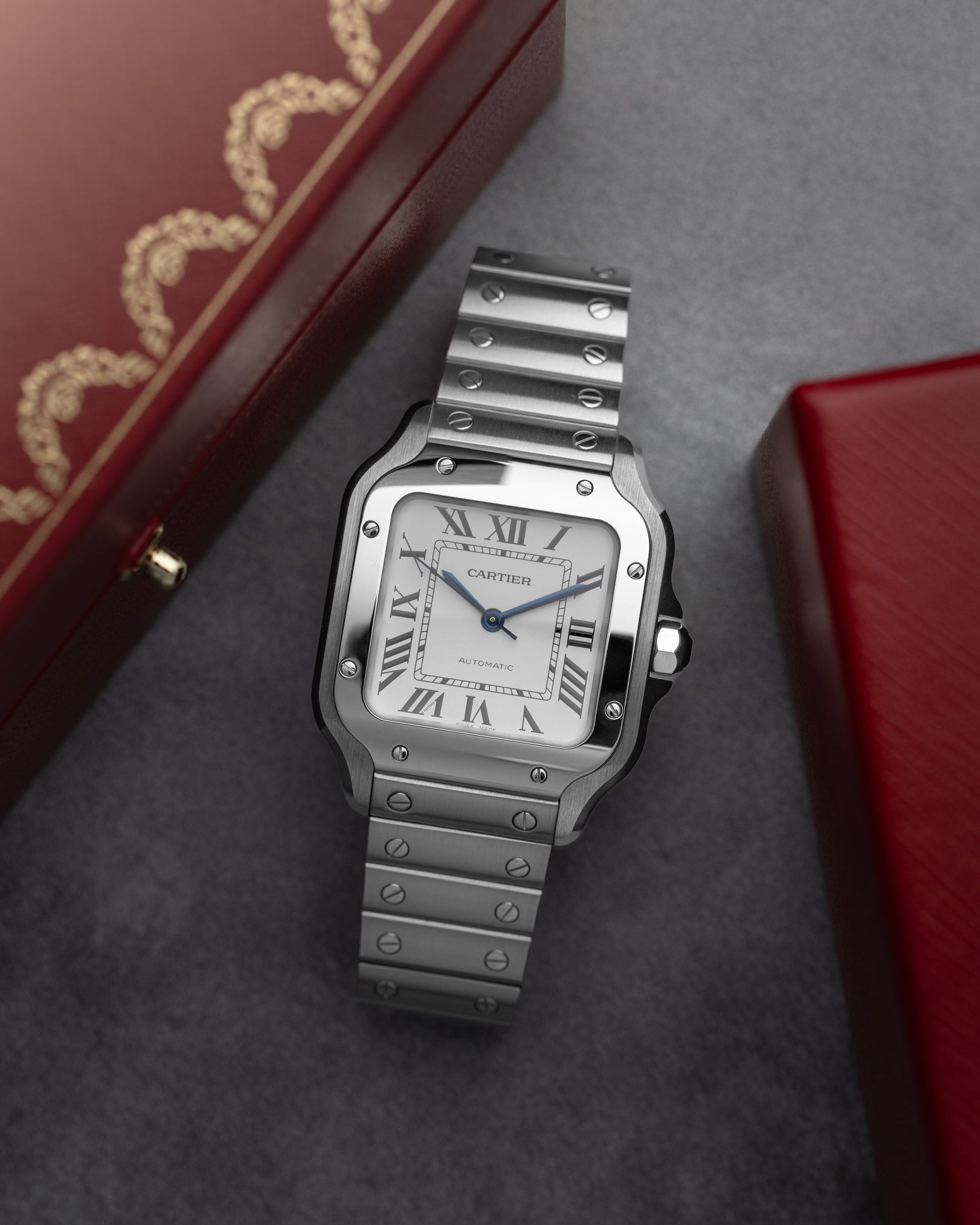
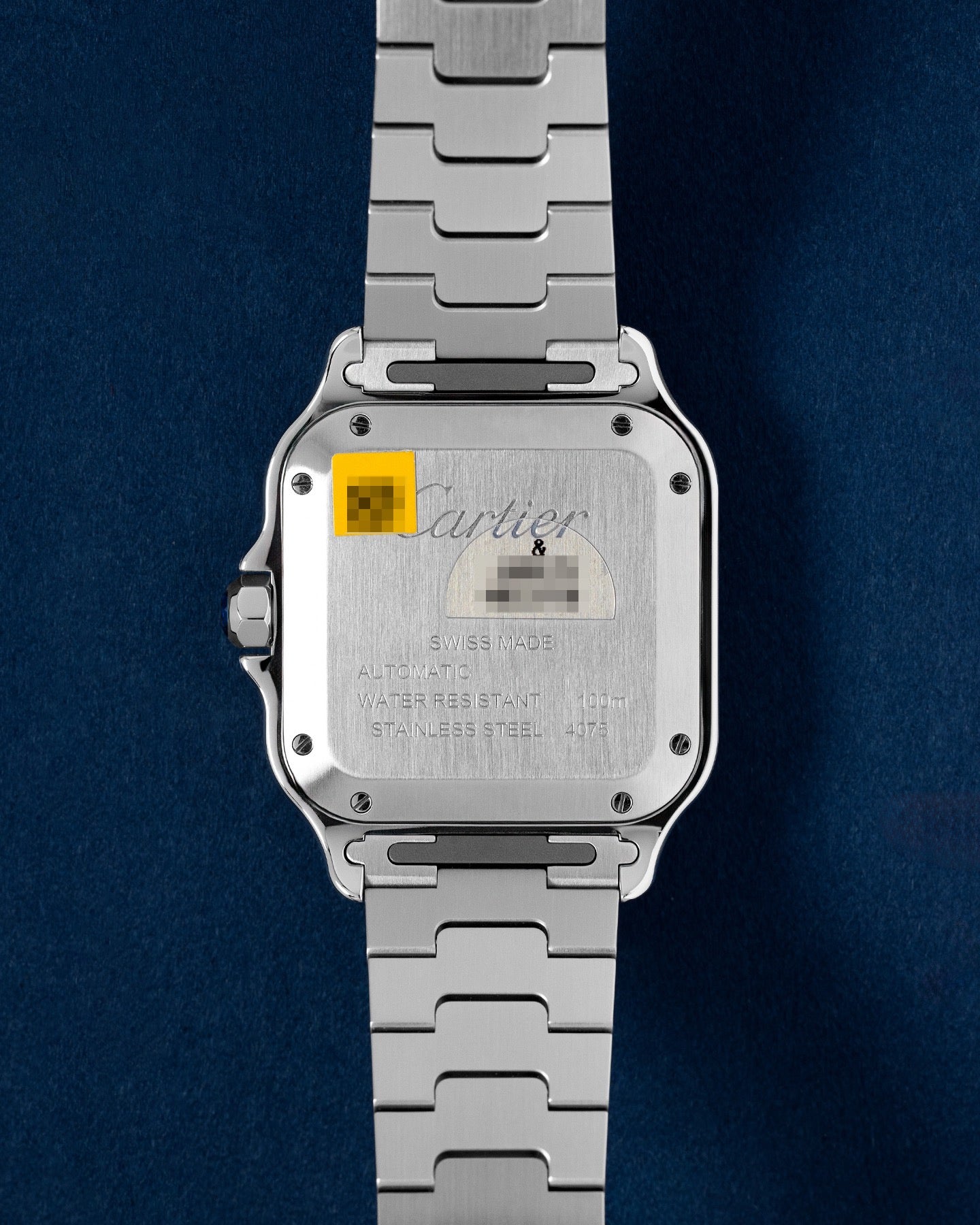
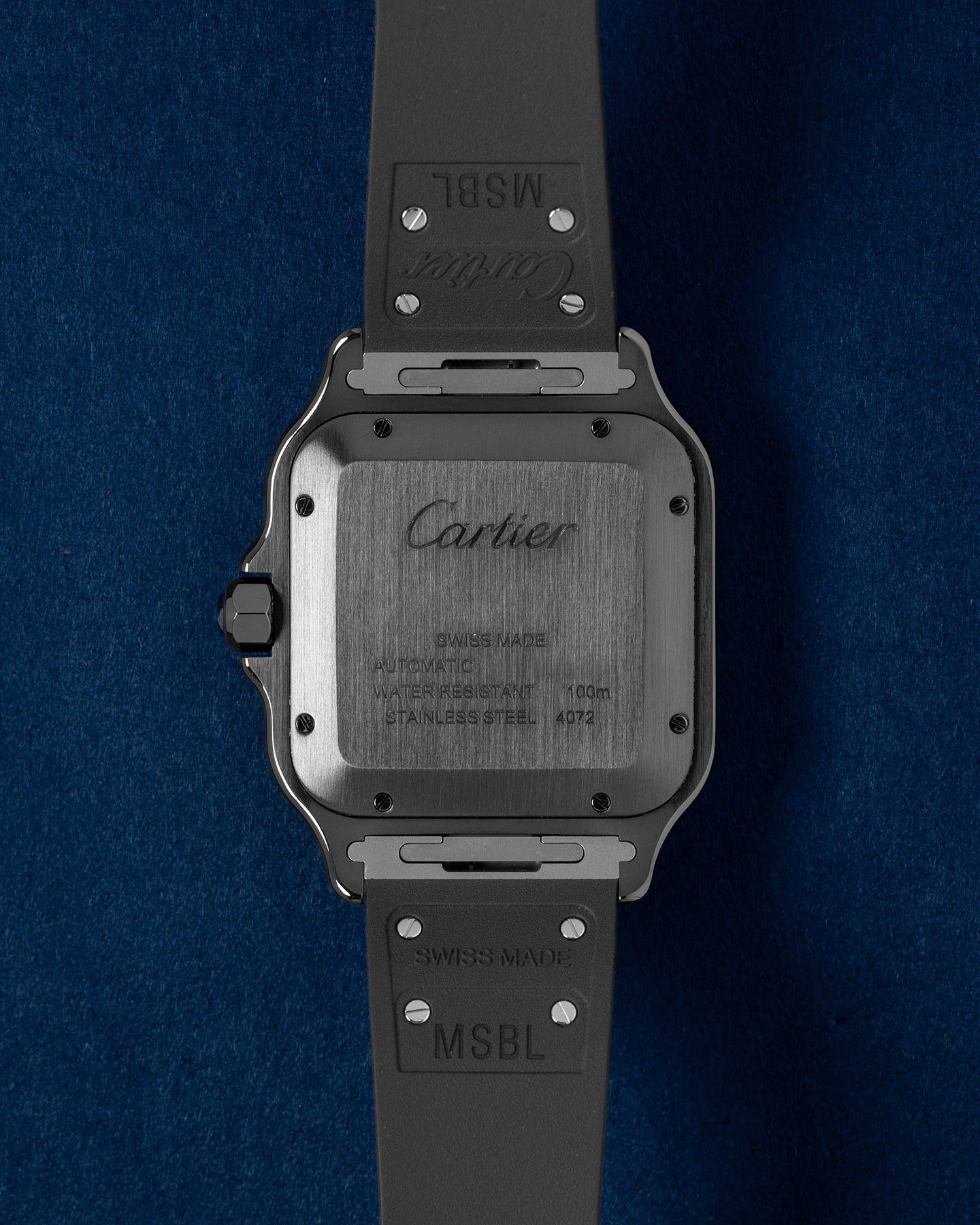
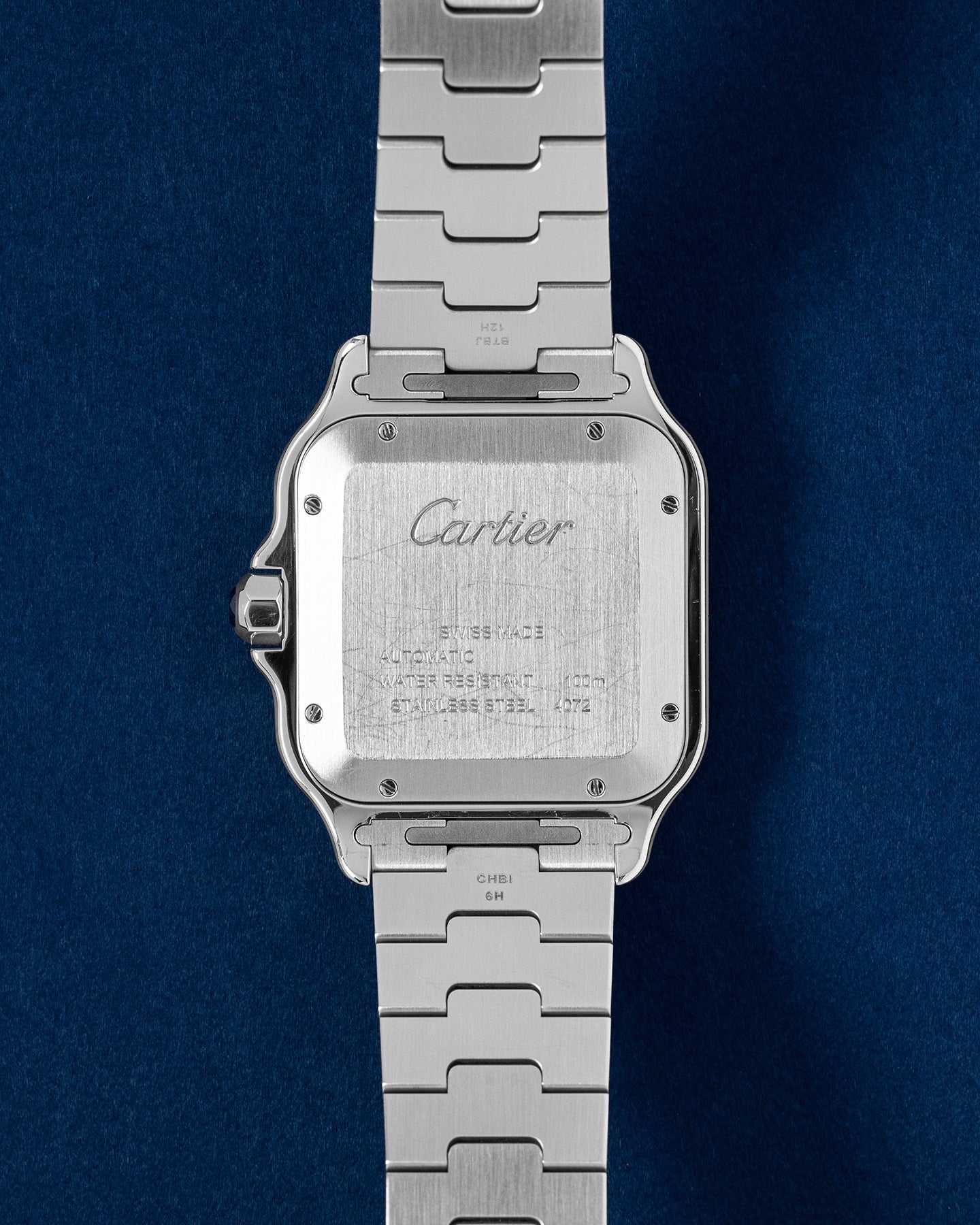
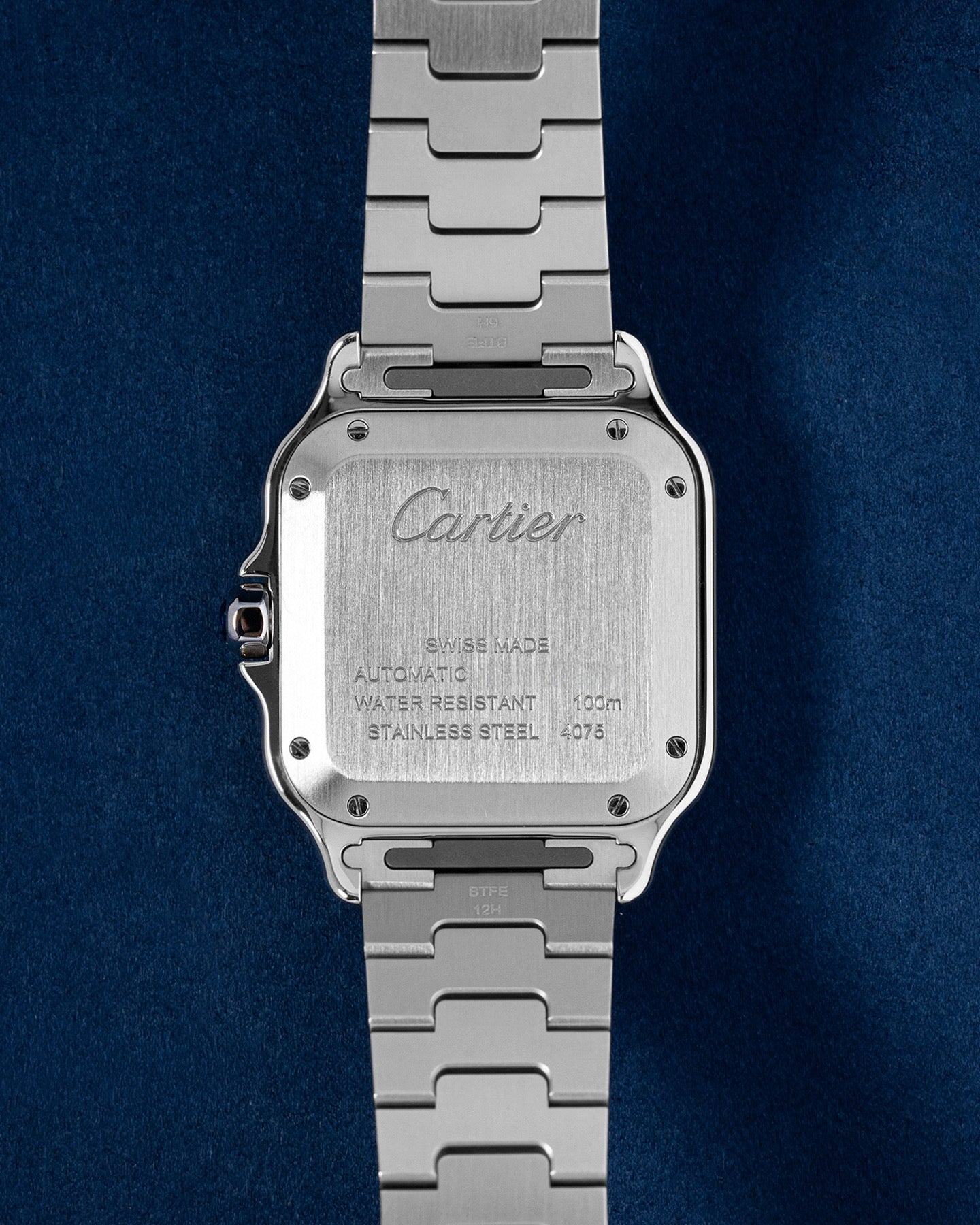
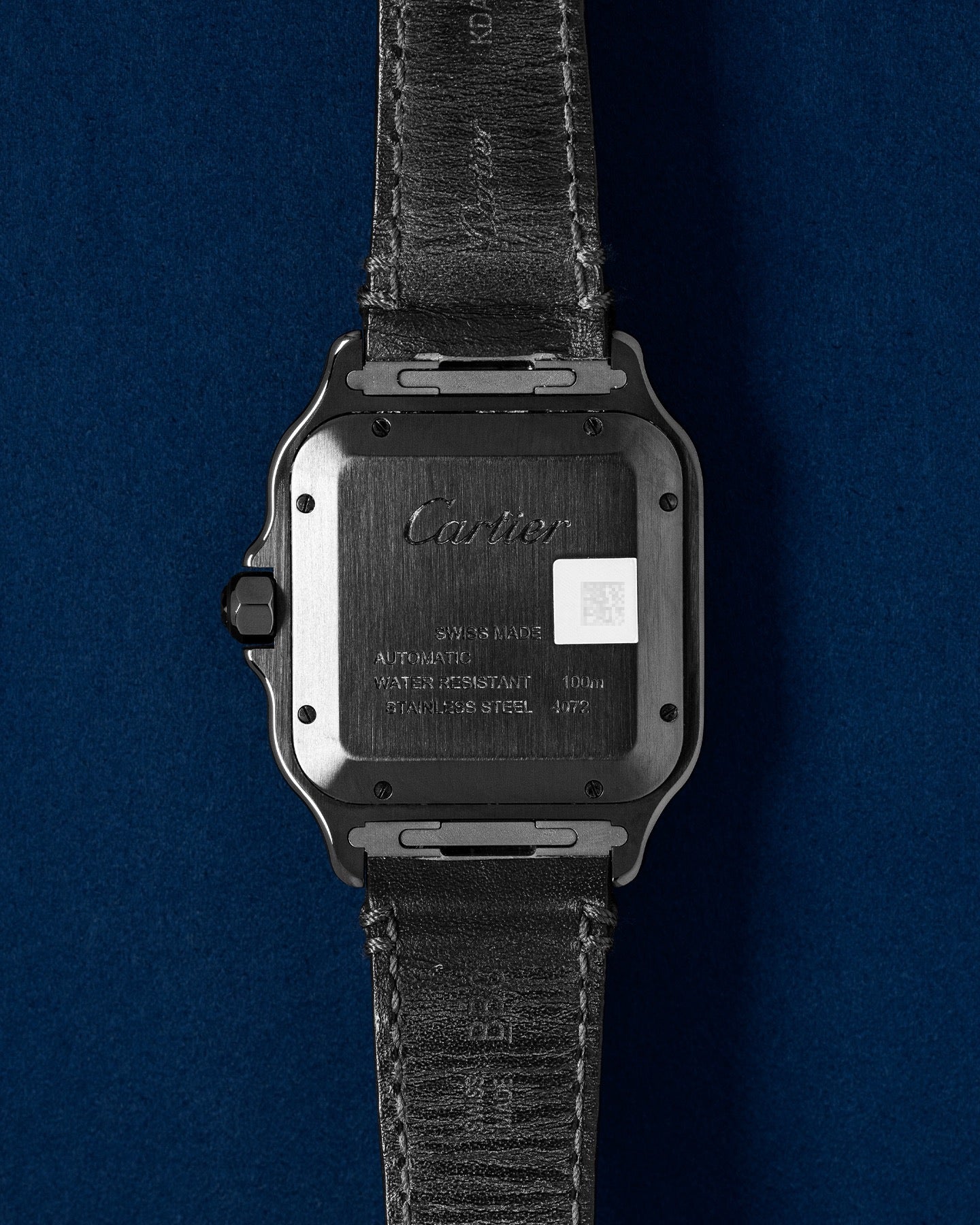
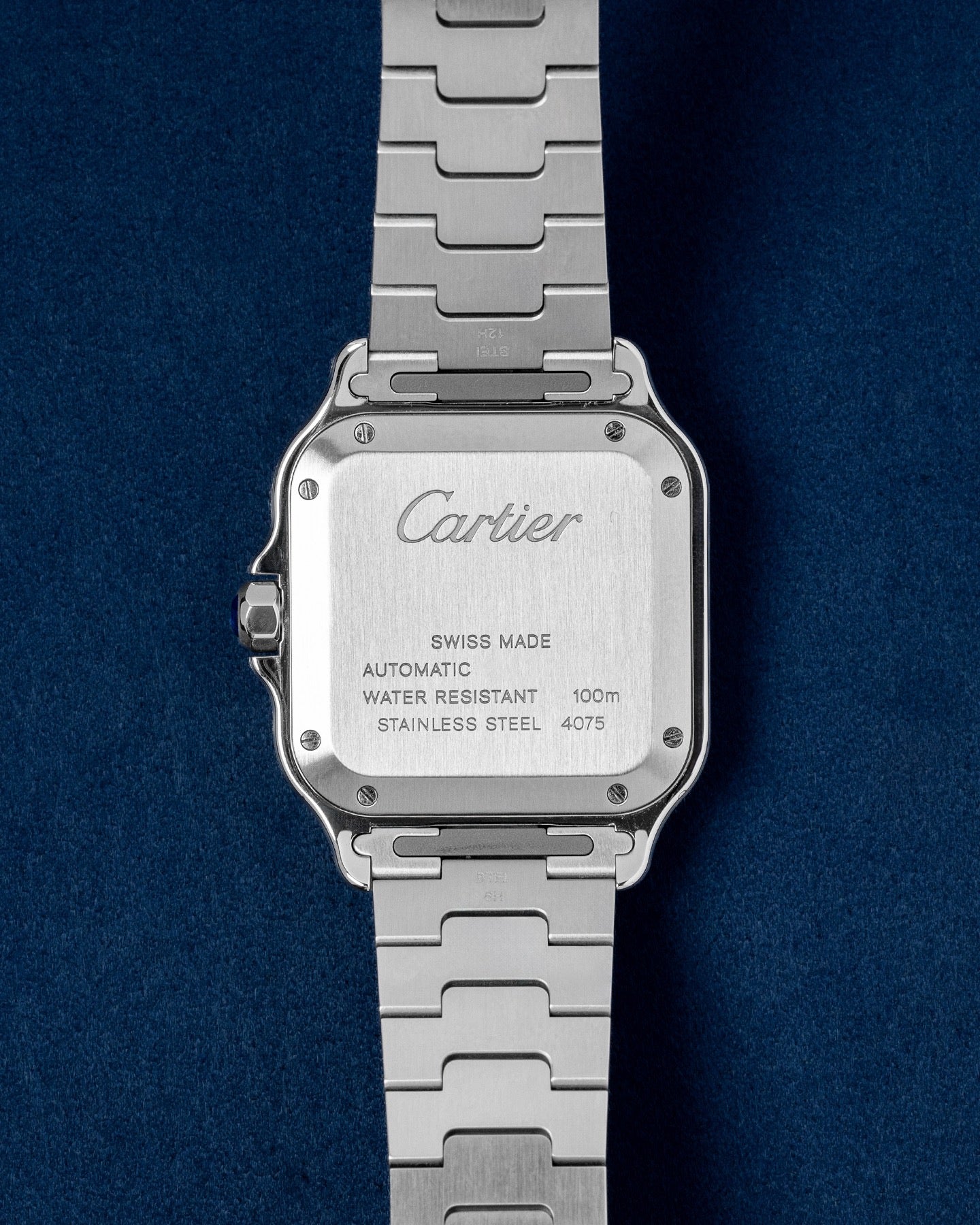
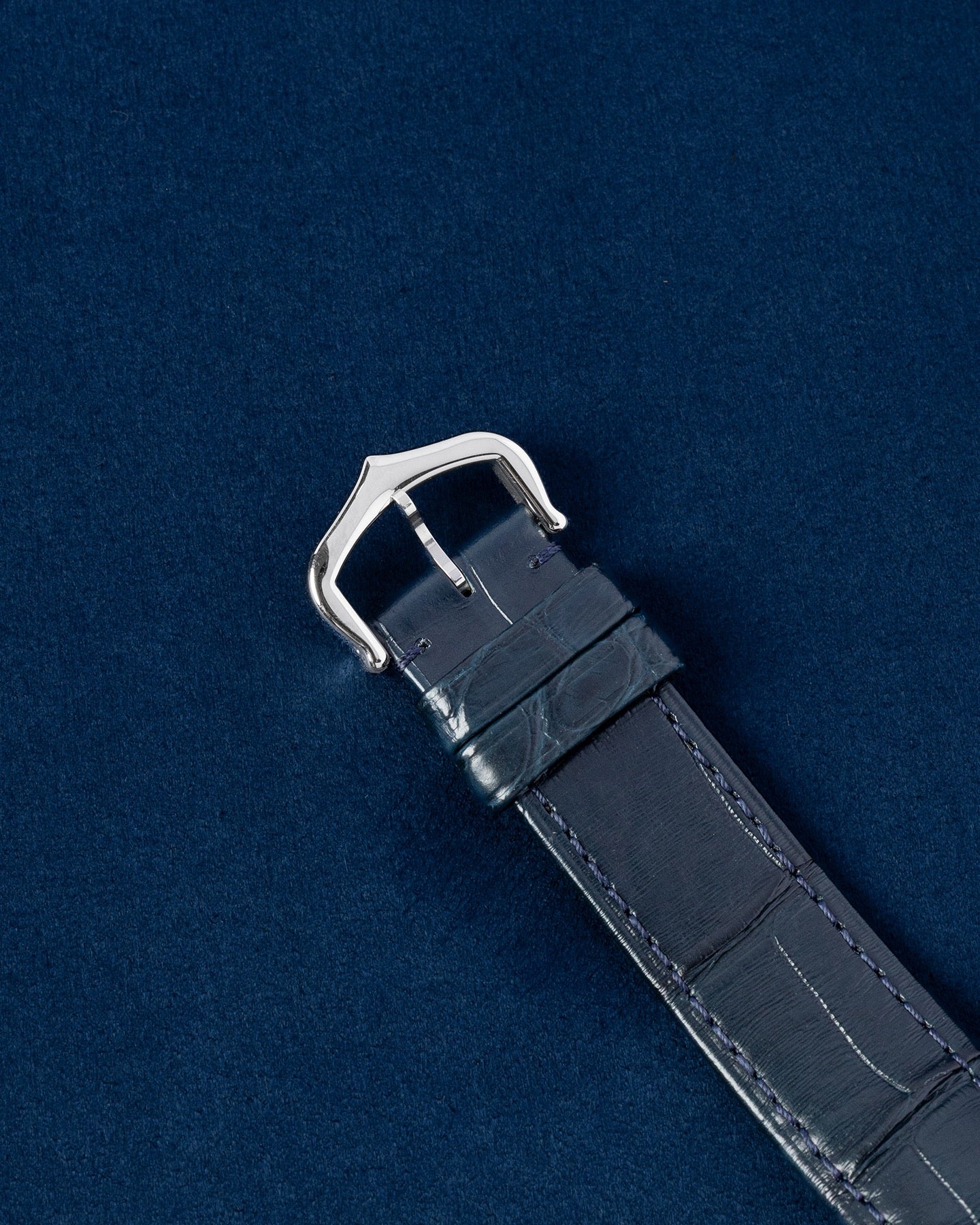
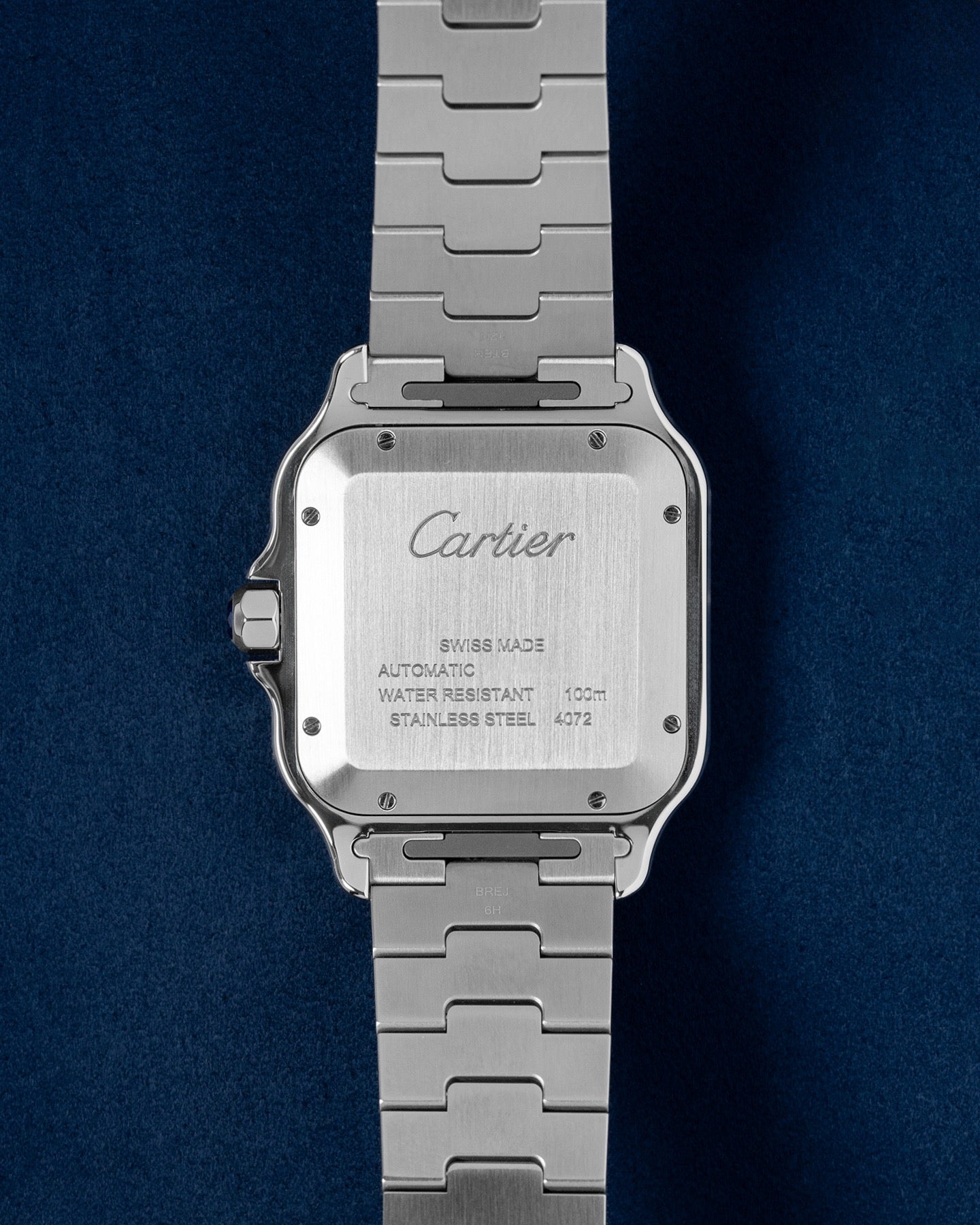
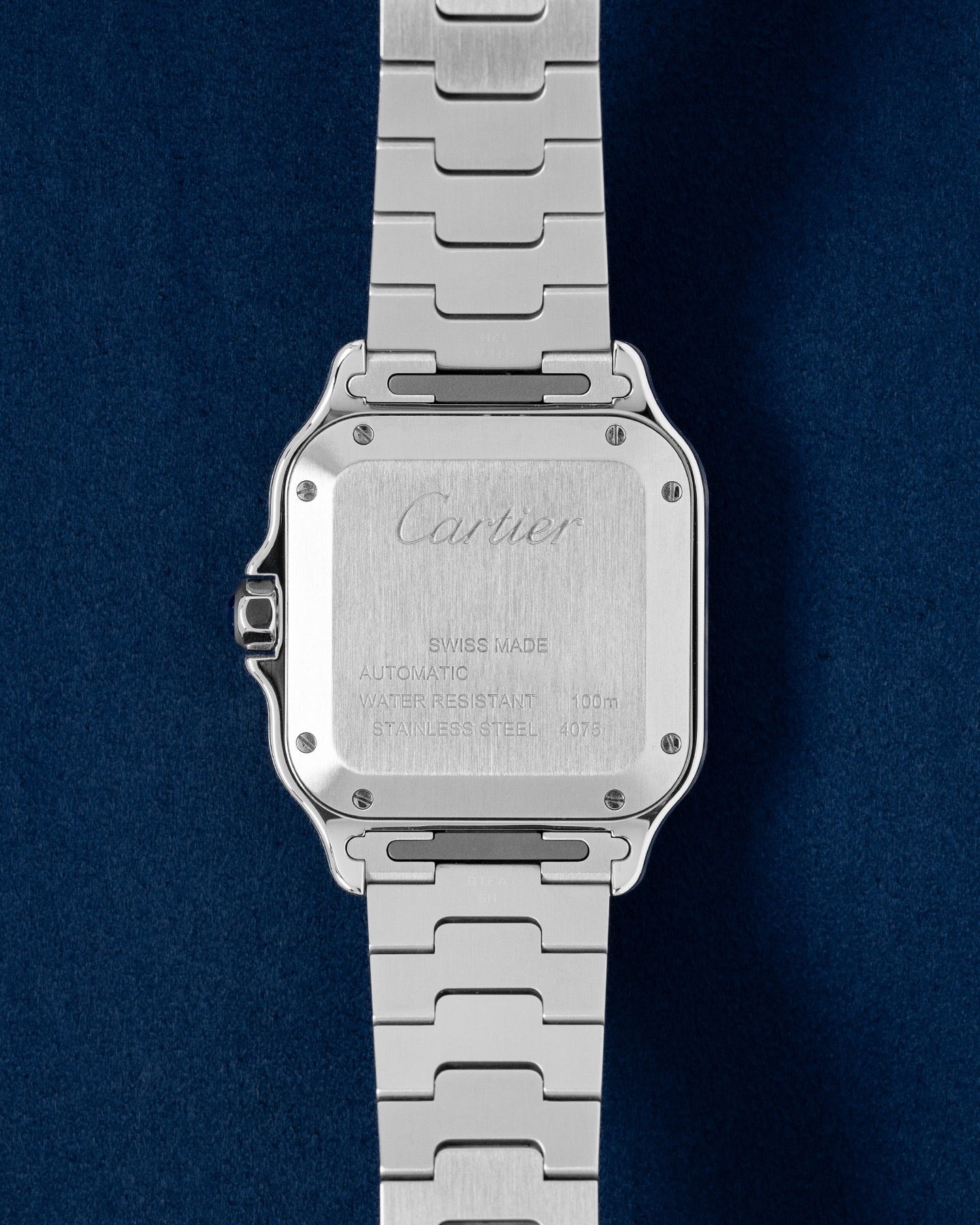
The core of the modern Santos collection is split into two primary sizes. The Medium model measures 35.1 millimeters in width and 41.9 millimeters lug to lug, with a thickness of 8.83 millimeters. The Large model increases the width to 39.8 millimeters and the lug to lug distance to 47.5 millimeters, with a thickness of 9.08 millimeters. The Large models feature a date window at six o'clock, while the Medium models remain time only, preserving the perfect symmetry of the dial. Both sizes are powered by the manufacture caliber 1847 MC, a self winding mechanical movement. The case offers 100 meters of water resistance, firmly positioning these Cartier watches as robust daily wearers that can transition from formal environments to casual settings without compromise.
Santos Dumont
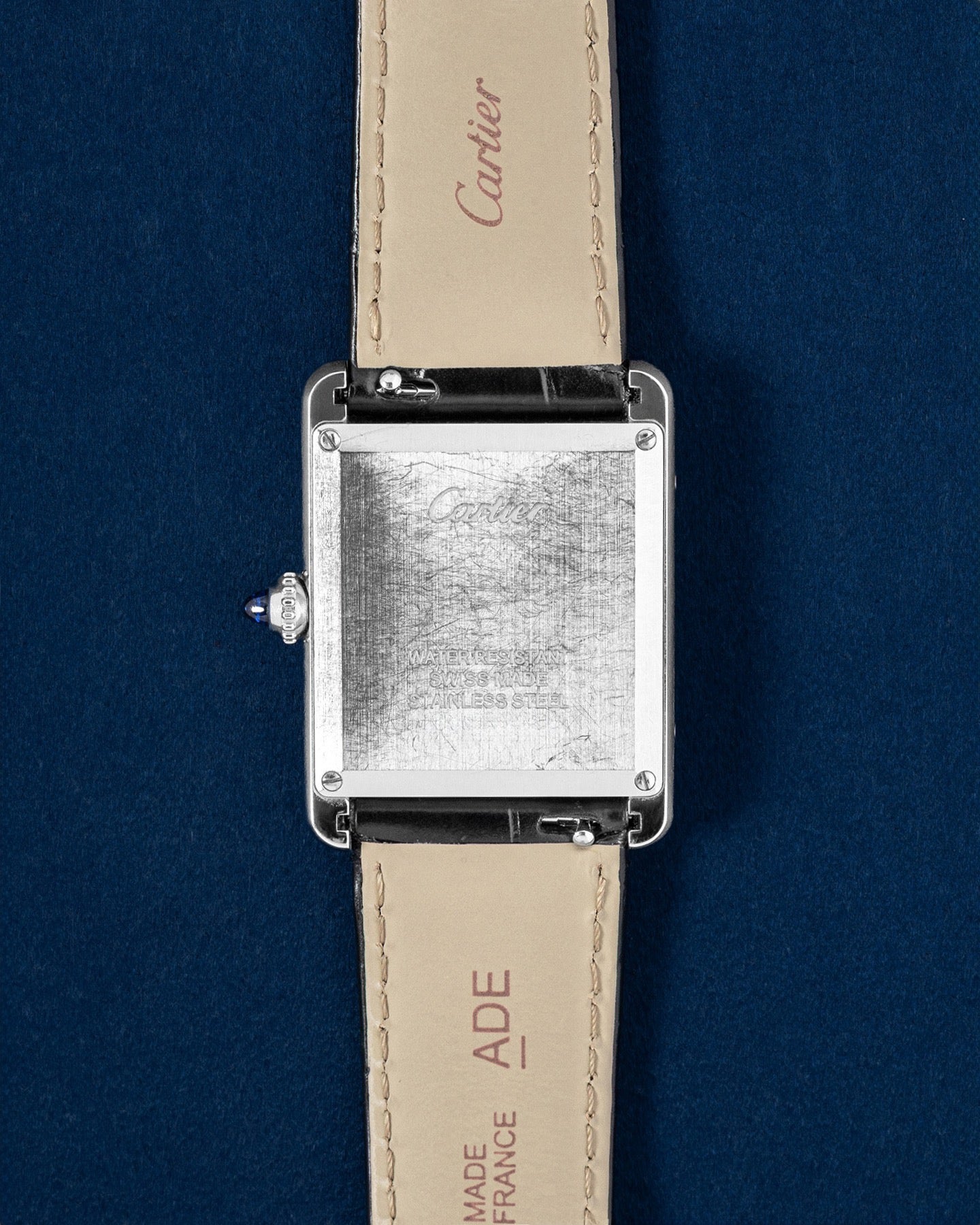
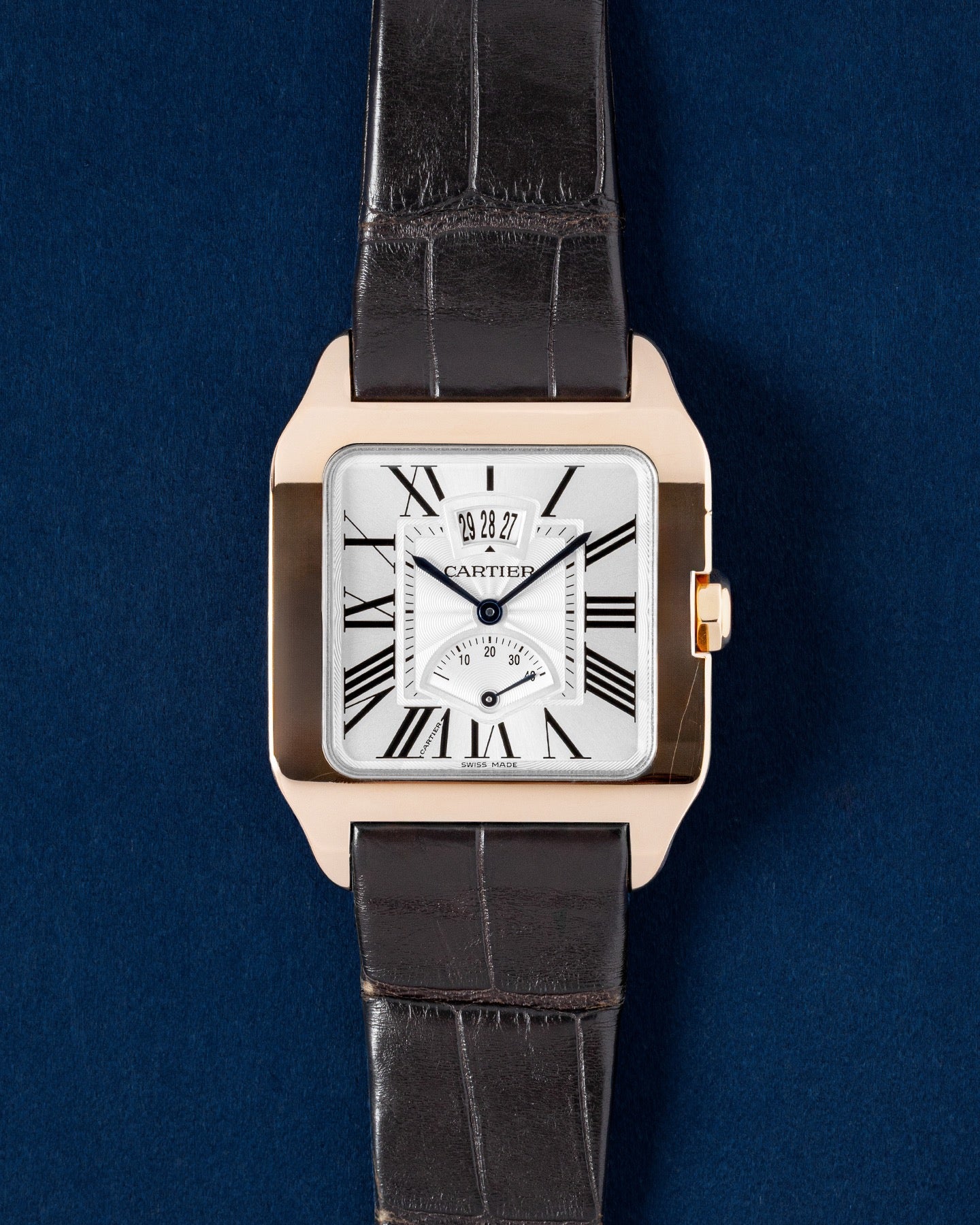
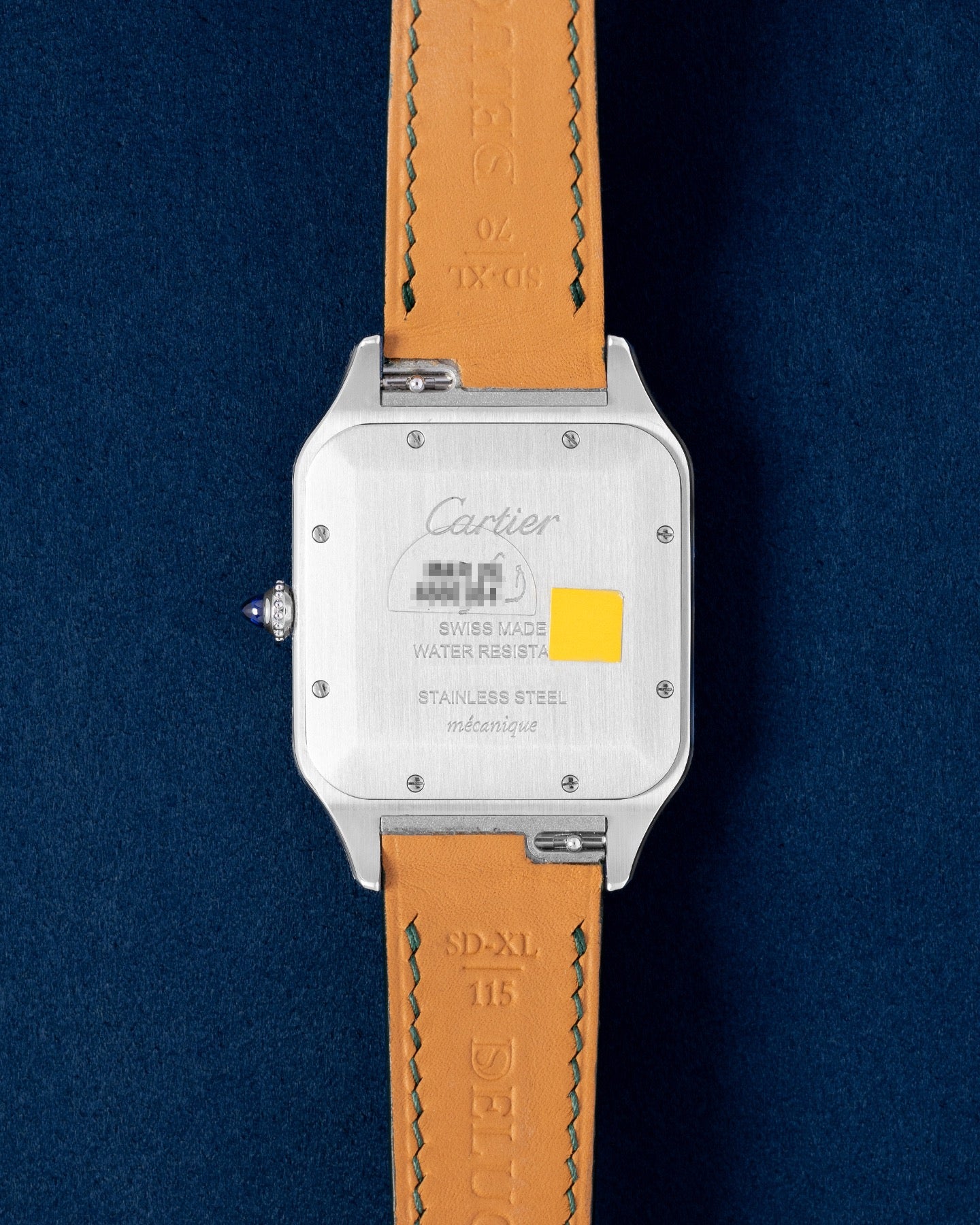
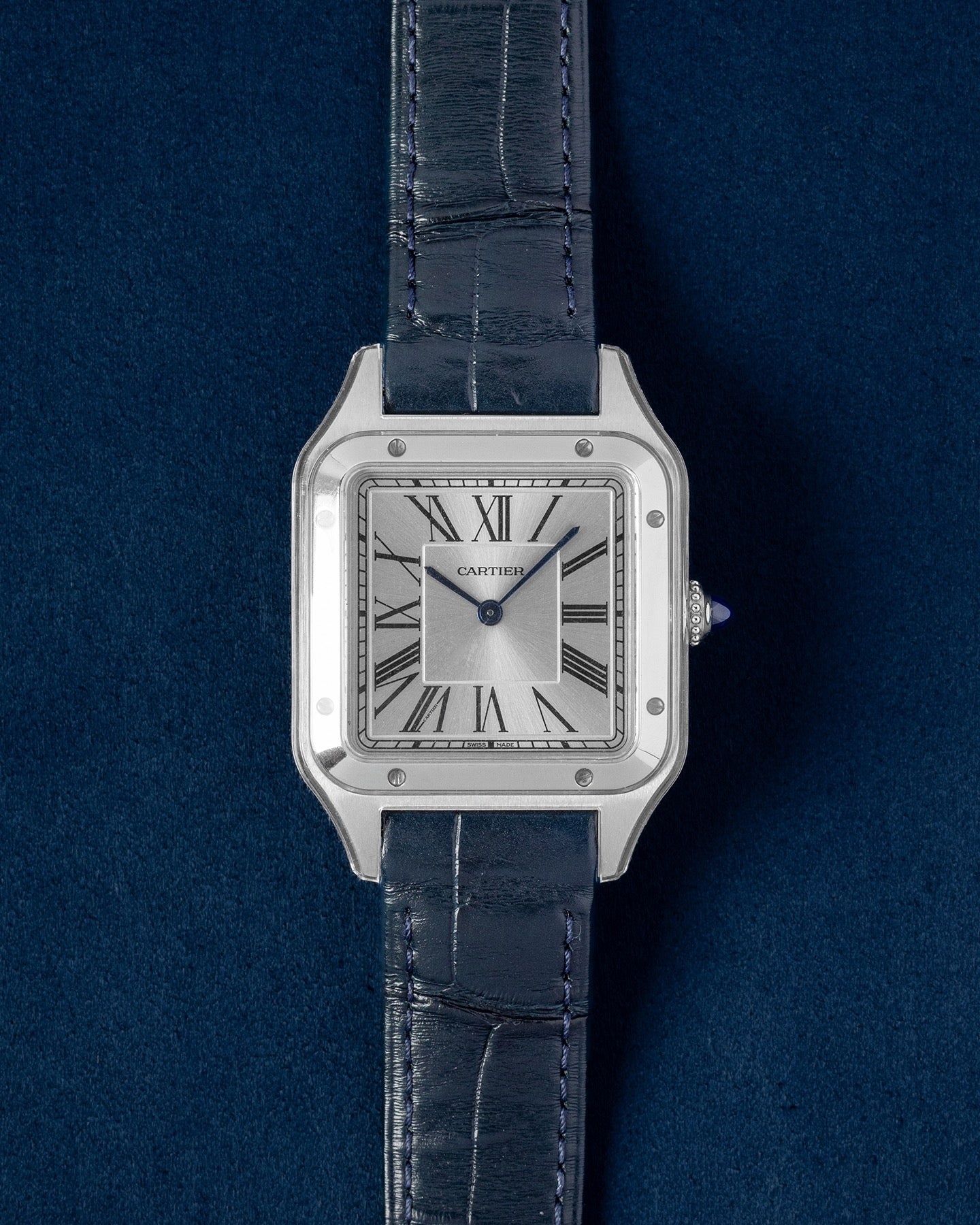
For collectors who prefer the classical elegance of the 1904 original, the Santos Dumont line offers a more refined, dress oriented alternative within the Santos family. The Santos Dumont cases are significantly slimmer, abandoning the integrated bracelet in favor of traditional leather straps and a more pronounced, beaded winding crown topped with a cabochon. Cartier watches in the Dumont line are offered in multiple sizes, including a large model measuring 43.5 millimeters by 31.4 millimeters and an extra large model measuring 46.6 millimeters by 33.9 millimeters. The line utilizes both high autonomy quartz movements and the ultra thin manual winding caliber 430 MC, which is based on the Piaget 430P.
Santos Chronograph and Skeleton
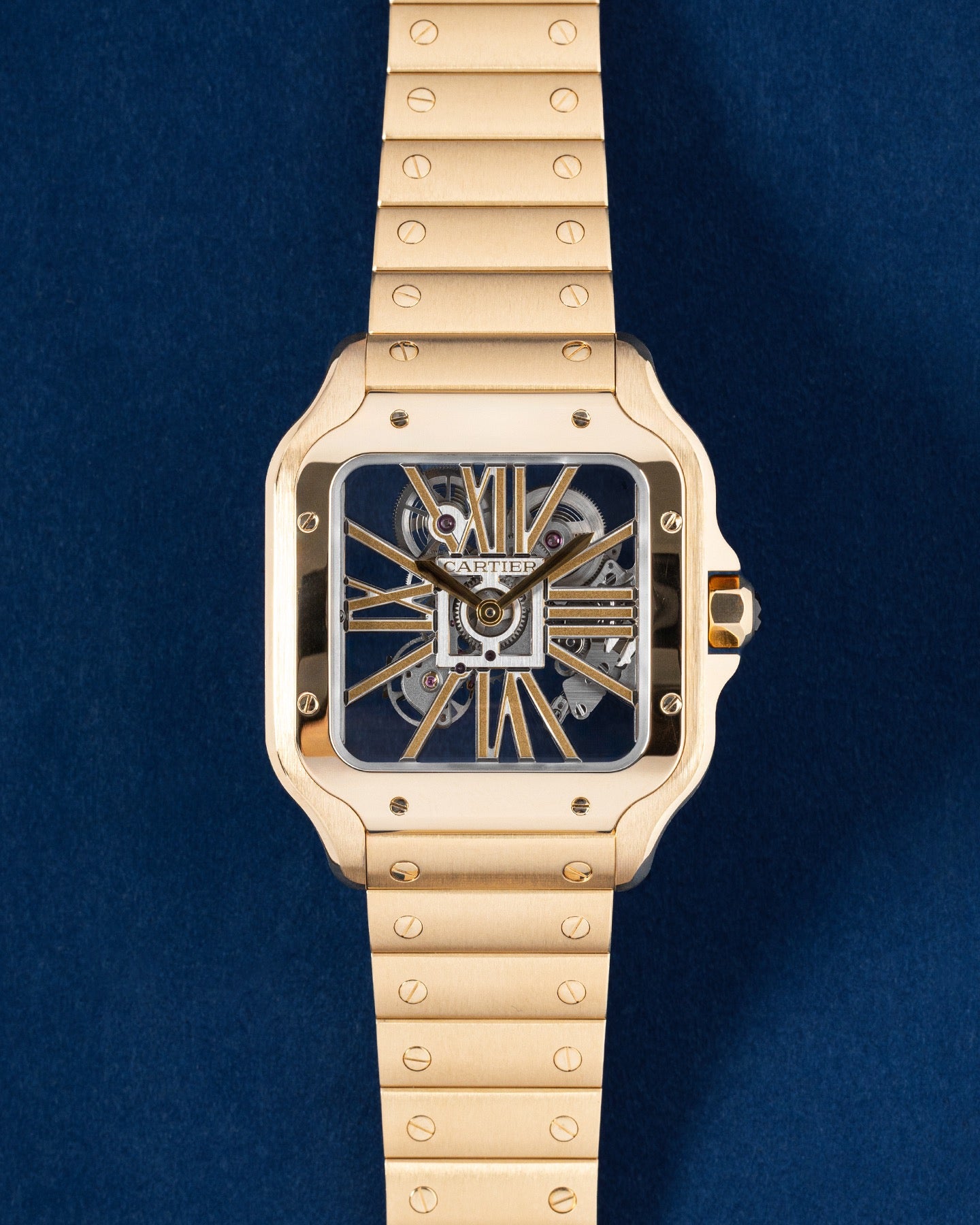
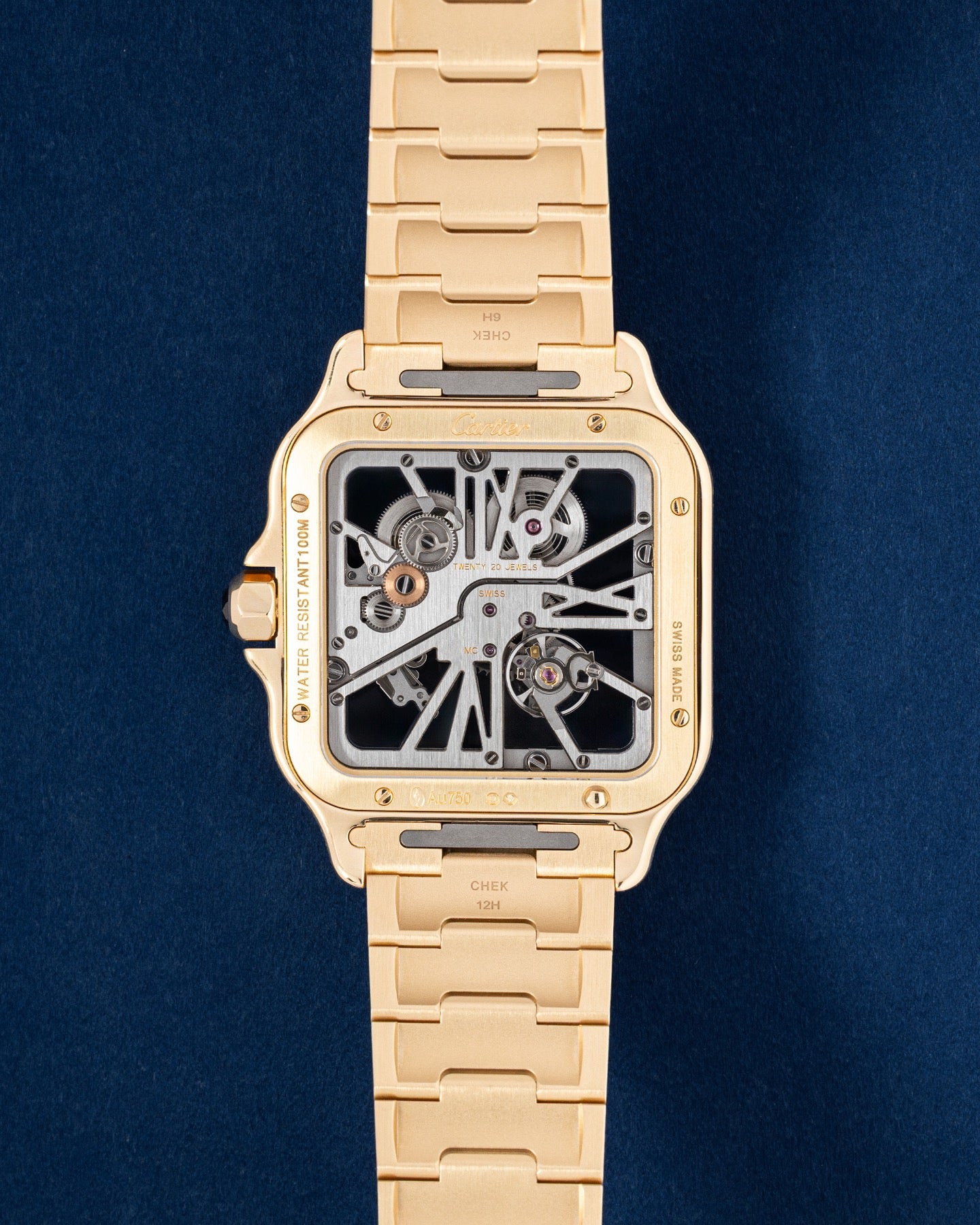
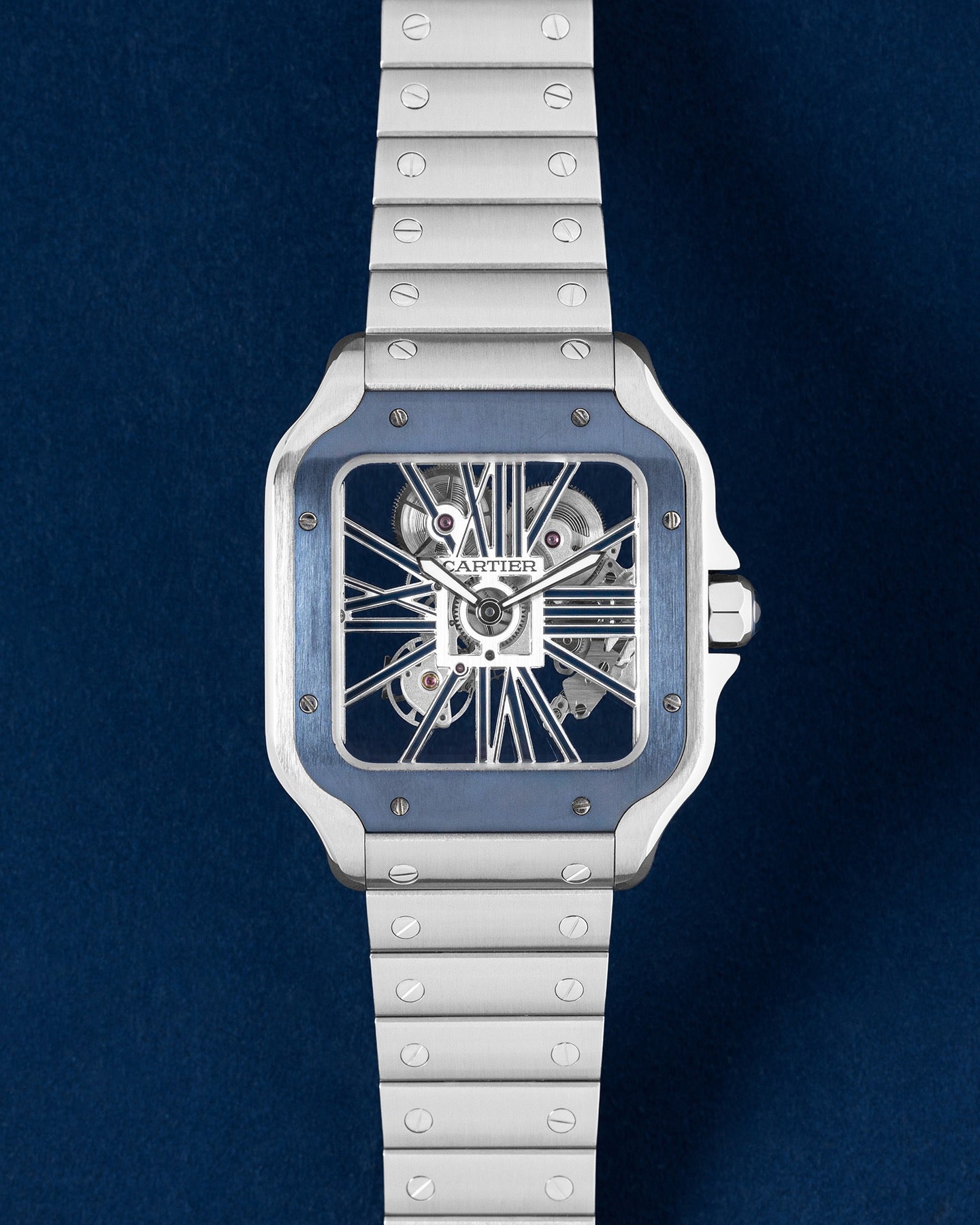
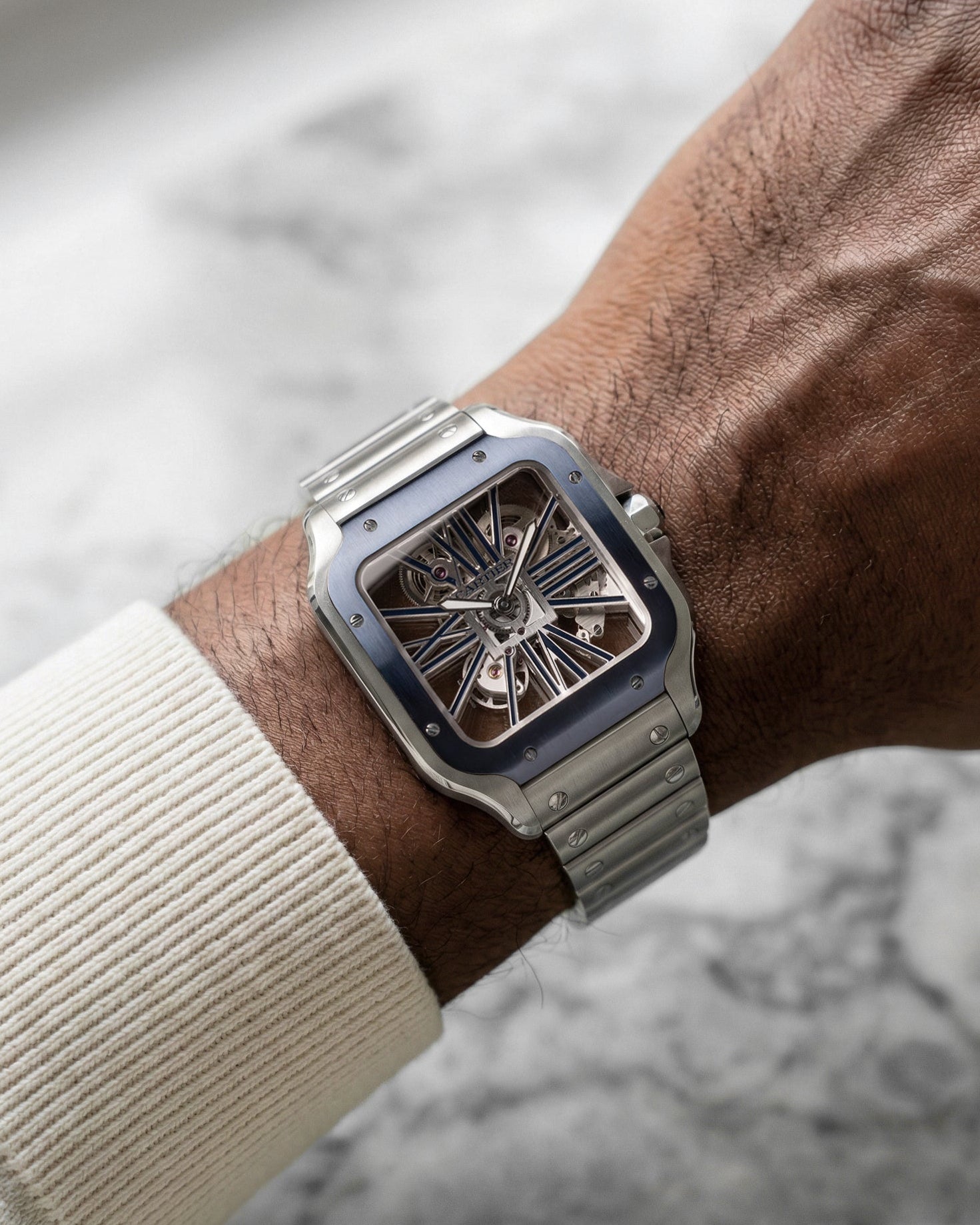
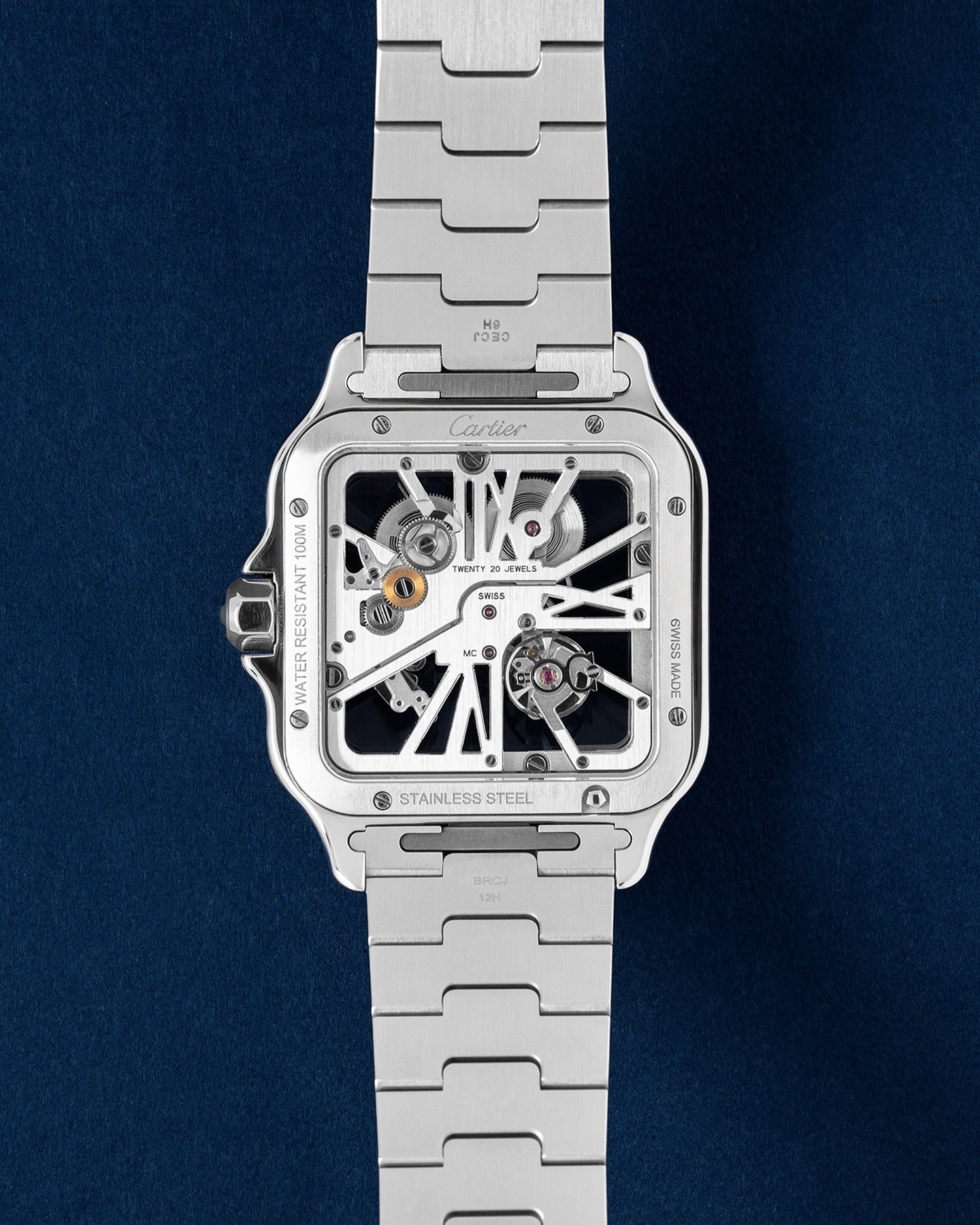
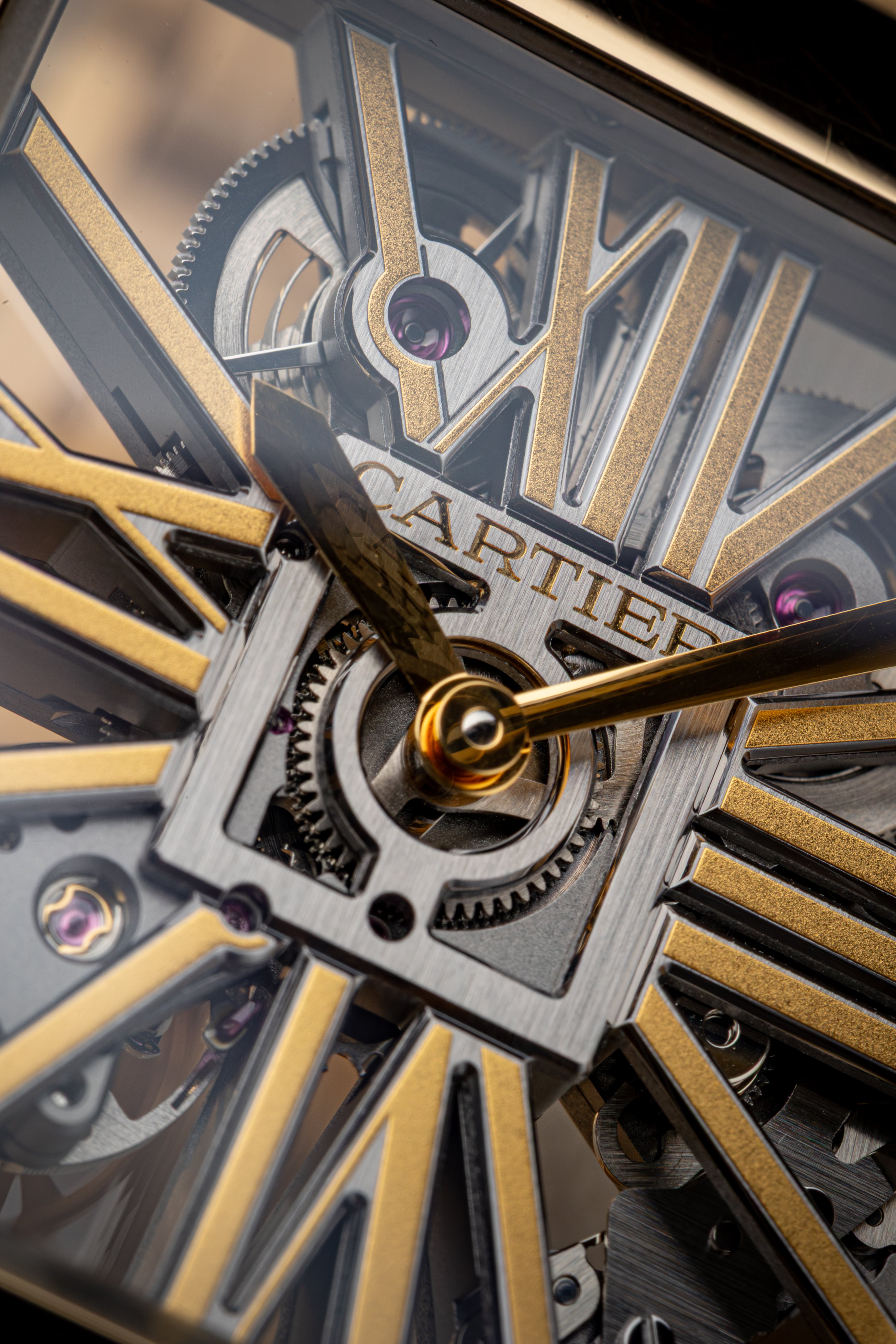
The Santos collection also serves as a platform for more complex Cartier watches. The Santos Chronograph XL shifts the traditional chronograph layout by moving the start and stop pusher to the nine o'clock side of the case, while the reset function is integrated directly into the winding crown. This preserves the balanced silhouette of the Santos case. It is powered by the caliber 1904 CH MC. The Santos Skeleton models push the design language into high horology, utilizing the caliber 9611 MC where the movement baseplate and bridges are machined into the shape of the Cartier Roman numerals, serving simultaneously as the structural foundation of the movement and the dial display itself.
The Cartier Tank Family
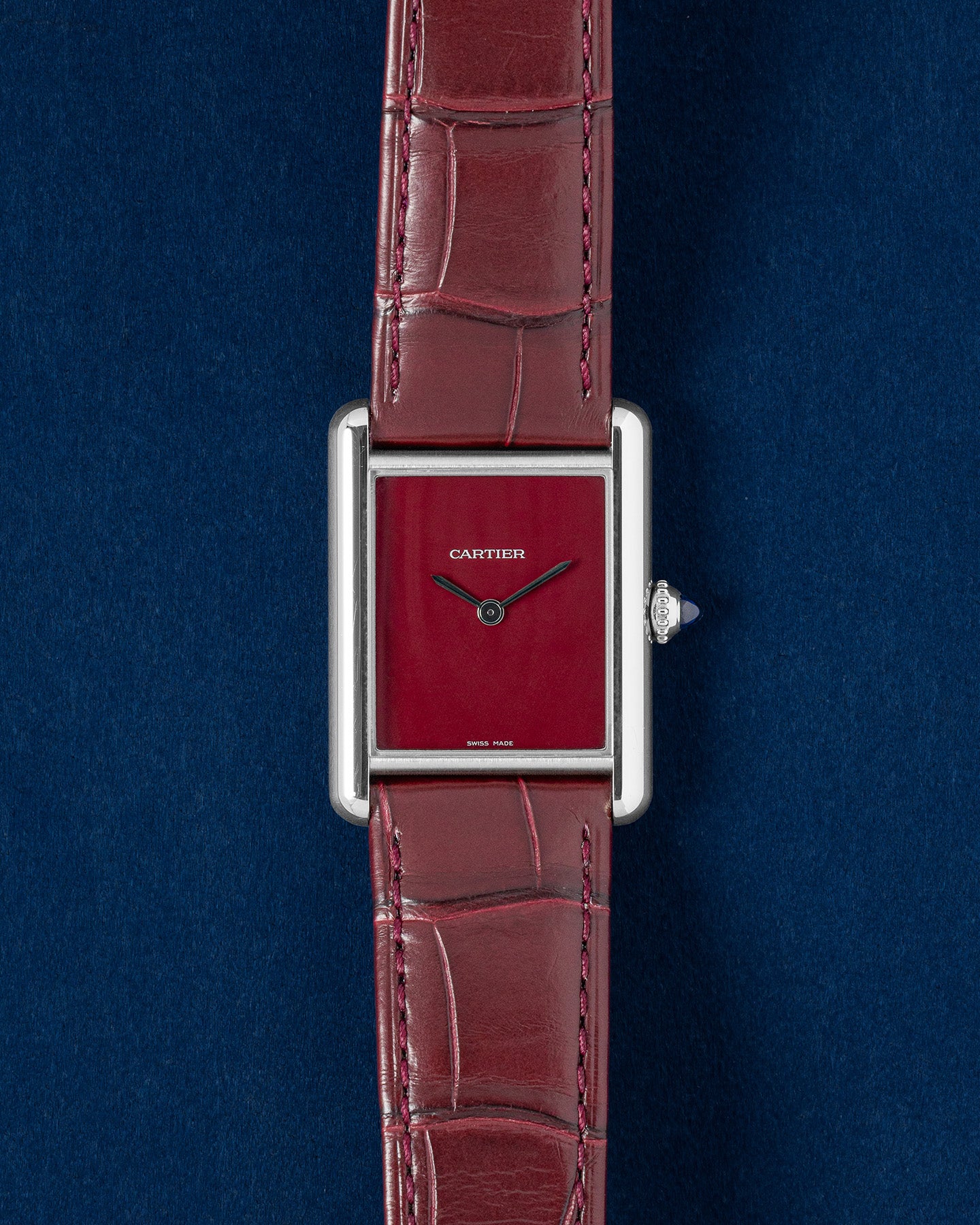
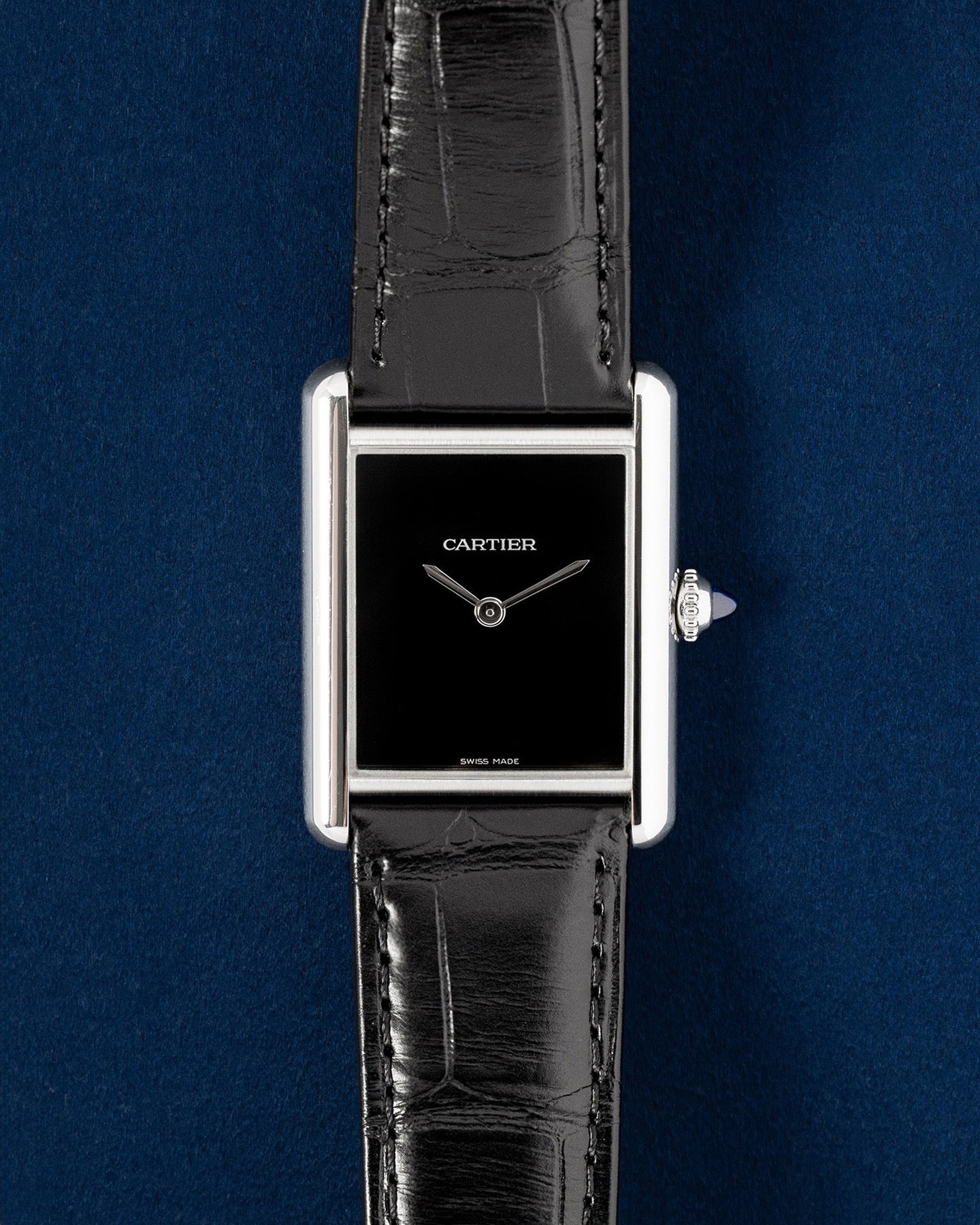
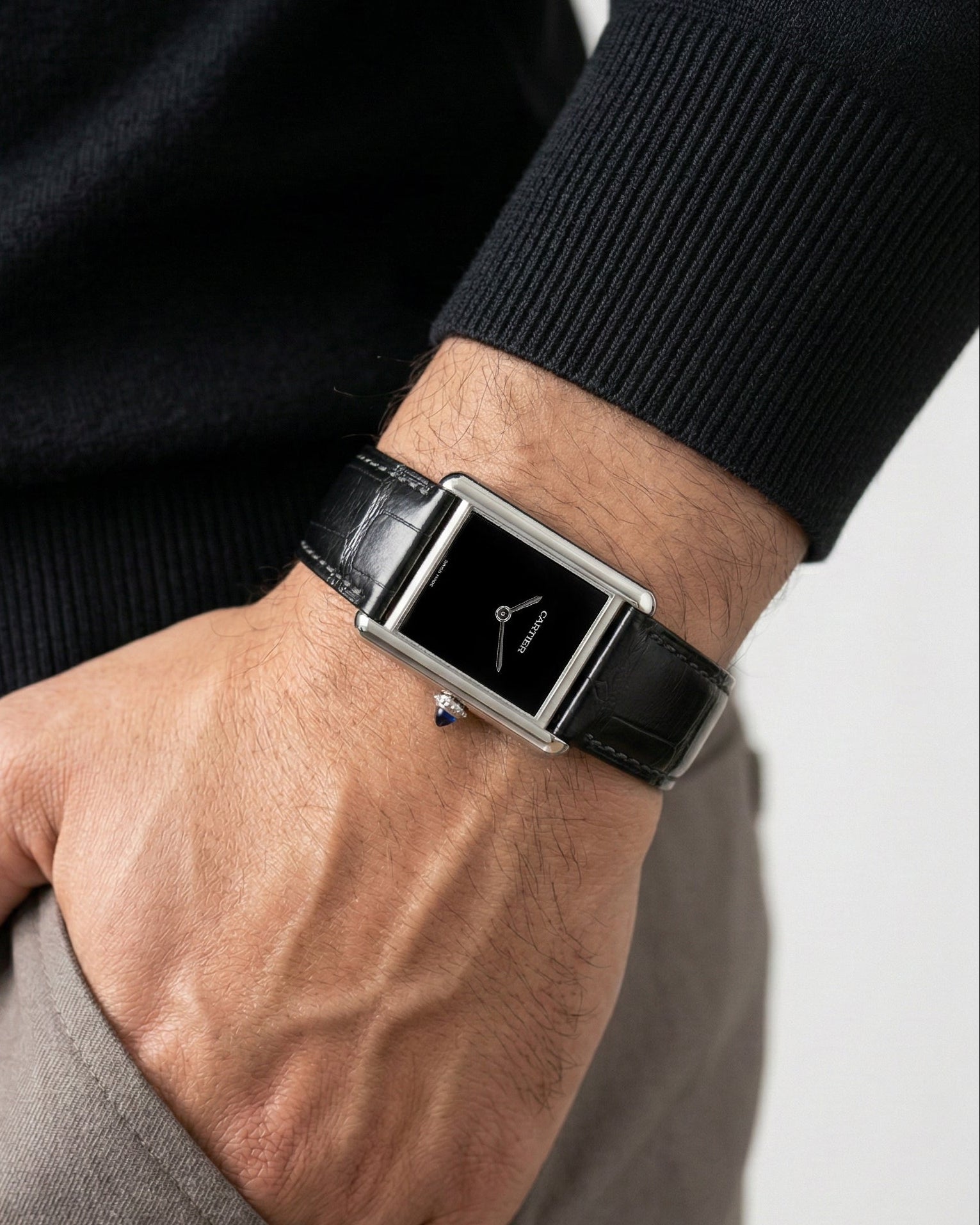
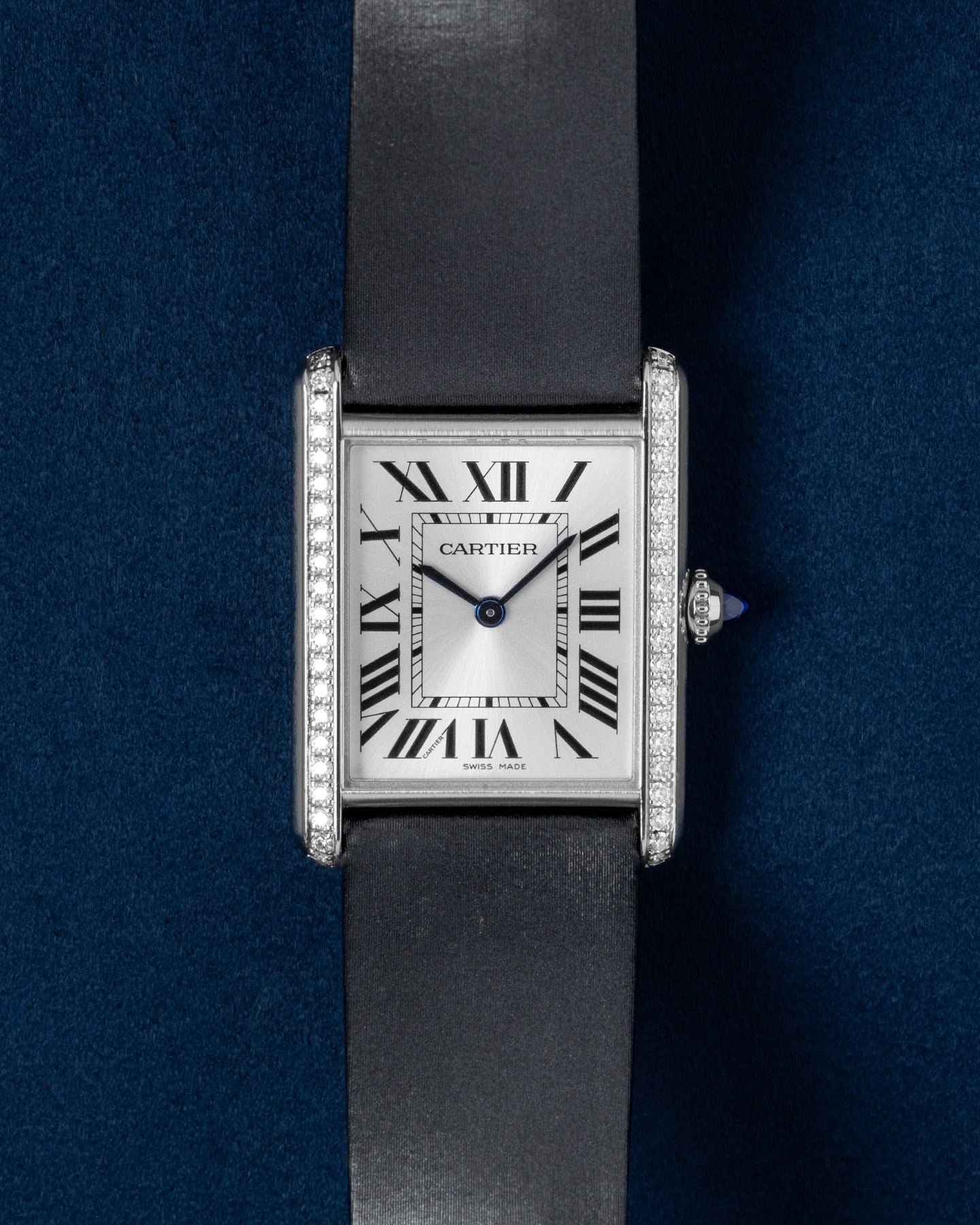
If the Santos is the pioneer, the Tank is the definitive icon among Cartier watches. Designed by Louis Cartier in 1917, the Tank was inspired by the top down view of the Renault FT 17 tanks used on the Western Front during the First World War. The genius of the Tank design lies in the brancards, the parallel vertical bars that serve as both the sides of the case and the lugs, integrating the strap seamlessly into the lines of the watch. General John J Pershing received one of the first prototypes in 1918, and commercial production began in 1919. Over the past century, the Tank has graced the wrists of Muhammad Ali, Andy Warhol, Princess Diana, and Jacqueline Kennedy Onassis, becoming a cultural artifact that transcends traditional watch collecting. The Tank proves that a single, powerful geometric concept can be stretched, curved, and reimagined dozens of times without losing its essential identity.
Tank Louis Cartier
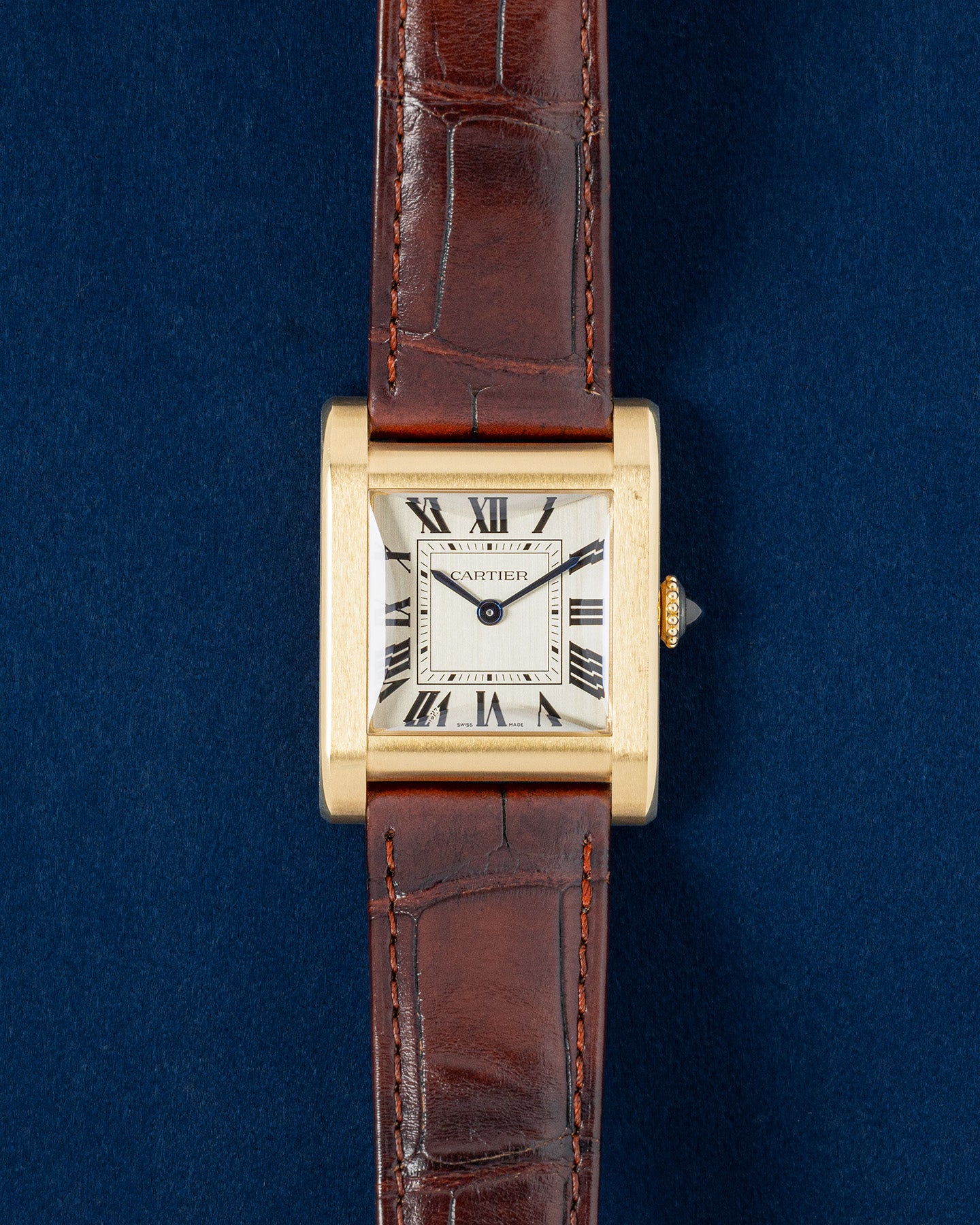
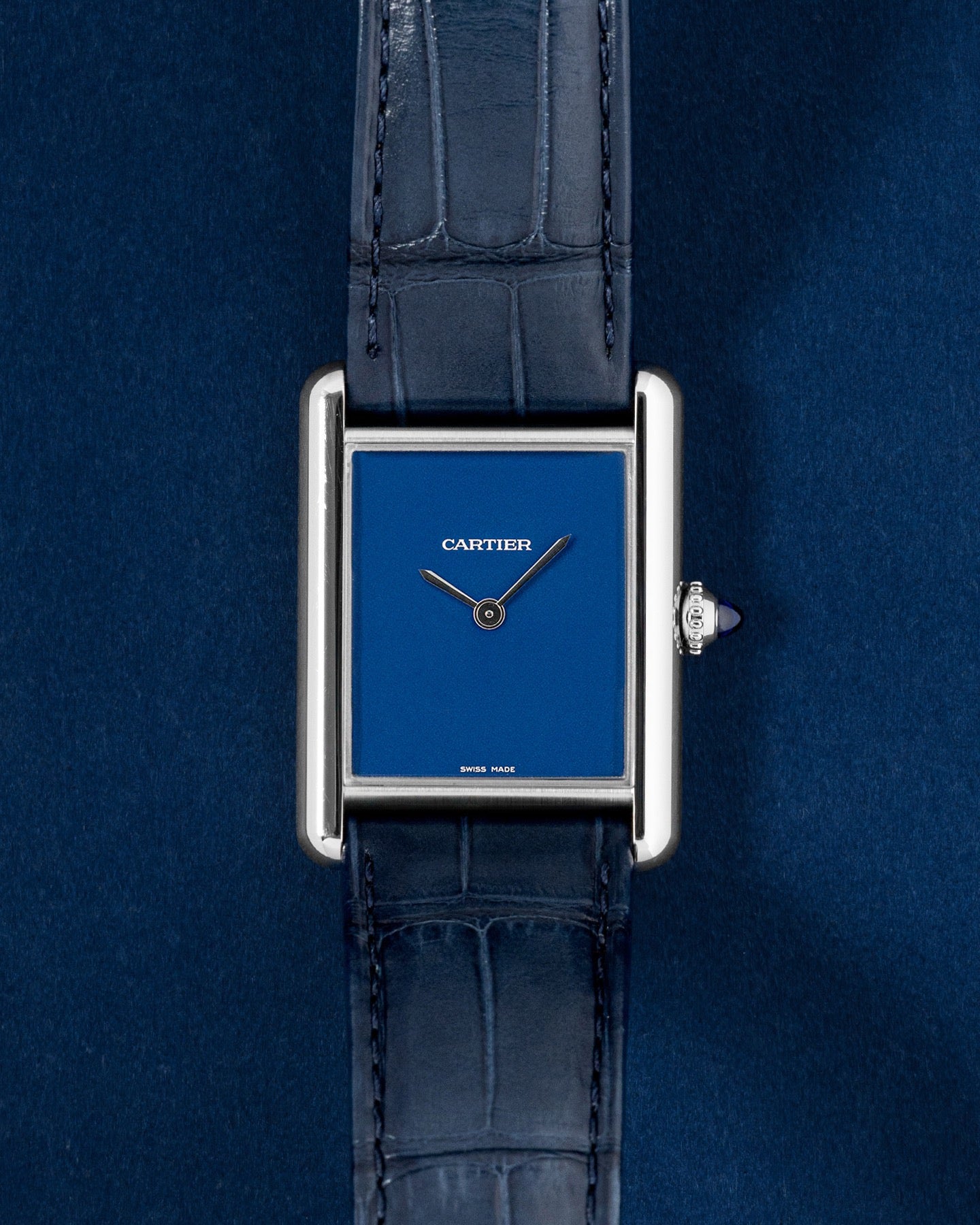
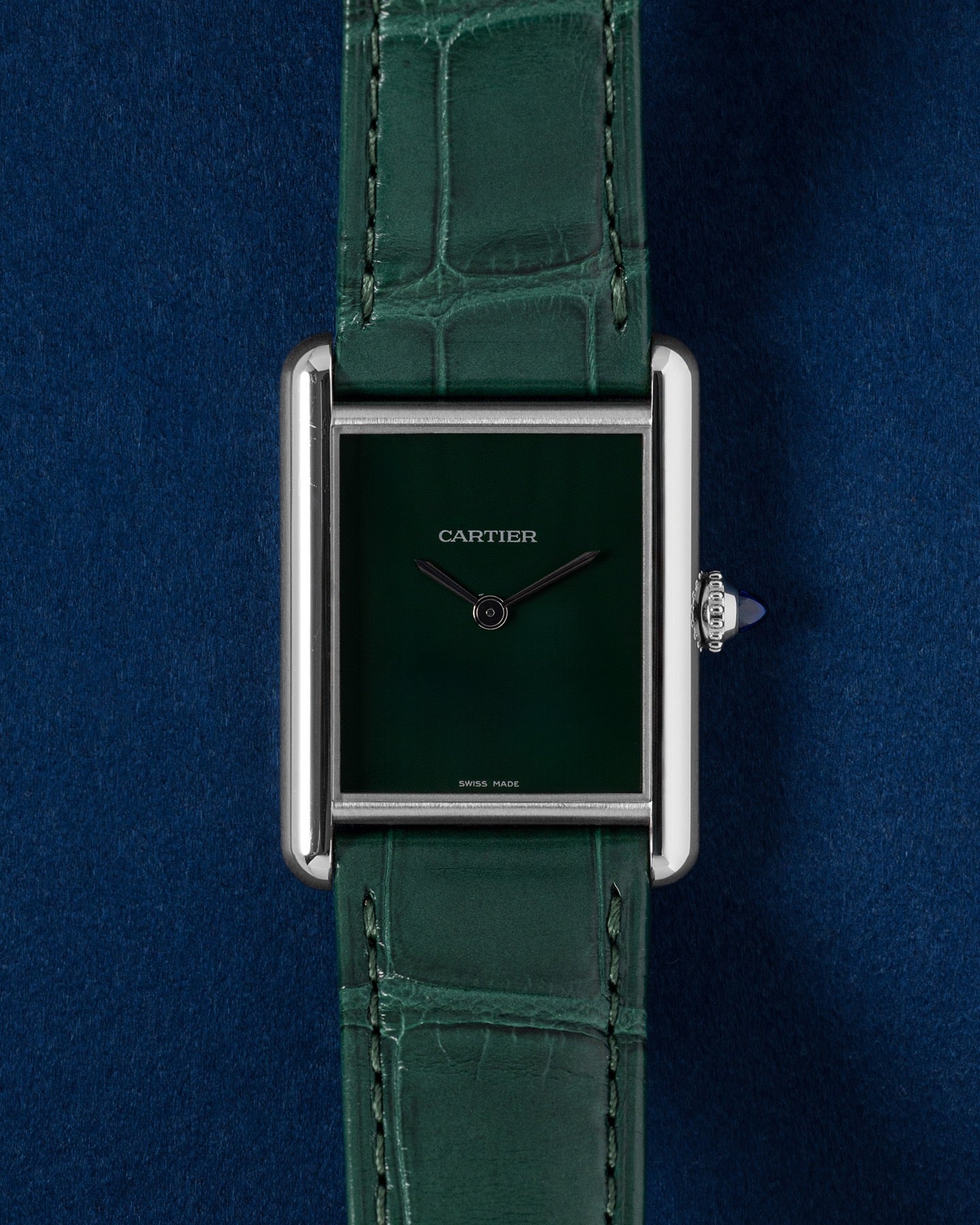
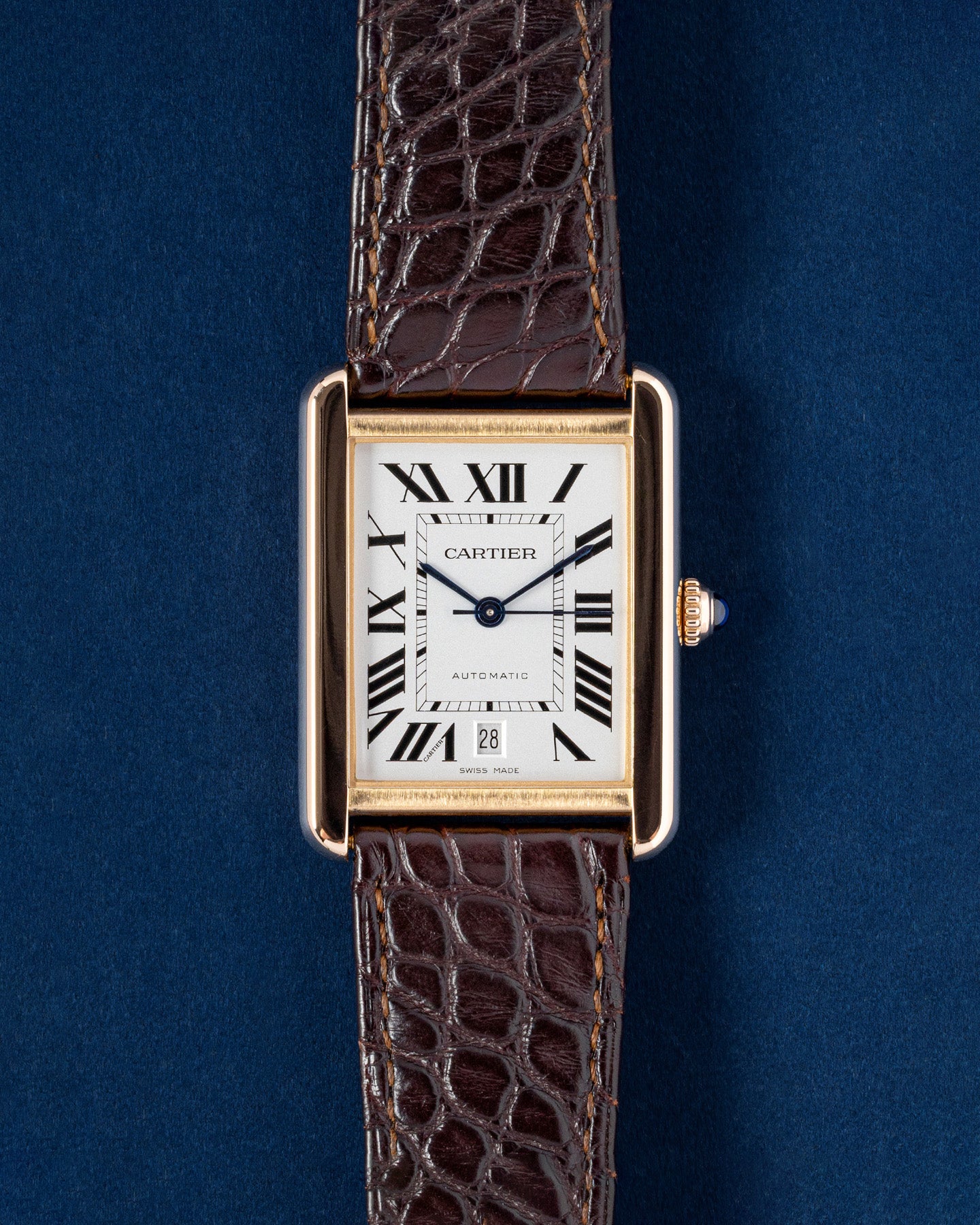
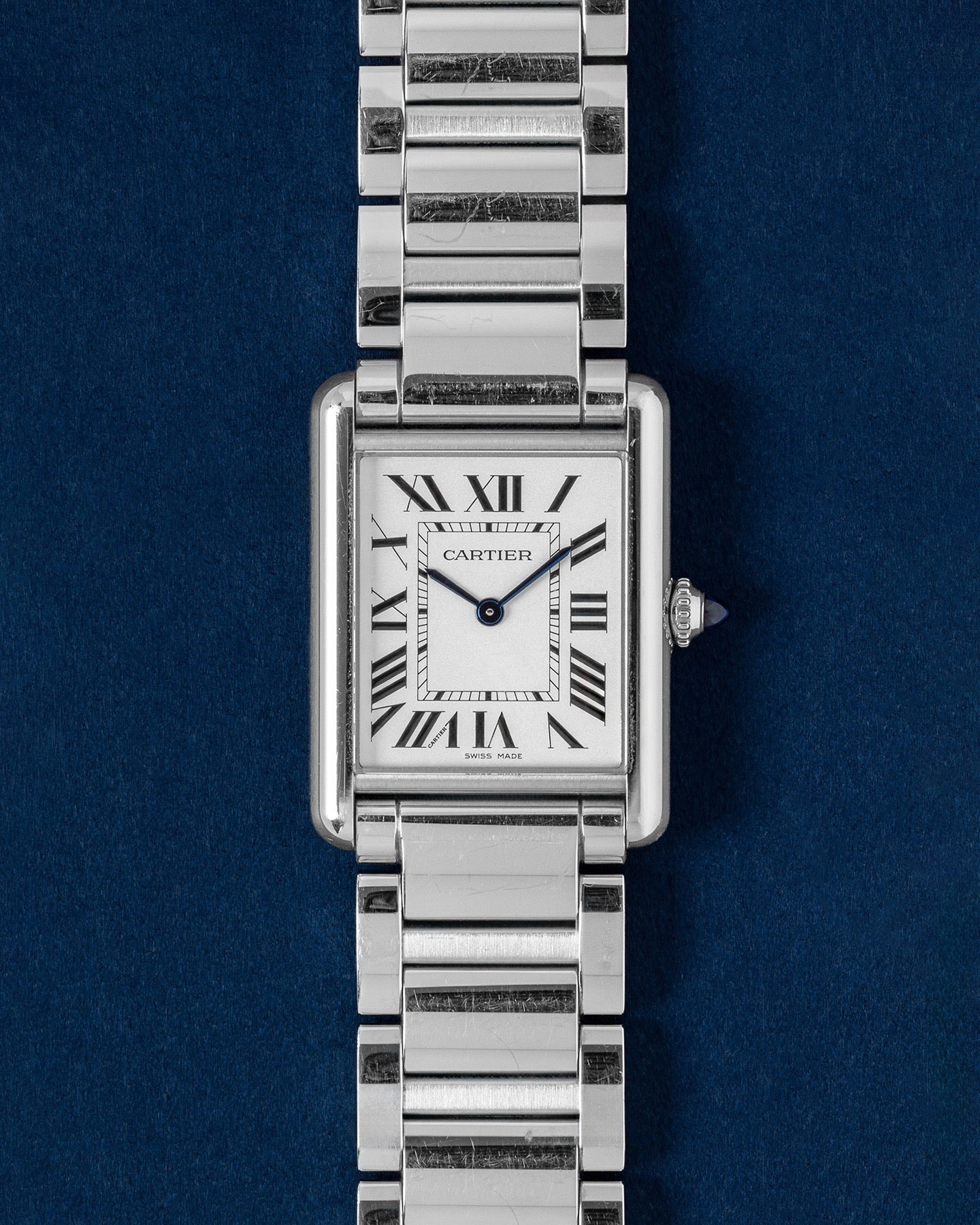
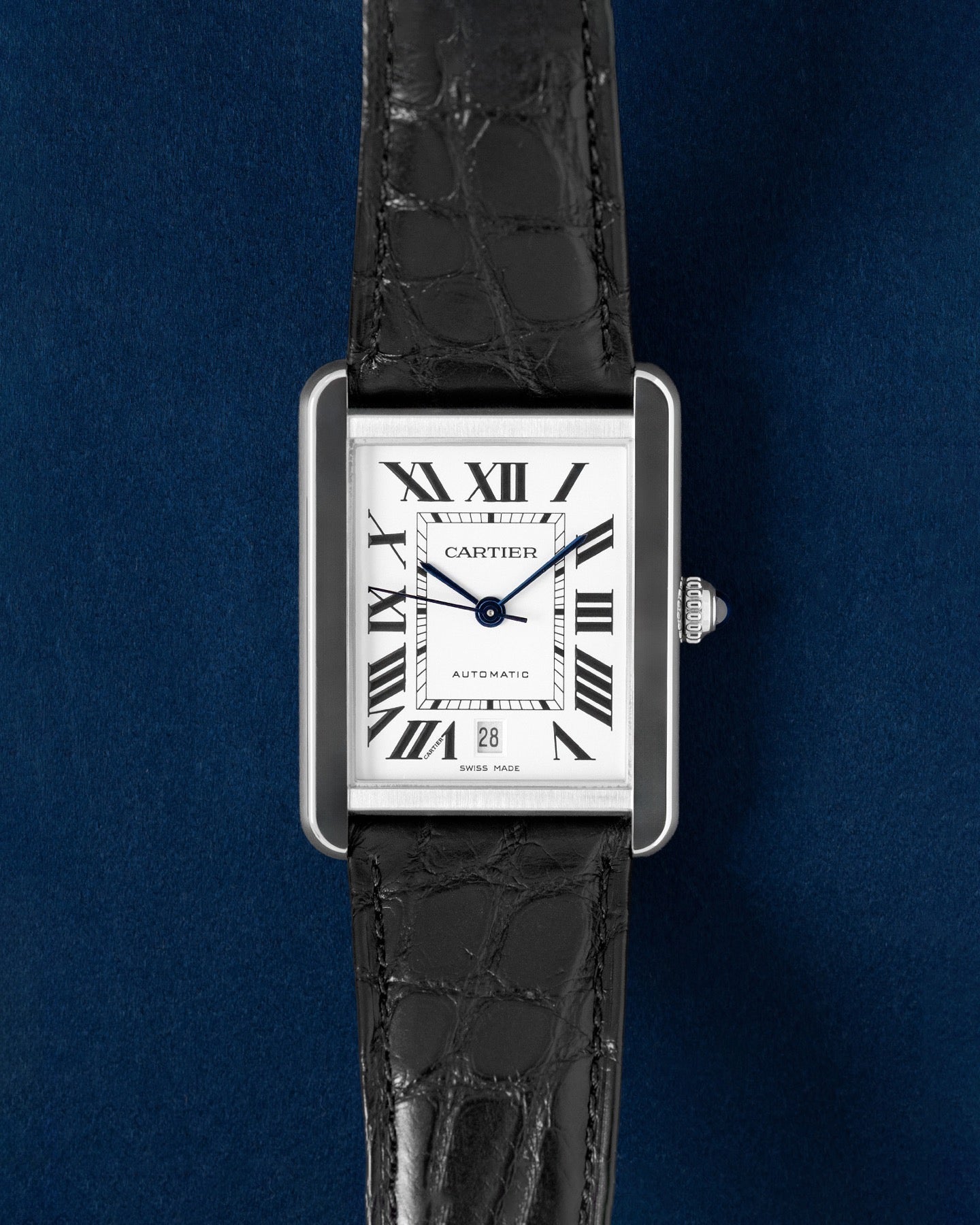
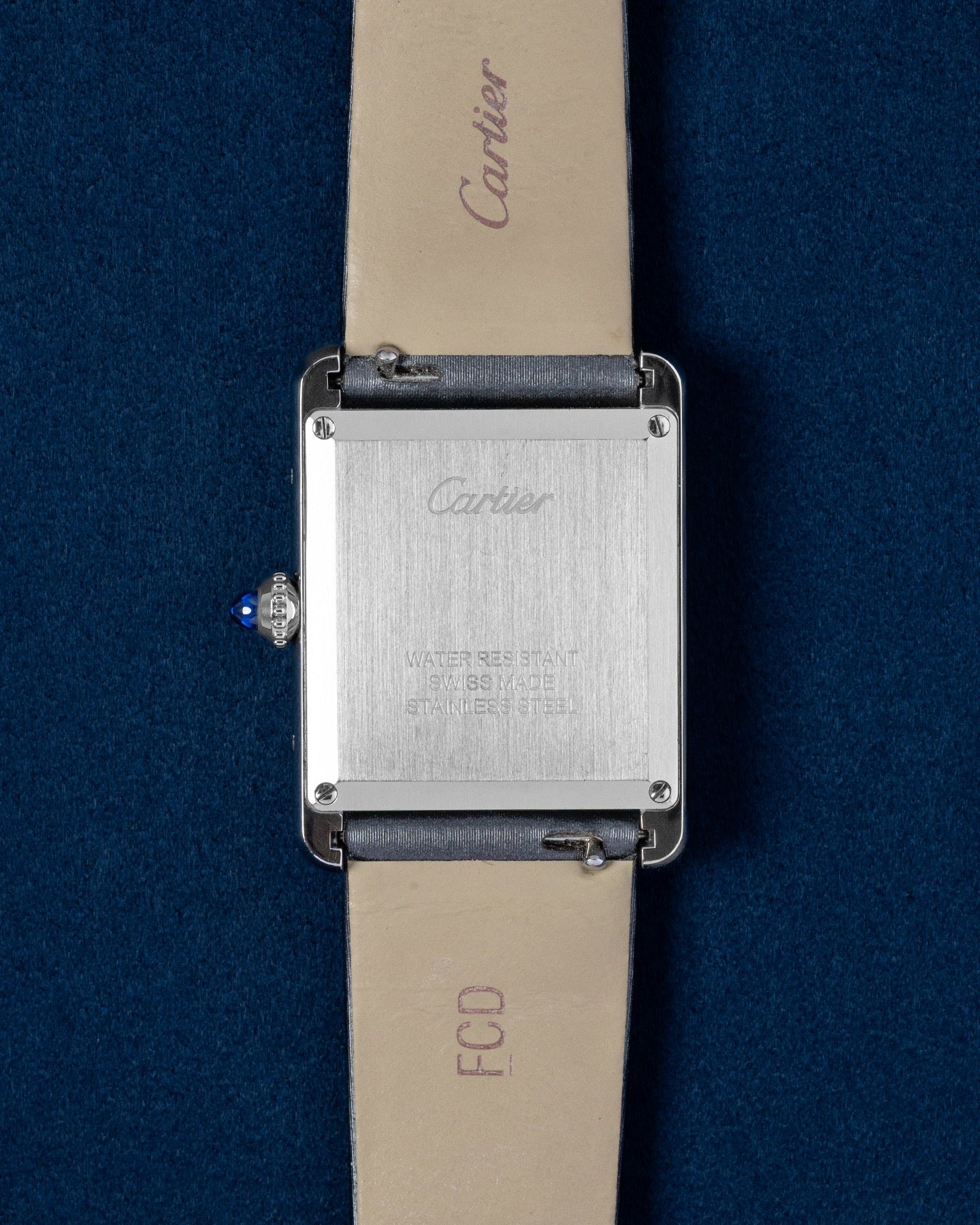
The Tank Louis Cartier, introduced in 1922, softened the sharp, aggressive edges of the original Tank Normale. Its brancards feature rounded edges, and the proportions are slightly elongated, establishing the classical dress watch profile that most people imagine when they think of Cartier watches. Historically produced almost exclusively in precious metals like yellow gold, rose gold, and platinum, the Tank Louis Cartier represents the absolute purist expression of the brand's aesthetic. Modern iterations are typically powered by the manual winding caliber 1917 MC or the 430 MC, keeping the case profile exceptionally slim and adhering to the strict dress watch codes that Louis Cartier championed.
Tank Americaine
Introduced in 1989, the Tank Americaine draws its inspiration from the vintage Tank Cintree of the 1920s. The Americaine features an elongated, rectangular case with a pronounced curve that allows the watch to hug the wrist perfectly. The brancards are thicker and more substantial than the Tank Louis Cartier, giving the watch a more imposing presence despite its elegant lines. Available in steel and precious metals, the Tank Americaine accommodates both self winding mechanical calibers and quartz movements. It serves as the ideal choice for collectors who want the formal presence of a Tank but require a larger footprint to suit modern wearing preferences.
Tank Francaise
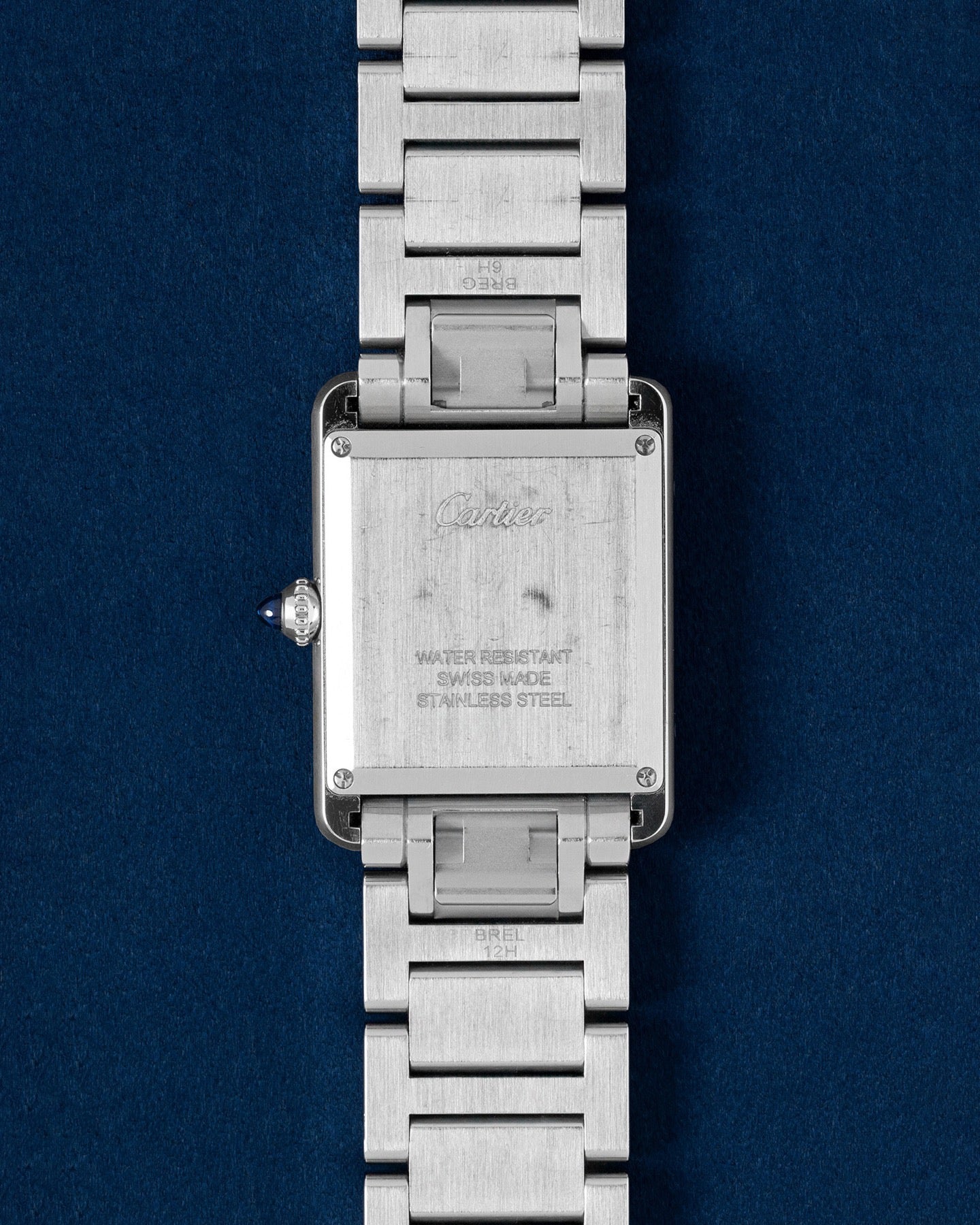
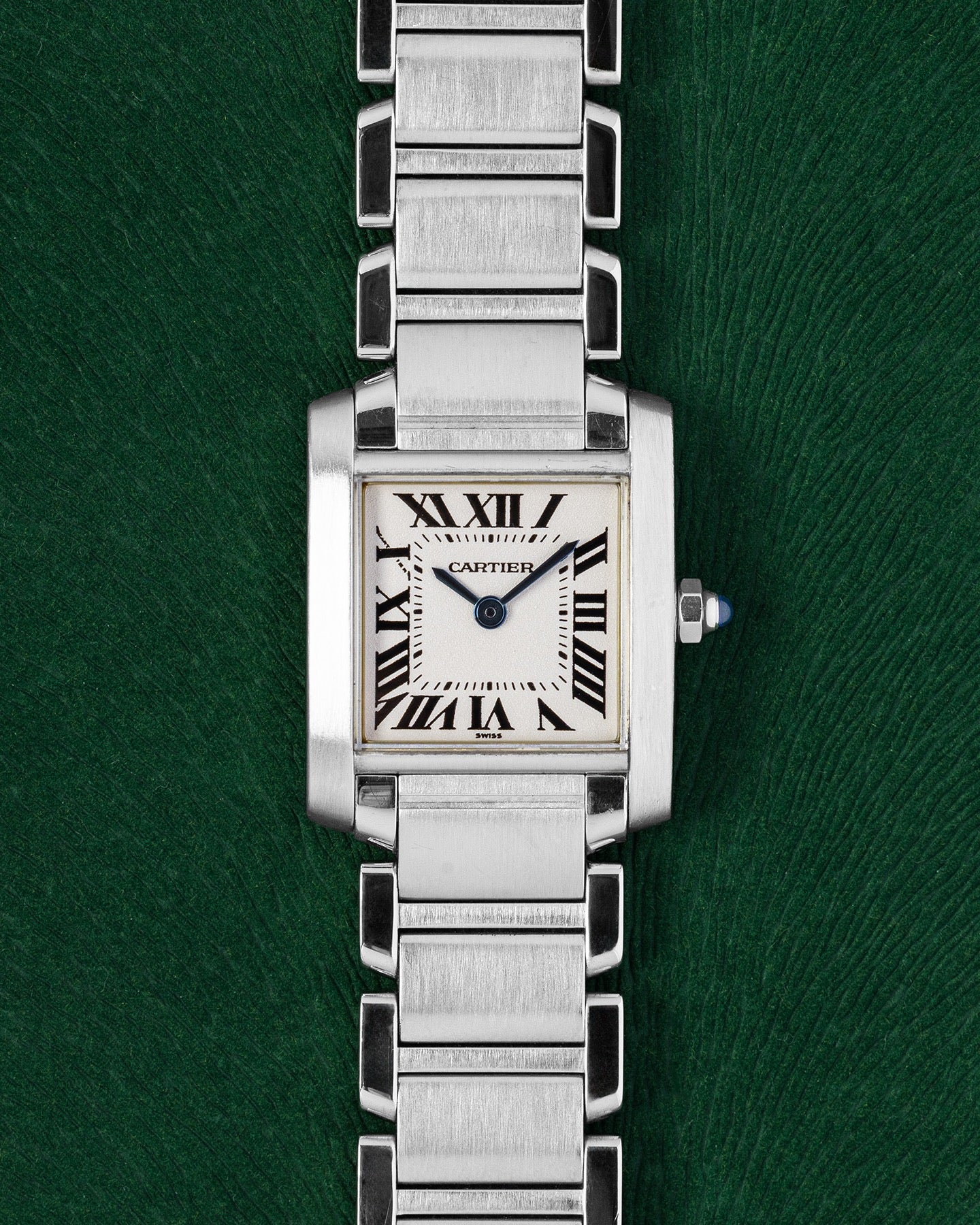
The Tank Francaise revolutionized the collection when it launched in 1996 by integrating a metal bracelet directly into the geometry of the Tank case. The brancards of the Francaise are angled and beveled to flow directly into the chain link bracelet, creating a piece that reads as a continuous band of metal rather than a watch head attached to a strap. The design is sharper, more industrial, and heavily influenced by French architecture. Cartier updated the Tank Francaise in 2023, refining the integration of the crown into the brancard and updating the bracelet links for a more ergonomic fit. The Francaise remains one of the highest volume sellers among Cartier watches, particularly in the quartz driven smaller sizes.
Tank Must and SolarBeat
The Tank Must traces its lineage to the Les Must de Cartier line launched in 1977, which saved the brand during the quartz crisis by offering affordable vermeil cases, gold plated over sterling silver, and reliable quartz movements. In 2021, Cartier watches revived the Tank Must nameplate to replace the Tank Solo as the entry point into the brand. The new Tank Must features stainless steel cases that closely mimic the rounded brancards of the Tank Louis Cartier. Alongside traditional quartz and automatic options, Cartier introduced the SolarBeat movement in the Tank Must, a photovoltaic caliber that charges through microscopic perforations in the Roman numerals on the dial. The SolarBeat boasts a sixteen year lifespan before requiring service, representing a rare intersection of classic Parisian design and cutting edge sustainable engineering.
The Pasha de Cartier
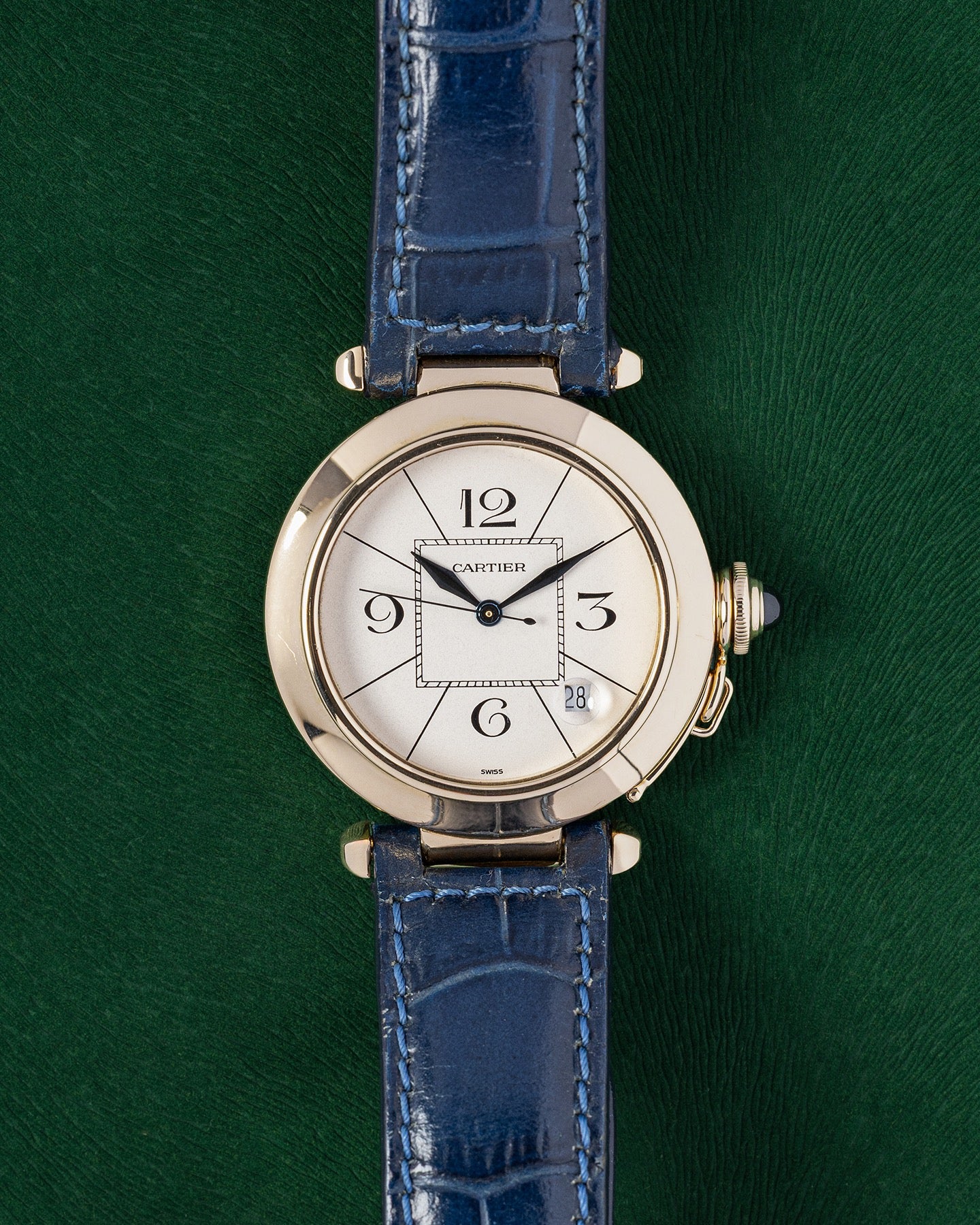
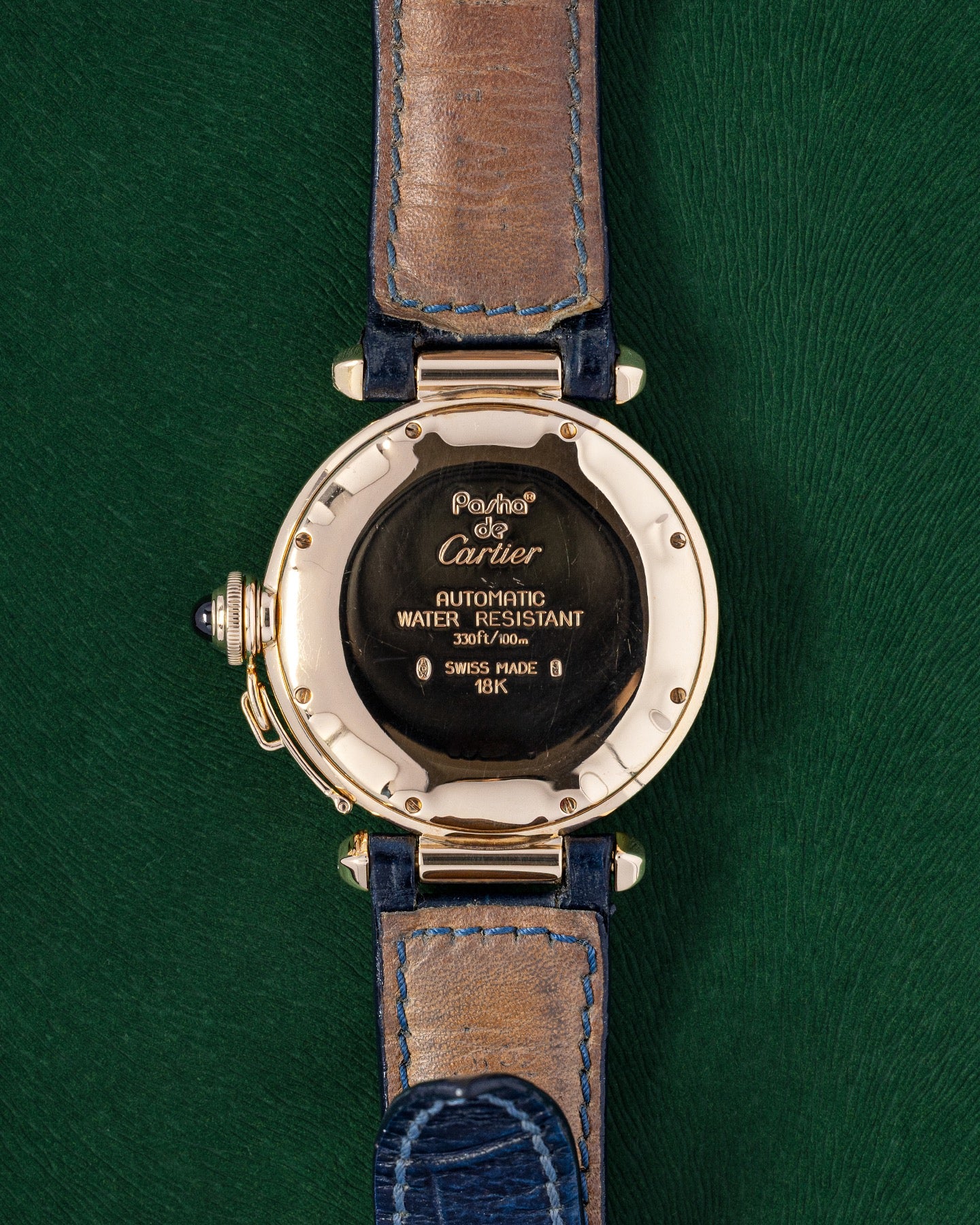
The Pasha de Cartier occupies a distinctly different design space than the rectangular and square models that dominate the brand's history. Officially launched in 1985 with significant design input from the legendary Gerald Genta, the Pasha was Cartier's answer to the luxury sports watch boom. The design is anchored by a perfectly round case, Vendome style lugs with prominent central bars, a unidirectional rotating bezel, and a massive screw down crown cap attached to the case by a small safety chain. The dial features a square minute track sitting inside the circular case, paired with four oversized Arabic numerals at the quarter hours. The Pasha was designed to be genuinely water resistant, a notable departure for Cartier watches at the time, and it quickly became a massive commercial success in the 1980s and 1990s.
Pasha Time Only
Cartier watches completely relaunched the Pasha collection in 2020, modernizing the proportions and upgrading the mechanics while retaining the iconic crown cap and chain. The current production time only Pasha models are offered primarily in 35 millimeter and 41 millimeter sizes, accommodating both men and women. The modern updates include a hidden personalization area under the crown cap where owners can engrave initials, as well as the implementation of the QuickSwitch strap system and SmartLink bracelet adjustment. Powered by the in house caliber 1847 MC, the new Pasha provides a round, sporty alternative for buyers who want Cartier design language without committing to the sharp corners of a Tank or Santos.
Pasha Chronograph
The 41 millimeter Pasha Chronograph expands the capability of the line by integrating two stylized pushers into the case side, flanking the signature chained crown cap. The chronograph retains the rotating bezel, giving it a more aggressive, tool oriented appearance than almost any other model in the current Cartier watches catalogue. It utilizes the caliber 1904 CH MC movement with a column wheel and vertical clutch mechanism, ensuring precise tactile feedback when starting and stopping the chronograph seconds hand. The Pasha Chronograph demonstrates Cartier's ability to seamlessly integrate high performance complications into a heavily stylized, design first case architecture.
The Panthere and Ballon Bleu Collections
While the Tank and Santos dominate horological discussions, the commercial power of Cartier watches in the modern era relies heavily on the Panthere and the Ballon Bleu. These two collections represent the brand's unmatched ability to bridge the gap between fine jewelry and daily wear timekeeping. They appeal massively to a demographic that values aesthetic presence and flawless finishing over movement architecture, though both lines carry the same rigorous manufacturing standards as the rest of the Cartier catalogue.
Panthere de Cartier
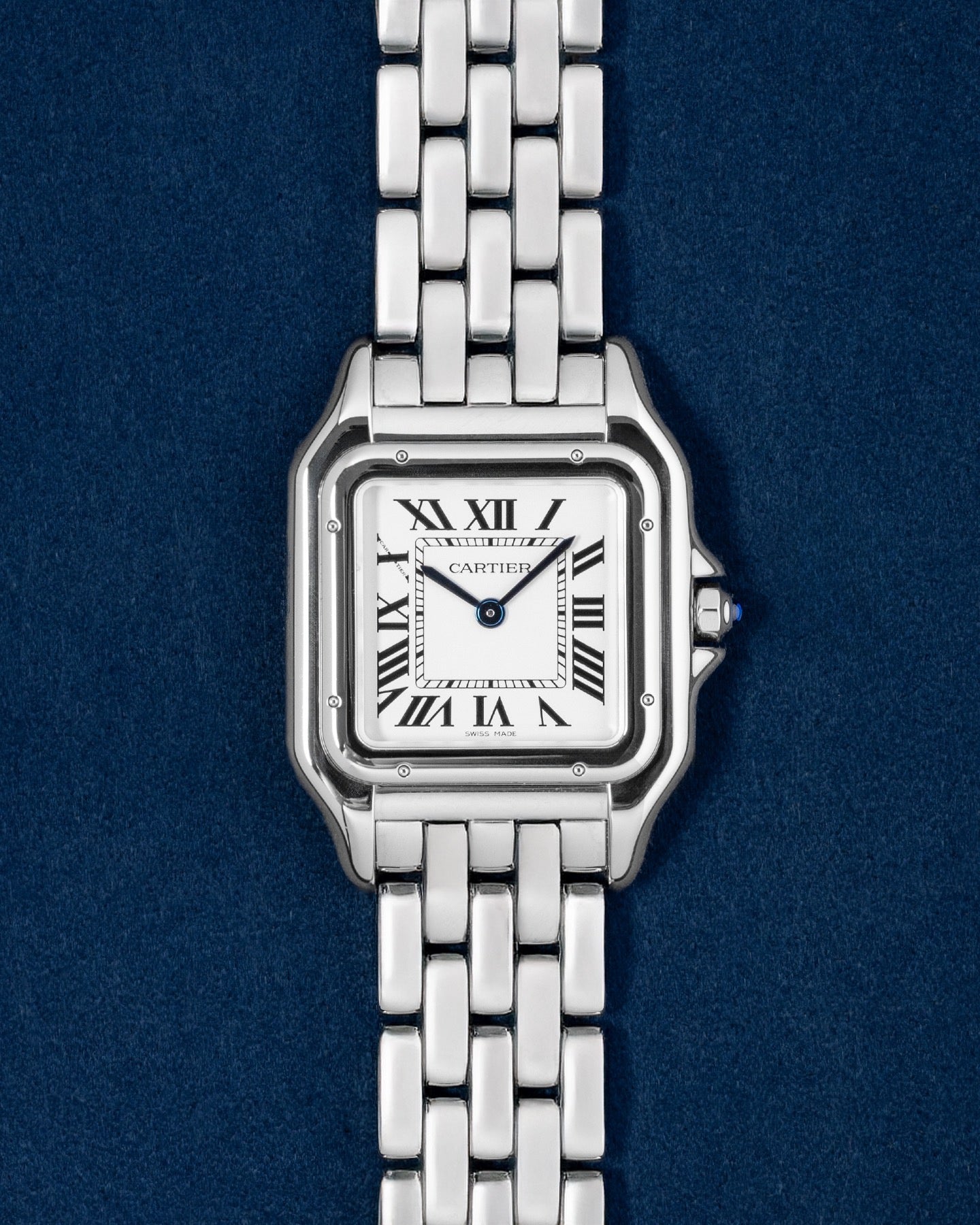
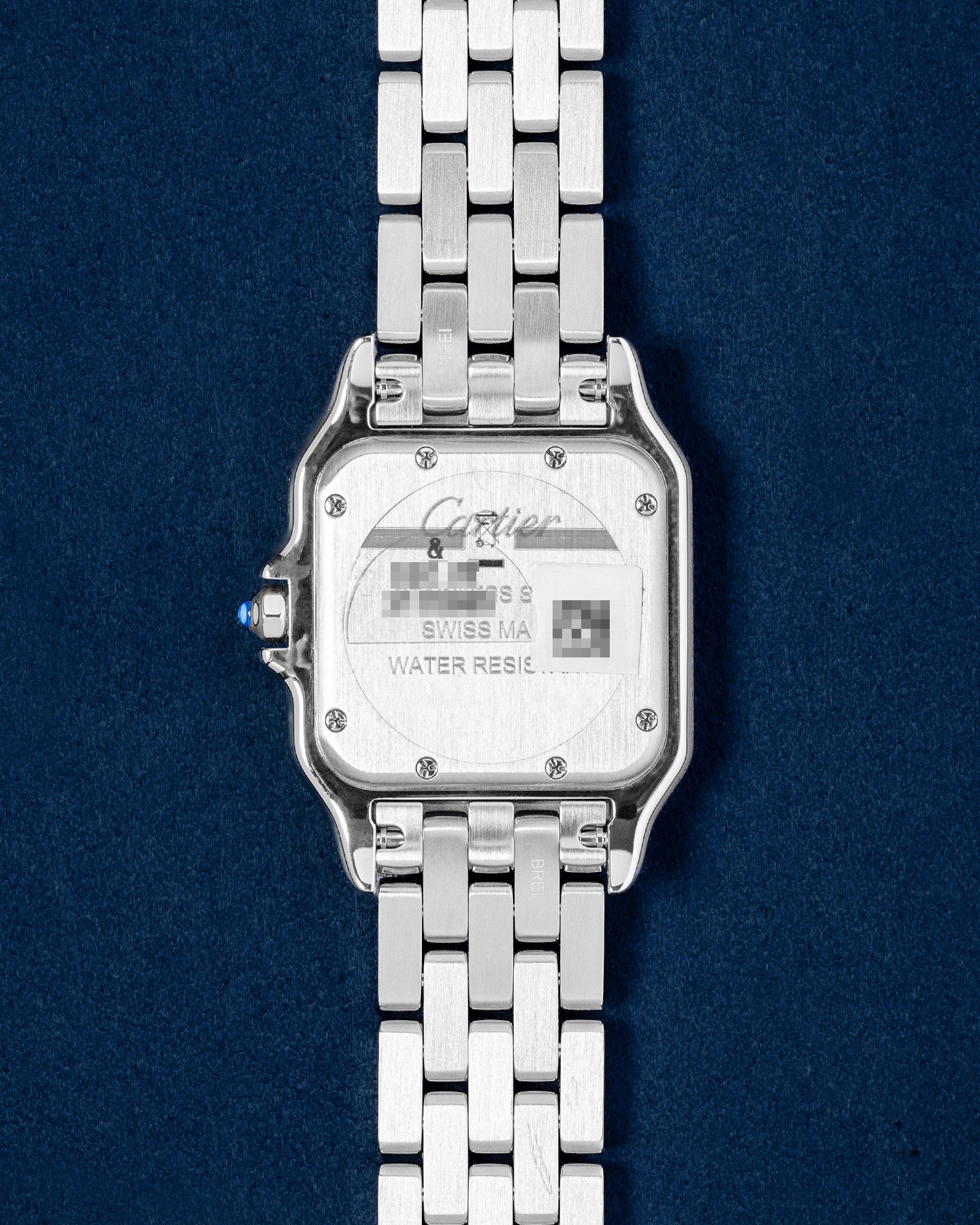
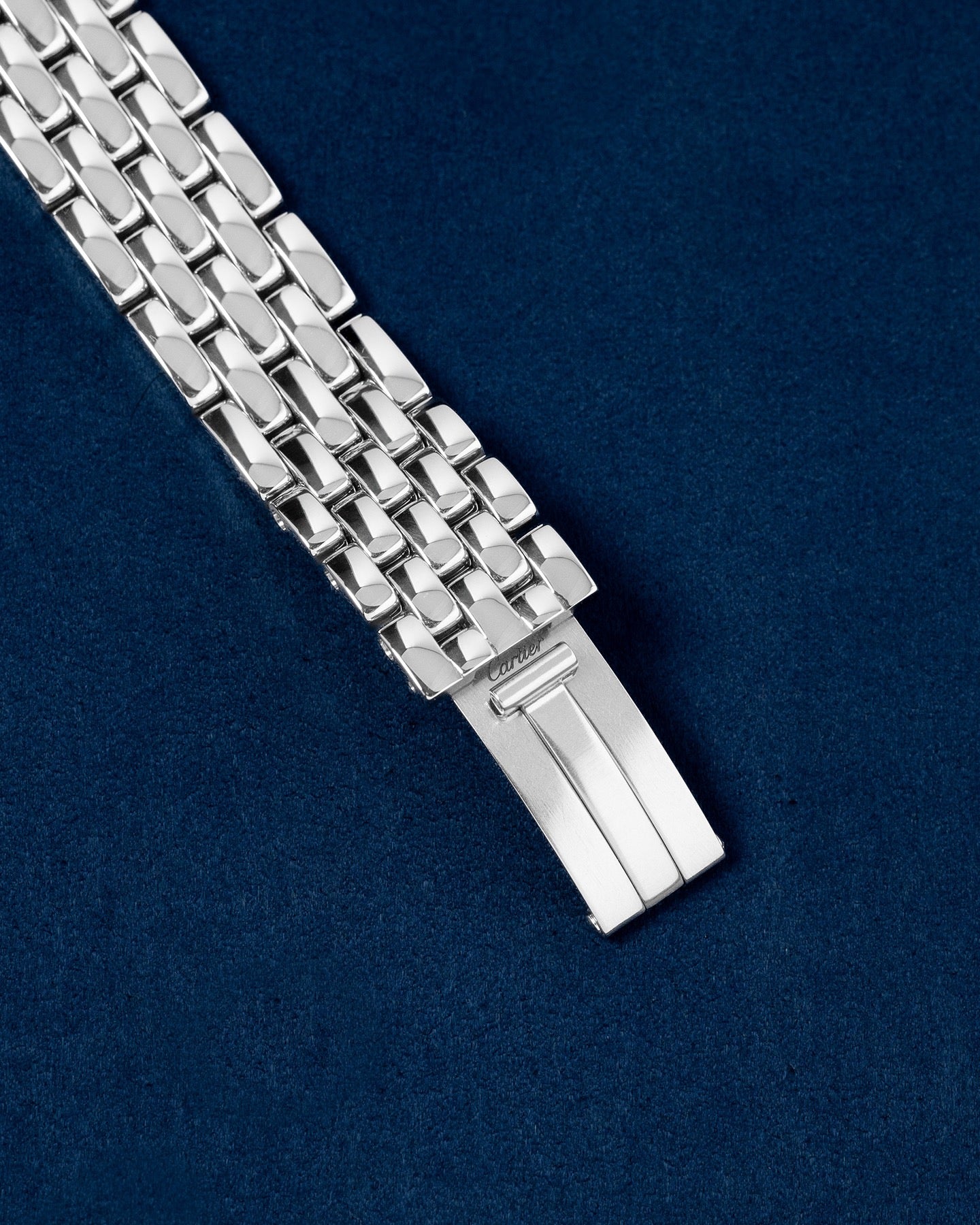
Relaunched in 2017 after being discontinued in the early 2000s, the Panthere de Cartier is structurally similar to the Santos, featuring a square case with exposed bezel screws. However, the Panthere is fundamentally a jewelry watch. Its defining characteristic is the ultra flexible, brick link bracelet that drapes across the wrist like fabric. The Panthere is offered exclusively with quartz movements, a deliberate choice that keeps the case profile incredibly thin and the maintenance requirements near zero. For buyers seeking Cartier watches that function primarily as exquisite bracelets that happen to tell the time, the Panthere remains the absolute benchmark in the luxury industry.
Ballon Bleu de Cartier
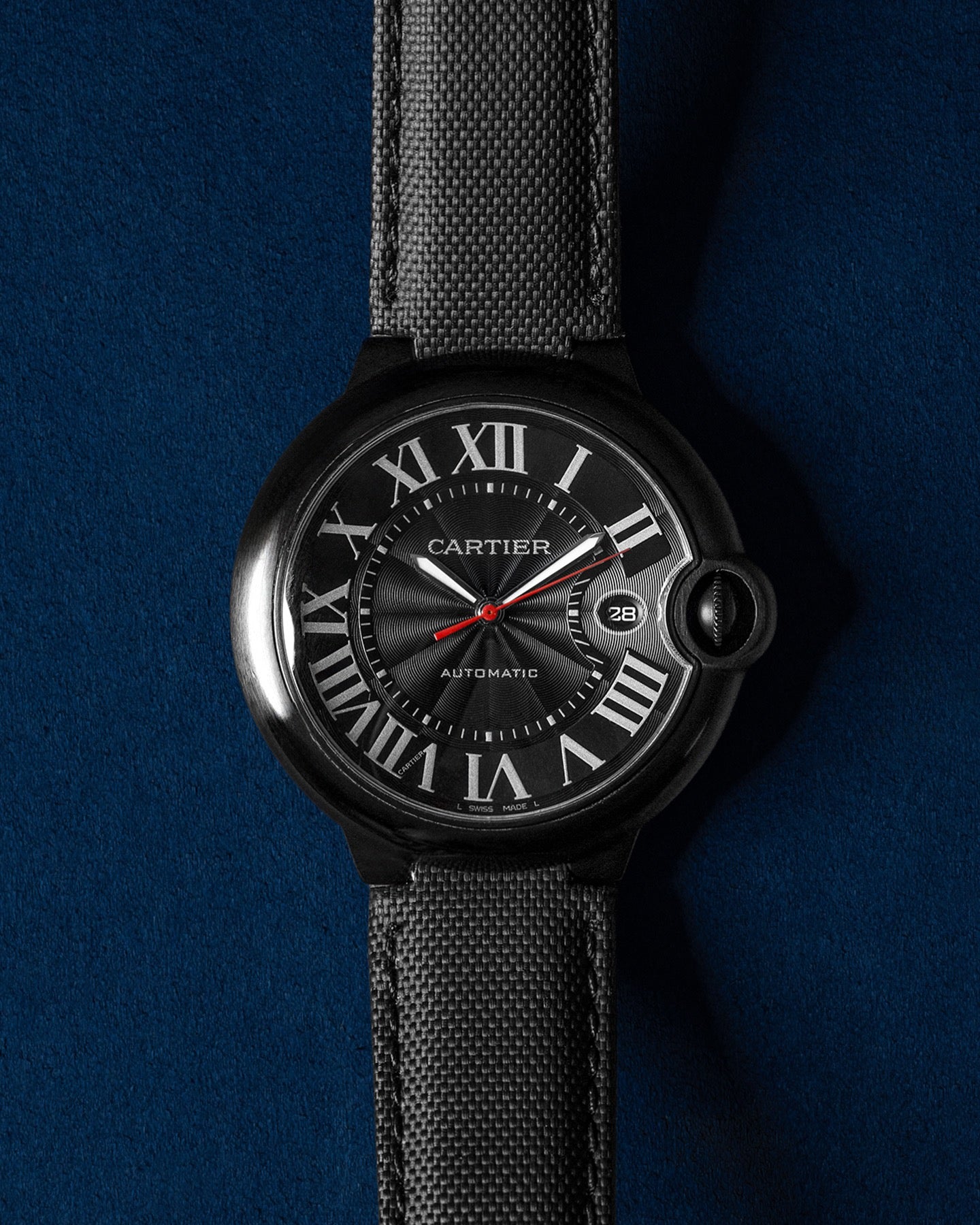
Introduced in 2007, the Ballon Bleu became an immediate, runaway commercial success. The design is based on a pebble shape, completely devoid of sharp angles or straight lines. Its most defining feature is the integrated crown guard, a bridge of metal that curves entirely around the sapphire cabochon crown, creating a slight indentation in the dial and the Roman numeral track at three o'clock. The domed sapphire crystal magnifies the guilloche dial, creating a soft, distorted visual effect at the edges. Available in sizes ranging from 28 millimeters up to 42 millimeters, and featuring both quartz and automatic movements, the Ballon Bleu proved that Cartier watches could still invent entirely new, globally dominant case shapes in the twenty first century.
Shaped Cases and Niche Cartier Watches
The true depth of Cartier's design archive is revealed in their niche, shaped cases. Because Louis Cartier was not constrained by the need to fit a standard round movement into his designs, the Parisian house spent the twentieth century experimenting with geometry in ways that traditional Swiss brands could not. These odd, asymmetric, and heavily stylized cases represent the purest expression of the brand's form over function philosophy, and they have recently become the most aggressively hunted models by serious horology collectors worldwide.
Cartier Crash
No model exemplifies the mythology of Cartier watches quite like the Crash. Introduced by the London branch in 1967 under the direction of Jean Jacques Cartier, the Crash features a radically asymmetrical, melted case design. For decades, a persistent myth claimed the watch was inspired by a Cartier Baignoire Allongee that had melted in a fiery car accident. The reality is that the Crash was a deliberate design exercise intended to capture the surrealist art movement and the countercultural energy of swinging sixties London. Early London Crash models are incredibly rare, often trading for well over one million dollars at auction. Modern reissues are highly restricted, making the Crash the ultimate allocation trophy for top tier Cartier clients.
Cartier Baignoire
The Baignoire traces its origins back to 1912, though the name, which translates to bathtub in French, was not officially adopted until the late 1950s. The case is a pure, unbroken oval, characterized by a thick, rounded bezel that frames a classical Cartier dial. The Baignoire is a masterclass in elegant restraint, offering a softer alternative to the rigid geometry of the Tank. Cartier expanded the line with the Baignoire Allongee, which stretches the oval into a dramatic, wrist spanning curve that leans heavily into the extravagant aesthetics of the 1960s.
Cartier Tortue and Tonneau
The Tonneau, introduced in 1906, and the Tortue, introduced in 1912, represent Cartier's earliest experiments with curved, ergonomic cases designed specifically for the wrist. The Tonneau features a barrel shape that curves dramatically to match the anatomy of the arm, while the Tortue resembles the shell of a tortoise with its widened central profile. Both models played crucial roles in the Collection Privee Cartier Paris era and remain staples of the modern Cartier Prive releases, offering collectors historical deep cuts that predate the vast majority of wristwatches from other major manufactures.
Movement Architecture and In House Calibers
For much of its history, Cartier operated as an etablisseur, designing the cases and dials in Paris while relying on premier Swiss movement makers like Jaeger LeCoultre, Audemars Piguet, and Piaget to supply the mechanical engines. This approach resulted in some of the most beautiful watches of the twentieth century, but as the luxury watch market evolved in the 2000s, collectors began demanding vertical integration. In response, Cartier invested massively in a centralized manufacturing facility in La Chaux de Fonds, Switzerland, shifting the brand toward true in house movement production for its mechanical offerings.
The 1847 MC Caliber
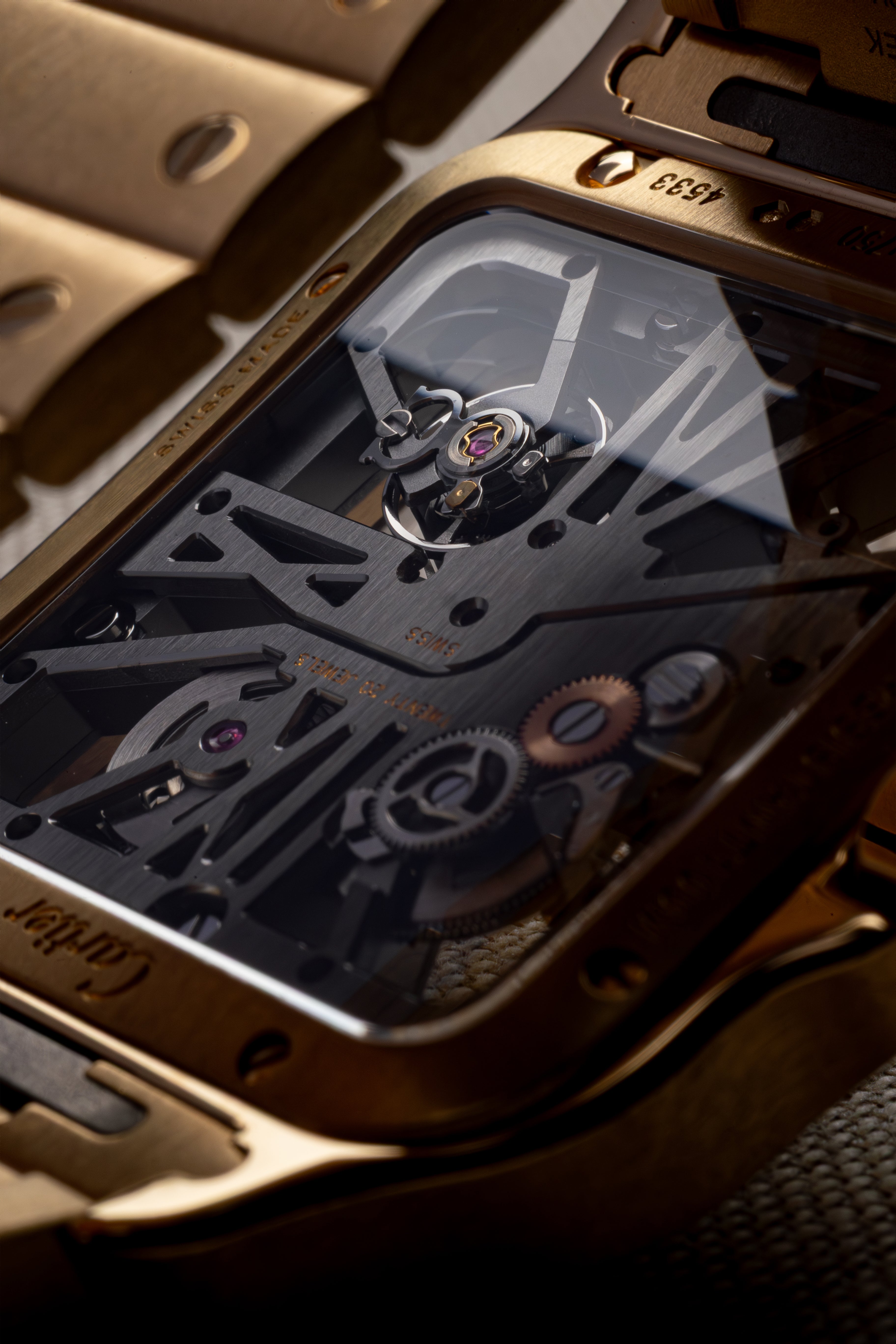
The caliber 1847 MC, named after the founding year of the house, serves as the modern workhorse for the majority of standard production mechanical Cartier watches. It is a self winding movement beating at 4 hertz, or 28,800 vibrations per hour, with a power reserve of approximately 42 hours. Cartier specifically engineered the 1847 MC to be robust and reliable for daily wear, incorporating nickel phosphorus components in the escapement and a shield made from a paramagnetic alloy to protect the movement from the magnetic fields generated by modern electronics. At just 3.8 millimeters thick, the 1847 MC allows Cartier to maintain the slim case profiles that their aesthetic demands.
The 1904 MC Caliber
Introduced in 2010, the caliber 1904 MC was the first true in house automatic movement developed entirely by Cartier. Designed under the direction of Carole Forestier Kasapi, the 1904 MC utilizes a twin barrel architecture. Rather than using the two mainspring barrels to extend the power reserve, which sits at a standard 48 hours, Cartier uses them to provide a more constant delivery of torque to the escapement as the watch winds down, improving chronometric stability. The 1904 MC serves as a base caliber that can be easily modified with modules for chronographs, as seen in the 1904 CH MC, or small seconds displays.
High Horology and Skeletonization
Cartier watches have also aggressively expanded into the realm of high horology. The brand's approach to skeletonization is entirely unique in the industry. Rather than taking a standard movement and cutting away material for decorative effect, Cartier engineers the skeletonized movement from the ground up to serve as the dial itself. The caliber 9611 MC, frequently utilized in the Santos Skeleton, features baseplates and bridges machined into the shape of large Roman numerals at three, six, nine, and twelve o'clock. This structural integration of movement and dial typography is a technical signature that distinguishes Cartier's high end pieces from traditional Swiss skeletonization techniques.
Collection Privee Cartier Paris and Modern Prive
To understand the current explosion of interest in Cartier watches among serious horology collectors, one must look at the Collection Privee Cartier Paris, known as CPCP. Running from 1998 to 2008, the CPCP line was created to celebrate the mechanical heritage of Cartier's historical shaped watches. The collection featured reissues of the Tortue, the Tonneau, the Tank Chinoise, and the Tank Cintree, among others. Crucially, these watches were equipped with high end mechanical movements supplied by Piaget, Jaeger LeCoultre, and Frederic Piguet, finished to exceptional standards. The CPCP pieces are identifiable by the word Paris printed on the dial beneath the Cartier name, and by a distinct, central rosette guilloche pattern radiating from the hands.
The CPCP era firmly established that Cartier could produce watches that appealed to the most snobbish mechanical purists. Today, these pieces are fiercely contested at auction. Building on that legacy, Cartier introduced the modern Cartier Prive collection in 2017. The Prive collection acts as an exclusive, limited edition tier within the brand, reviving a different historical shape each year. Recent releases have included the Crash, the Tank Cintree, the Tonneau, the Tank Asymetrique, the Cloche, and the Tank Chinoise. These highly limited runs sell out almost instantly to top clients and trade at significant premiums on the secondary market, proving that the market for historically faithful, mechanically serious Cartier watches has never been stronger.
Production Scale and La Chaux de Fonds
The sheer scale of Cartier's modern watchmaking operation is staggering, making the consistent quality of their output all the more impressive. The manufacture in La Chaux de Fonds is one of the largest fully integrated watchmaking facilities in Switzerland, bringing together over one hundred distinct crafts under a single roof. While exact production figures are tightly guarded by the Richemont Group, industry estimates suggest Cartier produces well over 400,000 watches annually, placing them firmly as the second largest luxury watch brand by revenue globally, trailing only Rolex.
Unlike many high volume brands that rely entirely on automated assembly, Cartier maintains a heavy reliance on traditional handcraft. The manufacture includes its own gold smelting facility to ensure the perfect hue and metallurgical properties of their precious metal cases. The blued steel hands that define Cartier watches are fired individually by hand over an open flame to achieve the exact shade of cornflower blue, rather than being chemically painted. This combination of massive industrial capability and retained artisanal handcraft is what allows Cartier to produce the high volume Tank Must alongside the million dollar minute repeaters without compromising the integrity of the brand name.
Comparison Against Direct Competitors
When evaluating where Cartier watches sit in the modern luxury hierarchy, the brand is most frequently compared against Rolex and Jaeger LeCoultre. These comparisons require understanding that Cartier plays by a completely different set of rules than its Swiss peers.
Cartier Watches vs Rolex
Rolex and Cartier are the two undisputed titans of the luxury watch industry by market share, yet they offer diametrically opposed philosophies. Rolex builds impenetrable tool watches focused on precision, durability, and incremental engineering evolution. A Rolex Datejust is designed to survive a lifetime of physical abuse. Cartier watches prioritize aesthetics, elegance, and distinct geometric silhouettes. While a modern Santos de Cartier is highly robust, a buyer chooses the Santos because of how the square case and exposed screws look on the wrist, not because of its water resistance rating. Rolex sells the promise of engineering reliability, while Cartier sells the promise of Parisian elegance and design heritage.
Cartier Watches vs Jaeger LeCoultre
The historical ties between Cartier and Jaeger LeCoultre run deep, given Jaeger's role as Cartier's primary movement supplier for decades. Today, the most direct competitive comparison is between the Cartier Tank and the Jaeger LeCoultre Reverso. Both are iconic rectangular watches born in the early twentieth century. The Reverso offers unparalleled movement depth and the unique reversing case mechanism originally designed for polo players. The Tank offers a purer, more refined dress watch silhouette that sits flatter on the wrist. Collectors who prioritize movement finishing and mechanical complexity often lean toward the Reverso, while collectors who prioritize case design and historical cultural impact inevitably gravitate toward the Tank.
Cartier Price Trends and Secondary Market
The secondary market for Cartier watches has experienced a massive paradigm shift since 2020. Historically, standard production Cartier pieces depreciated sharply upon leaving the retail boutique, making them excellent value propositions on the pre owned market. While entry level quartz models like the Tank Solo and Tank Must still offer accessible entry points into the brand on the secondary market, the dynamic has completely flipped for specific models.
Modern stainless steel sports models like the Santos de Cartier Large and Medium hold value exceptionally well, trading just slightly below their retail prices due to sustained global demand. The most dramatic price action, however, occurs at the top end of the catalogue. The limited edition Cartier Prive releases and the vintage CPCP models have exploded in value, frequently trading at double or triple their original retail prices as serious collectors pivot away from standard steel sports watches to hunt for rare, shaped precious metal cases. The vintage Cartier Crash from the London era has entered the stratosphere, with auction results consistently crossing the million dollar threshold. This bifurcated market means that Cartier watches offer both accessible, daily wear value in their volume models and highly speculative, investment grade potential in their limited production pieces.
Cartier Watches at Grand Caliber in Uptown Dallas
Grand Caliber presents a comprehensive inventory of Cartier watches, from the accessible Tank Must to the heavily sought after Santos de Cartier and the rare discontinued references from the CPCP era. Our position as an independent dealer allows us to source the exact case shape, dial configuration, and metal combination that serious collectors demand, without the restrictions of a retail boutique. Every timepiece in our inventory is physically present in our Uptown Dallas showroom located at 2811 McKinney Avenue. We do not play allocation games, we do not require you to build purchase history to buy the watch you actually want, and we post every price openly and transparently online.
The counterfeit market for Cartier watches is sophisticated, particularly concerning quartz models and the high volume Tank and Ballon Bleu lines. Grand Caliber mitigates this risk entirely through our rigorous in house authentication process. Our named specialist staff inspects every case signature, movement caliber, and dial printing to ensure absolute originality before any watch reaches our floor or our website. We offer insured nationwide shipping for our clients outside of Texas, and our team is ready to answer specific technical questions about any reference. Call us at 214-225-7198 or email info@grandcaliber.com to discuss the Cartier watches currently in our inventory or to request a specific model through our sourcing network.



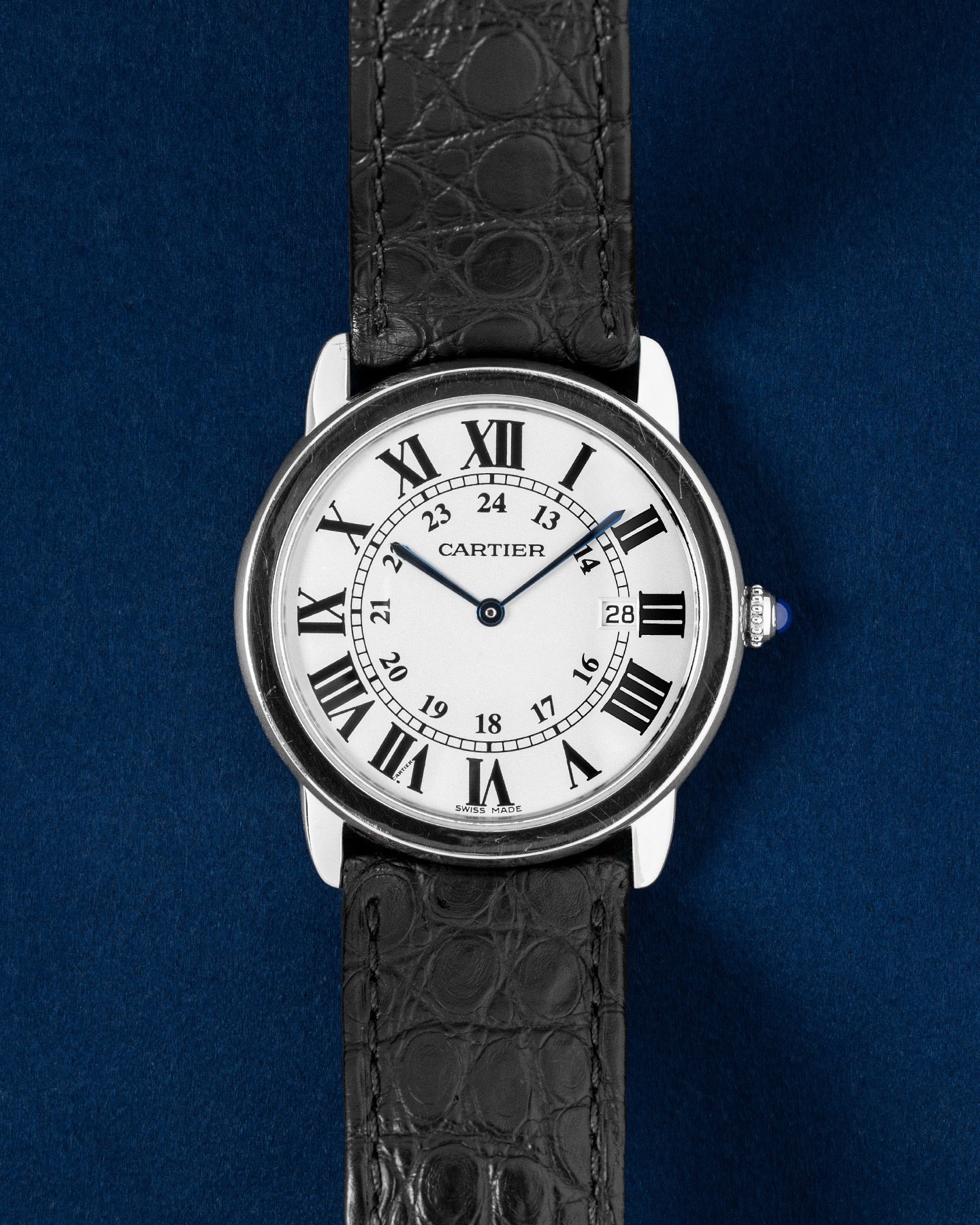
Cartier Ronde Solo de Cartier W6700255
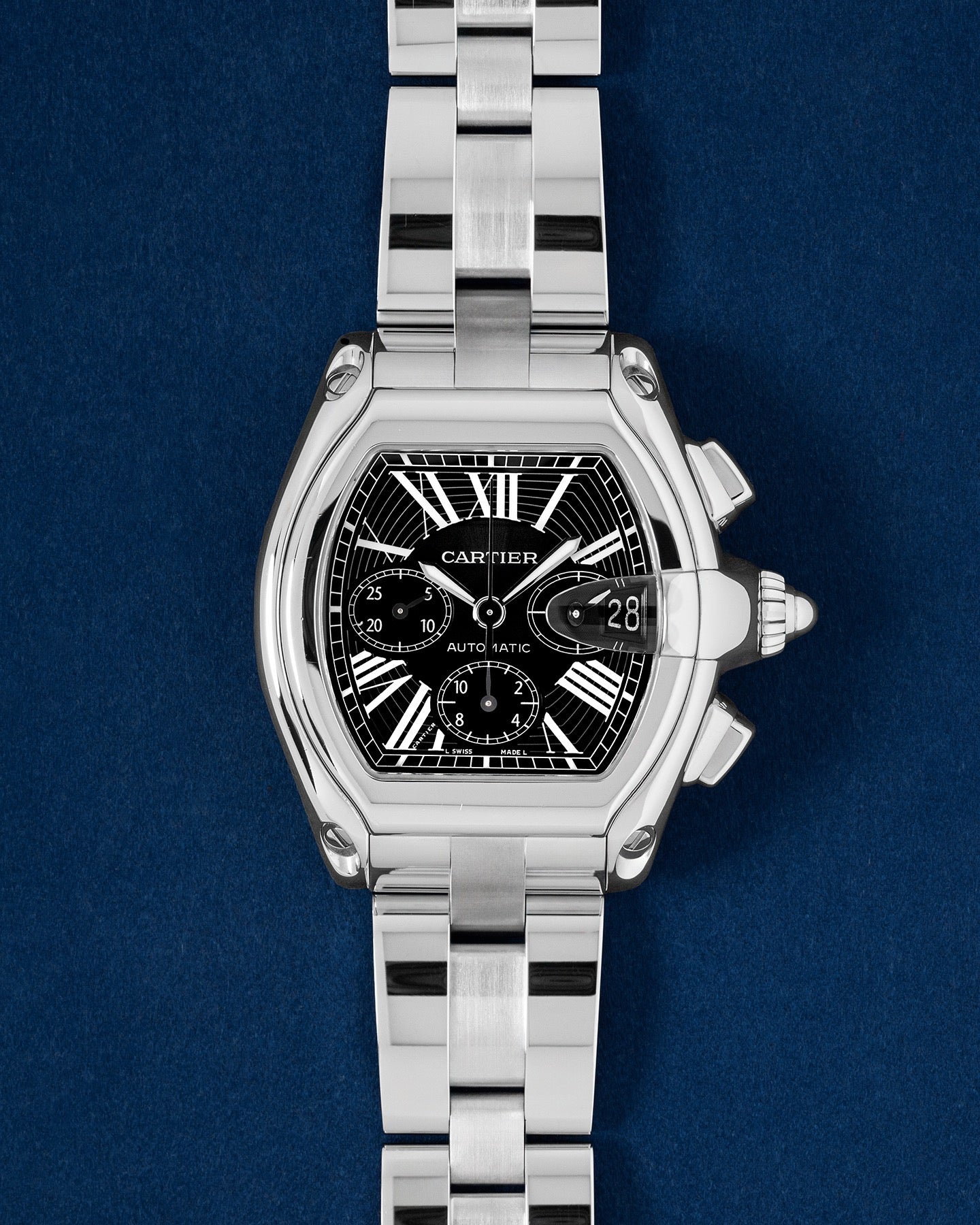
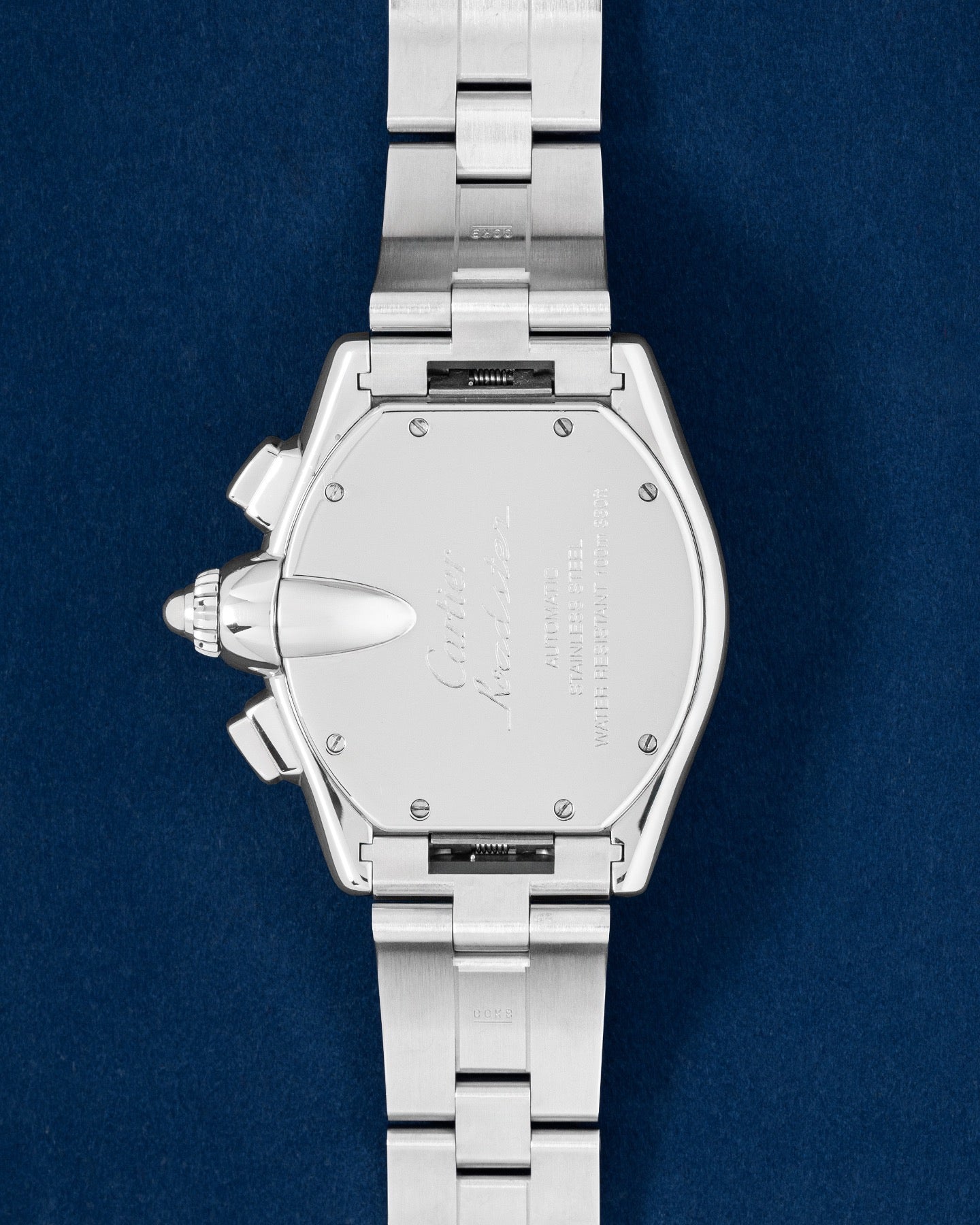
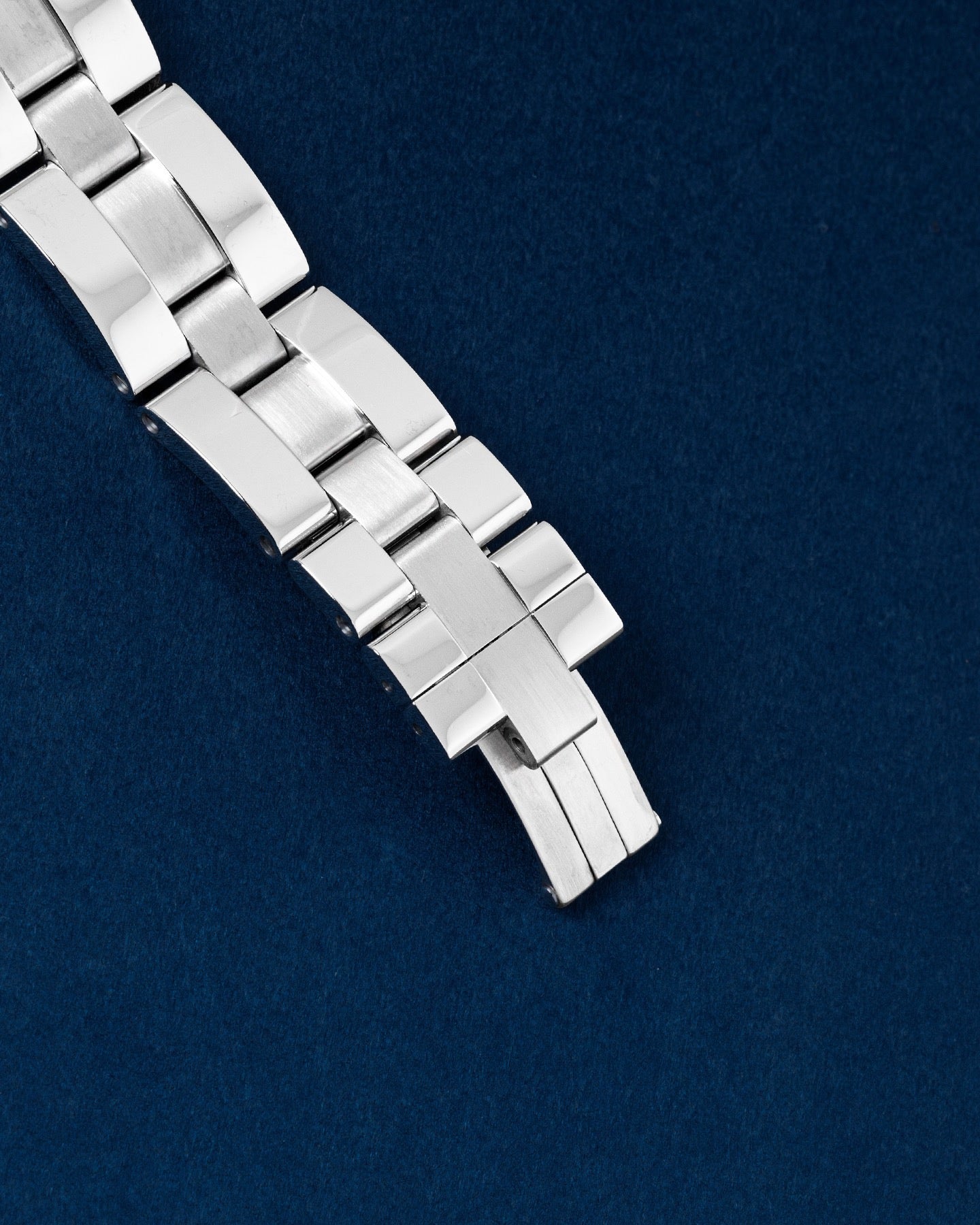
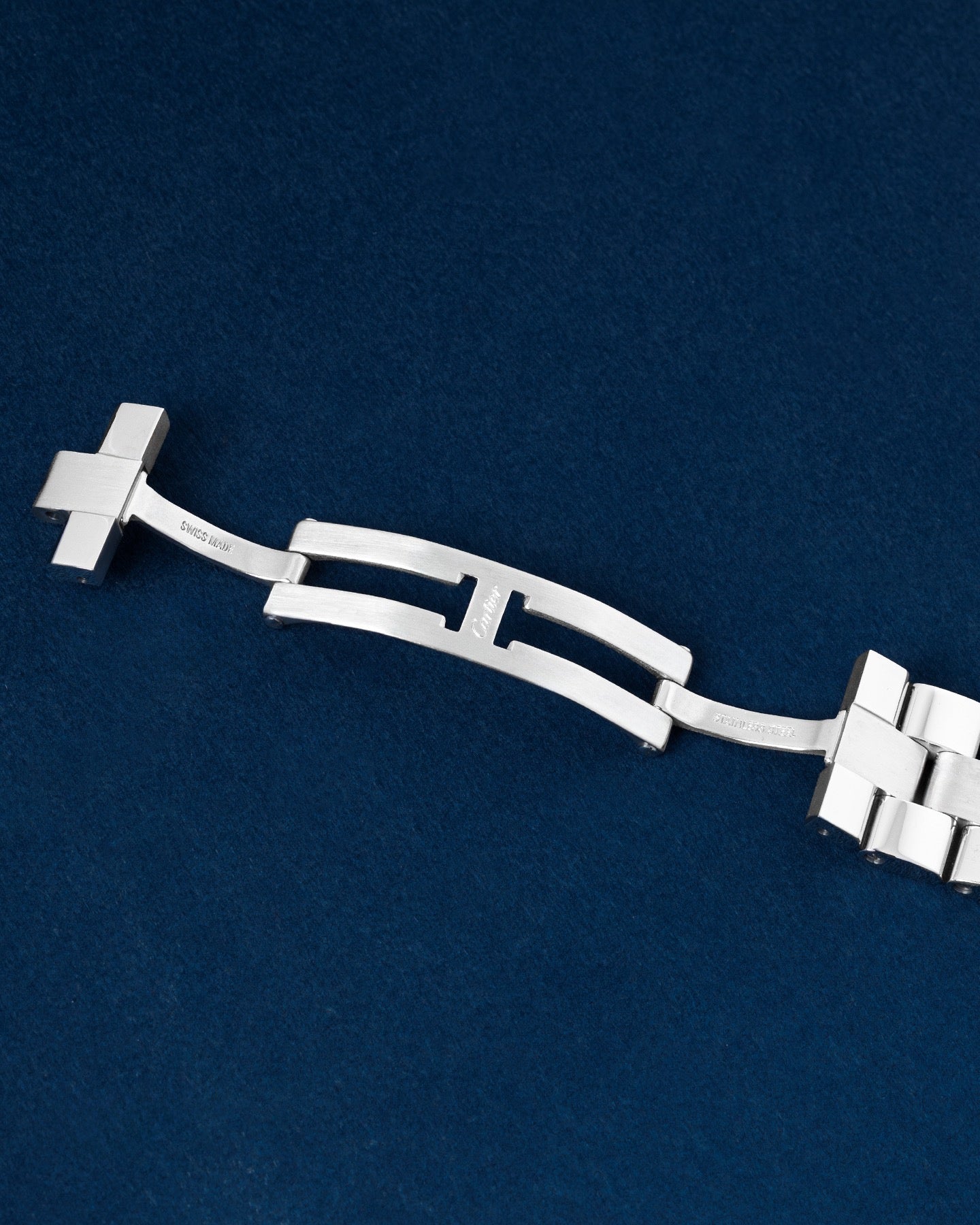
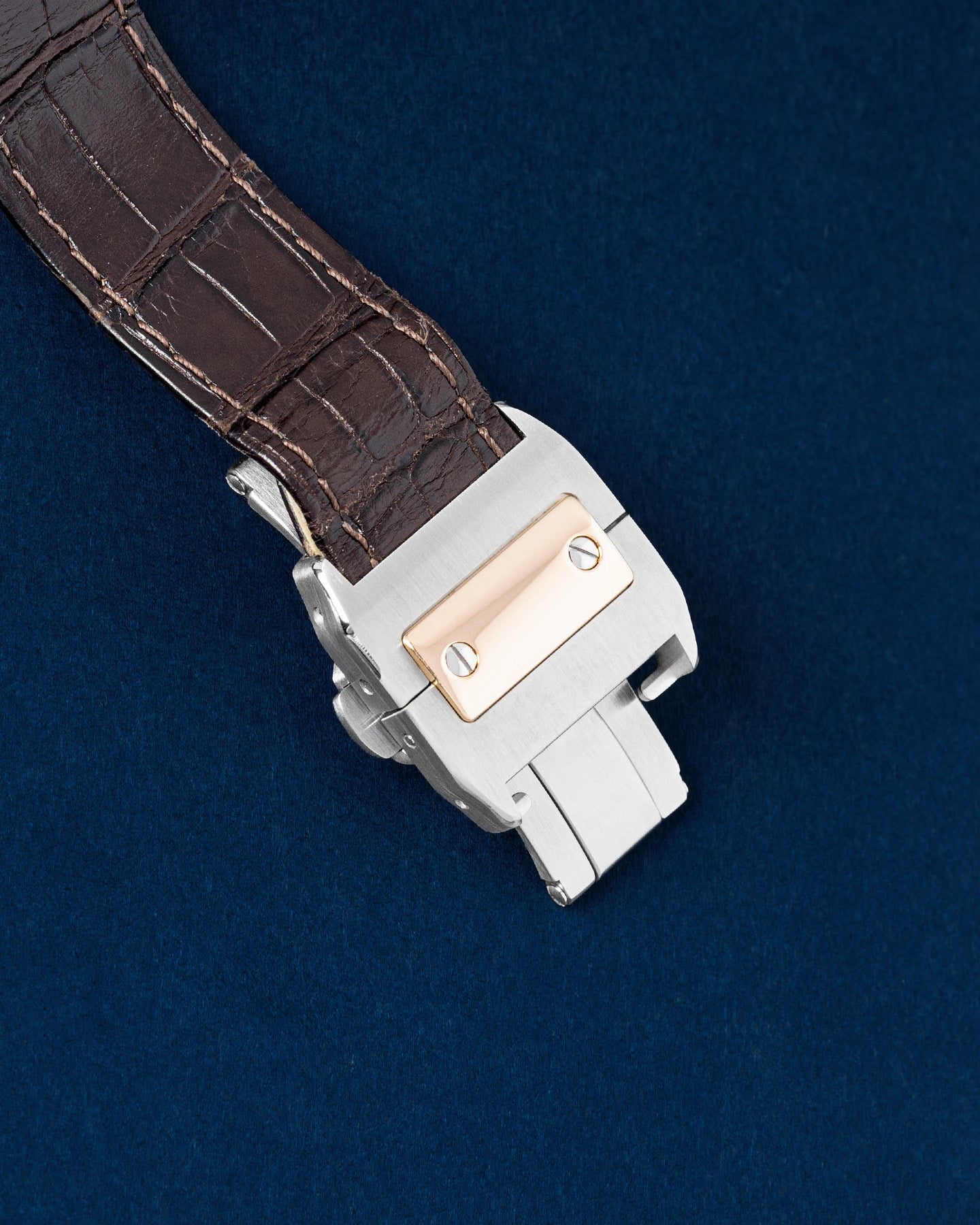
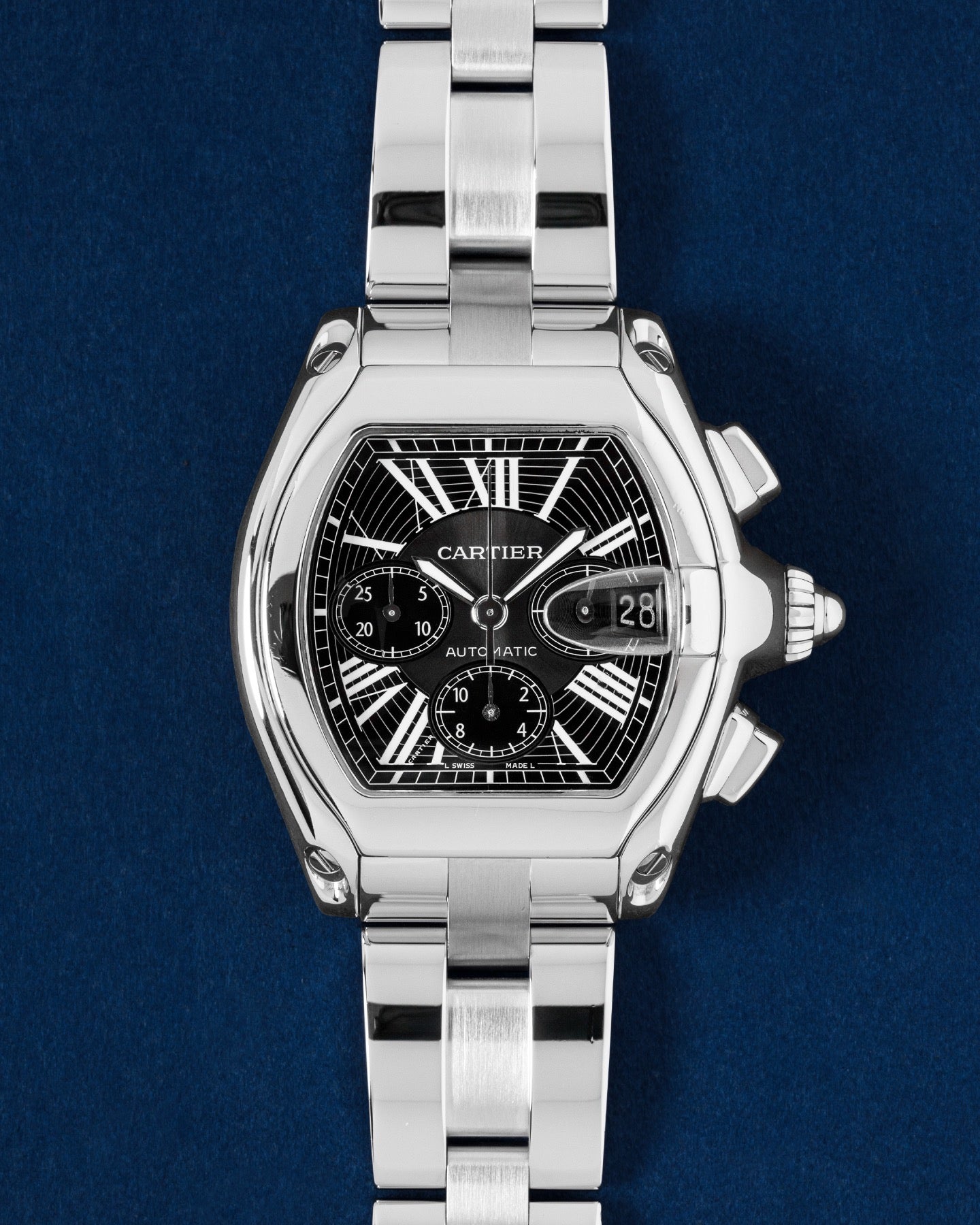
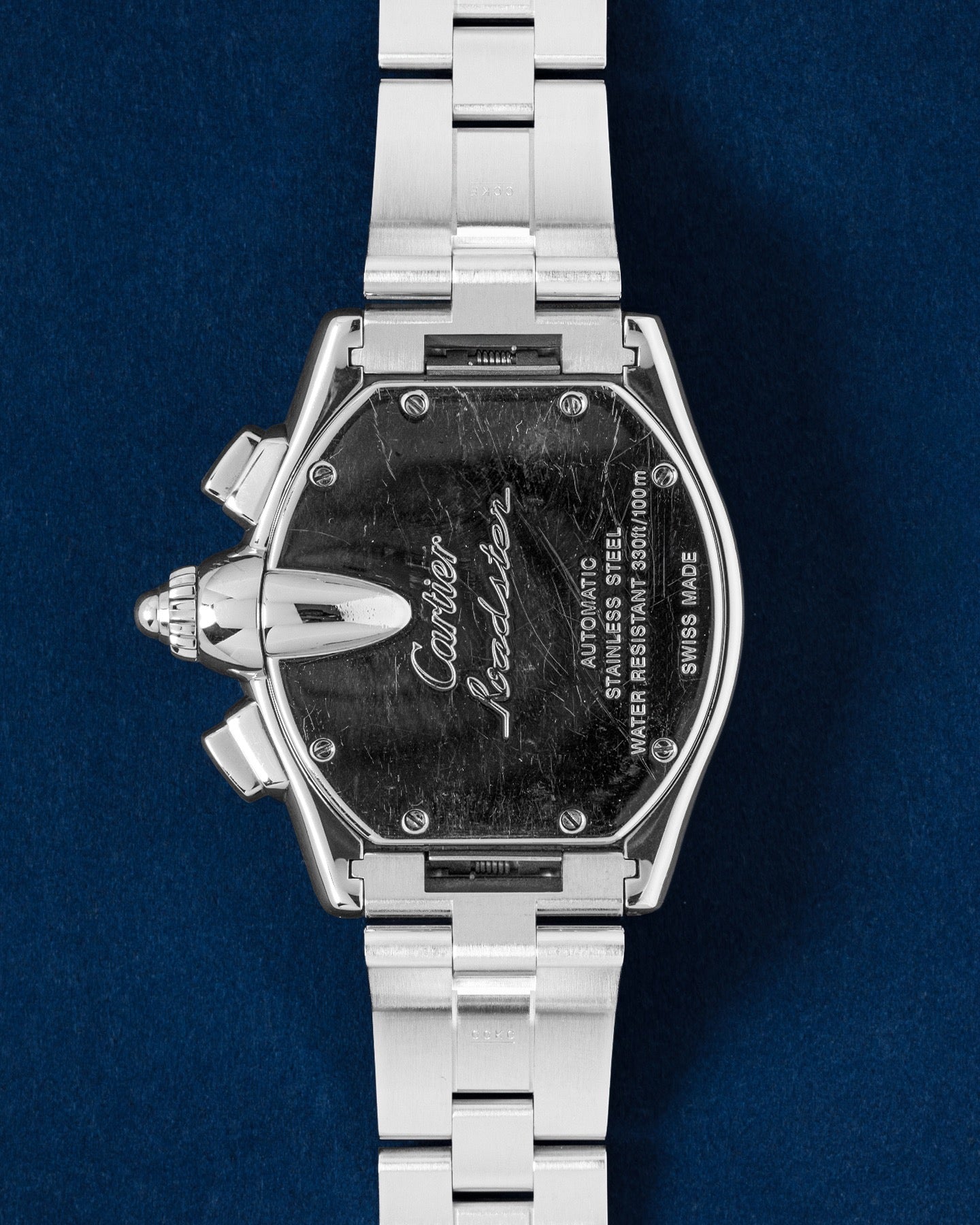
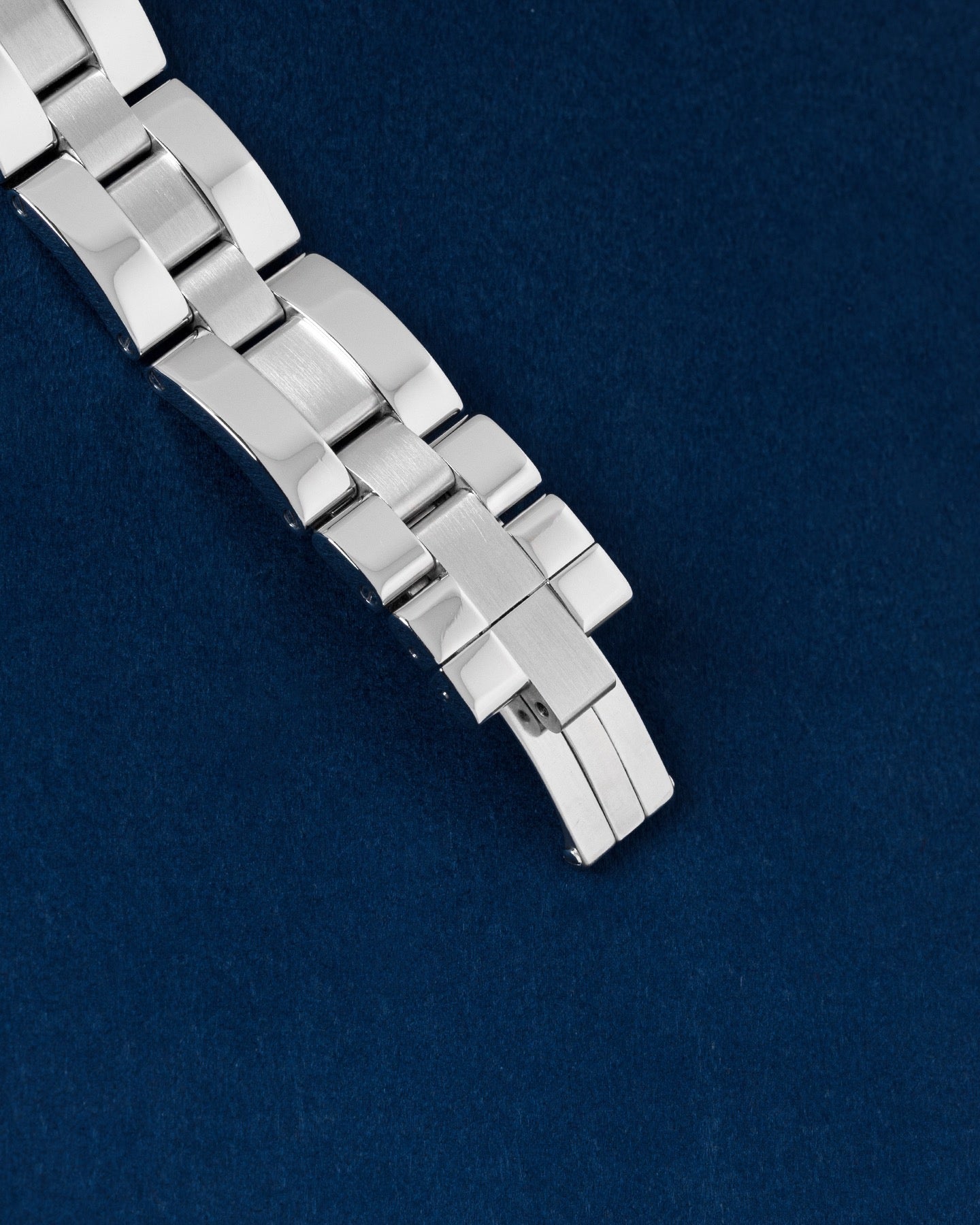
Cartier Roadster XL Chronograph W62020X6


Cartier Tank Americaine W2603556


Cartier Santos De Cartier W2SA0009


Cartier Tank Francaise W51005Q4
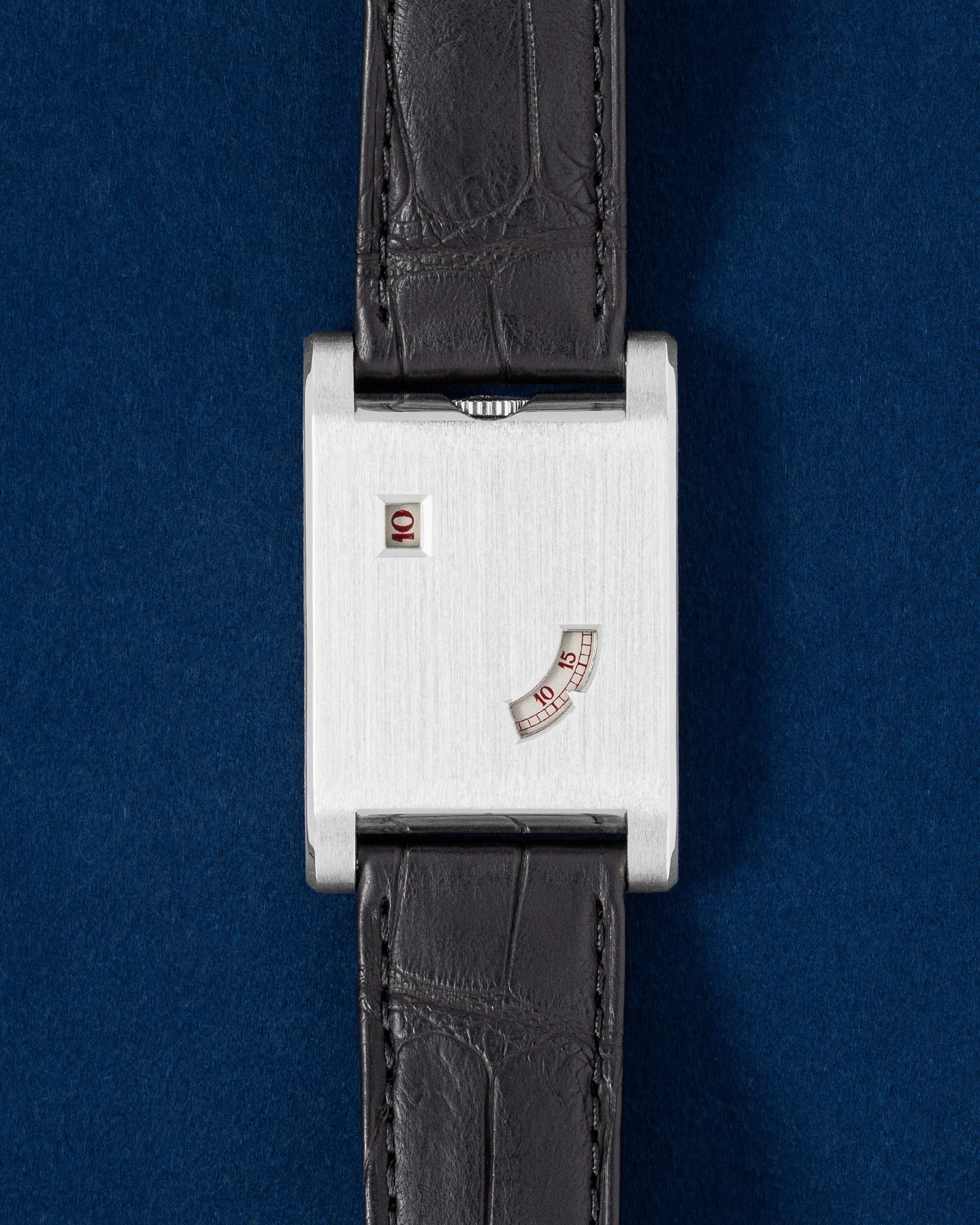
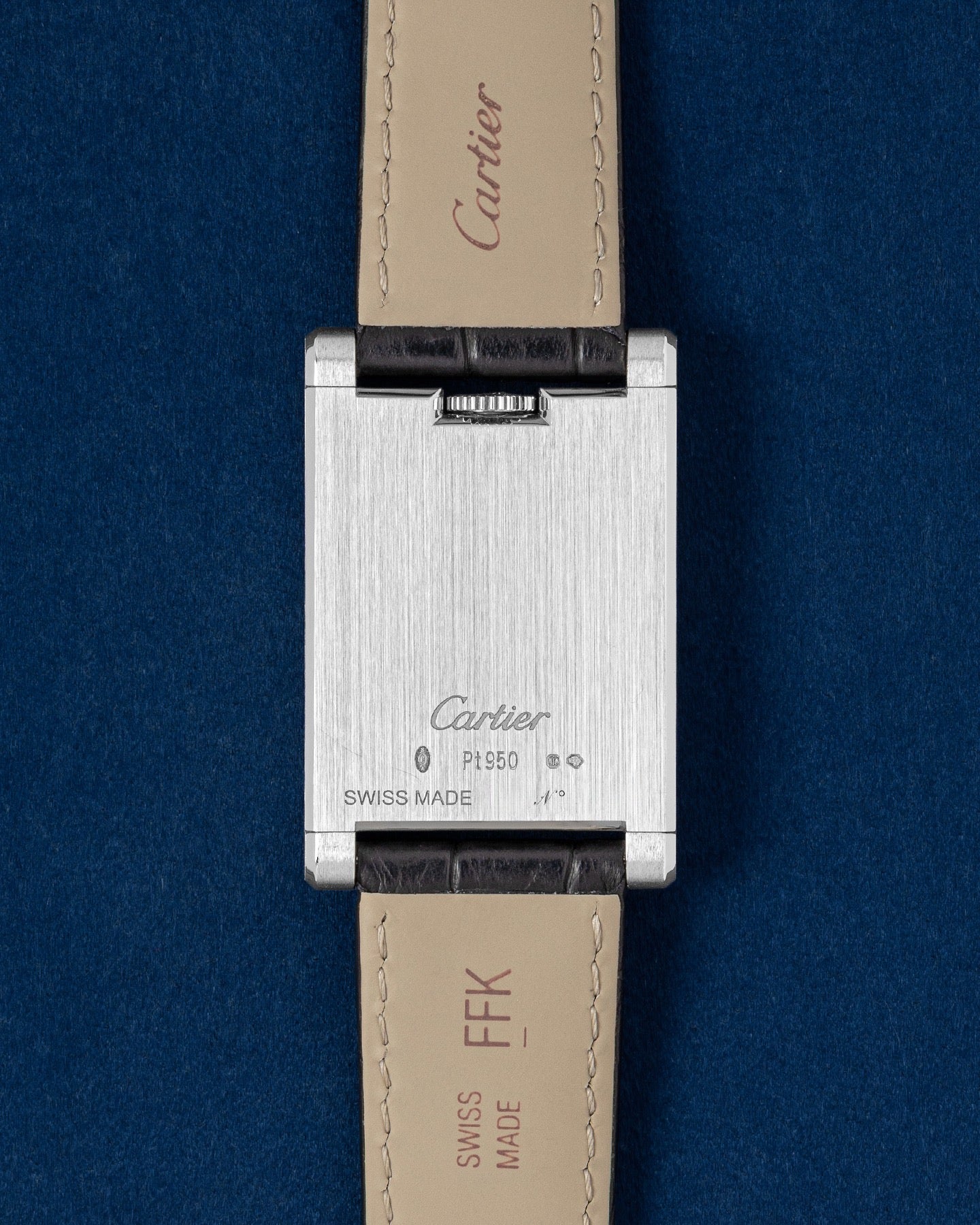
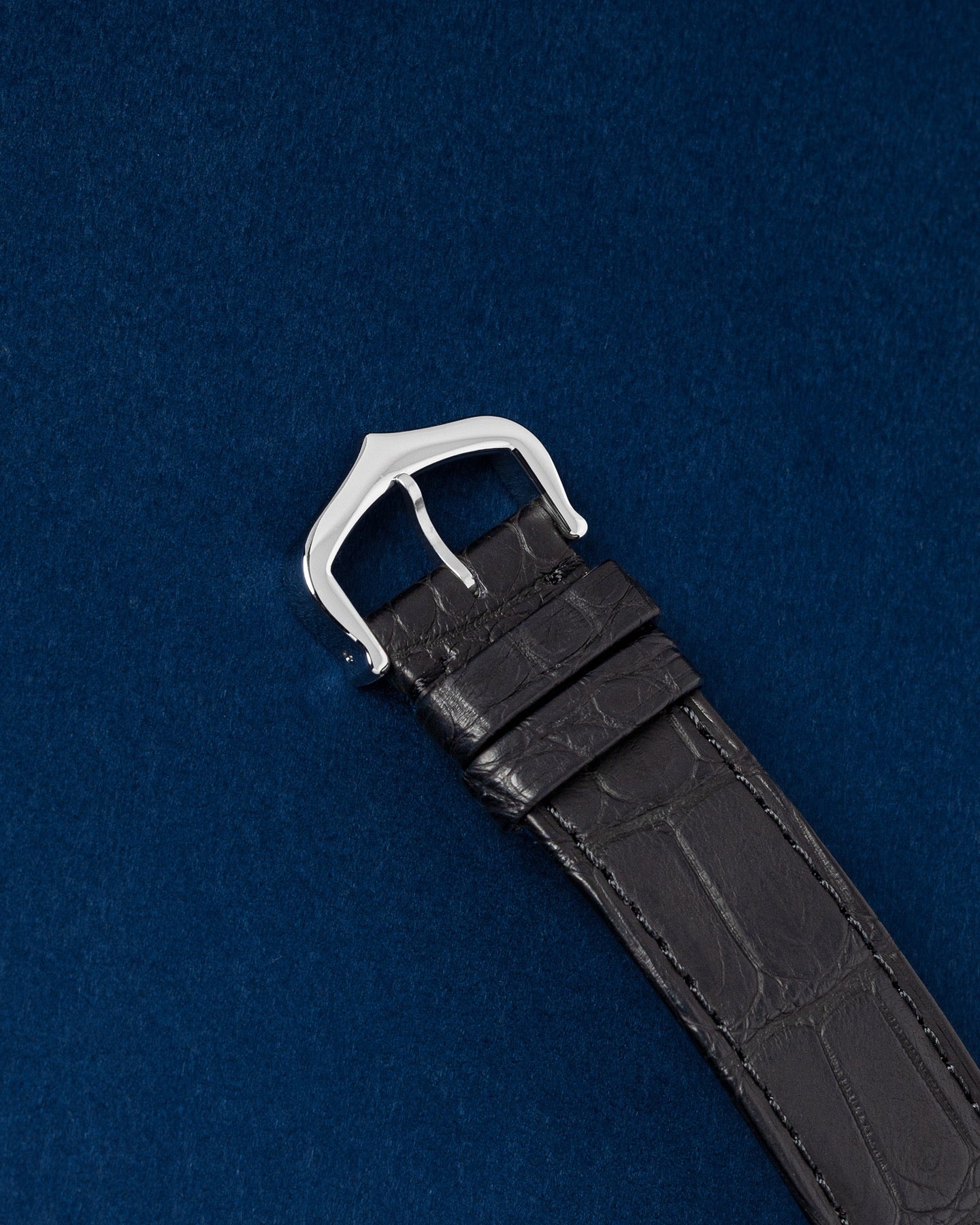

Cartier Privé Tank À Guichets "Oblique" WGTA0237
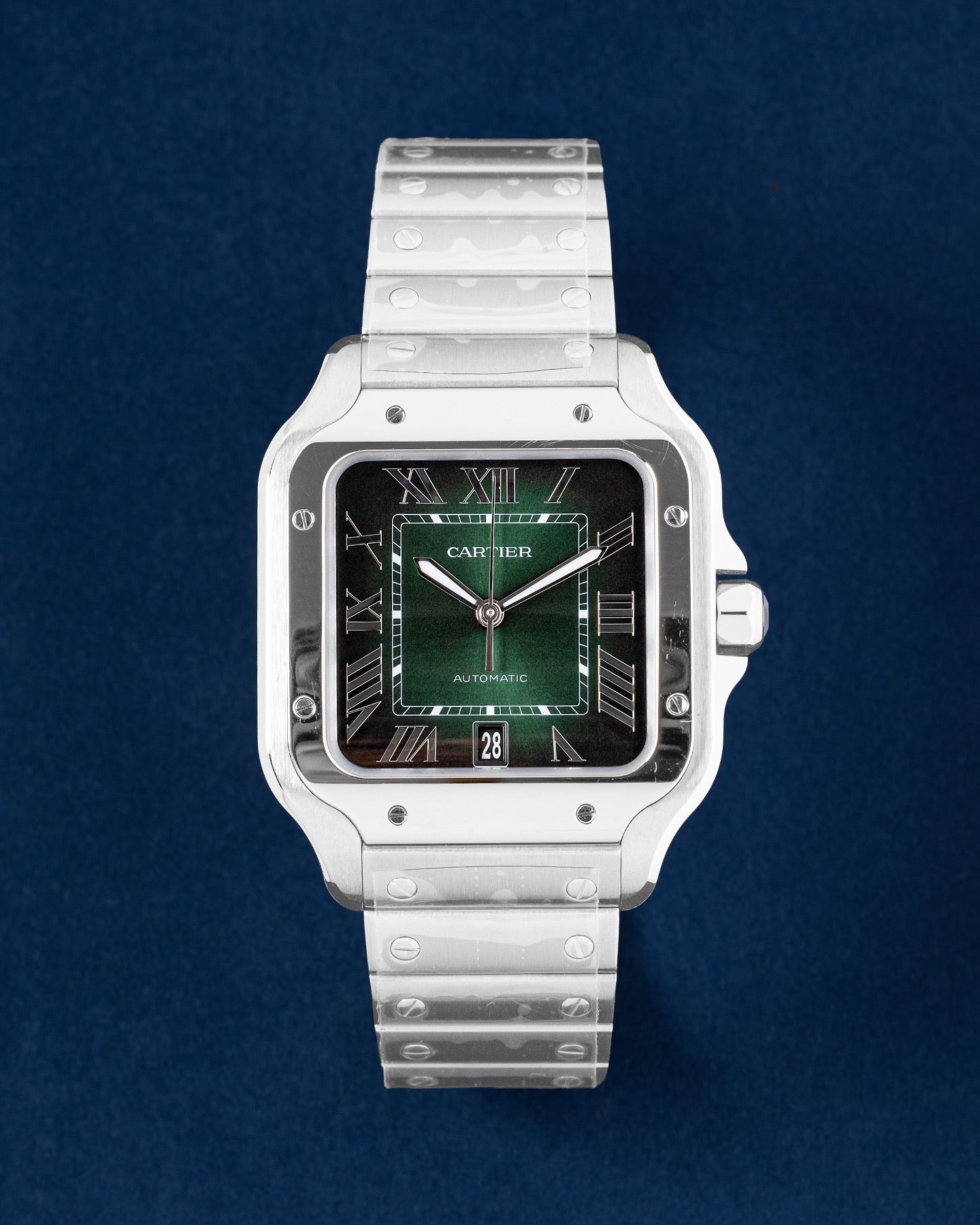
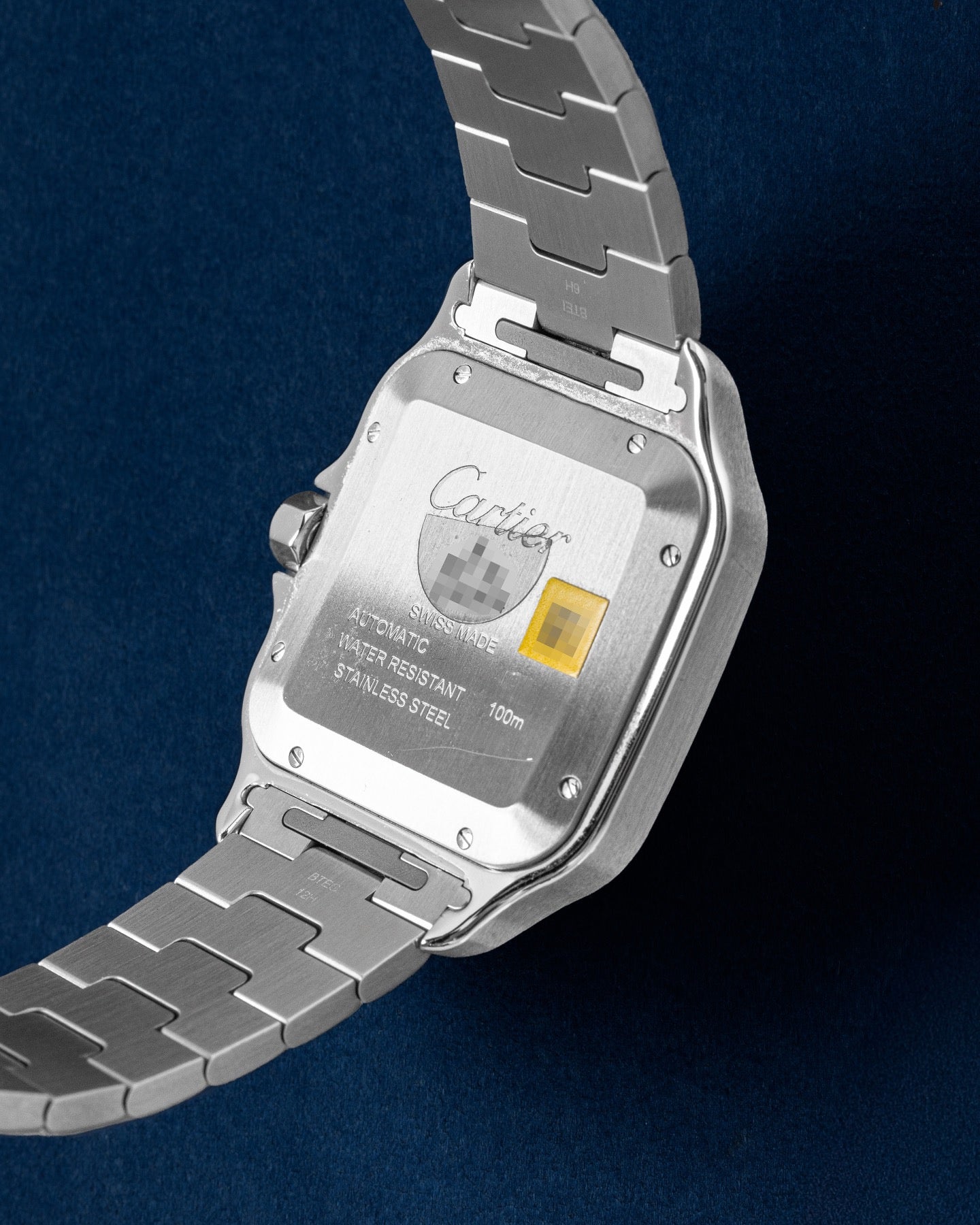
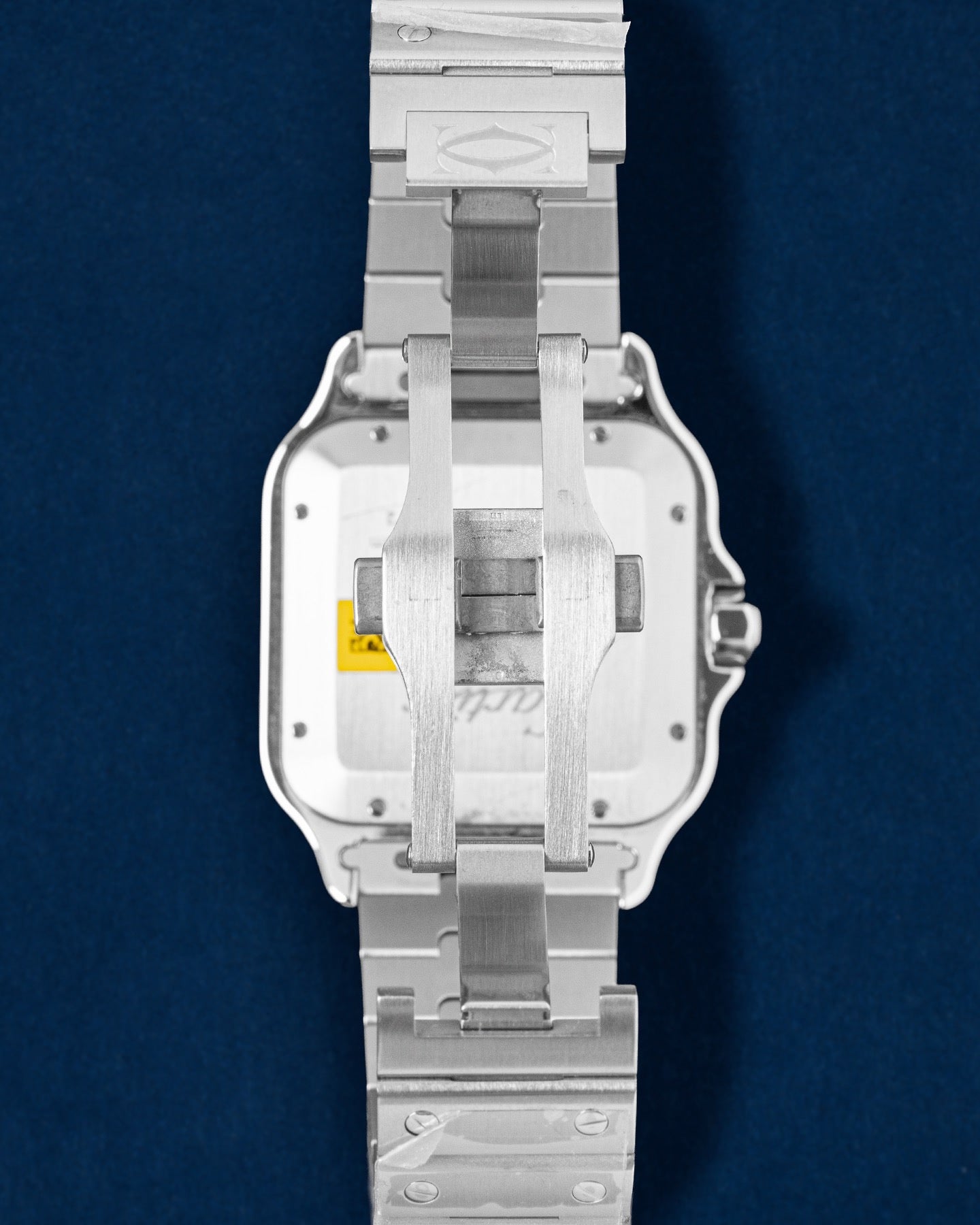

Cartier Santos de Cartier WSSA0062
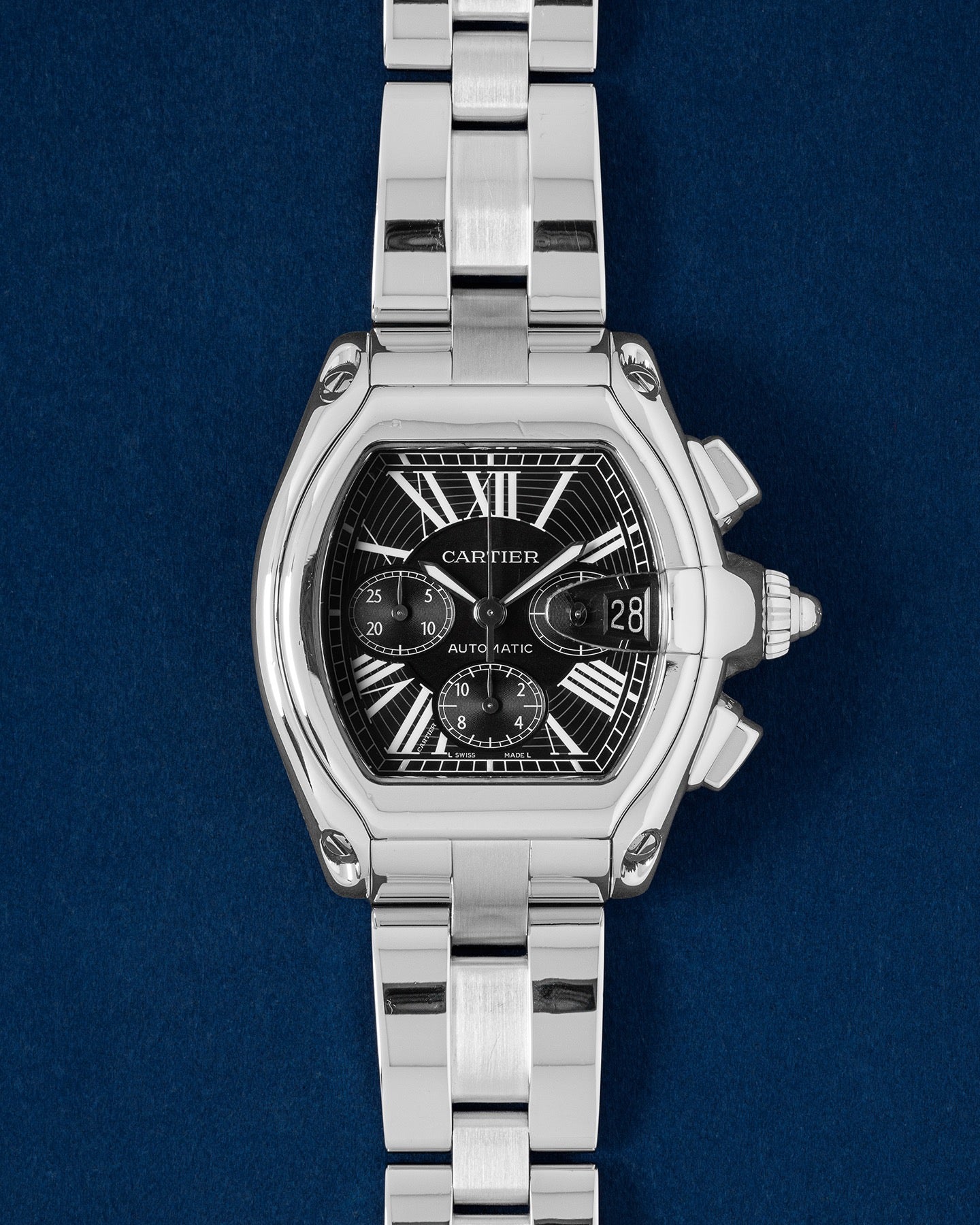
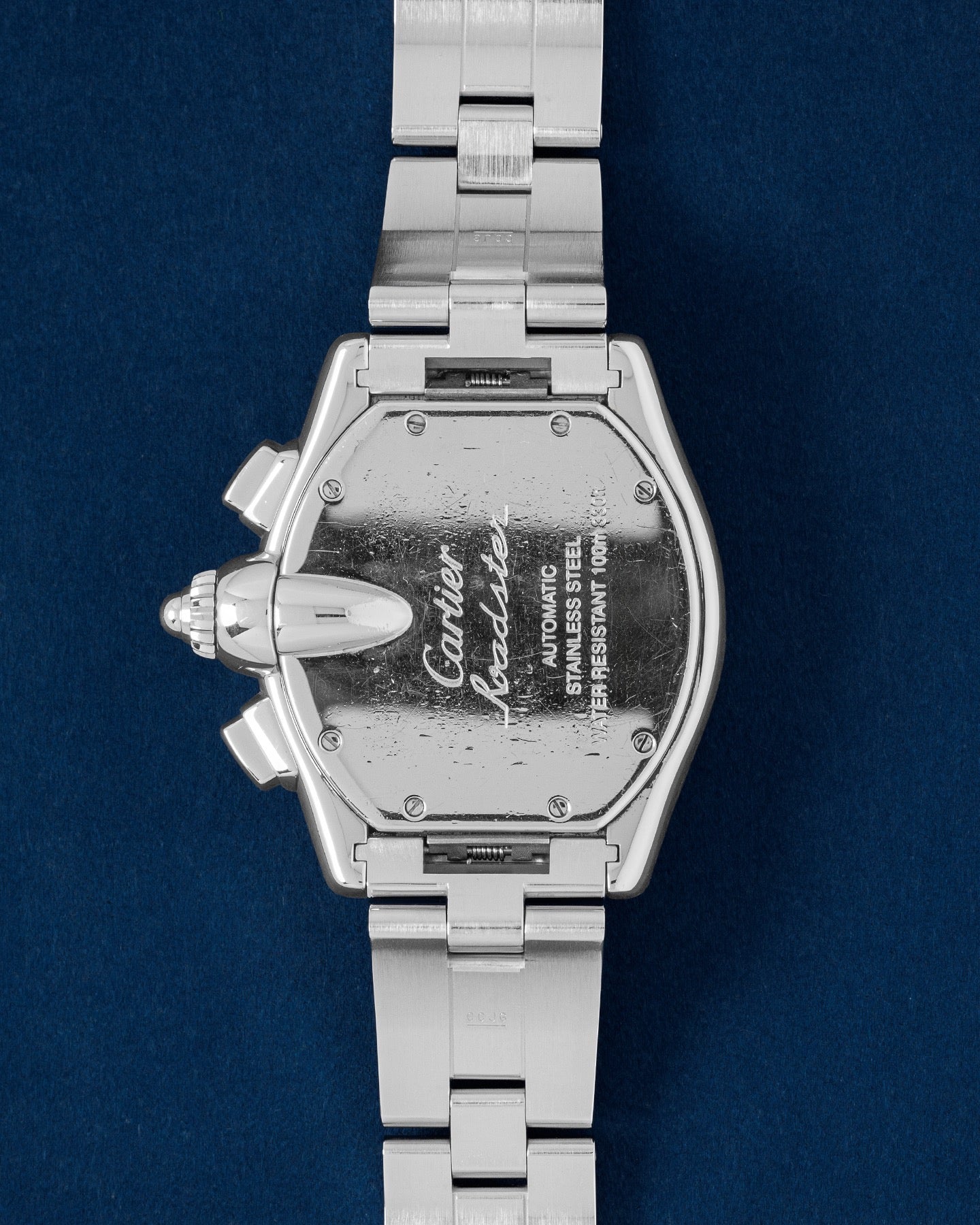
Cartier Roadster Chronograph W62020X6




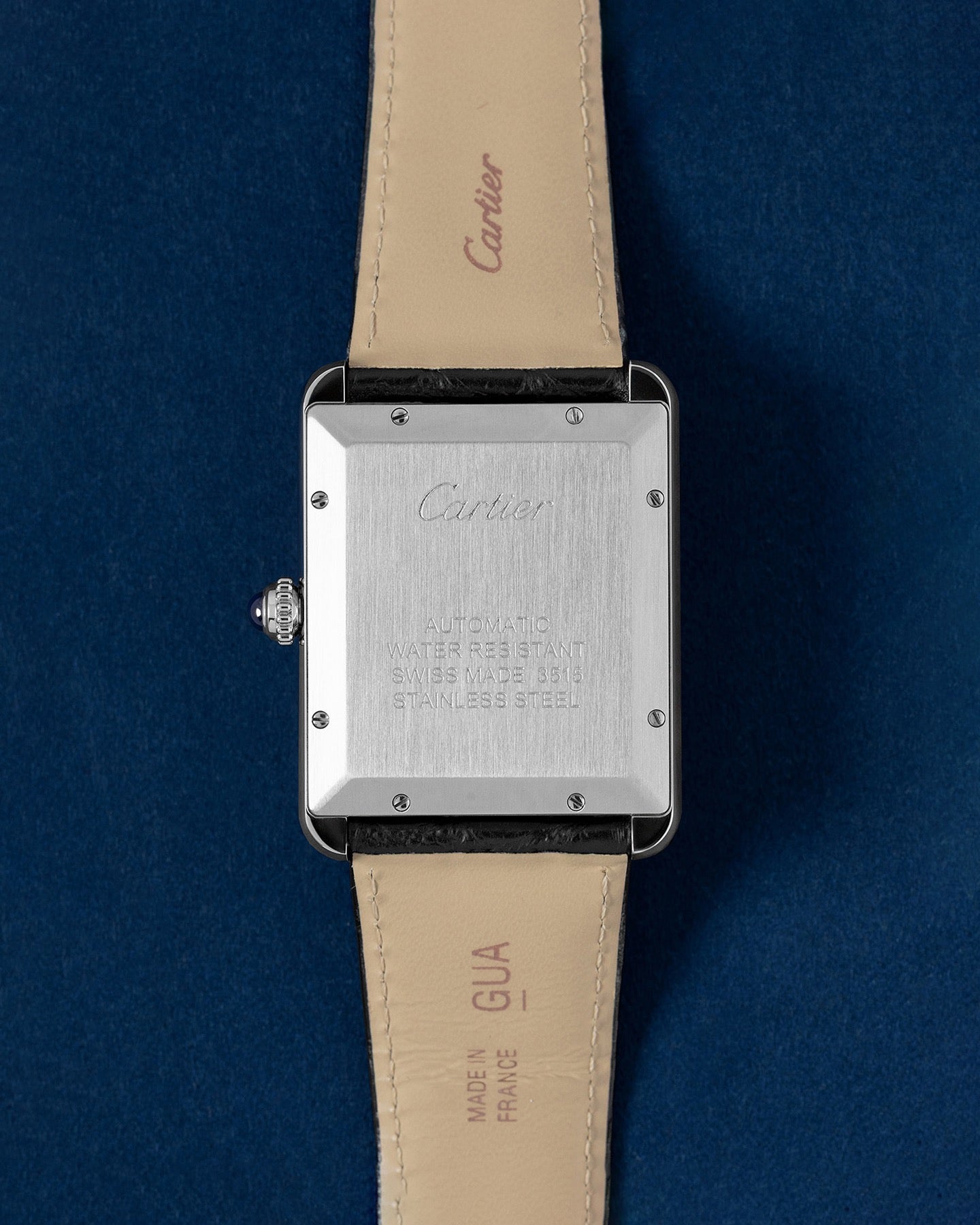
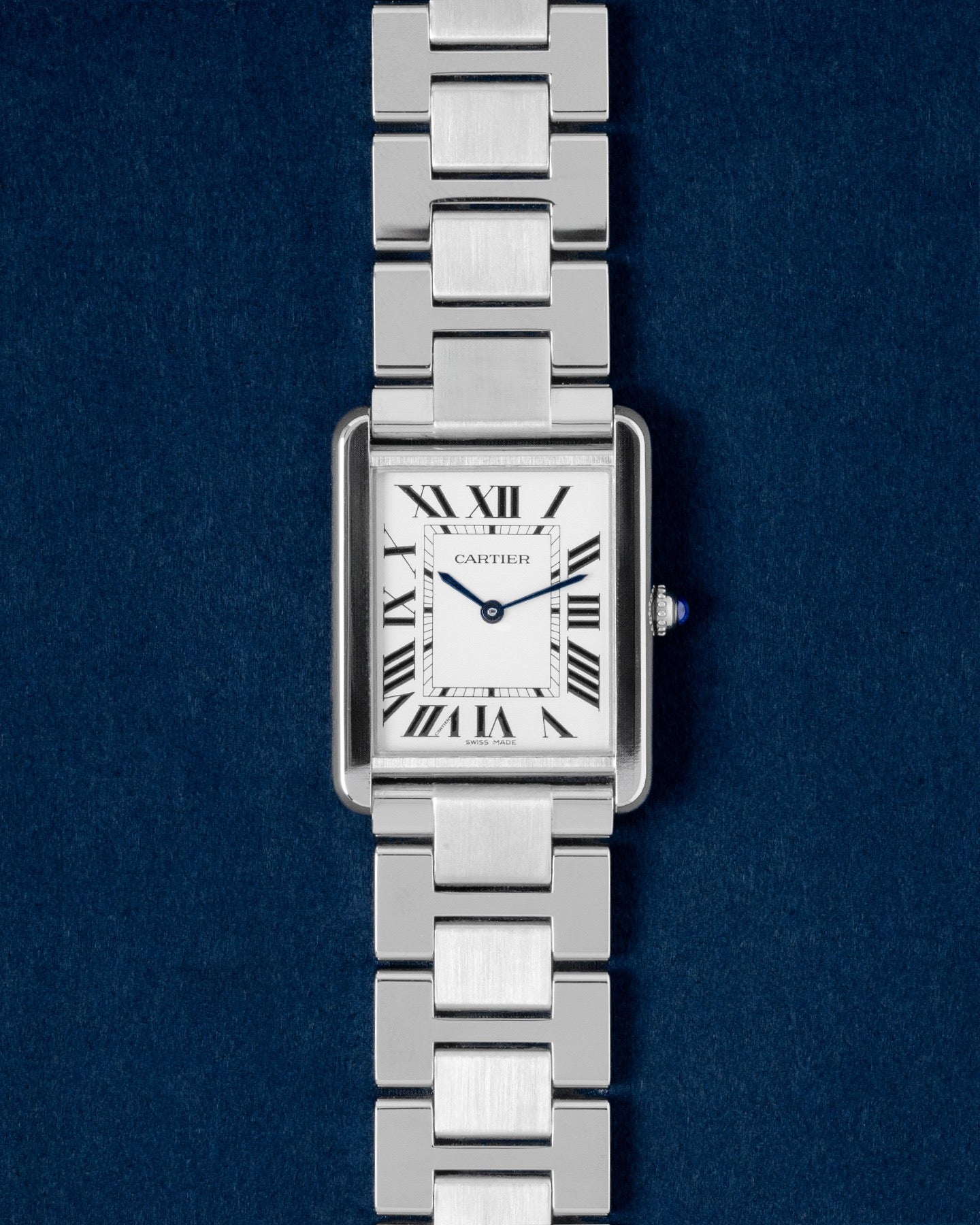
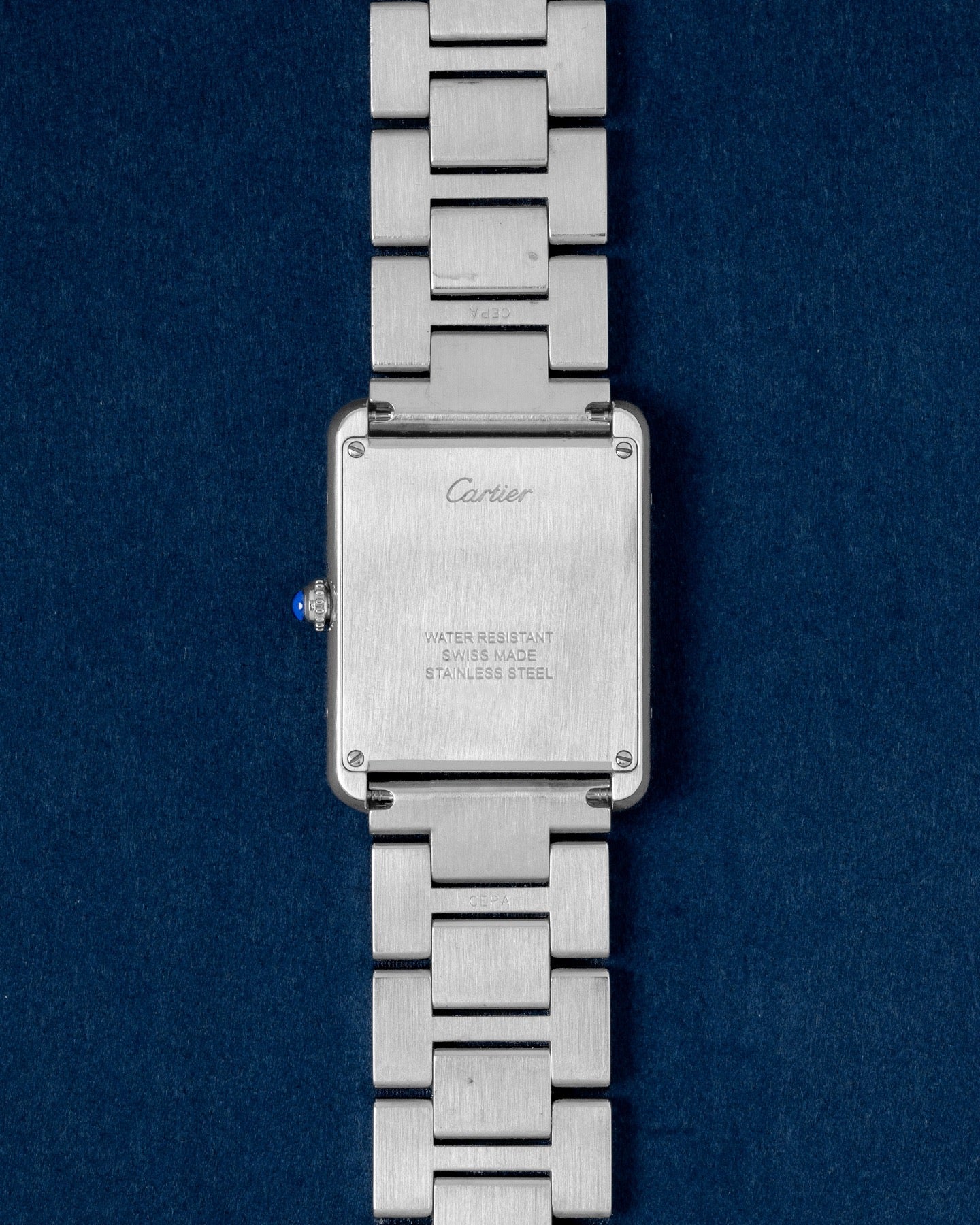
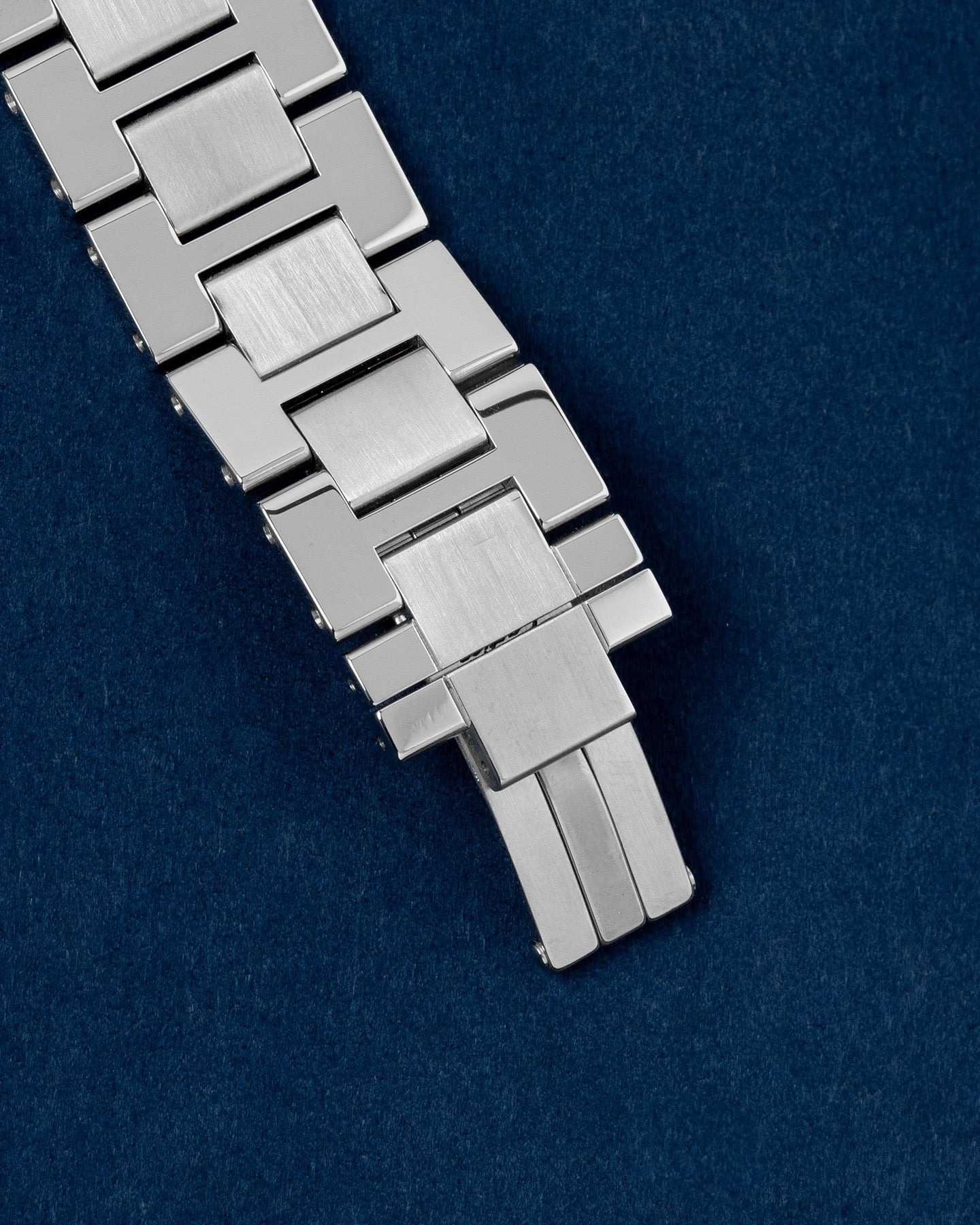
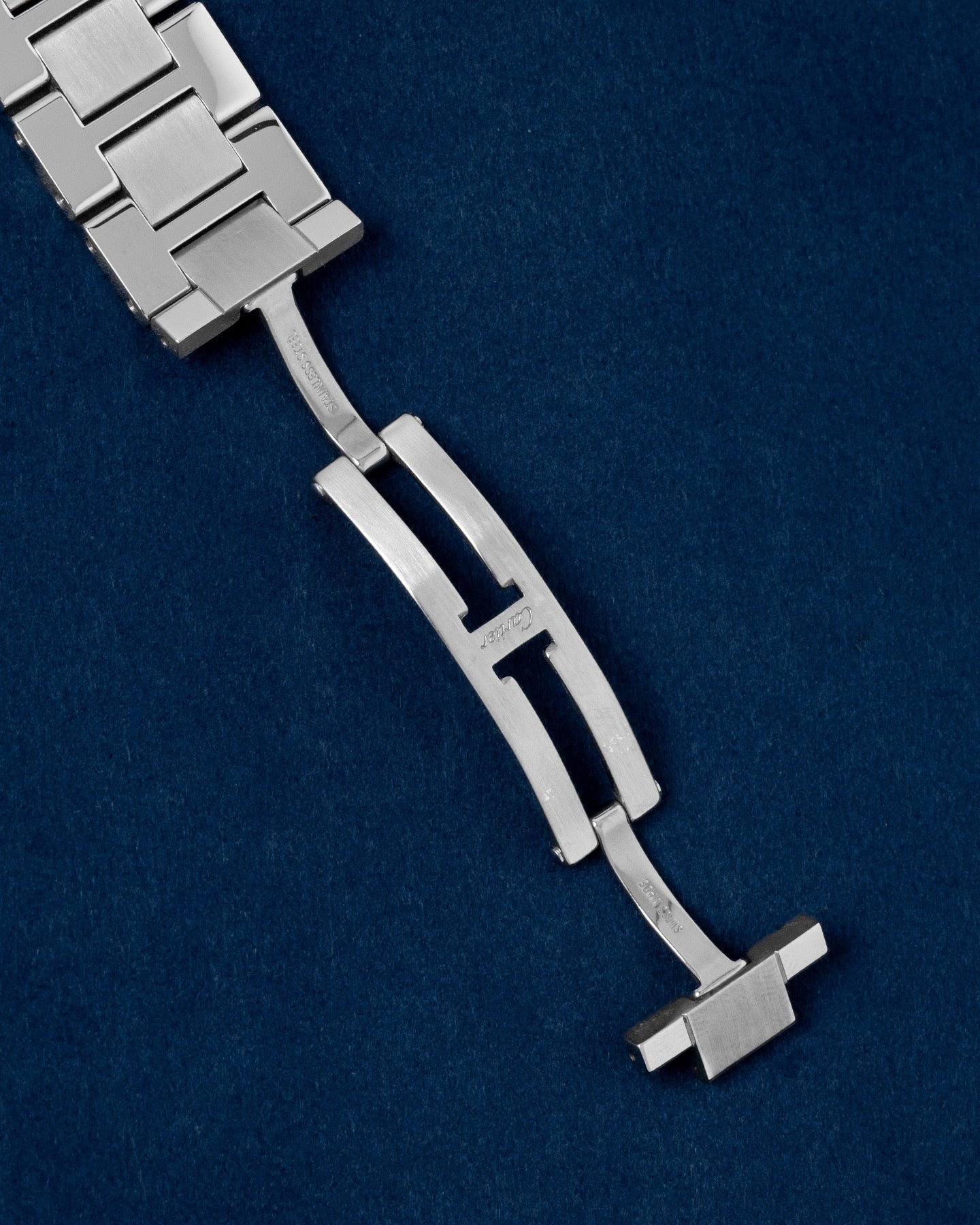

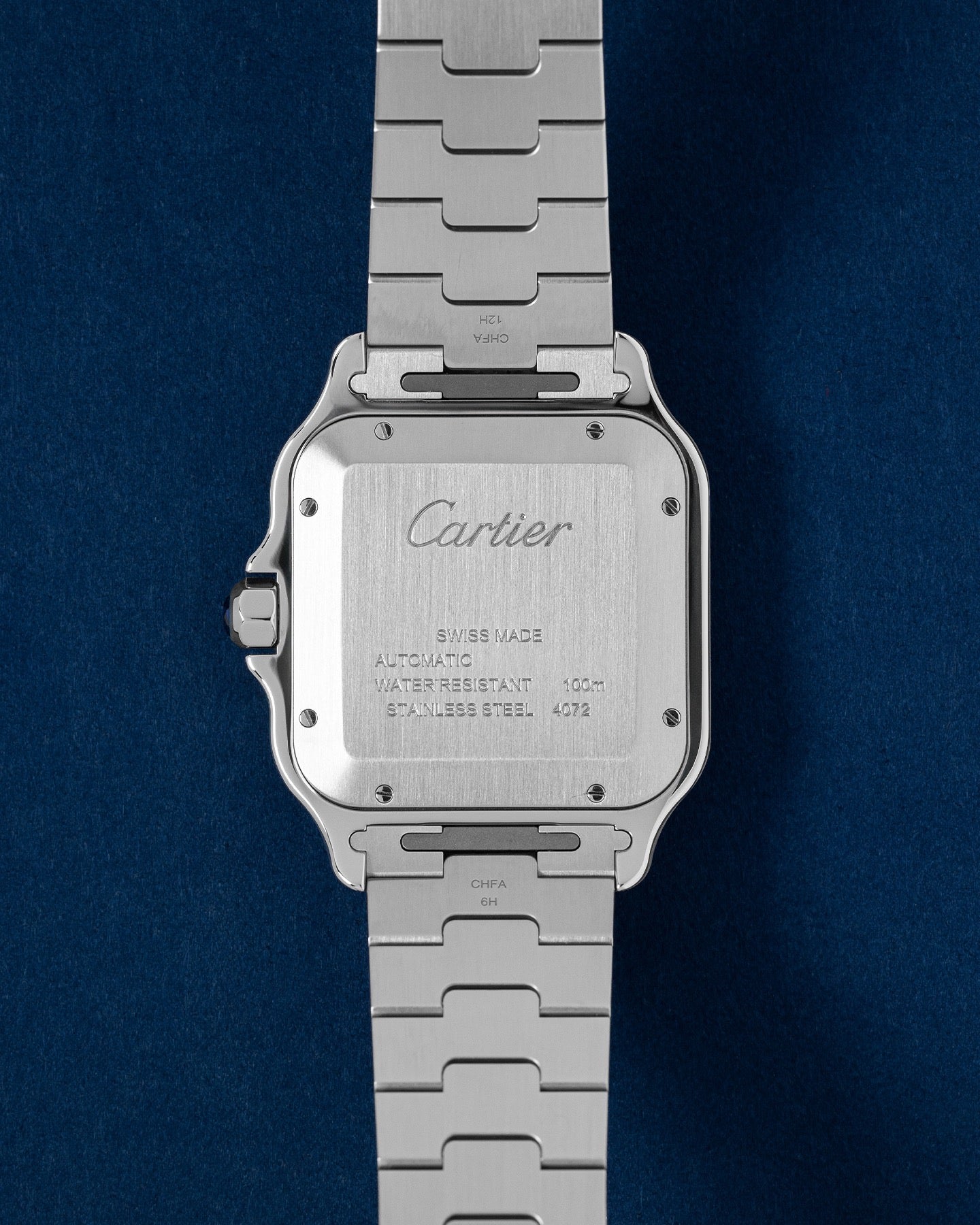


Vintage

Vintage
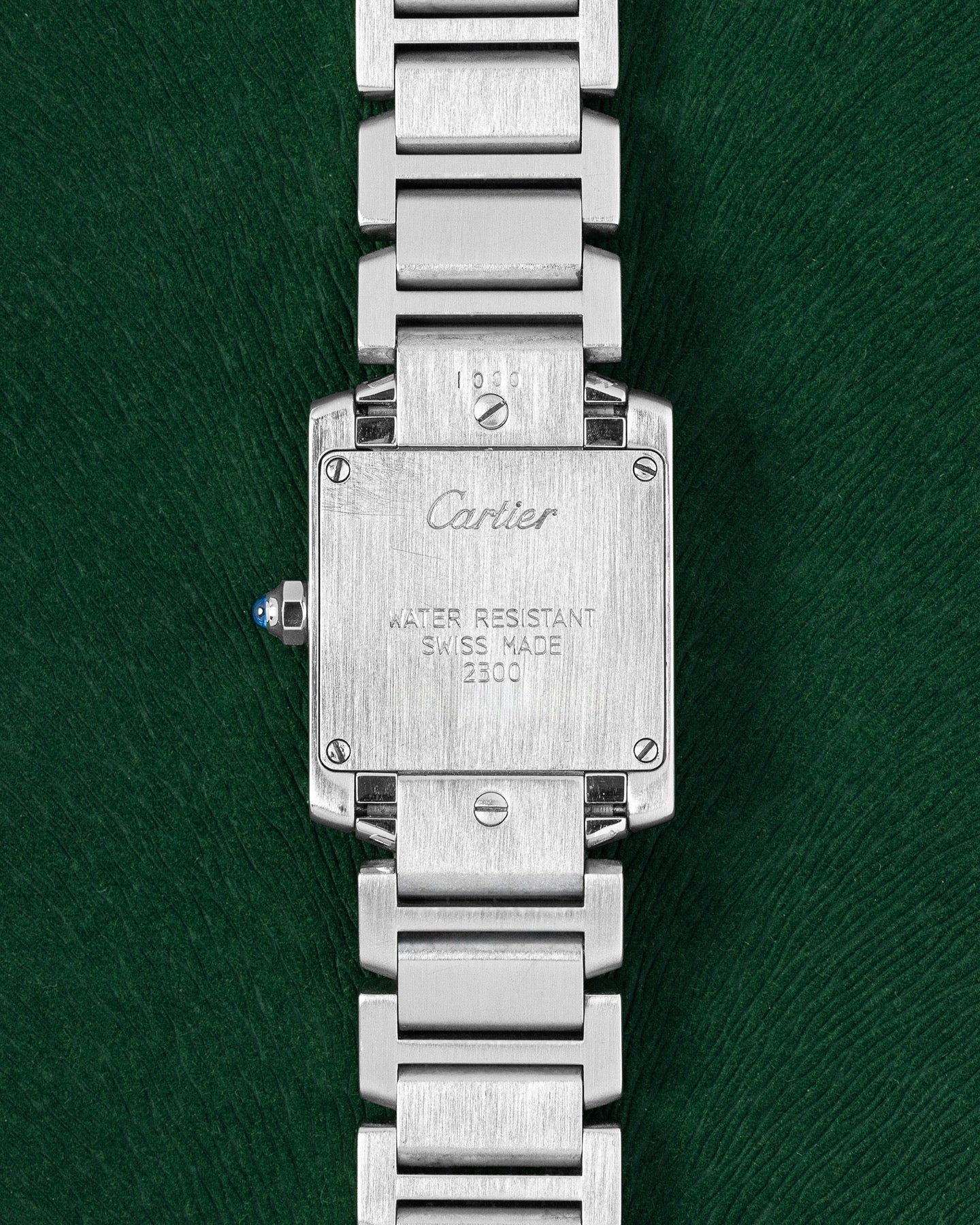
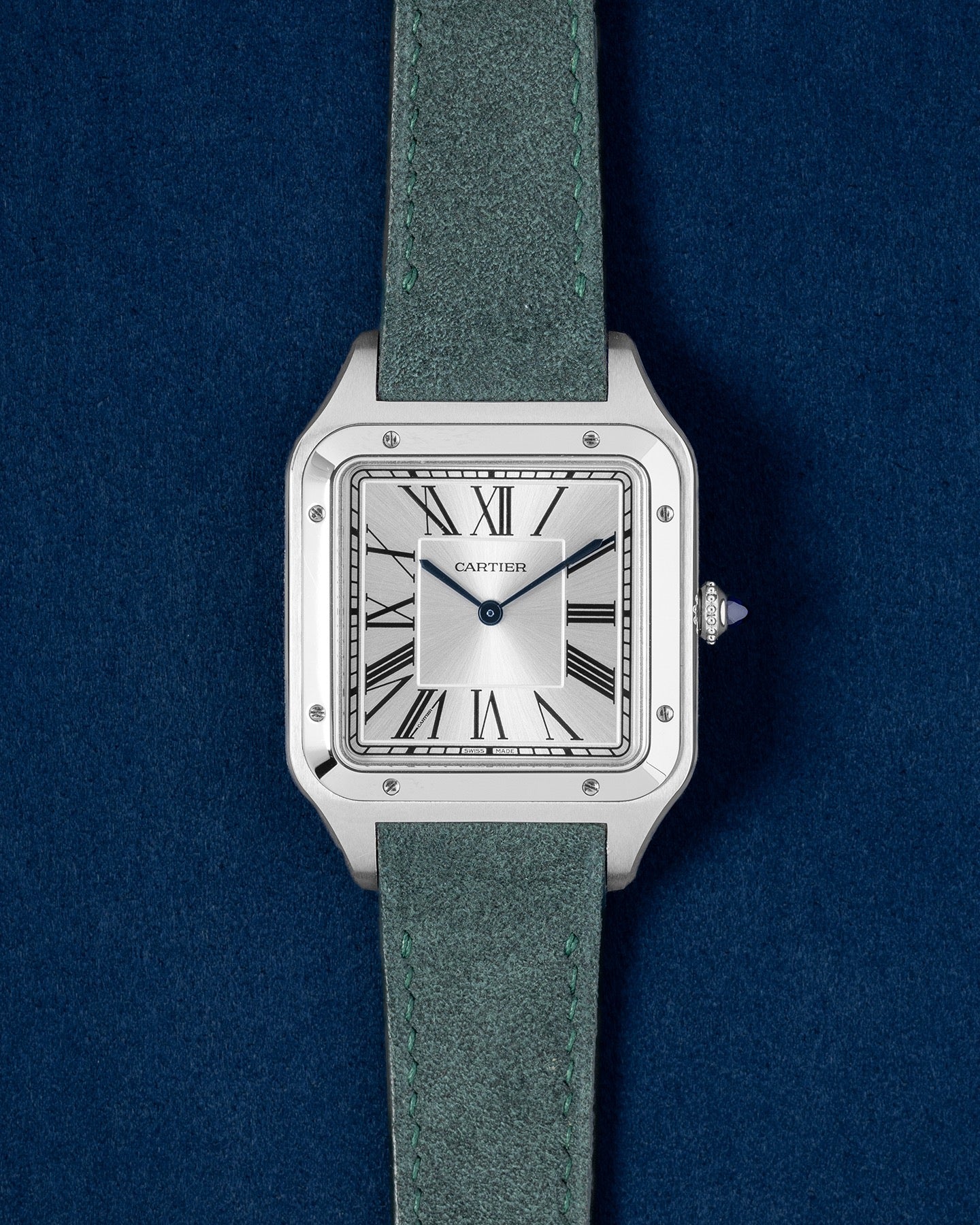
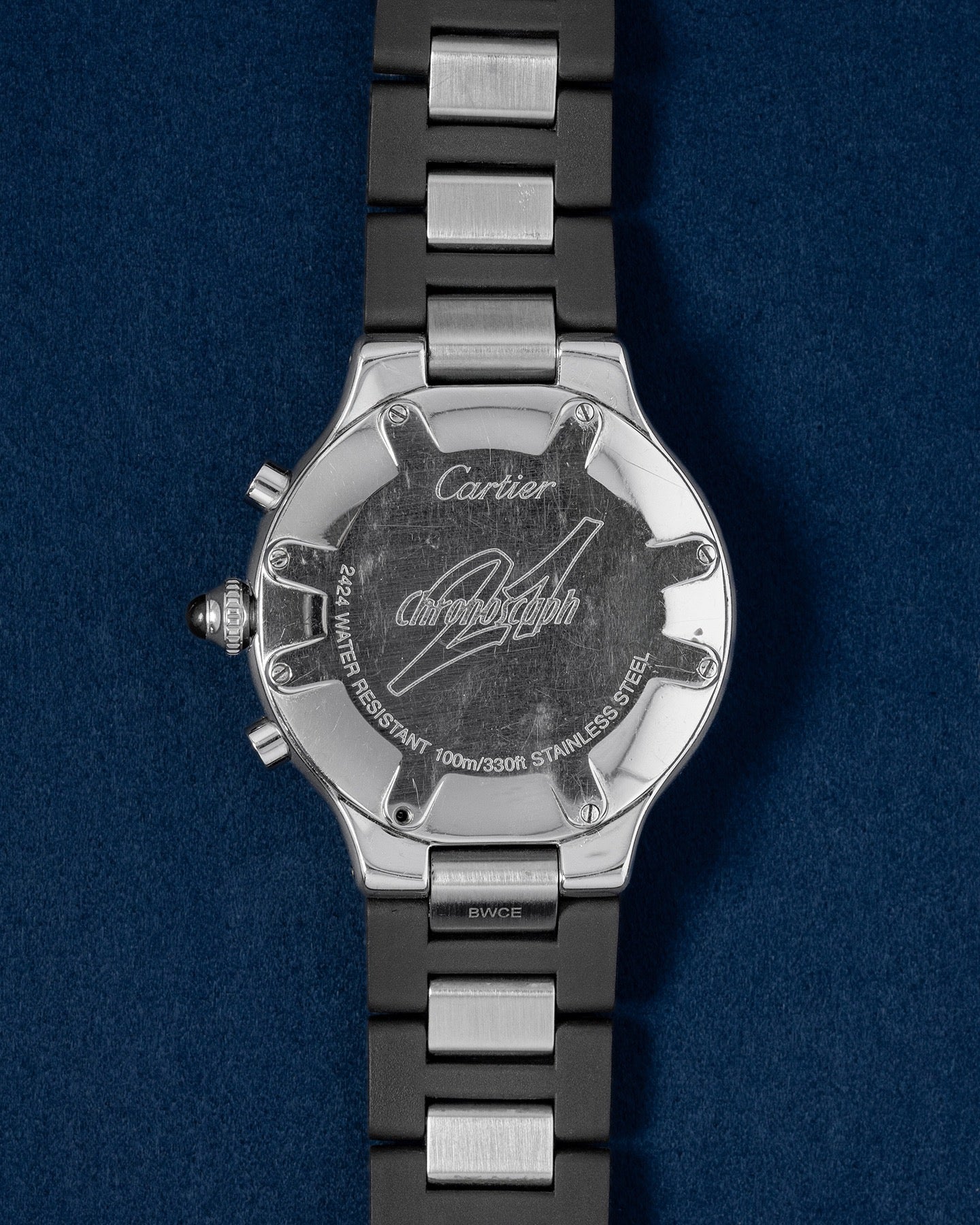
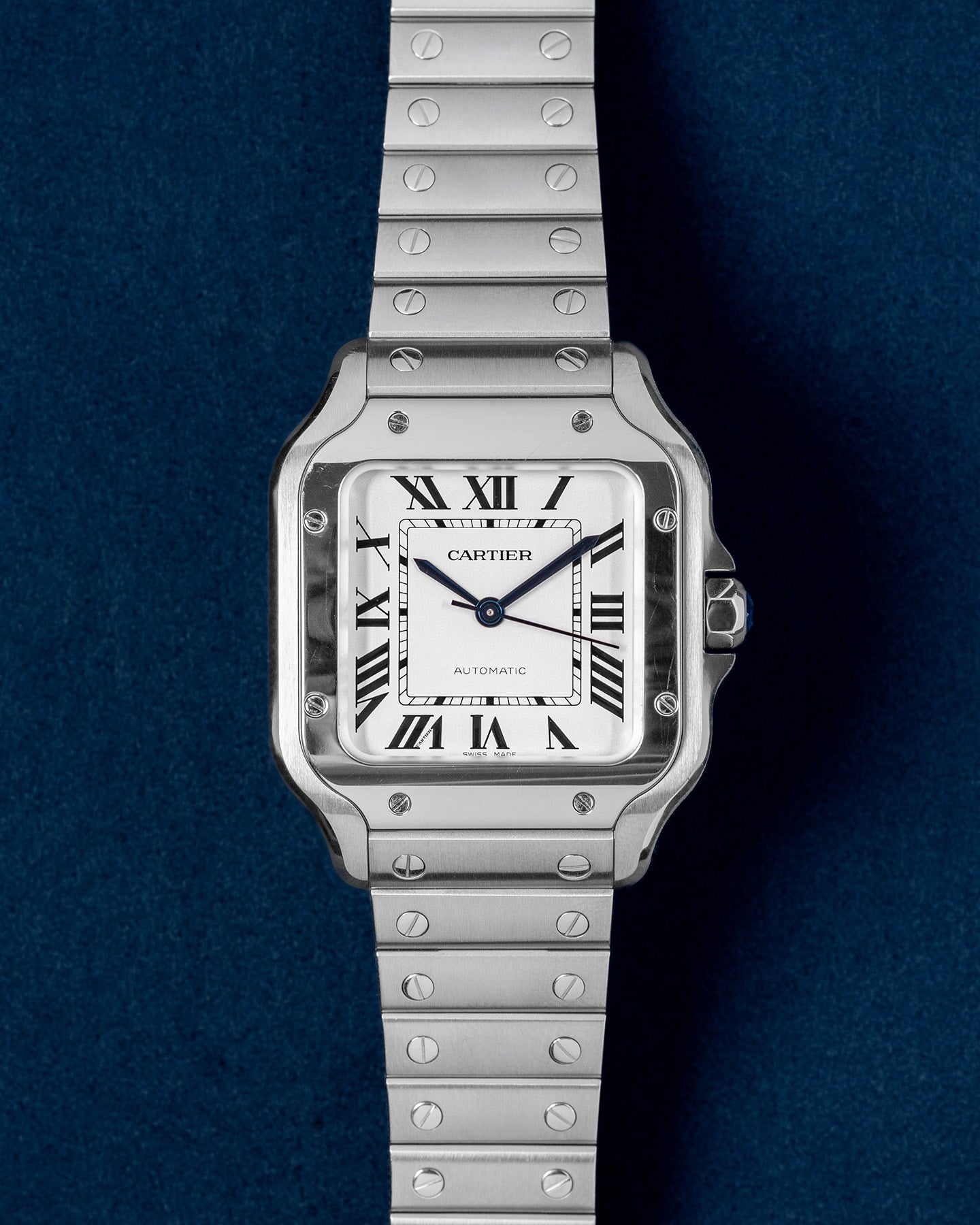


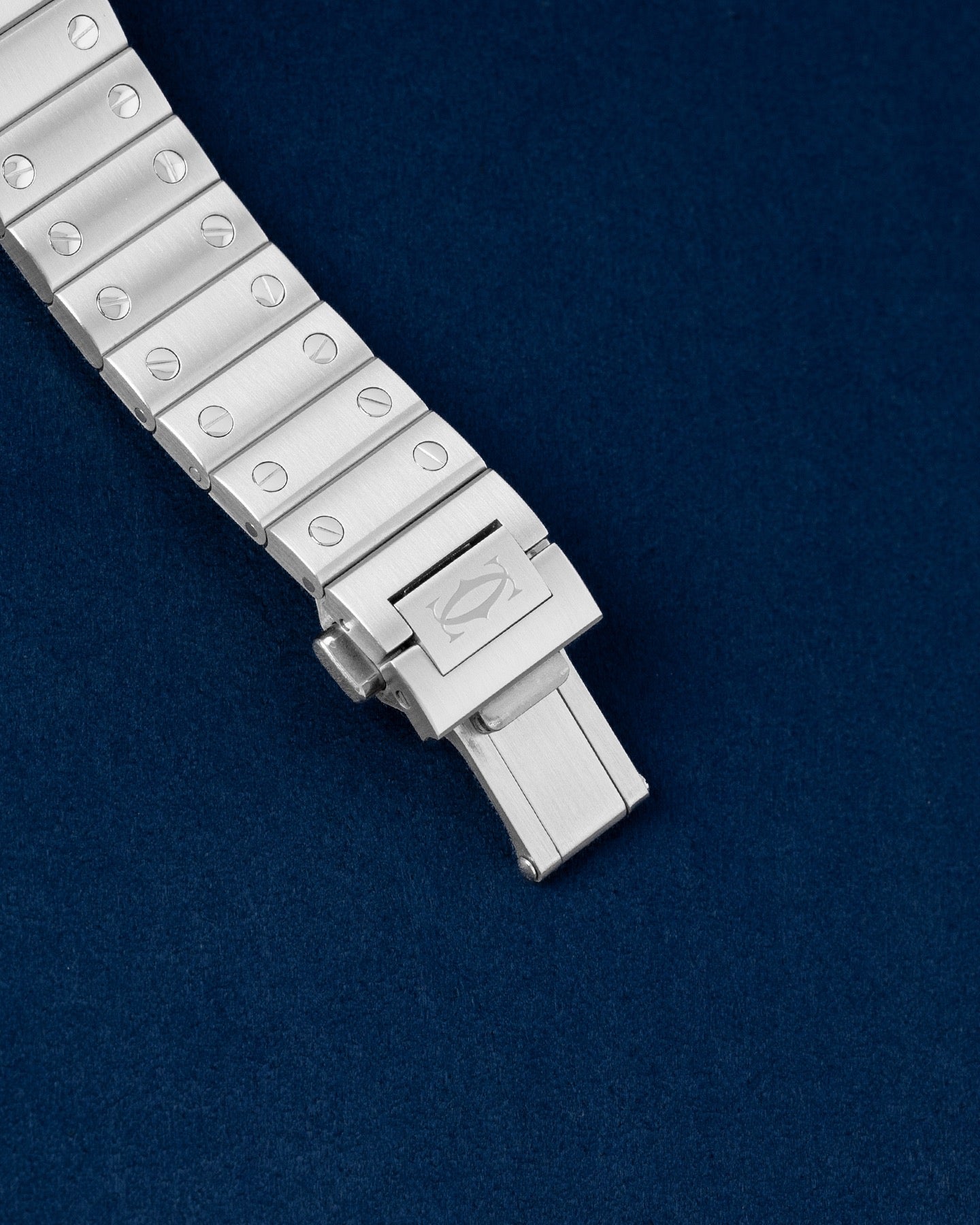
Vintage
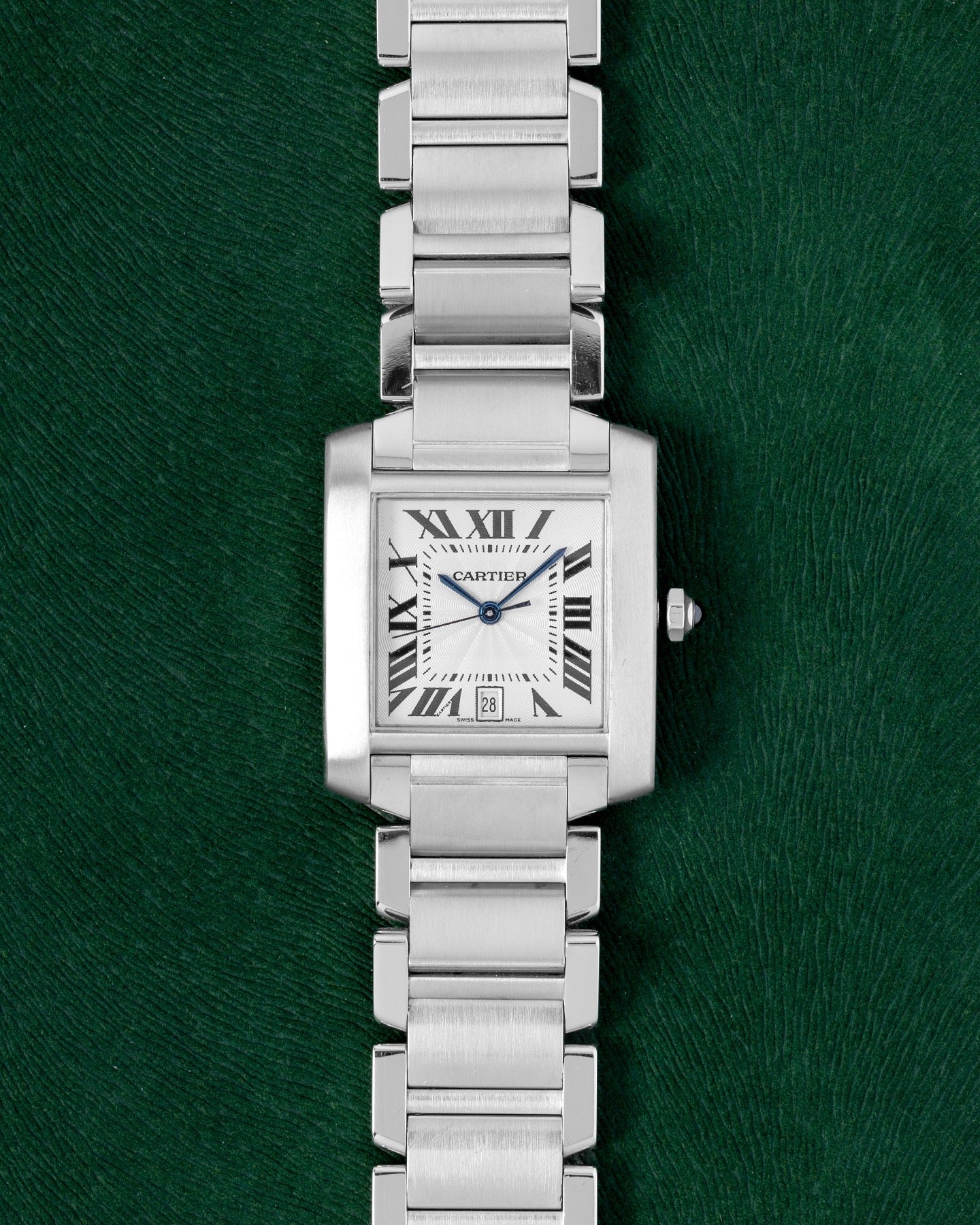
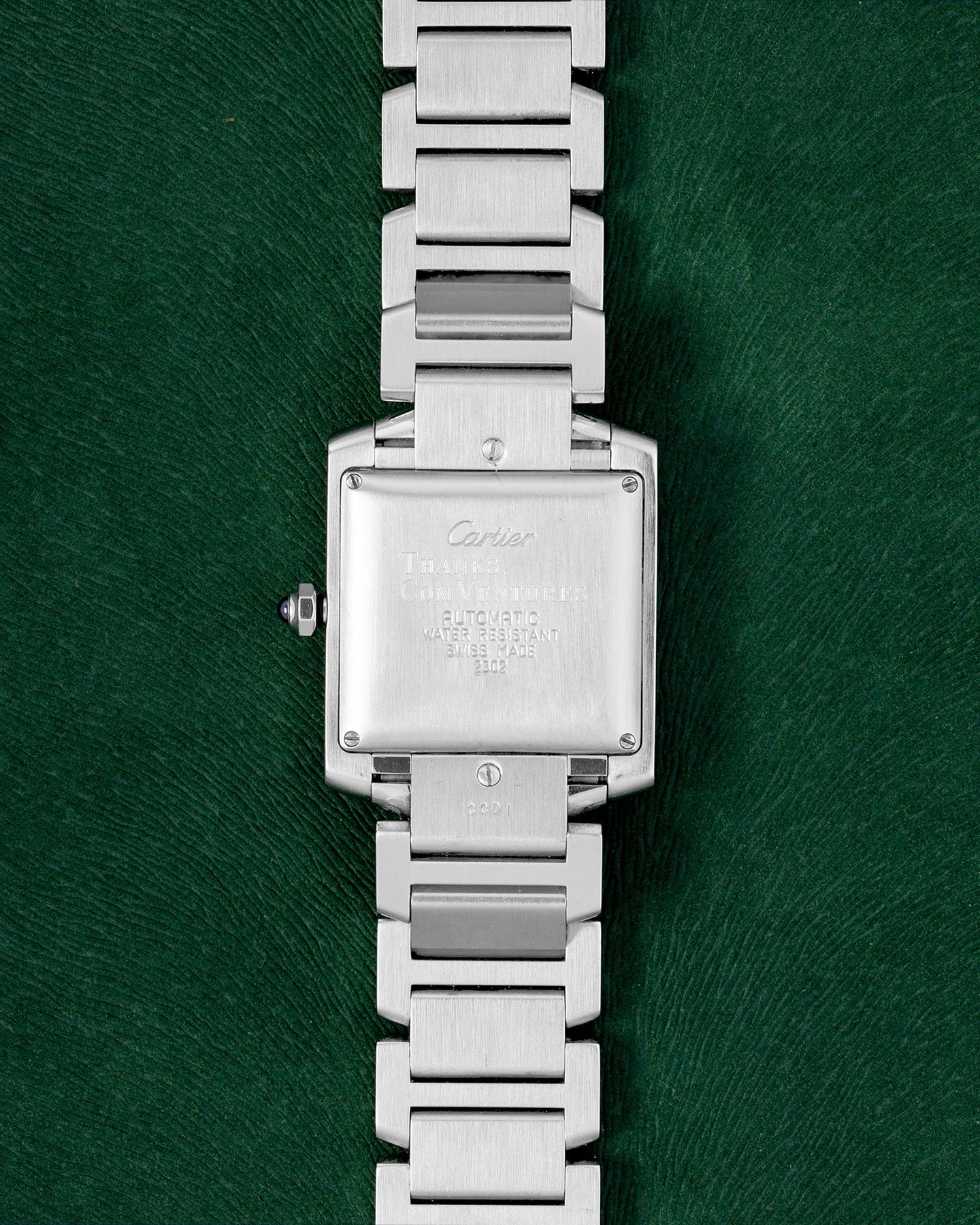
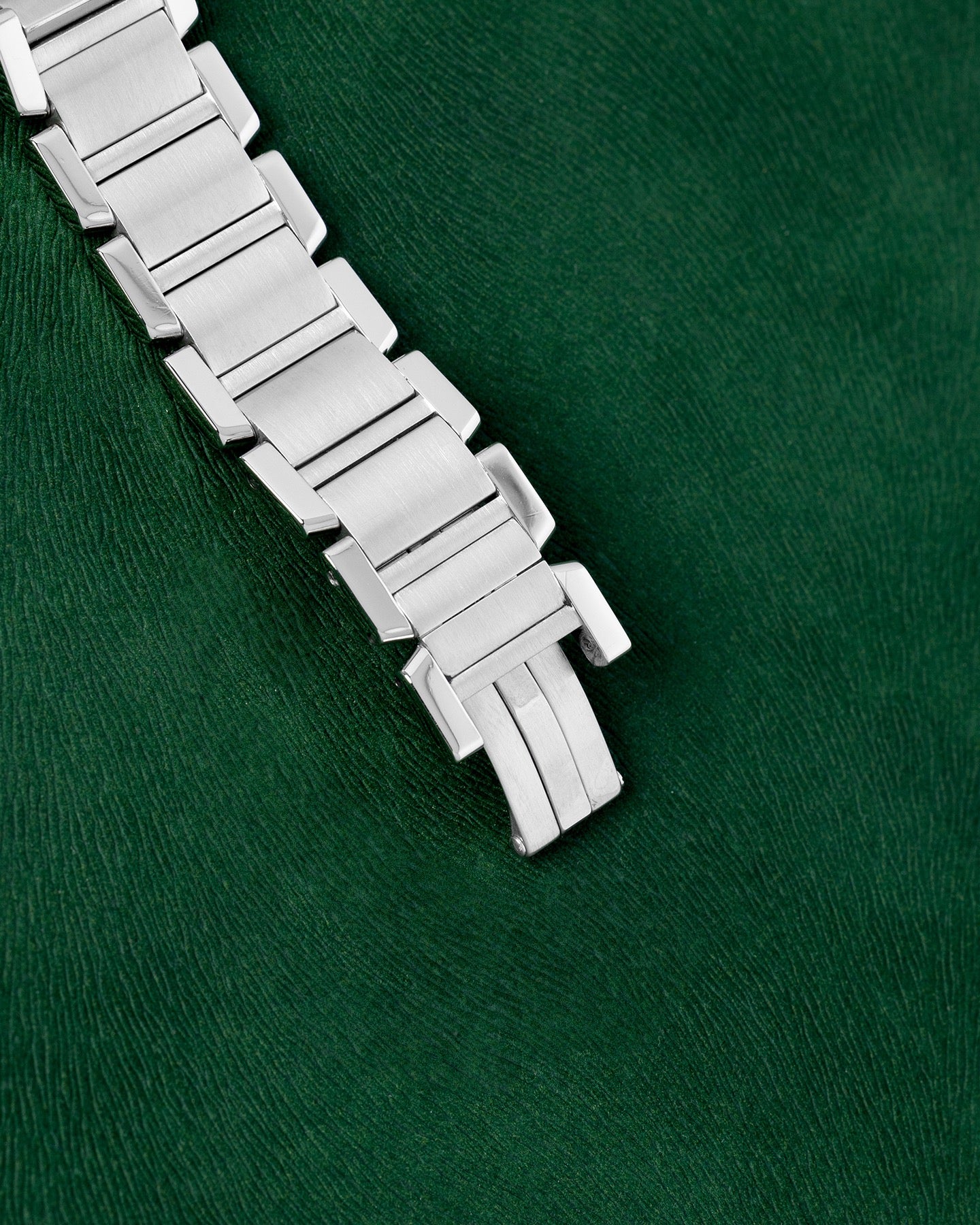
History of Cartier
Cartier was founded in Paris in 1847 when Louis-François Cartier, a twenty-eight-year-old jeweler, took over the workshop of his master, Adolphe Picard. By the early 1900s his grandsons Louis, Pierre, and Jacques had built the house into a global maison with branches in Paris, New York, and London, and King Edward VII had crowned it "the jeweller of kings, the king of jewellers." Cartier's first wristwatch arrived in 1904, designed by Louis Cartier for his friend, the Brazilian aviator Alberto Santos-Dumont. The Tank followed in 1917. More than a century later, both designs are still in production.
Why Choose Grand Caliber
Grand Caliber is a luxury watch dealer in Uptown Dallas, sitting on McKinney Avenue with clients spread across the country. We buy, sell, source, and consign Cartier across the full catalog, from the Santos-Dumont and Santos de Cartier to the Tank Louis Cartier, Tank Française, Tank Américaine, Tank Must, Panthère, Ballon Bleu, and the vintage Paris, London, and New York references that built the maison. Every watch is authenticated in-house by our specialists, prices are posted on every listing, and inventory is one-of-one. Whether you are buying your first Tank or hunting a vintage London piece, come find your next watch.
FAQs
What is the most affordable Cartier?
Wonderful news for anyone starting their Cartier journey: this is one of the most accessible entry points in true luxury watchmaking. The Tank Must, reintroduced by Cartier in 2021 and inspired by the bold vermeil and lacquered Tanks of the 1970s and 1980s, opens the current catalog with retail starting around $3,200 to $3,700 for the quartz-powered small and large sizes in steel. The Santos-Dumont in its smaller cases, also quartz-powered with an impressive six-year battery life, sits in a similar range. Step up to the $5,000 to $7,500 window and you are looking at the larger Santos-Dumont in steel, the mechanical Tank Louis Cartier in small size, and the Ballon Bleu 36mm. The pre-owned market opens things up further, with vintage Tank Louis Cartier and Tank Française references from the 1990s and 2000s frequently landing in the $3,500 to $6,000 range depending on condition and box-and-papers status. Tell us what you want to spend and what draws you to the brand, and we will help you find the right Cartier in your range. Reach out anytime. We are happy to walk through options at any budget.
Can I walk into Cartier and buy a watch?
Yes, generally. Cartier operates a wide network of boutiques and authorized retailers globally, and the brand has built its strategy around availability rather than scarcity. Walking into a Cartier boutique and purchasing a Santos, Tank, Panthère, or Ballon Bleu in current production is usually straightforward, though specific dial colors, limited editions, and certain anniversary references may require a short wait or sourcing from another boutique. The contemporary catalog is broad and well-stocked across most price points. The secondary market is where the more interesting Cartier hunting happens. Vintage Cartier Paris references from the 1970s and 1980s, Cartier London pieces from the celebrated Jean-Jacques Cartier era between 1967 and 1974, and discontinued models like the original Panthère, the Tank Cintrée, and the various Crash variations are only available pre-owned, and the collector market for these has grown substantially over the past decade. We carry modern Cartier alongside vintage examples in our Uptown Dallas showroom, and our specialists know the difference between a Paris-signed Tank from 1985 and a London-signed Tank from 1972 cold. If you are after something specific, we love a good hunt. Come see us, call, or text.
What is the best first Cartier to buy?
The Tank is where most people start, and there is good reason for that. The Tank Louis Cartier in 18k yellow or rose gold is the watch closest to Louis Cartier's 1917 original, and the hand-wound mechanical version is one of the most quietly elegant dress watches anyone makes at any price. If you want stainless steel and a modern wear, the Tank Must in large size hits the sweet spot, with the design heritage of the line and a comfortable everyday size. The Santos de Cartier in medium or large size is the right choice if you want something more substantial and sport-leaning, drawing on the 1904 original Louis Cartier designed for Alberto Santos-Dumont and reissued in its current form in 2018 with the QuickSwitch bracelet system. The Santos-Dumont, with the original square case and beaded crown, is the purist's pick. The Ballon Bleu 36mm in two-tone with the blue cabochon crown is the choice for buyers who want a softer, more rounded shape. None of these is a wrong answer. Tell us what draws you to Cartier and we will help you find the one that feels right. Grand Caliber loves a first-Cartier conversation.
Which Cartier model has the highest demand?
Modern demand is concentrated in two places: the current Santos de Cartier in steel and the vintage market for rare London pieces. The Santos de Cartier large in stainless steel with the blue dial holds steady demand at retail and on the secondary market, and the QuickSwitch bracelet system has made it one of the most quietly versatile sport-luxury watches in production. The Tank Louis Cartier in 18k gold, the Tank Française in stainless steel, and the Panthère medium model all carry consistent collector interest, particularly given the broader resurgence in Cartier popularity over the past decade. The vintage market is where things get genuinely exciting. The Cartier Crash, introduced in 1967 at the London branch, is now one of the most desired watches in any collection. A 1987 yellow gold London Crash sold at Sotheby's Hong Kong on April 24, 2026 for approximately $2 million, the highest price ever paid for a Crash at auction, and Sotheby's "Shapes of Cartier" sale across Hong Kong, Geneva, and New York this year has reset benchmark prices across the entire vintage Cartier market. If a specific Cartier is on your list, our specialists track the market closely and would love to help you find it.
How often should a Cartier be serviced?
Cartier's published guidance is approximately every five to seven years for a full service, which lines up with the industry standard across Swiss manufacturers. In practice, most experienced watchmakers consider every five to ten years a perfectly reasonable interval for daily-worn mechanical pieces, longer for watches in lighter rotation, and longer still for the quartz-powered Tank Must and Santos-Dumont references, which mostly need battery replacement and occasional pressure testing rather than full overhauls. A full service includes complete movement disassembly, cleaning, lubrication, gasket replacement, regulation on a timing machine, and pressure testing for water resistance. Your watch will usually tell you when it is ready: power reserve drops on the mechanical references, timing drifts a few seconds per day, or moisture appears under the crystal in cold weather. Modern Cartier mechanical watches powered by the in-house 1847 MC, 1904 MC, and Piaget-derived calibers are designed for long service intervals and consistent performance. Vintage Cartier with Jaeger-LeCoultre and Frédéric Piguet movements is well-supported by both Cartier and the broader independent watchmaking community. We offer service in-house at Grand Caliber, and our team is happy to walk you through the options when your watch is ready for attention.
How much does a full Cartier service cost?
Cartier service pricing is moderate by luxury watch standards, which is part of what makes the brand such a pleasant long-term ownership proposition. A standard service through Cartier or an authorized service center for a quartz Tank Must, Santos-Dumont, or Ballon Bleu typically runs $400 to $600, often including battery replacement, gasket renewal, pressure testing, and a light polish if the case warrants it. Mechanical time-only services for the Tank Louis Cartier, the larger Santos-Dumont references, and the Santos de Cartier with the 1847 MC movement generally fall in the $700 to $1,200 range. The Santos Chronograph and other chronograph references with the in-house 1904-CH MC caliber run higher because of the additional complexity, typically $1,200 to $1,800 for a full service. Vintage Cartier from the Paris, London, and New York workshops, particularly pre-2000 pieces with Jaeger-LeCoultre or Frédéric Piguet movements, requires specialist work and individual quotes, often best handled through Cartier directly or through a watchmaker with specific Cartier vintage experience. For a specific quote on a watch in our care, our team at Grand Caliber can advise based on the reference, the movement, and the condition of the case and bracelet.
Can I wear my Cartier every day?
Absolutely, and Cartier is one of the most enjoyable luxury watches to wear daily. The Santos de Cartier was built for daily life from the start, with the 1904 original designed specifically as a wear-it-while-flying tool watch for Alberto Santos-Dumont. The modern version in stainless steel handles daily wear beautifully, with 100 meters of water resistance, the QuickSwitch bracelet system for changing between metal and leather straps in seconds, and the in-house 1847 MC movement designed for daily reliability. The Tank Must and Tank Louis Cartier are more dress-oriented but still wear comfortably day to day, particularly in smaller sizes for daily office and dinner use. The Ballon Bleu and Panthère are similarly easy daily companions. The quartz-powered references are essentially maintenance-free for years at a time. Cartier in precious metal cases, particularly the rose gold Tank Louis Cartier and the yellow gold Santos-Dumont, will show wear faster than steel from contact with desk edges and car doors, but many of our clients consider that part of the relationship. Avoid hot tubs and saunas since heat ages gaskets faster than anything else. Have a vintage piece pressure-tested before serious water use. Otherwise, wear it. The watches are built for it.
How long does a Cartier last?
A lifetime, with proper service. Cartier builds its watches to be serviced, and the maison maintains the parts, the institutional knowledge, and the trained watchmakers to service the modern catalog plus most vintage references going back to the early twentieth century. A Tank Louis Cartier from the 1950s can be brought back to running condition today, either through Cartier's own service operation in La Chaux-de-Fonds or through experienced independent watchmakers who know the Jaeger-LeCoultre movements that powered the line for decades. The modern in-house calibers, including the 1847 MC, the 1904 MC, and the various Piaget-derived movements used across the catalog, are designed for long-term serviceability with parts availability that should extend well beyond any current owner's lifetime. Quartz Cartier references typically need battery service every two to three years and a full overhaul every decade or so, which means a Tank Must purchased today should reasonably keep good time and original appearance for thirty years or more with routine attention. A Santos de Cartier or Tank purchased now will be wearable, accurate, and meaningful a generation from today. The watches reward consistent wear and periodic service, and we are here at Grand Caliber to help with both whenever you need us.
Is it safe to buy a Cartier on the secondary market?
Absolutely, when the dealer authenticates and stands behind what they sell. The pre-owned Cartier market is one of the most active in luxury watches, with substantial volume across dealers, auction houses, and platforms, and the renewed collector interest in vintage Cartier over the past decade has made it one of the most rewarding categories to buy into thoughtfully. Counterfeit Cartiers exist, particularly fakes of the Santos, Tank Française, and Ballon Bleu, and the quality varies. What you want from a dealer is straightforward: in-house authentication, posted pricing, honest condition disclosure including the distinction between Paris-signed, London-signed, and New York-signed vintage pieces where it matters, and a real warranty on the sale. At Grand Caliber, every Cartier is authenticated by our specialists before listing. Every watch is photographed individually, and box-and-papers status appears in the spec list of every product page. If a watch has any non-original component, service-replacement dial, or refinishing that affects collector value, we say so in writing, and the price reflects it. Vintage Cartier collecting rewards transparency more than almost any other category in the market. If you have a question about a specific piece in our inventory, we are happy to walk through it with you on the phone, in the showroom, or over text.
Is a Cartier a good investment?
Cartier has been one of the strongest-performing categories in the luxury watch market over the past decade, and certain references have appreciated meaningfully. Vintage London-signed pieces from the Jean-Jacques Cartier era between 1967 and 1974, original Crash watches, Tank Cintrée references, Pebble watches, and discontinued Panthère models have all moved up significantly, in some cases dramatically. The Sotheby's "Shapes of Cartier" auction series in 2026, with combined estimates exceeding $15 million across Hong Kong, Geneva, and New York, has further reset benchmark prices and brought broader collector attention to the vintage Cartier market than ever before. Modern Cartier holds its value reasonably well, with the Santos de Cartier in steel and the Tank Louis Cartier in gold consistently among the better performers. Here is the honest truth, though: a watch is not a stock, and the Cartier collectors who do best are the ones who buy the watches because they love the design history and the maison's century-and-a-half of jewelry-and-watchmaking heritage. They tend to end up with collections that have appreciated nicely while actually enjoying the watches along the way. That is the right way to think about it. Find the Cartier that speaks to you, and we are ready when you are. Come find your next watch at Grand Caliber.