

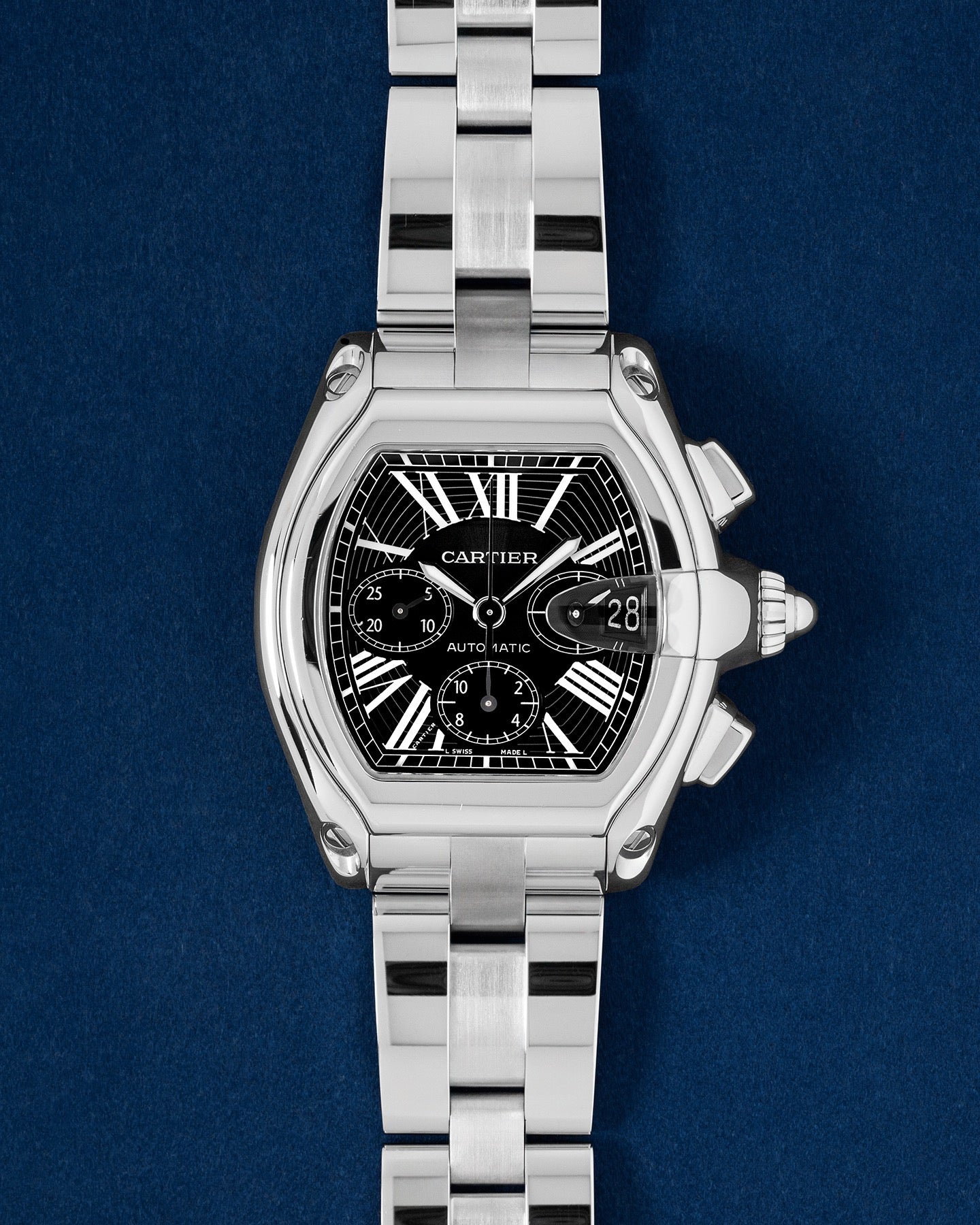
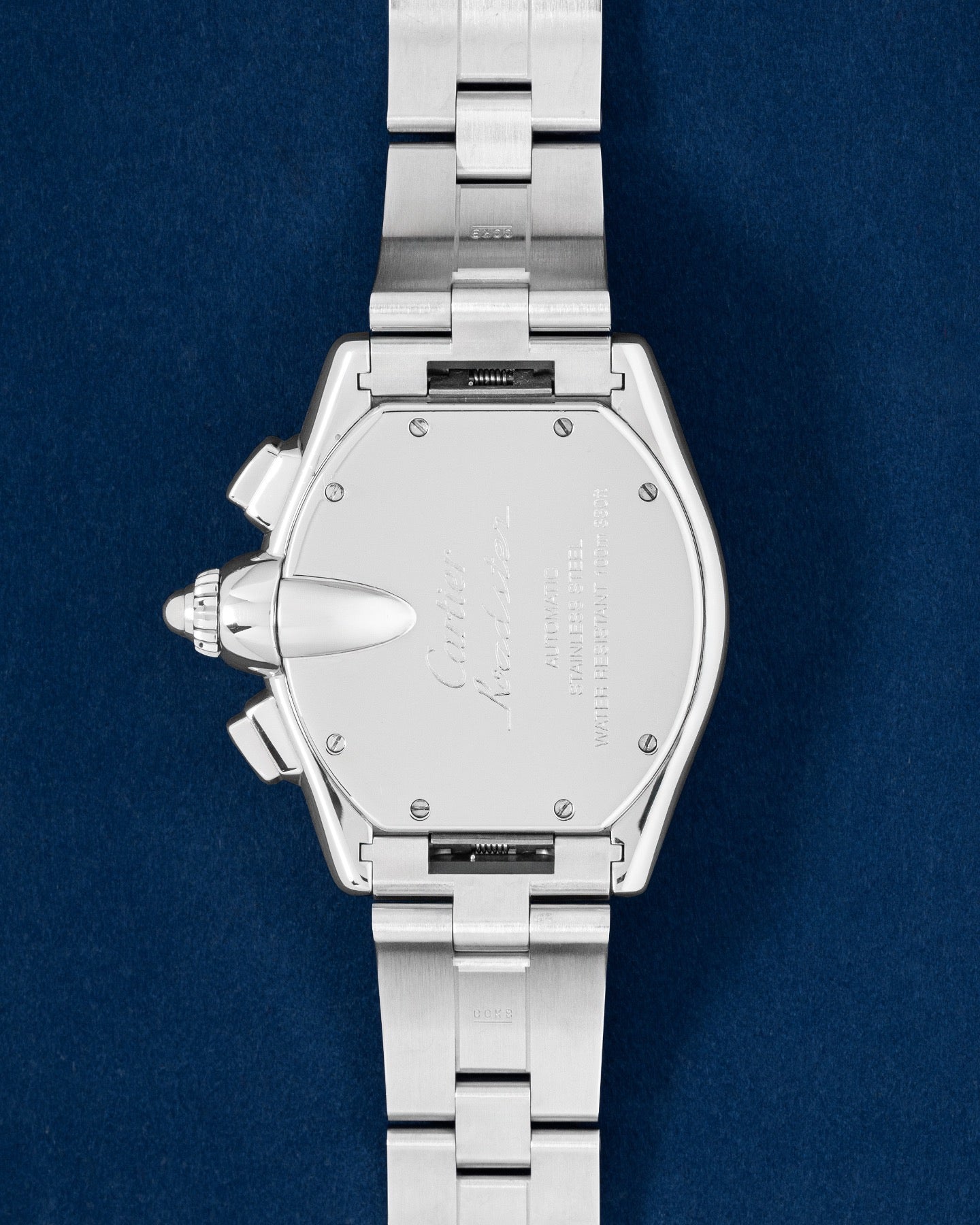
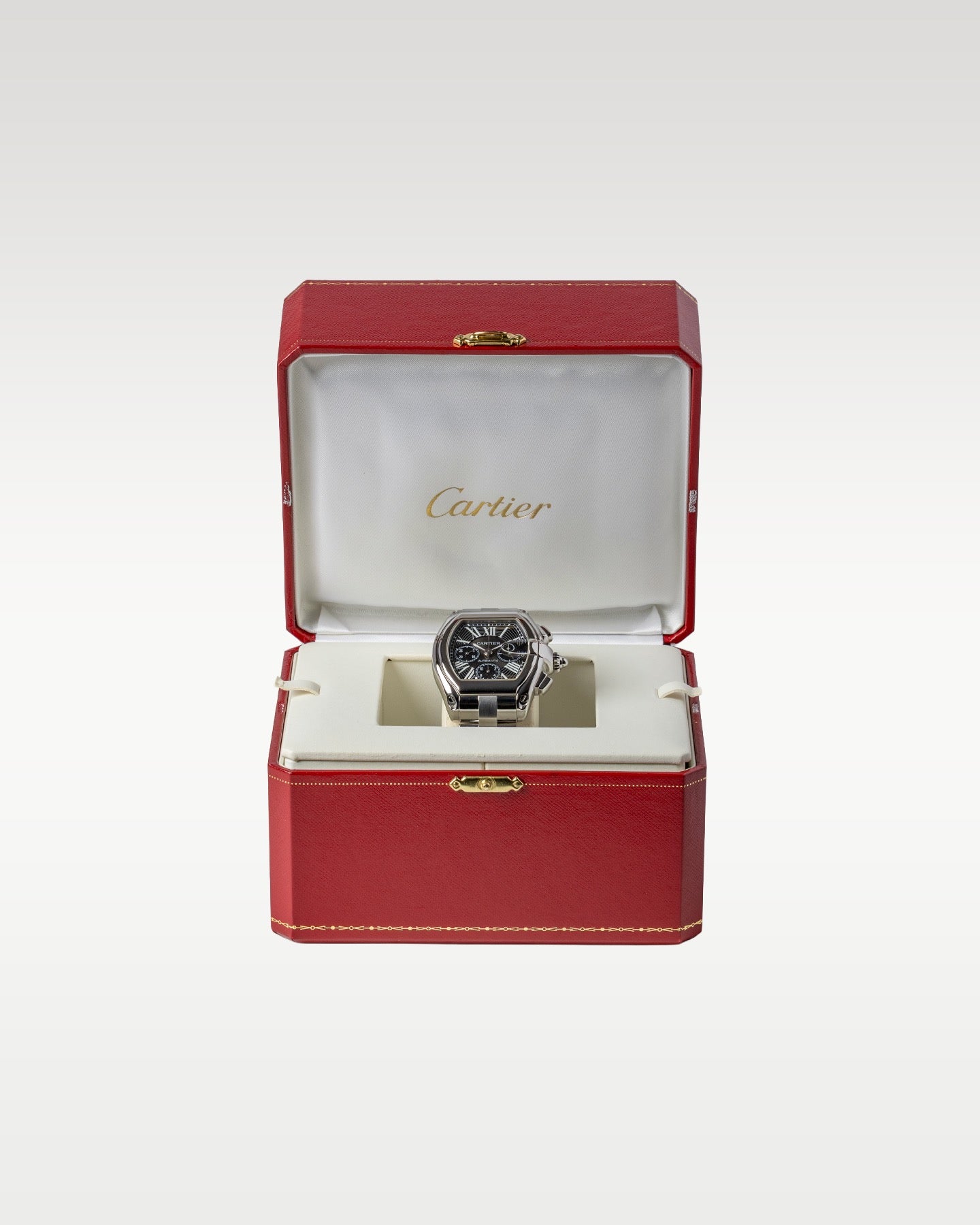
Cartier Roadster XL Chronograph W62020X6
Price on Request
Collector's Notes
Product Details
Brand: Cartier
Model: Roadster XL Chronograph
Reference: W62020X6
Case Material: Steel
Bracelet Material: Steel
Size: 40mm
Dial Color: Black
Bezel Material: Steel
Date: 2006
Condition: Pre-Owned
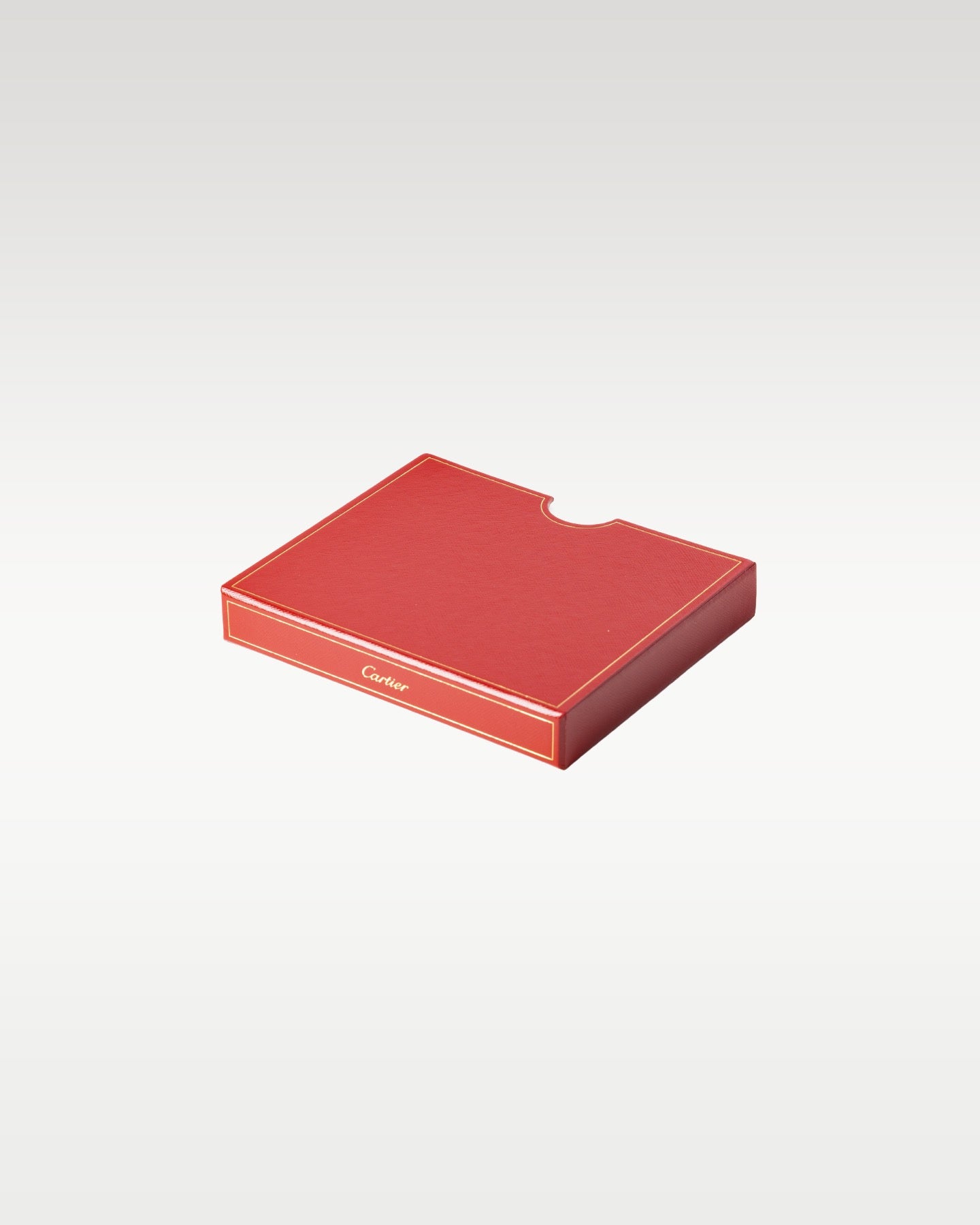
Included Items: Watch with original box and papers
Movement: Automatic
Crystal: Sapphire Crystal
Water Resistance: 10 ATM
Stock ID: 437RR
Shipping & Delivery
Grand Caliber offers free, fully insured FedEx 2-Day shipping on all domestic watch orders. Most orders ship within one business day after payment verification, with delivery to your nearest FedEx Office for secure pickup. Orders are processed Monday through Friday and may ship separately if multiple items are purchased. Delivery dates cannot be guaranteed, and shipments require a physical street address, as P.O. boxes and APO/FPO addresses are not accepted.
A Closer Look at Cartier
Cartier sits in a category of its own at the top of luxury watchmaking, treated as both a Parisian jeweler and a foundational name in the history of the wristwatch. If you are looking at one of our pieces and want to understand what the case shape, the dial, and the reference number are actually telling you, here is what is worth knowing before you decide.
Getting to Know Cartier
Most names at the top of Swiss watchmaking earned their place by perfecting a movement. Cartier earned its place by inventing how a watch sits on the wrist. The house began in Paris in 1847 as a jeweler, and that origin still drives the work today. When you handle one of these pieces, you are looking at a watch designed by people who came to horology from the discipline of jewelry rather than mechanical engineering. The case is the primary object, the dial is the second, and the movement is engineered to fit inside whatever shape the designer has drawn. That order is the opposite of how most Swiss manufactures work, and it is the single biggest thing to understand before you evaluate one of our Cartier pieces.
In practice, the Cartier catalogue looks nothing like any of its competitors. There is no single round case to memorize, no single bezel to spot. Instead there is the Tank, the Santos, the Ballon Bleu, the Pasha, the Panthere, and a deep bench of shaped cases like the Crash and the Baignoire that exist nowhere else in watchmaking. Reading one on the wrist starts with identifying which family you are holding.
How a Cartier Reference Number Works
Every modern Cartier carries a reference number printed on the certificate, etched between the lugs, and engraved on the case back. The current format begins with the letter W followed by a seven character code, typically four letters and four digits. The W is constant across the catalogue and simply indicates a watch. The three letters that follow encode the case material and the collection family: a reference starting with WSSA generally points to a steel Santos, WGTA to a gold Tank, WSBB to a steel Ballon Bleu, WJPN to a jewelry Panthere. The fourth letter usually denotes a sub-variant such as size or dial configuration, and the four digit number at the end is the variant sequence within that line. Cartier has never published an official decoder, so the system is read by recognition rather than by formula, but the second and third letters are reliable signals of metal and family.
Older watches, broadly anything from the 1980s and 1990s, used a four digit reference number on its own without the W prefix. Spotting a four digit reference alone is a quick signal that you are holding either a pre-2000s production piece or an early modern one that predates the migration to the W system. The W prefix rolled out gradually through the 2000s as the Cartier catalogue consolidated under one global naming convention. The reference is the single most useful piece of data to pull off a listing. Match it against the certificate, search it on the secondary market, and you will land within minutes on the exact retail history, the production years, and comparable sale results for that specific case, dial, and metal combination.
The reference number is not the same as the serial number, and the distinction matters when verifying a watch against its paperwork. The serial number is a unique six or seven digit code that identifies the individual watch within its production run. On modern pieces both are engraved on the case back, and the international certificate of guarantee lists both side by side. Hallmarks engraved on the case provide a second layer of confirmation. Precious metal pieces carry a stamp identifying the metal and its purity, Au750 for eighteen karat gold and Pt950 for platinum, and on most cases there will also be a small struck poincon, the assayer's mark required by Swiss or French regulation for precious metal goods. A reference number without a matching serial number, hallmarks that do not align with the stated metal, or a certificate with handwritten alterations are all early signals that a piece deserves a closer authentication pass.
What the Specifications Actually Tell You
Movement and Calibre
Modern mechanical pieces sit on a small handful of in-house calibres made at the manufacture in La Chaux-de-Fonds. The calibre 1847 MC is the workhorse: a self winding movement running at 28,800 vibrations per hour, carrying roughly a 42 hour power reserve, and measuring only 3.8 millimeters thick. It is engineered to stay flat enough for the slim cases the aesthetic demands, and resistant enough to absorb the magnetic exposure of modern phones and laptops thanks to nickel phosphorus escapement components and a paramagnetic shield. The 1904 MC, introduced in 2010, sits a tier above and uses a twin barrel architecture for more constant torque delivery to the escapement rather than for longer reserve. Its chronograph variant, the 1904 CH MC, drives the Pasha Chronograph and the Santos Chronograph XL with a column wheel and vertical clutch. The ultra thin manual winding calibre 430 MC, derived from the Piaget 430P, sits inside the slimmest Tank Louis Cartier and Santos Dumont models. The skeletonized calibre 9611 MC, found in the Santos Skeleton and a few other high horology pieces, is engineered so its baseplate and bridges form the Roman numerals on the dial itself. Outside the mechanical lineup, the Tank Must SolarBeat runs on a photovoltaic quartz movement that draws light through perforations in the dial and is rated for a sixteen year service interval.
Beyond the workhorse 1847 MC, the catalogue uses several other named calibres that show up on listings. The 1904 PS MC adds a small seconds subdial to the standard 1904 MC architecture. The 1853 MC variant appears in select Pasha references. High horology pieces sit on dedicated complications calibres including the 9452 MC tourbillon and movements engineered specifically for the minute repeater and perpetual calendar references in the Rotonde line. Most quartz pieces use Cartier-developed movements based on ETA platforms, identified by reference numbers rather than by a calibre name. Mechanical service is recommended on a roughly five year interval to keep lubricants fresh and the regulating organ in tolerance, though in practice many owners run seven to ten years between service visits. Standard quartz pieces typically need only a battery change every three to four years. The SolarBeat in the Tank Must is the exception, rated for a sixteen year service-free lifespan with no battery to replace at any interval during that window. Knowing which calibre is in the watch in front of you tells you what service costs will look like, what the movement is engineered to prioritize, and where the piece sits in the hierarchy.
The Dial
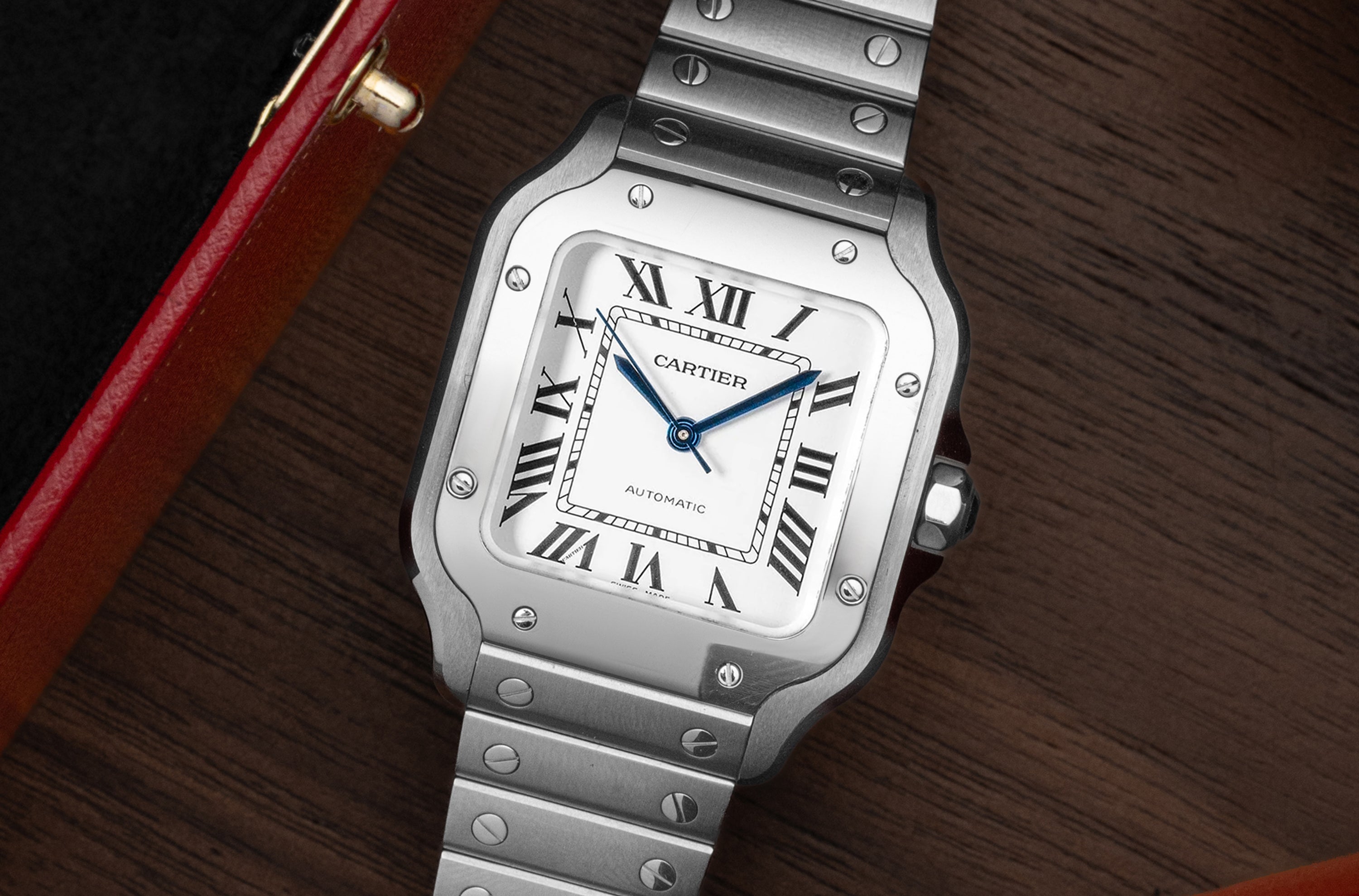
The dial is where Cartier signs its work. The classical signatures are unmistakable: black Roman numerals on a silvered or white guilloche field, a railway minute track running along the chapter ring, blued steel sword shaped hour and minute hands, and a hidden secret signature printed inside the seven o'clock numeral that authenticates the dial under magnification. Every detail is deliberate. The Roman numerals are scaled to the case dimensions individually rather than enlarged uniformly. The blued hands are heat treated over an open flame to reach a specific shade of cornflower blue rather than chemically painted. The cabochon set into the crown is a real sapphire on precious metal cases and a synthetic spinel on most steel pieces. When you handle a dial that has the numerals slightly thin, the proportions slightly off, or a cabochon that catches no light, those are the first signs the piece deserves a closer authentication pass.
Dial finishing itself is a strong signal of where a watch sits in the catalogue. Standard production pieces use a fine grain or sunray finish, often in silver or opaline white. The Tank Louis Cartier in precious metal typically carries a grain d'orge guilloche, a fine barleycorn texture that catches the light at narrow angles. The CPCP and modern Prive pieces use a central rosette guilloche radiating outward from the hands, a signature pattern that is one of the easiest ways to identify a Prive at a glance. Modern Cartier dial colors run beyond the classical silver and white: slate gray, burgundy, deep green, navy blue, and lacquered black have all entered the regular production palette across the Santos and Ballon Bleu lines in the last several years. Mother of pearl dials appear on women's pieces across the Ballon Bleu, the Panthere, and the Tank Francaise. When a listed dial color does not match what reference databases show for that exact reference, the dial has either been refinished or service-replaced, both of which materially affect value.
Case Material and Size
Material drives both price and presence on the wrist. Steel anchors the entry into the brand and dominates the modern Santos de Cartier, Ballon Bleu, and Tank Must lines. Yellow, rose, and white gold are reserved for the more formal pieces, particularly the Tank Louis Cartier, which is almost never made in steel. Platinum and high jewelry executions sit at the top of the catalogue, often as limited Prive pieces. Sizes are best read by silhouette. The Tank is measured by case width and lug to lug length rather than diameter, the Santos by width across the brancards, and the round cases by traditional diameter. A 35 millimeter Santos Medium wears noticeably larger than a 35 millimeter round watch from any other manufacture because the square case takes up more of the wrist surface. Read the printed dimensions alongside the case shape, never in isolation.
Water Resistance and Crystal
Ratings vary widely across the catalogue. The modern Santos de Cartier carries a 100 meter rating that makes it a genuine daily wearer, and the modern Pasha de Cartier carries 100 meters as well, drawing on the screw down crown architecture that the line originally introduced to the brand. The Tank line generally sits at 30 meters or 50 meters depending on the model, enough for handwashing and unexpected weather but not for swimming. The Ballon Bleu sits in the 30 meter range. Crystals are sapphire across the modern catalogue, often domed to follow the curve of the case as on the Ballon Bleu and the Baignoire, and frequently shaped to match the case geometry rather than cut from a standard circular blank.
Case Back Markings
The case back carries the technical fingerprint of the watch. On modern pieces, the engraving sequence typically reads from the outer edge inward: the model name and reference number, the serial number, the water resistance rating, and Swiss Made on contemporary catalogue pieces. Hallmarks for precious metal Cartier cases appear separately, often near the edge of the case back. Solid case backs are standard across the catalogue, with sapphire exhibition backs reserved for the Skeleton, Prive, and high horology lines where the movement architecture is itself the design statement. Engraved limited edition numbering, when present on a Prive piece, sits prominently on the back in the format XX/YY indicating the position within the production run. A blank or smoothed case back, a faint reference number, or a missing serial number are all signals that the case has been polished aggressively or refinished, both of which affect the value of the piece.
Strap and Bracelet Systems
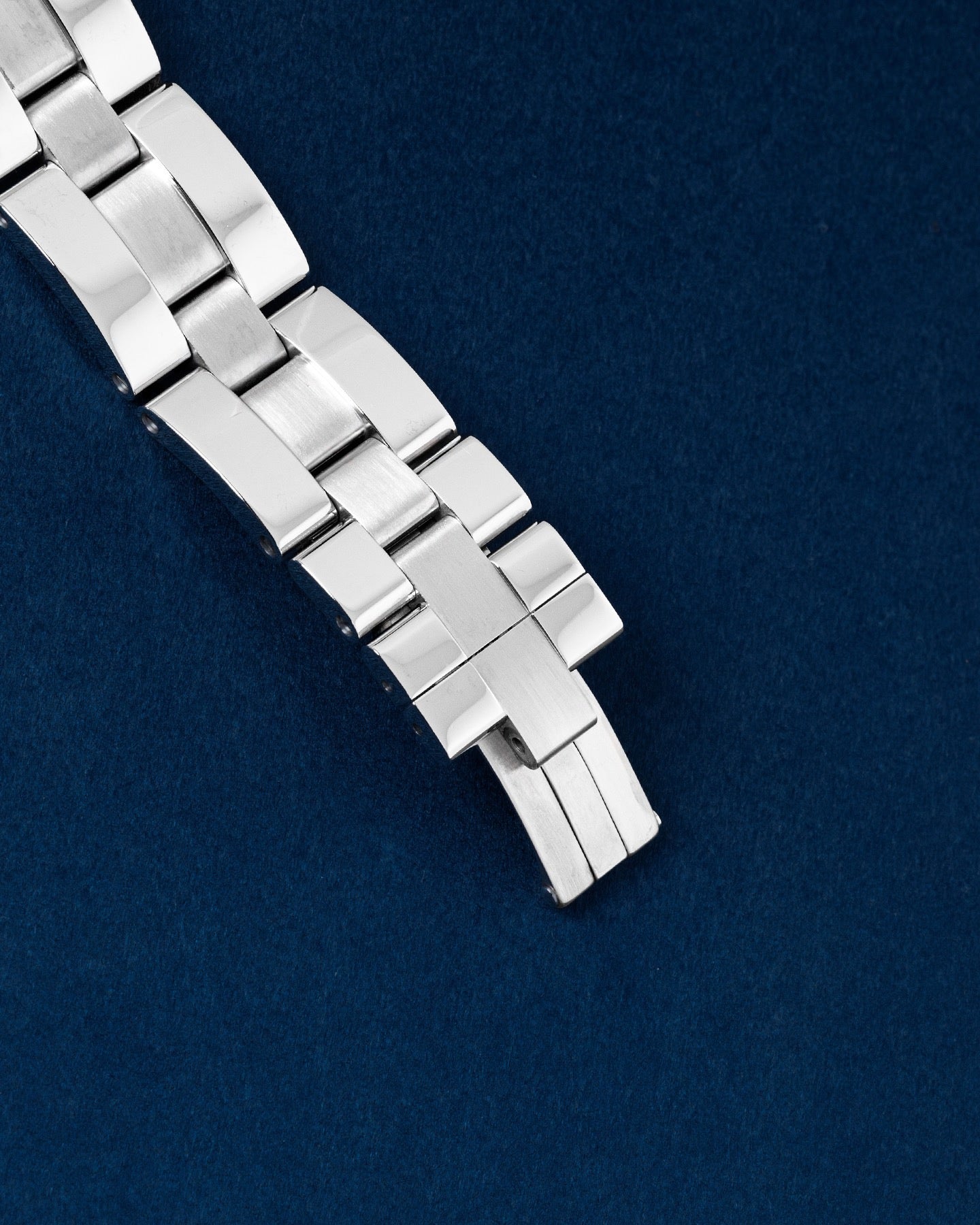
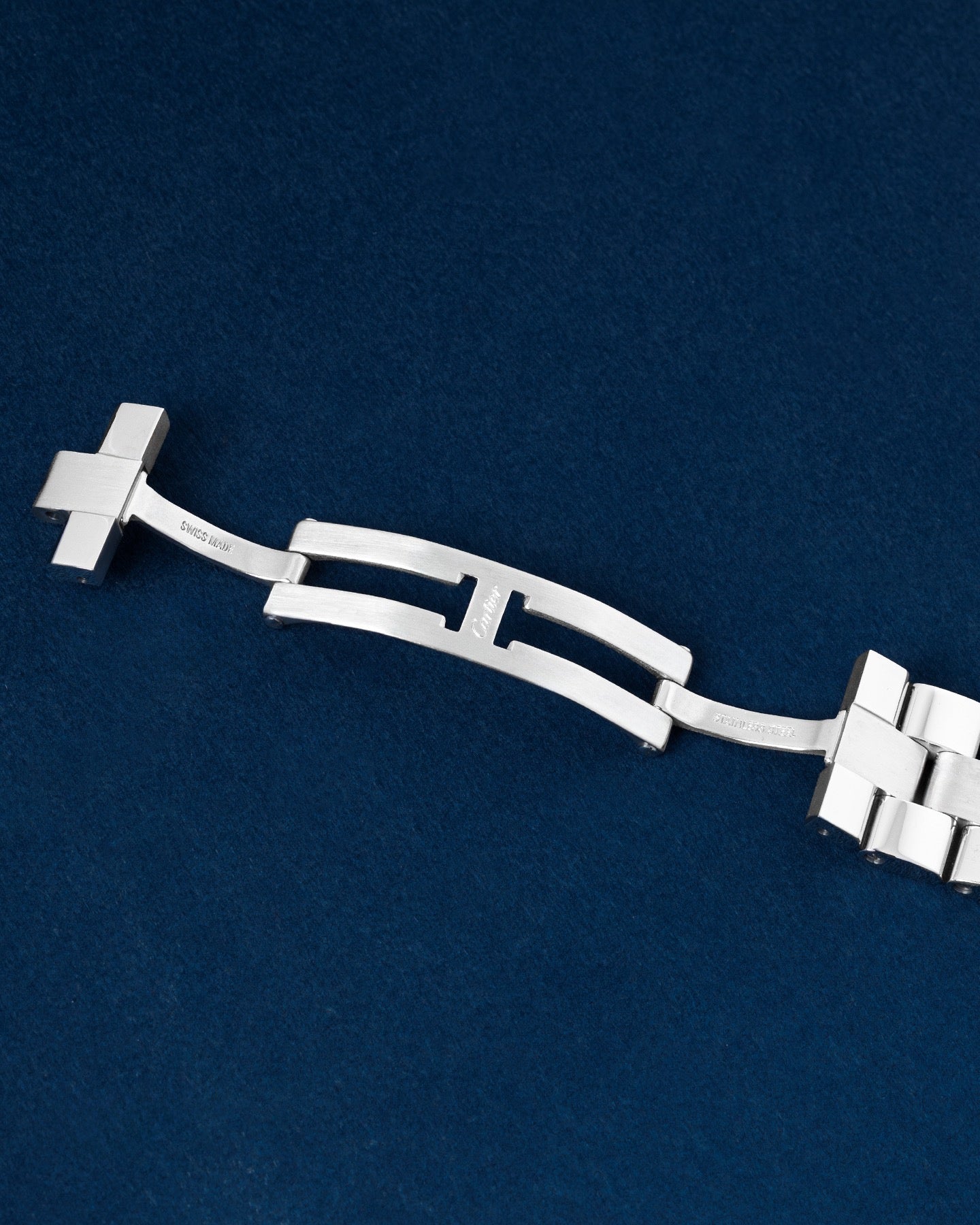
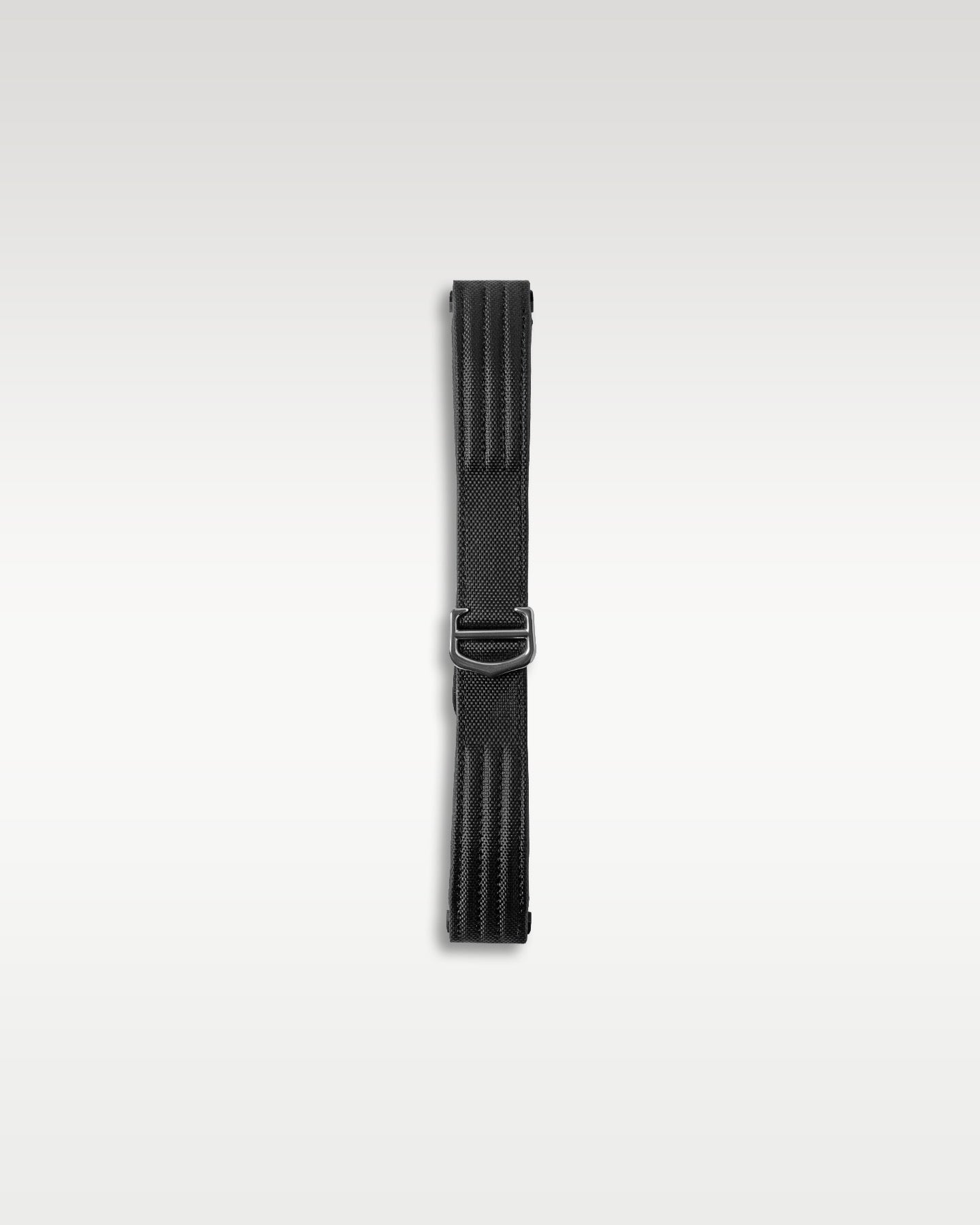
The modern catalogue uses two proprietary systems for strap and bracelet management. QuickSwitch is the hidden button under each lug that releases the strap or bracelet from the case with a single push, allowing the owner to swap between leather, fabric, rubber, and metal options without tools. SmartLink is the bracelet sizing mechanism: each link contains a small integrated push piece that releases the link from its neighbor, again with no tools required. Both systems are standard on the modern Santos, the new Pasha, and several Tank references, and both significantly improve the ownership experience compared to older spring bar designs. Leather straps from Cartier are alligator on the standard mechanical pieces and calf on the entry-level Tank Must, with an integrated deployment buckle on most precious metal references. Original straps wear in over twelve to eighteen months of regular use and are widely available as replacement parts through Cartier service centers. Spotting a non-original strap on a watch sold as a full set is one of the more common condition issues, and most product listings note when a strap has been replaced.
Telling the Collections Apart
Tank
The Tank is the rectangular silhouette framed by two parallel vertical bars on either side of the dial called brancards. If the case is rectangular and the lugs are integrated into the side bars rather than projecting from the corners, you are holding a Tank. Within the family, the Tank Louis Cartier is the slim precious metal dress watch, the Tank Francaise integrates a metal bracelet directly into the case, the Tank Americaine elongates and curves the case, and the Tank Must serves as the steel entry point with quartz, automatic, and SolarBeat variants.
Santos
The Santos is the square case with a beveled bezel held down by eight visible screws. The bracelet integrates directly into the case rather than attaching through traditional lugs, and the same screws continue across the bracelet links. Modern Santos de Cartier pieces carry the QuickSwitch system that releases the strap or bracelet from the case with a hidden push button under the lug, and the SmartLink system that lets bracelet links be added or removed without tools. If you see a square case with exposed bezel screws, it is almost certainly a Santos, with the closely related Panthere being the main exception.
Ballon Bleu
The Ballon Bleu is the round, pebble shaped case with no sharp edges and a small bridge of metal arching over the winding crown at three o'clock. That guarded crown intrudes slightly into the dial track, creating a small notch in the Roman numerals at three. The crystal domes outward to follow the curve of the case. If the watch looks like a softened river stone with a guarded crown, you are holding a Ballon Bleu de Cartier.
Pasha
The Pasha is the round case with a screw down crown cap connected to the case by a small chain, four oversized Arabic numerals at twelve, three, six, and nine, and a square minute track sitting inside the circular dial. The current production Pasha de Cartier is offered primarily in 35 millimeter and 41 millimeter sizes, with a chronograph variant in 41 millimeters.
Panthere
The Panthere shares the square case and exposed screws of the Santos, but the bracelet is what sets it apart: a flat, articulated brick link that drapes across the wrist like fabric. Cartier offers it exclusively with quartz movements, which keeps the case slim and the maintenance minimal. The Panthere functions as a jewelry watch first and a timepiece second.
Discontinued Collections Still in Circulation
Several collections that have been discontinued in the last decade still circulate heavily on the pre-owned market. The Calibre de Cartier, produced from 2010 to roughly 2018, was a round mechanical sports watch positioned as a competitor to the steel sports models from Swiss peers, featuring an integrated bracelet and the in-house 1904 MC. The Cle de Cartier, produced from 2015 to roughly 2019, used a distinctive crown set flush with the case in a key shape rather than a traditional pulled crown, and remains a quietly admired piece for collectors who appreciate Cartier's odder geometry. The Drive de Cartier, produced from 2016 to roughly 2020, used a softened rectangular cushion case that sits between the Tonneau and a traditional round watch. The Tank Solo, replaced by the Tank Must in 2021, appears frequently on the secondary market and was the catalogue entry point for over a decade. The Tank Anglaise, discontinued around 2019, fully integrated the crown into the brancard rather than exposing it on the side of the case. The Santos 100, replaced by the redesigned modern Santos de Cartier in 2018, is a recognizably larger and more masculine variant that retains a loyal following among collectors who prefer its more pronounced case geometry.
Shaped and Prive Pieces
Beyond the five main collections and the recently discontinued ones, Cartier produces a deep bench of shaped cases that surface primarily in the Prive limited editions and on the vintage market: the Crash with its melted, asymmetrical case, the Baignoire with its pure oval, the Tortue with its widened central profile, the Tonneau with its barrel curve, and the Cintree with its long curved rectangle. These are rare in regular inventory and command meaningful premiums when they appear.
Buying Your Cartier from Grand Caliber
Everything on this page, from the reference to the calibre to the condition, is something we confirm before a watch is ever listed. Grand Caliber is an independent dealer in Uptown Dallas, and every Cartier we sell is authenticated in house and priced openly so you see the real market value before you decide. If you want to talk through a specific piece or are hunting a reference we do not currently have, reach us at 214-225-7198 or info@grandcaliber.com, or browse the full Cartier collection online.
Frequent Questions
Can I see a Cartier in person before buying?
Yes. Every Cartier watch we list is held physically in our Dallas showroom and can be tried on in person before you commit. For clients buying from out of state, ask us and we will send additional photography, a video, or specific close ups of the dial, the bracelet, or the case back.
Are Grand Caliber's Cartier watches authenticated?
Every piece is inspected by our specialists before it ever reaches the website. The case signatures, the dial printing including the secret signature inside the seven o'clock numeral, the movement, the bracelet, and the paperwork all get checked against known references for that exact model. Anything that fails authentication does not enter inventory.
Do your Cartier watches come with box and papers?
It depends on the specific watch. Some of the Cartier pieces in our inventory are full sets with the original presentation box and certificate, others are sold as watch only or watch and box, and every product page lists exactly what is included so there are no surprises at checkout.
Can Grand Caliber source a specific Cartier reference for me?
Yes. When the dial color, metal, size, or reference you want is not currently in our inventory, our team can locate it through our private sourcing network. This applies to current production pieces and to discontinued or vintage references that Cartier no longer makes. Reach us at (214) 225-7198 or info@grandcaliber.com with what you are looking for.
Does Grand Caliber ship Cartier watches nationwide?
Yes. We ship fully insured to any address in the United States, and the same watch can always be inspected and purchased in person at our Dallas showroom before it leaves the floor.
How does Grand Caliber price its Cartier watches?
The price posted on the product page is the current secondary market value for that exact reference, dial, metal, and condition. Cartier pricing varies sharply by configuration, so what looks like the same model on two listings often is not, and the per piece pricing reflects those differences directly.