

Omega Constellation
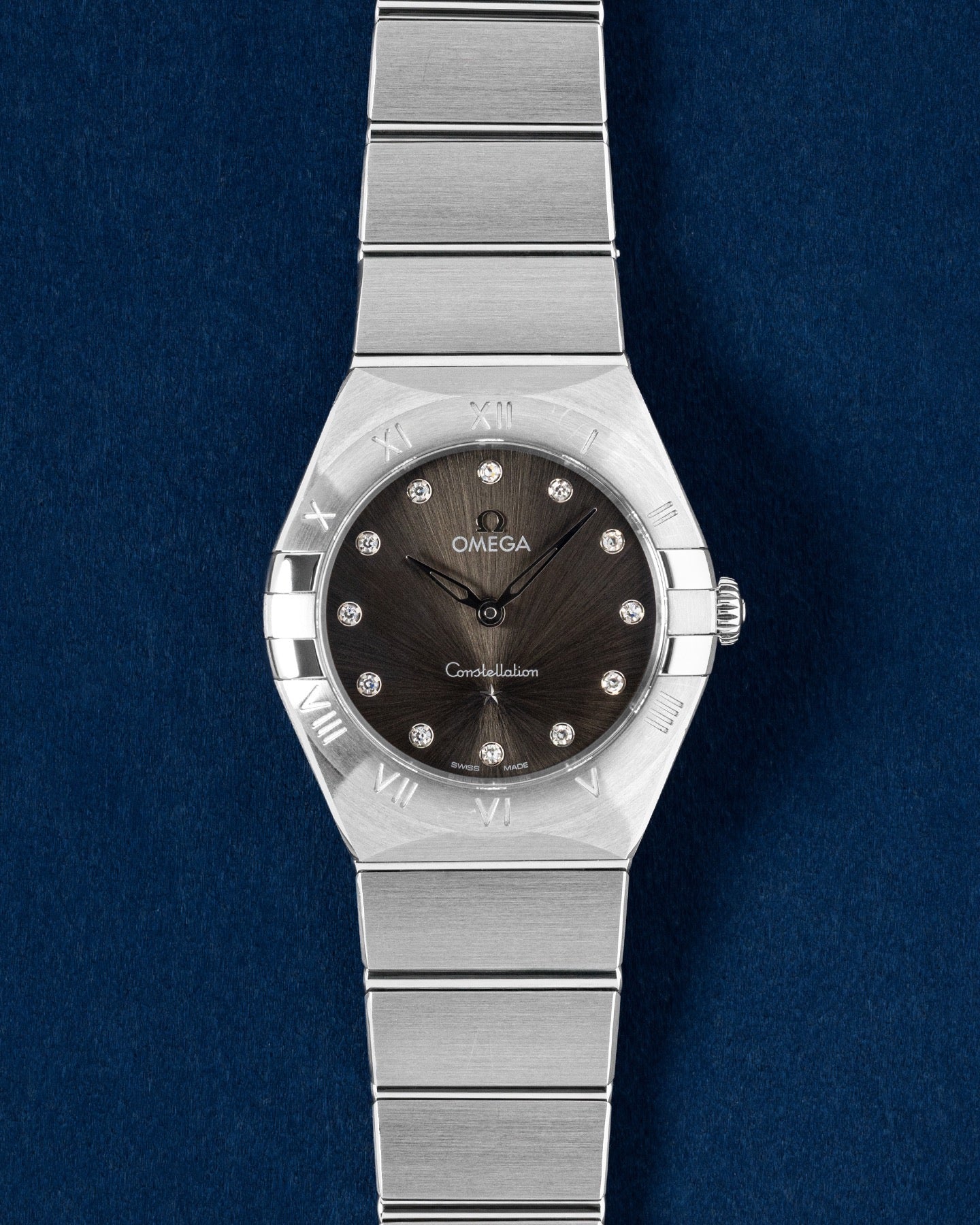
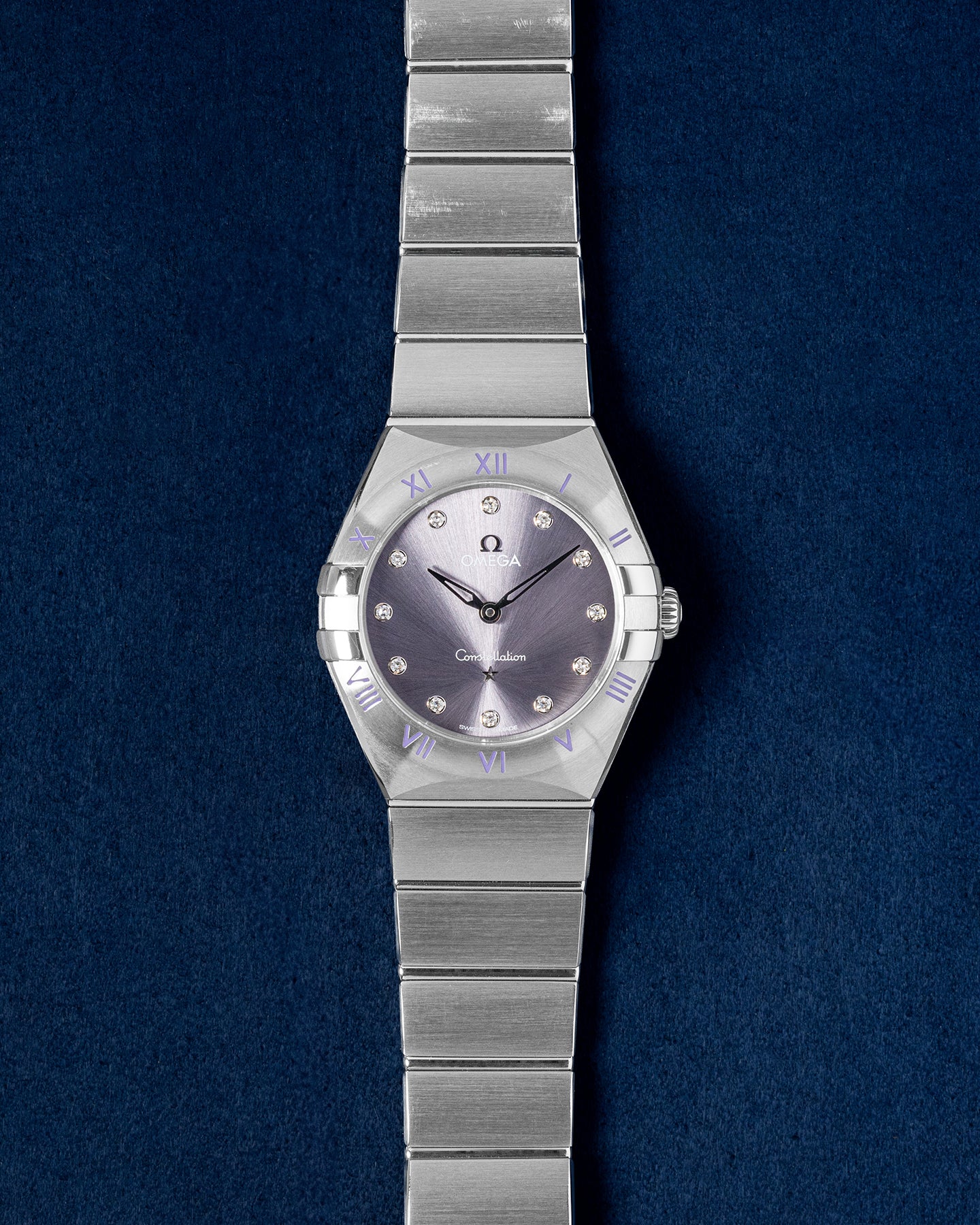
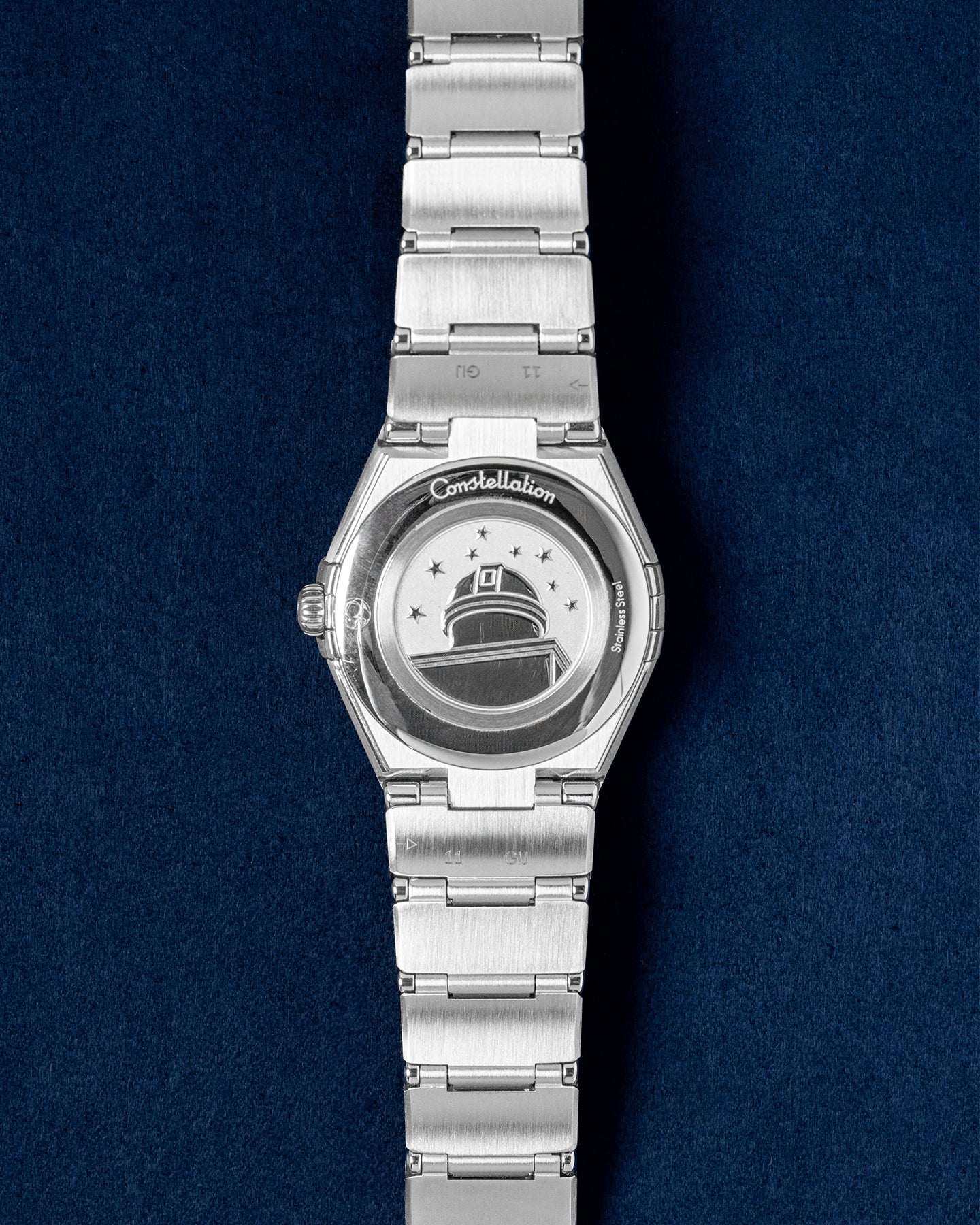
Shop new and pre-owned Omega Constellation watches at Grand Caliber. The brand's longest-running precision line, marked by the star at six, the half-moon claws on the case, and the observatory medallion on the back. Globemaster pie-pan dials carry forward the original mid-century design.
The Omega Constellation at Grand Caliber
The Omega Constellation is the longest-running chronometer collection in modern Swiss watchmaking. Launched in 1952 as the first family of watches in the world built exclusively to chronometer standard, the Omega Constellation has crossed seven decades, four distinct design eras, and the entire arc from bumper-rotor automatic movements to METAS Master Chronometer certification without losing the thread of what it set out to do: produce a precision wristwatch that looks like a precision wristwatch. The Geneva Observatory medallion on the caseback and the single star above the six o clock marker have been there since the beginning. They are still there today.
Grand Caliber sees the Omega Constellation cross the desk across the full breadth of the collection. Vintage pie-pan Omega Constellation references from the 1950s and 1960s with the bumper-rotor 351, 352, and 354 calibres and the full-rotor 501, 505, 551, 561, and 564 calibres that succeeded them. C-shape Omega Constellation references from the Gerald Genta era (1964 to 1978) with the integrated lugs and tonneau case profiles, including the textured frosty dials and the fluted bezel variations. Constellation Manhattan references from the 1982 redesign forward with the four polished claws at three and nine o clock. Modern Constellation Manhattan men and women references in 29mm, 39mm, and 41mm with the current Co-Axial Master Chronometer movements. Constellation Globemaster references in 39mm and 41mm with the pie-pan dial revival and the fluted bezel. The 2024 Constellation Meteorite collection with the genuine meteorite dial. What follows is the case for the Omega Constellation as the most historically deep and technically credible mid-tier dress watch collection in modern Swiss production, told the way a dealer who has handled the line tells it.
The 1948 Centenary and the Origin of the Constellation Idea
The Omega Constellation does not start in 1952. It starts in 1948 with the Omega Centenary, a limited-edition wristwatch produced to mark the Omega hundredth anniversary as a company (Omega was founded in 1848 by Louis Brandt) and the first chronometer-certified automatic wristwatch the brand had ever produced. The Centenary was designed by Rene Bannwart (who would later leave Omega to found Corum) and was produced in approximately 6,000 pieces total: 2,000 examples using the deluxe 28.10 RA JUB calibre (later designated 341) and 4,000 examples using the 30.10 family of movements. The watches sold out quickly. The market response told Omega something it had not previously known: there was real demand for a serially produced wristwatch chronometer at retail.
The Centenary was a limited edition and was never intended to anchor a collection. The success caught Omega by surprise. Four years later, in 1952, the brand returned with a series-produced descendant: the Omega Constellation. The Constellation took the chronometric ambition of the Centenary and added what the Centenary had lacked, a permanent collection identity that could be built across decades. The 28.10 calibres of the Centenary became the direct genetic ancestors of the bumper-rotor 351, 352, and 354 calibres that powered the first Omega Constellation references.
The 1952 Launch and the Geneva Observatory Caseback
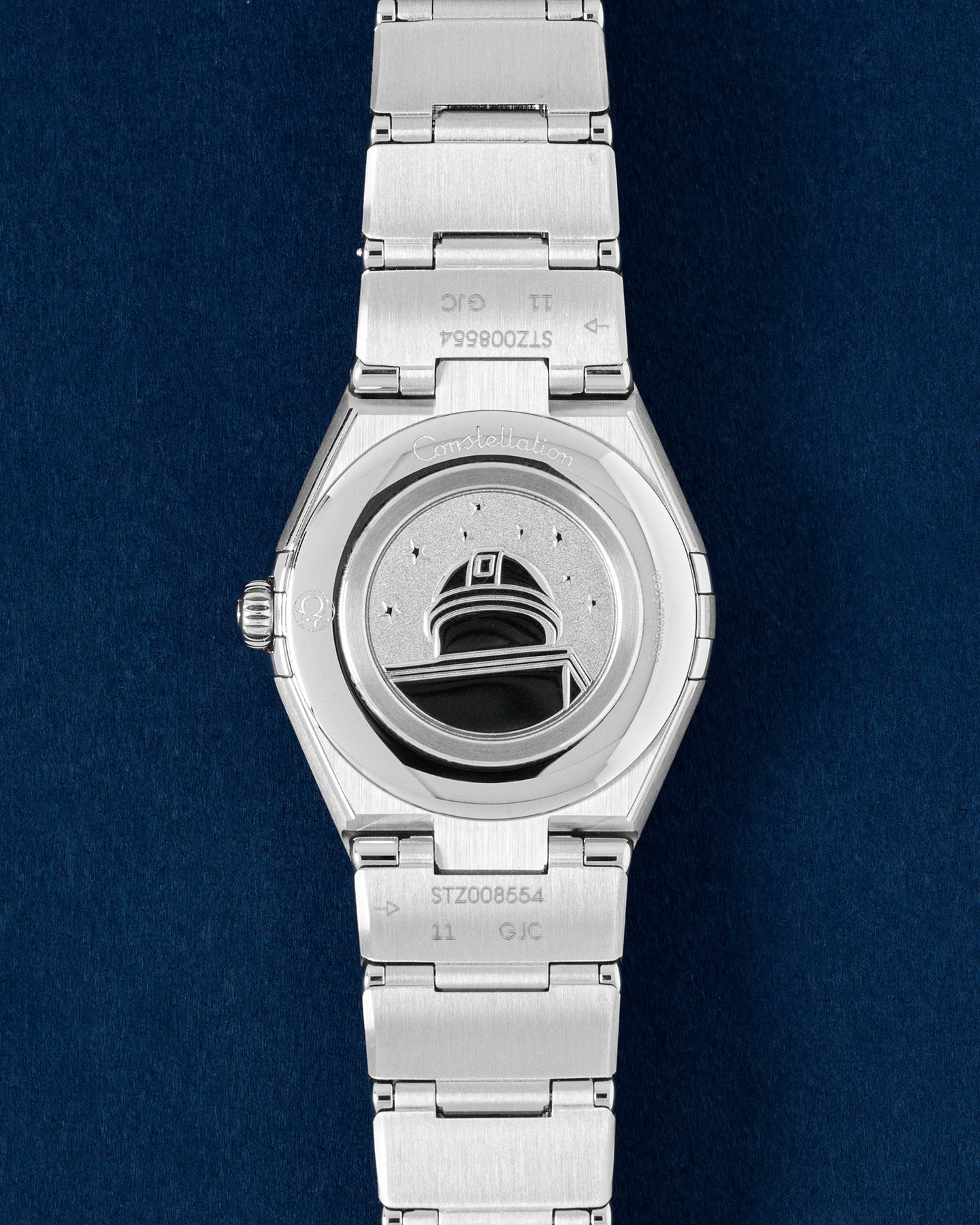
The Omega Constellation launched in 1952 with reference 2648 as the first model off the line, fitted with the bumper-rotor calibre 352 on the earliest production examples and the broader-running calibre 354 on later 2648 references and the closely-following 2652, 2699, and 2700 references that filled out the launch lineup. The cases ran 34mm to 35mm in steel, gold-capped steel, or solid gold. Two visual elements made the watch immediately identifiable as an Omega Constellation and have remained on every Omega Constellation produced since. The first was a small applied star above the six o clock marker on the dial, accompanied by the Constellation name. The second was a relief medallion engraved into the caseback depicting the dome of the Geneva Observatory crowned by eight stars.
The medallion was not decorative. Each of the eight stars represented a specific chronometric victory Omega had won at the observatory trials in Kew-Teddington, Neuchatel, and Geneva between 1933 and 1952. Two of those victories were world precision records set at Kew-Teddington in 1933 and 1936. Six were wristwatch-sized contests won between 1945 and 1952 as the observatory trials shifted from pocket-watch precision to wristwatch precision. By engraving the medallion into the caseback of every Omega Constellation, Omega was not claiming a marketing position. It was citing a documented competitive record that no other Swiss brand of the era could match. The Omega Constellation was, from launch, a watch backed by published chronometric victories.
A note on the United States market: from 1952 through 1956, the Omega Constellation was sold in the United States under the name "Globemaster" rather than "Constellation," due to a trademark conflict with the Lockheed Constellation aircraft. The name reverted to Constellation in the United States market in 1956. The Globemaster name later returned to the Omega catalogue in 2015 as the title of a specific Constellation sub-line, closing the loop on a sixty-three-year naming arc.
The Pie-Pan Era and the 1950s to 1960s Movement Progression
The first decade of the Omega Constellation belongs to what collectors call the pie-pan dial. The dial was multifaceted, convex-curved, with twelve flat sections sloping down from a raised central plateau to a slightly recessed outer minute track. The shape, when viewed from the side, resembled an inverted pie pan. Hour markers were applied as triangular wedges with cross-faceting that caught light at the angles. Hands were sword-style on the early references, transitioning to dauphine on later references. The pie-pan dial gave the Omega Constellation a three-dimensional quality that flat-dial competitors could not match. It became, and remains, the most recognised vintage Omega Constellation signature.
The mechanical progression across the pie-pan era moved through three movement generations. The bumper-rotor 351, 352, and 354 calibres of 1952 to roughly 1955 used a semi-circular rotor that swung through a limited arc and bumped against buffer springs at the ends of its travel. The mechanism was reliable but produced a slightly perceptible tick on the wrist when the rotor changed direction. In 1955 and 1956 Omega transitioned to full-rotor calibres 501 and 505, which used a conventional 360-degree oscillating weight and produced a quieter, smoother winding action. The 500-series calibres powered references 2648, 2652, 2782, 2852, and 2943, the canonical references of the mid-1950s pie-pan era. By the early 1960s the Omega Constellation moved to the 550-series and 560-series calibres, with the 561 (the date version) and 564 (the later refinement) regarded by collectors and watchmakers as among the finest automatic chronometer movements Omega ever produced. The 564 in particular ran in Omega Constellation references through 1974 and is still considered a benchmark movement of the period.
The pie-pan era also gave the Omega Constellation its case-shape progression. The earliest references had cleanly curved lugs. Mid-period references introduced the lyre-lug profile with its gentle outward flare. Late pie-pan references introduced the "dog-leg" lug, a sharply angled lug that bent outward and then back toward the wrist, named for its resemblance to a canine hindleg. Each lug profile reads as period-correct to its decade and matters meaningfully for vintage condition assessment. Reference 167.005 is the canonical dog-leg pie-pan Omega Constellation of the early-to-mid 1960s.
The C-Shape Era and the First Major Gerald Genta Design
In 1964 Omega commissioned Gerald Genta to redesign the Omega Constellation. The result was the C-shape case, named for the case profile when viewed from the side, which described two mirrored letter Cs flowing continuously from the bezel through the lugs to the caseback. The pie-pan dial was retired in favour of a flat dial. The dauphine hands gave way to slim batons. The dog-leg lugs disappeared entirely and were absorbed into the continuous case curve.
The C-shape Omega Constellation matters in two ways that the broader watch press tends to underplay. First, the 1964 C-shape was the first major Gerald Genta case design in Swiss watchmaking. Genta would go on to design the Audemars Piguet Royal Oak in 1972 and the Patek Philippe Nautilus in 1976, two of the most valuable modern watch designs in existence. The Omega Constellation C-shape predates both by nearly a decade and demonstrates the same design instinct that would later define those icons: clean continuous geometry, integrated case architecture, and a contemporary visual language applied to a traditional dress-watch tradition. Second, the C-shape arrived while the pie-pan was still in production. The two designs coexisted in the catalogue for several years, with the pie-pan continuing to outsell almost every competing watch in its class. The Genta brief was not to replace the pie-pan but to give the Omega Constellation a contemporary parallel for the 1960s buyer who wanted a more modern silhouette.
The C-shape era ran from 1964 to 1978. Canonical references include 168.017 and 168.019. Variants included fluted bezels and textured frosty dials that added visual depth without breaking the clean geometry. In 1969 Omega patented an integrated bracelet design by Pierre Moinat that locked the bracelet end links directly into slots cut into the case, making strap substitution impossible. The integrated bracelet was a structural feature of many C-shape Omega Constellation references and presaged the integrated-bracelet design language that would dominate Swiss luxury sport watches a decade later.
The 1982 Constellation Manhattan and the Four Claws
In 1982 Omega launched the Constellation Manhattan, the redesign that consolidated the Omega Constellation into the case shape it still uses today. The four polished claws (or "griffes") extending from the case onto the bezel at three and nine o clock became the new defining visual signature. The Constellation name and star moved off the dial centre and onto the bezel. The case became thinner, the bracelet integrated, and the overall reading shifted from traditional dress watch to architectural modernist.
A correction worth making here, because the watch press has propagated the wrong attribution for decades: the Constellation Manhattan was not designed by Gerald Genta. The Manhattan was designed by Carol Didisheim (later Carol Gygax-Didisheim), a young jewellery designer who had joined Omega in 1980 and was commissioned by product director Pierre-Andre Aellen to redesign the Omega Constellation from scratch. Didisheim filed the United States design patent in 1985. The claws themselves were inspired by a mundane observation: Aellen had noticed how his bathroom mirror was held to the wall by small bracket-shaped clips and wondered whether a similar mechanism could be used to clamp a sapphire crystal directly onto a watch case without requiring a separate bezel. Didisheim turned that idea into the four griffes, which originally served the structural function of holding the sapphire crystal and gasket against the case to achieve water resistance in an unusually thin profile. The bezel as a separate component was eliminated. The Roman numerals were printed on the inside of the crystal in the first-generation Manhattan, a space-saving choice that kept the watch ultra-thin.
The first Constellation Manhattan models ran the calibre 1422, an ultra-thin quartz movement co-developed with ETA. In 1984 Omega reintroduced mechanical automatic movements to the Omega Constellation Manhattan with the calibre 1111, an ETA 2892-A2 base finished and regulated to COSC chronometer standard. The Manhattan ran on quartz, mechanical, and quartz-mechanical variants through the 1980s and 1990s in steel, two-tone, and solid-gold configurations.
In 1995 Omega moved the Roman numerals from the underside of the crystal to the surface of the bezel itself, where they remain on the current production Omega Constellation Manhattan. In 2003 Omega introduced the Constellation Double Eagle at the European Masters golf tournament, the first Omega Constellation fitted with a Co-Axial escapement (calibre 2500). The Double Eagle marked the moment the Constellation joined the broader Omega Co-Axial movement programme that had launched with the Seamaster Aqua Terra in 2002.
The 2009 Manhattan Redesign and the Women Direction
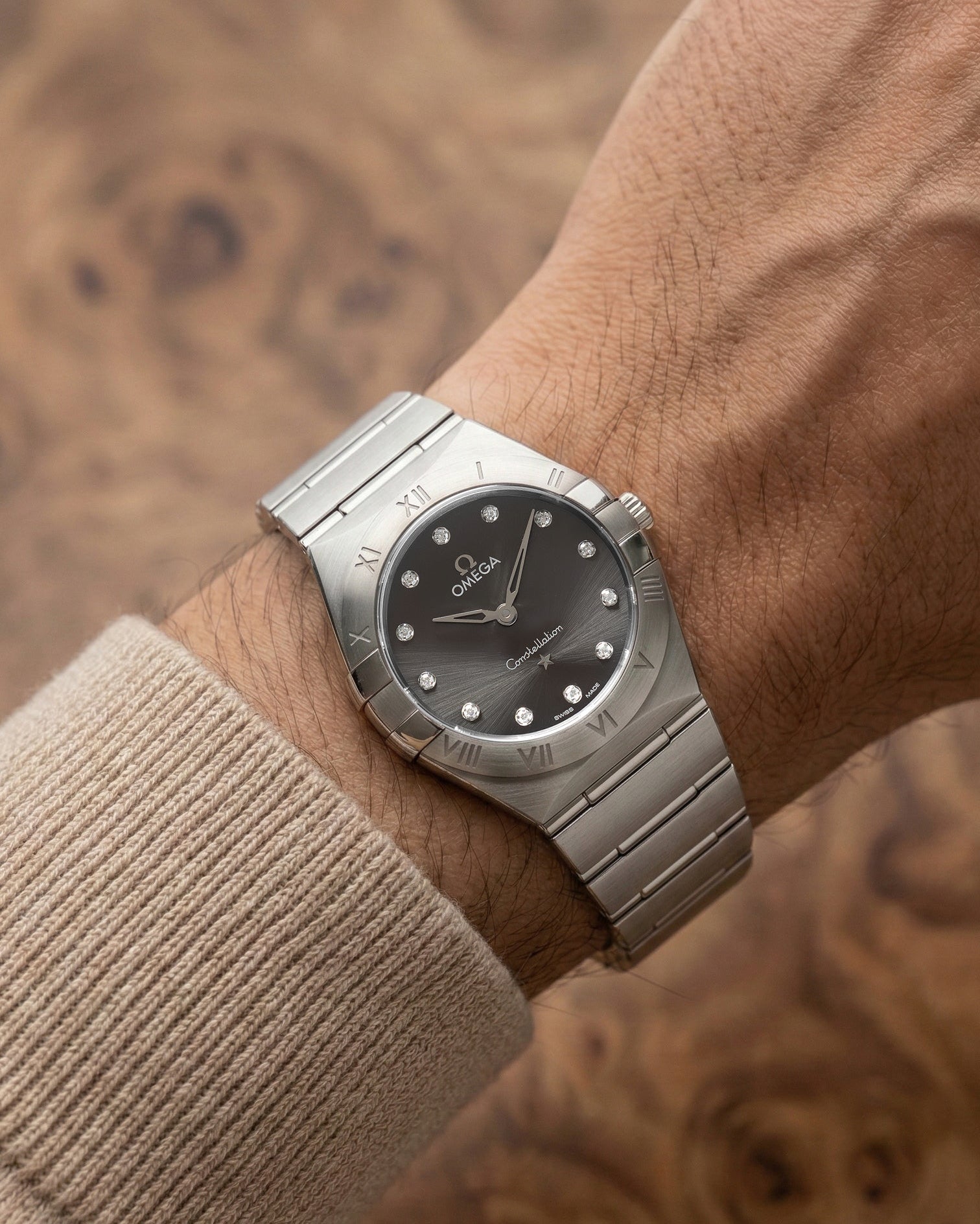
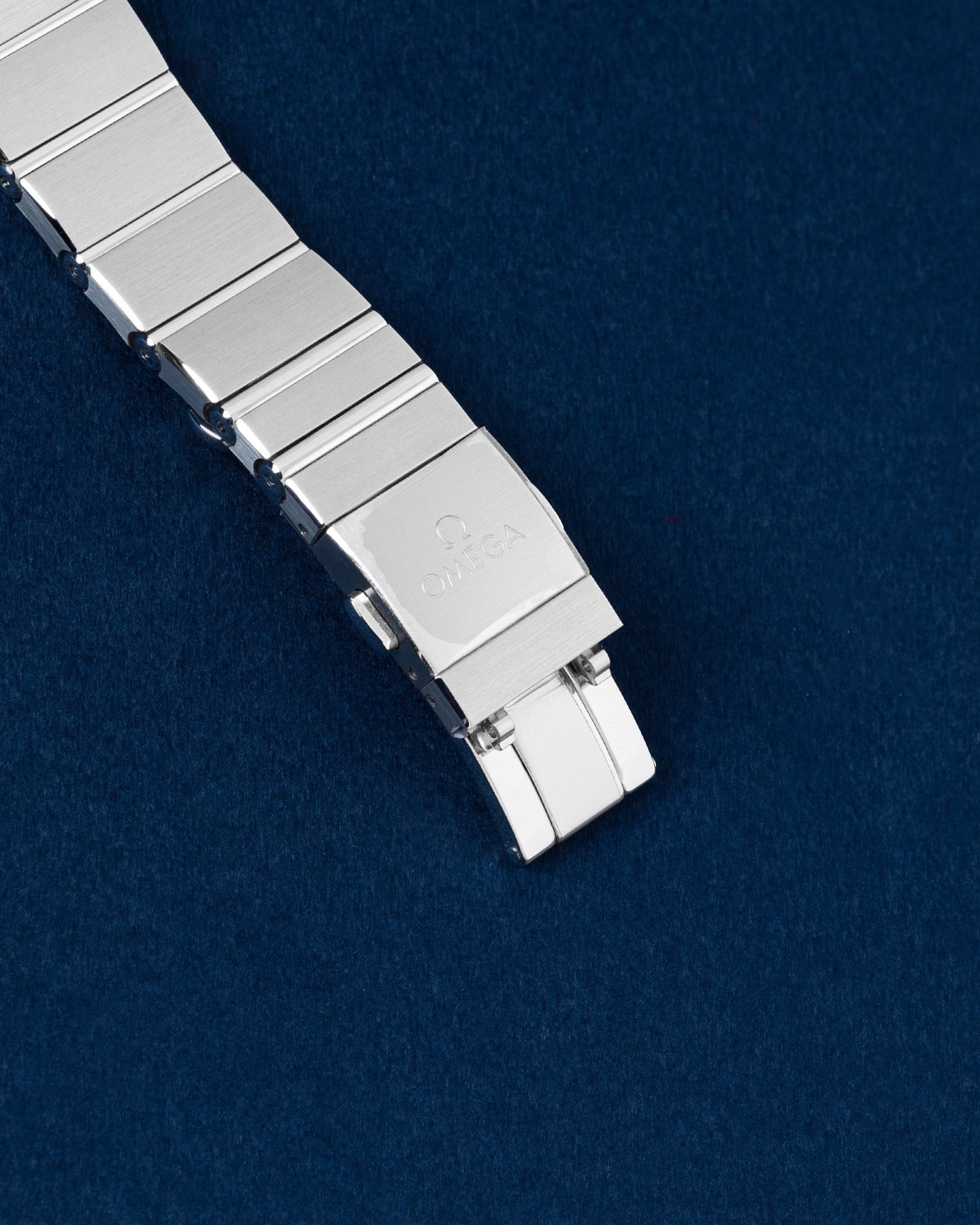
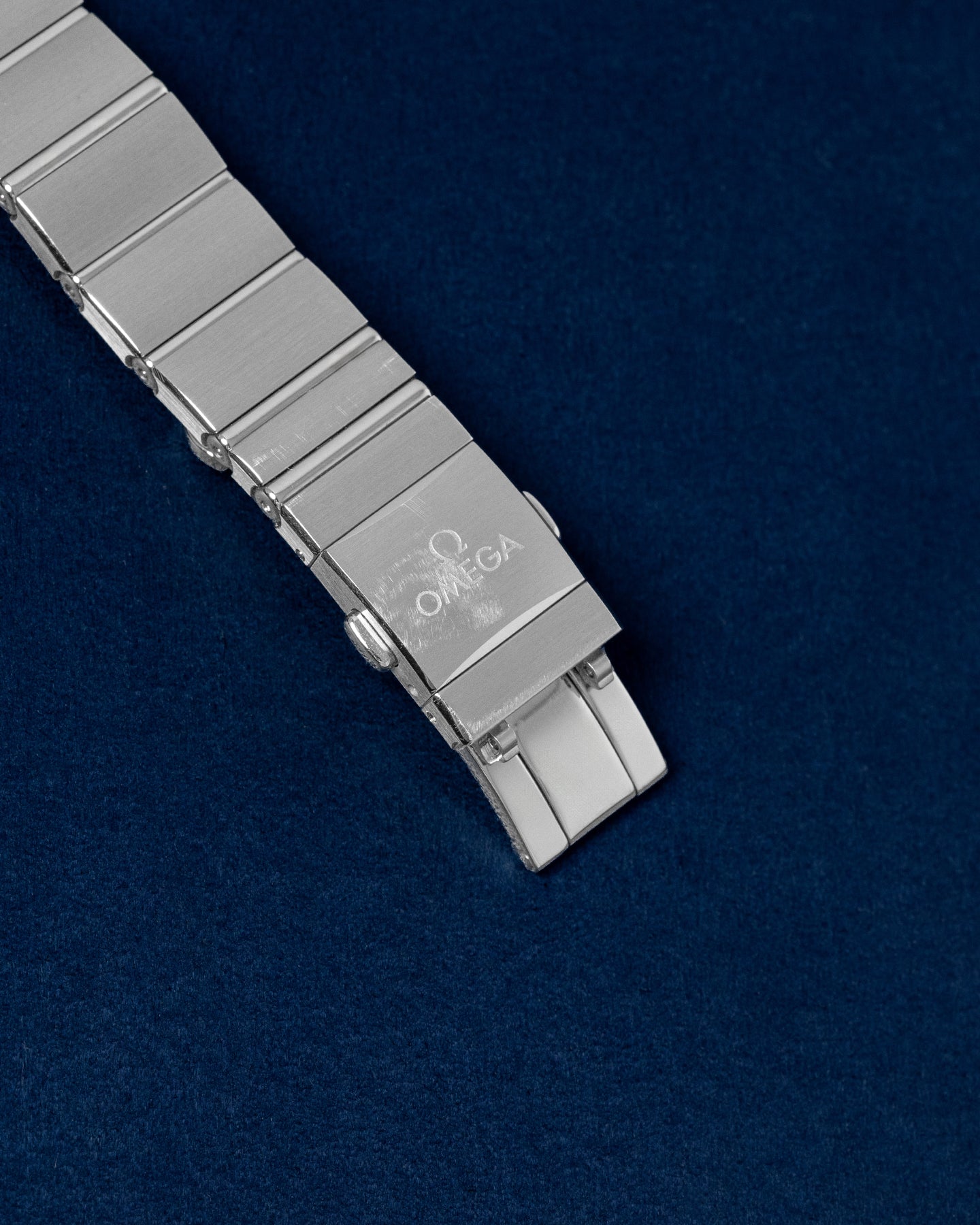
In 2009 Omega comprehensively redesigned the Constellation Manhattan. The claws were re-proportioned, the dial layout was refined, the bracelet was reworked into the mono-rang single-link configuration that runs across the current production line, and the butterfly clasp was introduced. The 2009 redesign also marked the moment Omega began directing the Manhattan more explicitly toward a women audience, with the case-size programme consolidating around 25mm and 28mm quartz references and a 29mm mechanical reference rather than the broader unisex-and-men lineup that had defined the 1980s and 1990s Manhattan.
The 29mm Constellation Manhattan currently runs the calibre 8700 in steel references and the calibre 8701 in two-tone, Sedna gold, and precious metal references, both Master Chronometer certified automatics with a 50-hour power reserve, 15,000 gauss magnetic resistance, and 50m water resistance. The smaller 25mm and 28mm references run quartz movements. The 29mm Master Chronometer mechanical is the technical anchor of the women collection and represents one of the few sub-30mm cases on the modern market that runs a fully certified automatic Master Chronometer movement.
In 2018 Omega expanded the women Omega Constellation Manhattan with new diamond and non-diamond configurations, the date window repositioned at 6 o clock on some references, thinner lugs, polished bevels, more stylised hands, and a broader dial palette. The 2018 update is the version of the women Omega Constellation that current showroom inventory primarily reflects.
The 2015 Globemaster and the First Master Chronometer
In 2015 Omega launched the Constellation Globemaster, the watch that gave the Omega Constellation its most consequential modern moment. The Globemaster was the first watch in the world to receive METAS Master Chronometer certification, the new Omega-developed standard that exceeded the COSC chronometer test by adding magnetic resistance to 15,000 gauss, water resistance, and accuracy testing across multiple positions under real-world wear conditions. Master Chronometer certification has since become the standard across the broader Omega catalogue and has spread to the Aqua Terra, Speedmaster Professional, and Seamaster Diver 300M lines. The Globemaster was the test platform.
The Globemaster reached back into the Omega Constellation archive for its design language. The pie-pan dial returned for the first time since the 1960s, opaline silver on the launch reference with the same twelve-section faceted construction that had defined the 1950s Omega Constellation. The fluted bezel returned from the C-shape era, executed on the steel reference in tungsten carbide for scratch resistance. The case took a slightly tonneau profile that referenced the 1964 Genta C-shape. The result was a watch that read as historically literate without being a reissue, combining 1952 dial language with 2015 movement technology.
The Globemaster runs the calibre 8900 in steel references and the calibre 8901 in precious metal references, both Master Chronometer certified with 60-hour power reserves and 15,000 gauss magnetic resistance. The annual calendar variant in the 41mm Globemaster runs the calibre 8923, also Master Chronometer certified. The Constellation Globemaster is available in steel, Sedna gold, two-tone, and (in limited editions) platinum.
The eight stars on the Omega Constellation caseback medallion now carry a dual meaning on the Globemaster references. They continue to represent the eight historical chronometric victories from the 1933-to-1952 observatory trials. They also represent the eight separate tests required to earn METAS Master Chronometer certification: accuracy testing at zero magnetic field, accuracy testing under 15,000 gauss exposure, deviation of rate between maximum and minimum exposure, water resistance, power reserve, and accuracy testing across multiple wrist positions. The symbolism is deliberate and well-earned.
The Current Constellation Manhattan Men 39mm and 41mm
The current production Constellation Manhattan men collection runs in two case sizes. The 39mm Omega Constellation Manhattan runs the calibre 8800 in steel references and the calibre 8801 in precious metal references, with Master Chronometer certification, 55-hour power reserve, and the same 15,000 gauss magnetic resistance as the broader Omega Master Chronometer programme. The 41mm Omega Constellation Manhattan runs the calibre 8900 in steel and the calibre 8901 in precious metal, with 60-hour power reserve and the additional jumping hour hand feature that allows the wearer to advance or retract the hour hand in one-hour increments without disturbing the minute or seconds hands.
The case dimensions tell the story of where the modern Omega Constellation Manhattan sits in the market. The 41mm case runs approximately 13.5mm thick with a 44mm lug-to-lug, an unusually short lug-to-lug measurement that lets the 41mm wear smaller than its case diameter would suggest. The 39mm runs slightly thinner with proportionally shorter lugs. Water resistance is rated at 50 metres across the line, sufficient for the dress-and-occasional-pool brief that the Omega Constellation has occupied since 1982 but not rated for serious water sport. The integrated bracelet is interchangeable between the 39mm and 41mm sizes by Omega design.
In 2024 Omega launched a Constellation 41mm Meteorite collection with dials cut from genuine iron-nickel meteorite, displaying the natural Widmanstatten pattern (the crystalline lattice structure that forms only during the multi-million-year cooling of meteoritic iron in deep space). The Meteorite references also introduced an updated butterfly clasp with a 2mm comfort-extension push-button system, the same mechanism that had launched on the Aqua Terra Black Lacquer references a few months earlier in the same year.
The Omega Constellation Versus the Rolex Datejust 36
The Omega Constellation and the Rolex Datejust 36 are the two most cross-shopped mid-tier mechanical chronometer dress watches in modern Swiss production. Both run in-house automatic chronometer-certified movements. Both ship in case sizes between 36mm and 41mm. Both descend from the same post-war moment in Swiss watchmaking when the dressy daily-wear chronometer became the defining category of the mechanical wristwatch.
The Rolex Datejust 36 reference 126234 runs in a 36mm Oystersteel case with an 18k white gold fluted bezel, 12mm case thickness, and Cyclops magnifier over the date window. The calibre 3235 is Superlative Chronometer certified at negative two to positive two seconds per day, 70 hours of power reserve, 100 metres of water resistance, paramagnetic Parachrom hairspring, and Chronergy escapement. Available on the Jubilee five-piece-link bracelet or the Oyster three-piece-link bracelet, across a broad dial palette including the Wimbledon Roman numeral, the fluted motif dials introduced in 2022, and the recent palm-motif green and bright blue configurations.
The Omega Constellation 39mm runs in a 39mm steel case with the polished griffes at three and nine o clock, no separate bezel structure (the claws hold the crystal directly), and Roman numerals printed on the bezel surface. The calibre 8800 is METAS Master Chronometer certified at zero to plus five seconds per day, 55 hours of power reserve, 50 metres of water resistance, silicon balance spring, and Co-Axial escapement. The Constellation Globemaster 39mm sits alongside on the same architecture with the pie-pan dial and fluted tungsten-carbide bezel, running the calibre 8900 with 60 hours of reserve.
The technical differences read meaningfully on paper. The Datejust 36 delivers a tighter accuracy tolerance (negative two to positive two versus zero to plus five), a longer power reserve (70 hours versus 55), and a higher water resistance rating (100m versus 50m). The Omega Constellation delivers a meaningfully higher magnetic resistance specification (15,000 gauss versus the unpublished but lower Rolex threshold) and the deeper historical and design lineage that runs from 1952 forward through the pie-pan, C-shape, and Manhattan eras.
On the wrist the two read very differently. The Datejust 36 carries the fluted bezel, Cyclops, and Jubilee bracelet as visual signatures that have remained essentially unchanged since the 1940s. The Omega Constellation carries the Didisheim claws as a visual signature that has remained essentially unchanged since 1982 (and the broader Constellation visual heritage from 1952). The Datejust is the heritage piece in the most universal sense of recognition. The Omega Constellation is the heritage piece in the more specifically horological sense of lineage and movement architecture. Buyers cross-shopping the two are typically deciding which design language they want on the wrist, not which watch performs the chronometer brief better. Both perform the brief at a high level.
The Omega Constellation at the Grand Caliber Dallas Showroom
The Grand Caliber Dallas showroom sits in the corridor that has become the address for serious watch buying outside the authorised dealer network. The Omega Constellation examples on our floor are authenticated in-house, the prices are posted openly on every product page, and inventory rotates across the full Omega Constellation line. Current production Constellation Manhattan men references in 39mm with calibre 8800 and 41mm with calibre 8900 across steel, two-tone, and Sedna gold configurations. Current production Constellation Manhattan women references in 29mm Master Chronometer with calibre 8700, including diamond and non-diamond dial variants. Constellation Globemaster references in 39mm and 41mm with the pie-pan dial revival and the tungsten-carbide fluted bezel. The 2024 Constellation Meteorite references with the genuine Widmanstatten-pattern dial. Vintage pie-pan Omega Constellation references when condition and provenance meet our standards, including the canonical 2648, 2782, 2852, 2943, and 167.005 references with the bumper-rotor and full-rotor calibres of the 1950s and 1960s. Gerald Genta C-shape Omega Constellation references from the 1964-to-1978 era when condition justifies the listing. First-generation Carol Didisheim Constellation Manhattan references from 1982 forward for buyers seeking the original quartz-era Manhattan in its earliest configuration.
There is no waitlist conversation at Grand Caliber. No purchase history requirement. The Omega Constellation you are looking for is generally either in our case or sourceable within days through our network. If you want to handle a 39mm Constellation Manhattan next to a 39mm Globemaster next to a vintage pie-pan reference before deciding, the showroom is the right place to do that. Vintage Omega Constellation buying in particular rewards in-person evaluation: dial originality, case-back medallion sharpness, lug profile correctness for the reference, movement service history, and bracelet correctness all matter meaningfully, and photographs rarely tell the full story.
We also buy Omega Constellation examples outright and take consignments, with free shipping and full insurance on outbound and inbound transit and national coverage for clients buying remotely. The Omega Constellation is among the more liquid Omega lines on the secondary market across both modern and vintage references, and the right dealer relationship makes selling, trading, or upgrading frictionless when you decide to move a piece.
Visit the Dallas showroom Monday through Friday, 10am to 5pm Central, or by appointment on Saturday. Call (214) 225-7198, email info@grandcaliber.com, or browse current Omega Constellation inventory at grandcaliber.com.
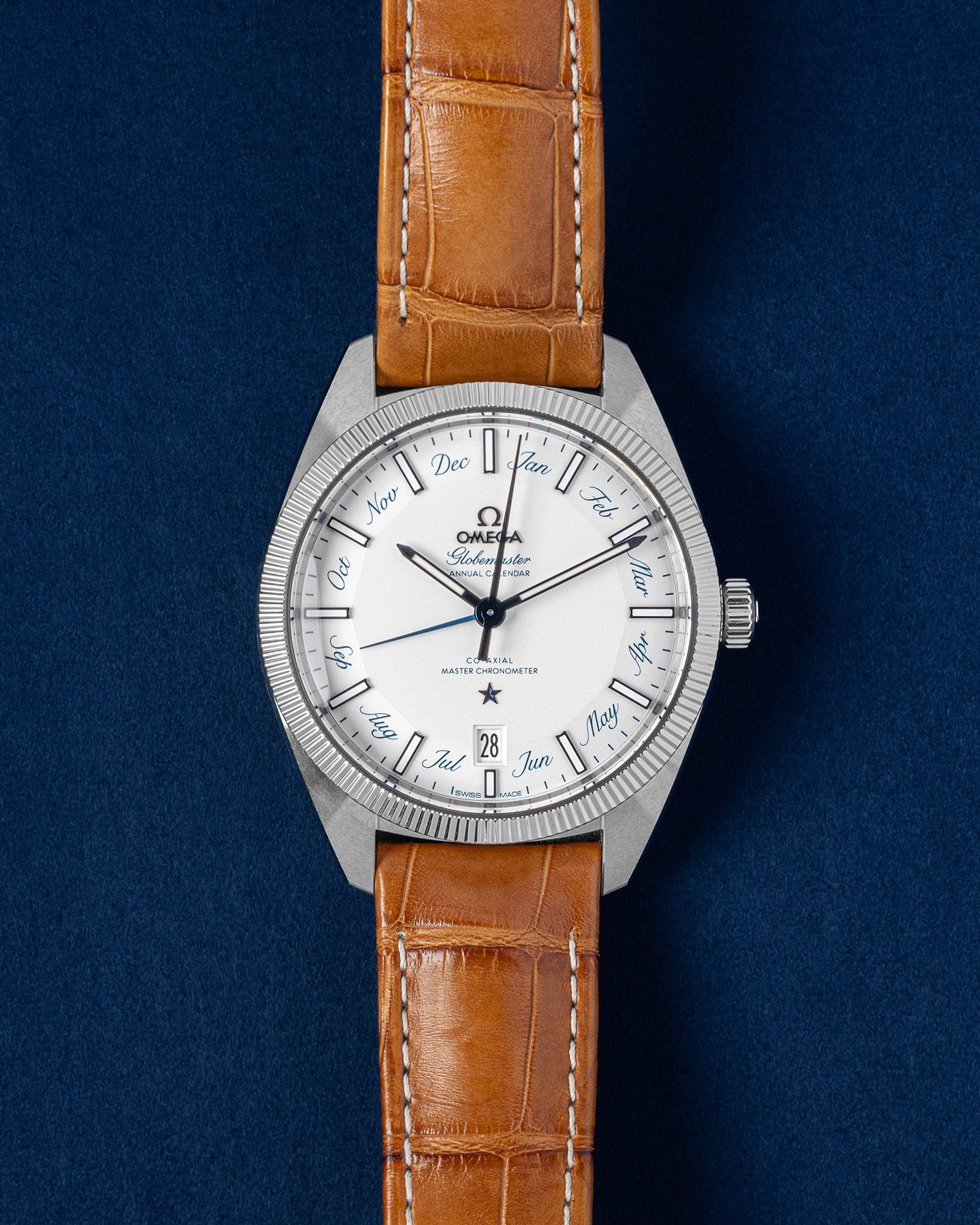
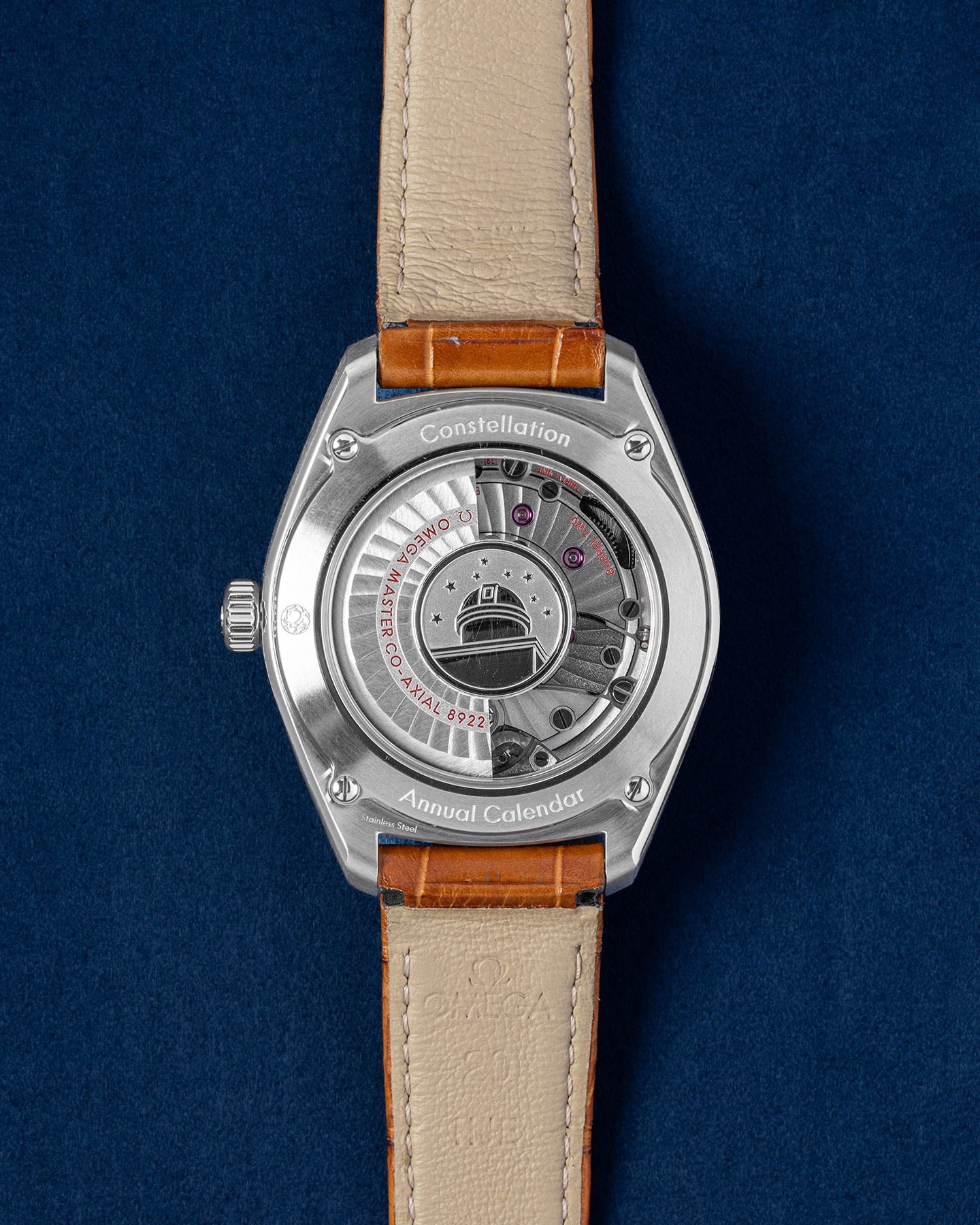
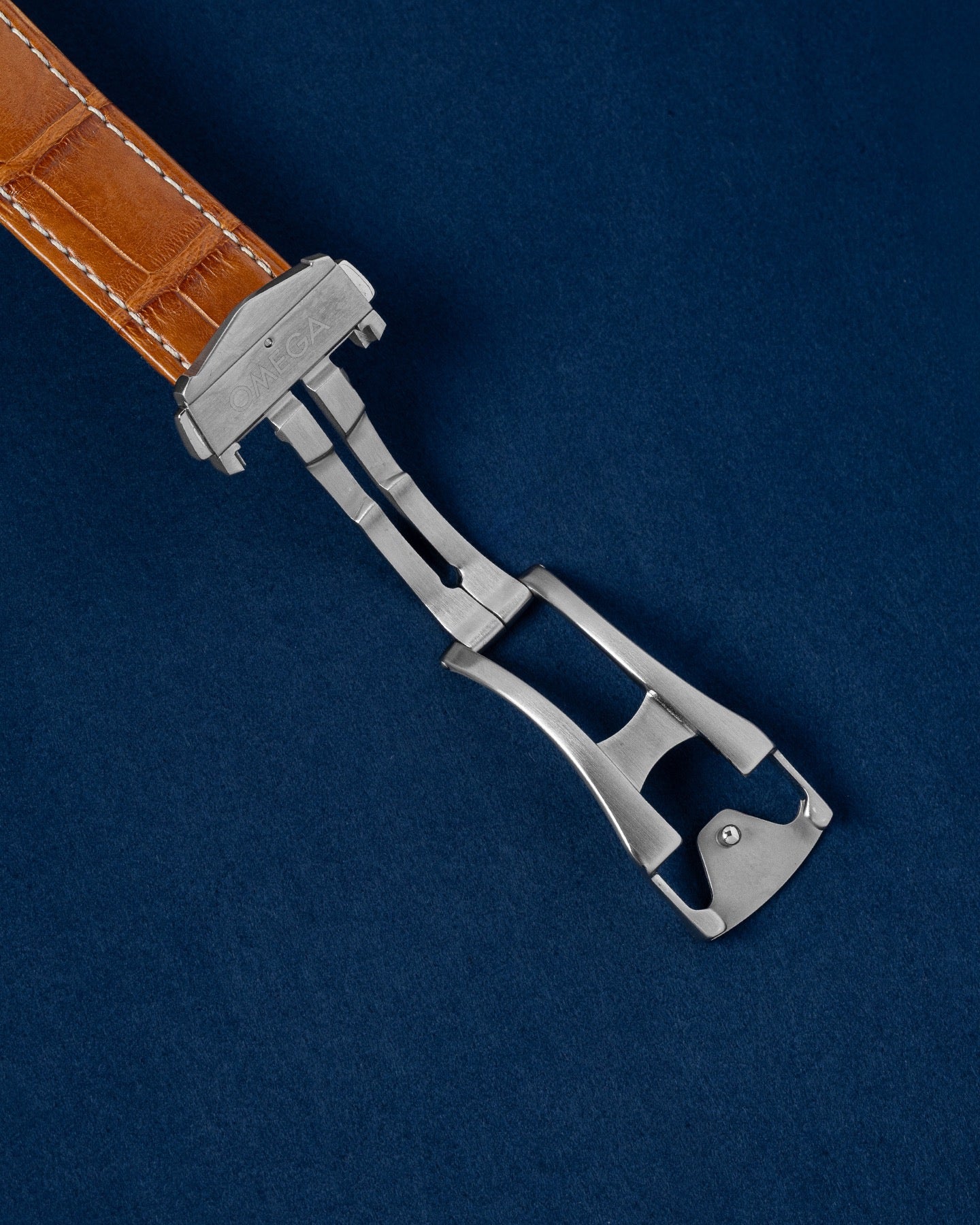
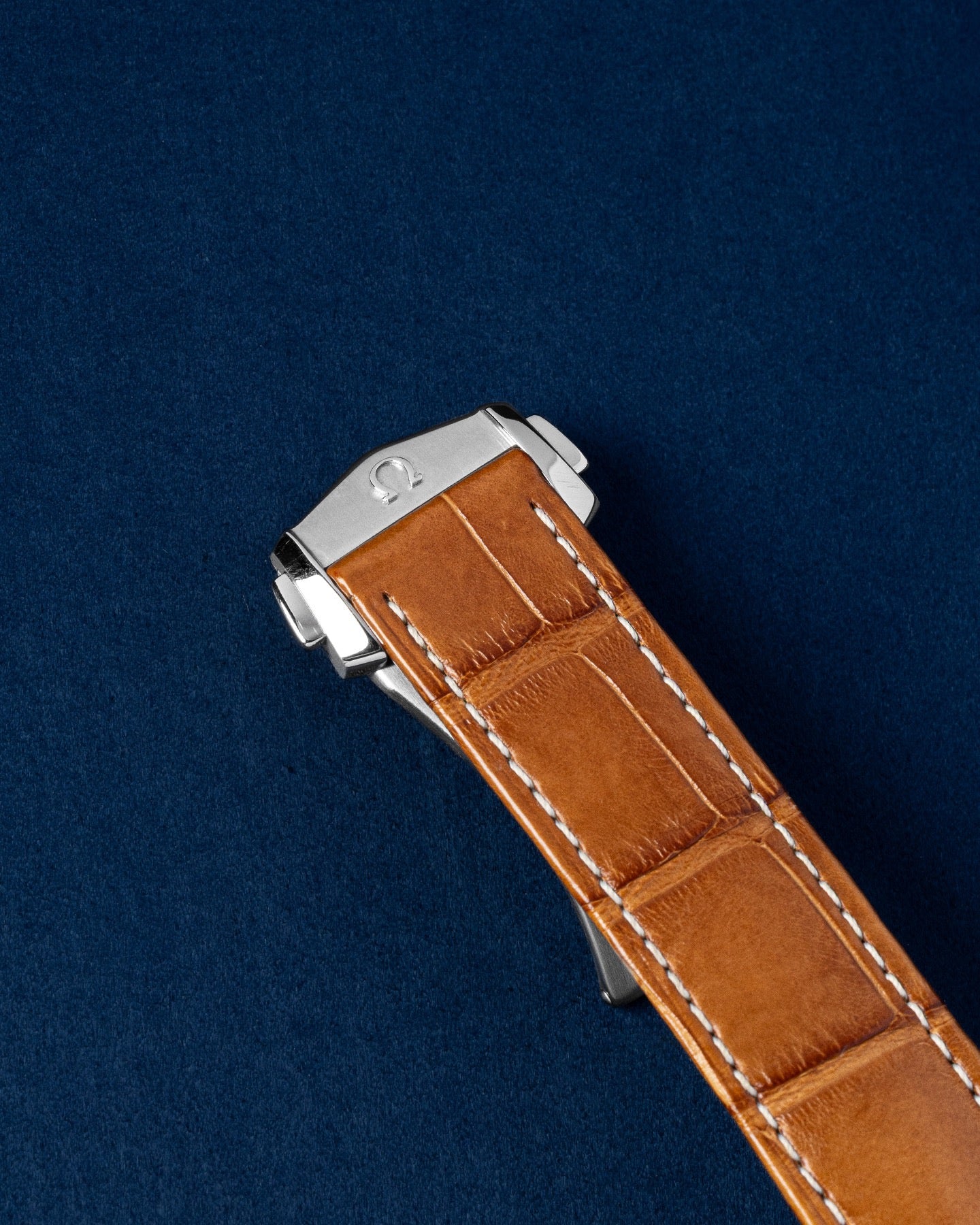
Omega Constellation Globemaster Annual Calendar 130.33.41.22.02.001
Vintage
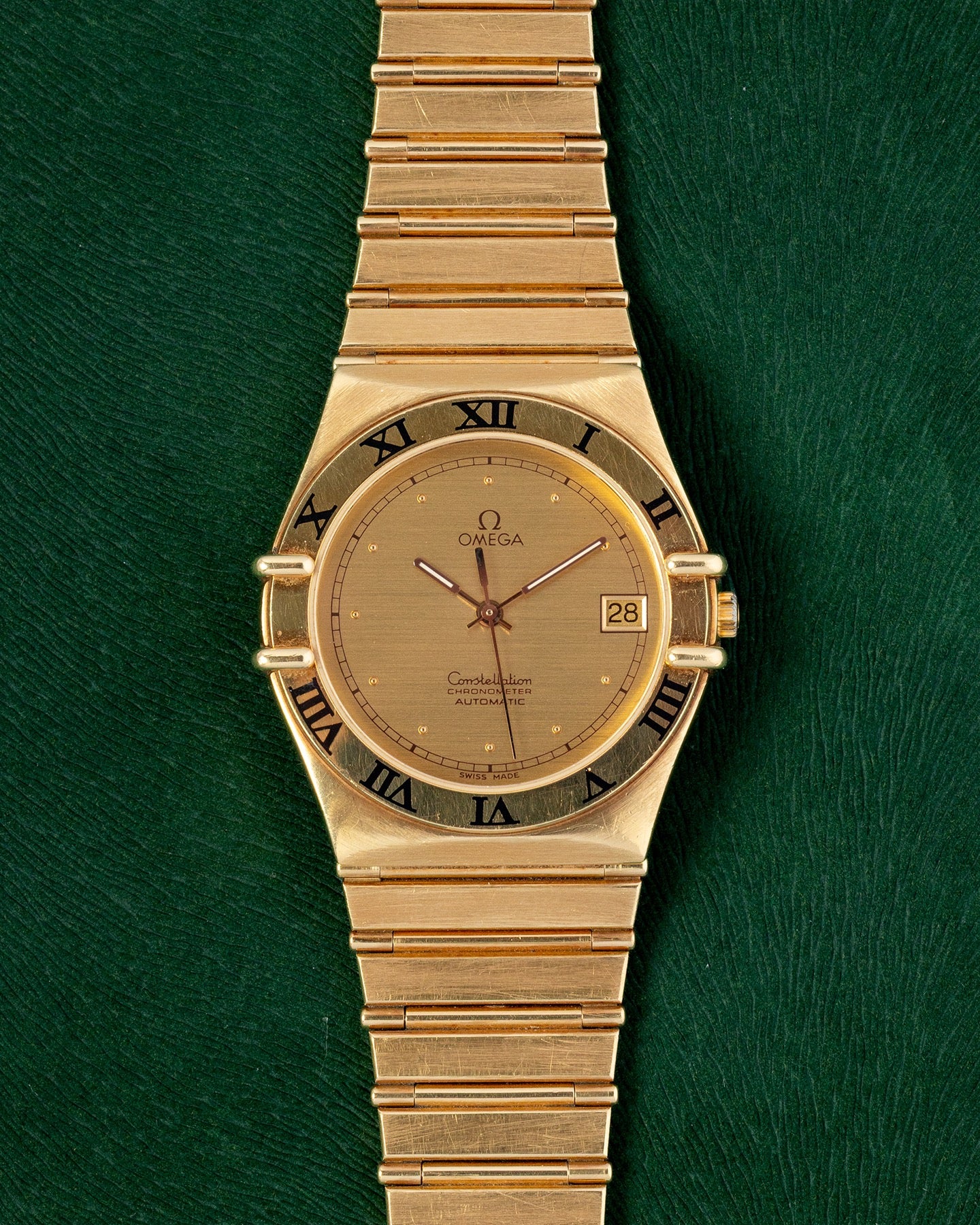
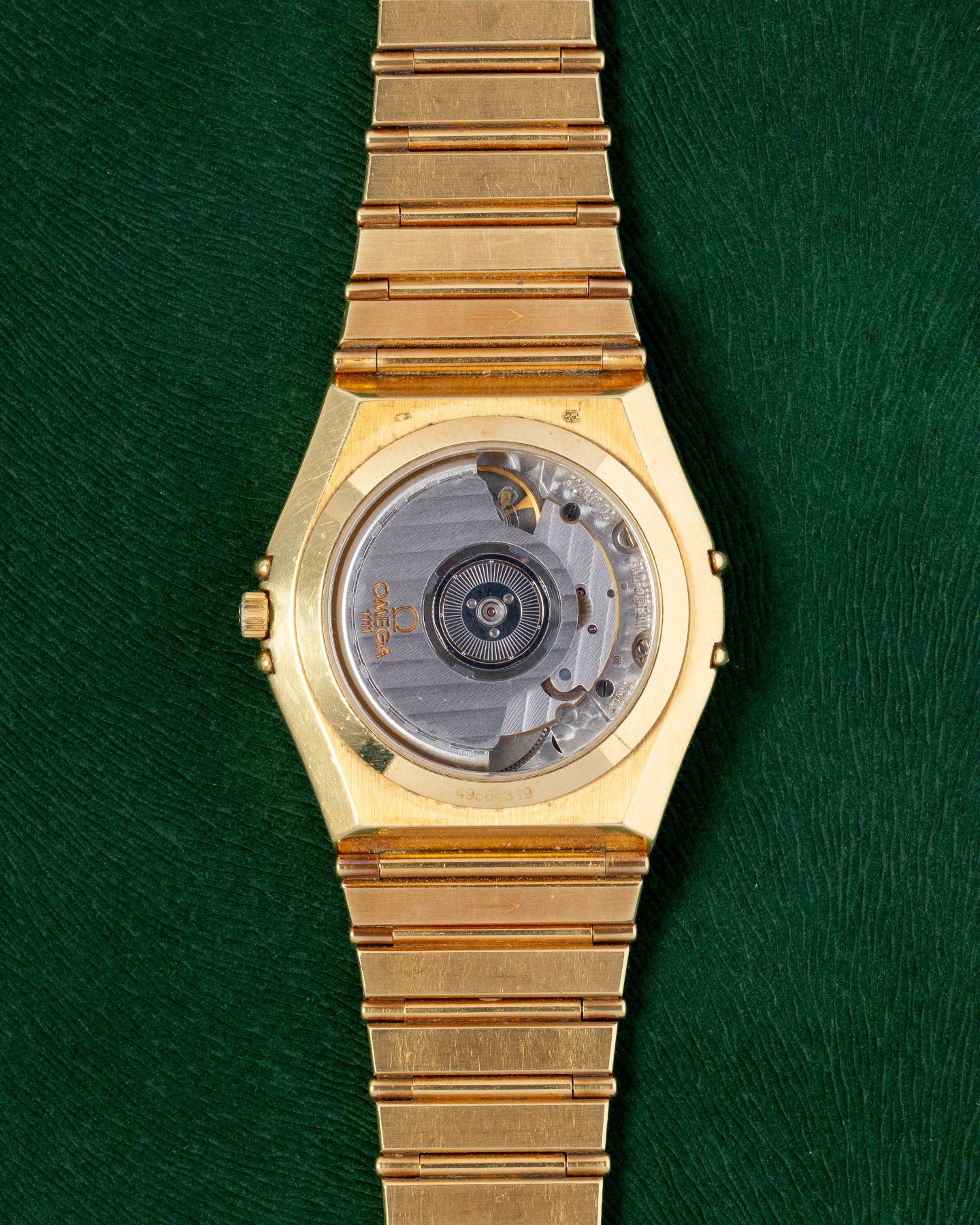
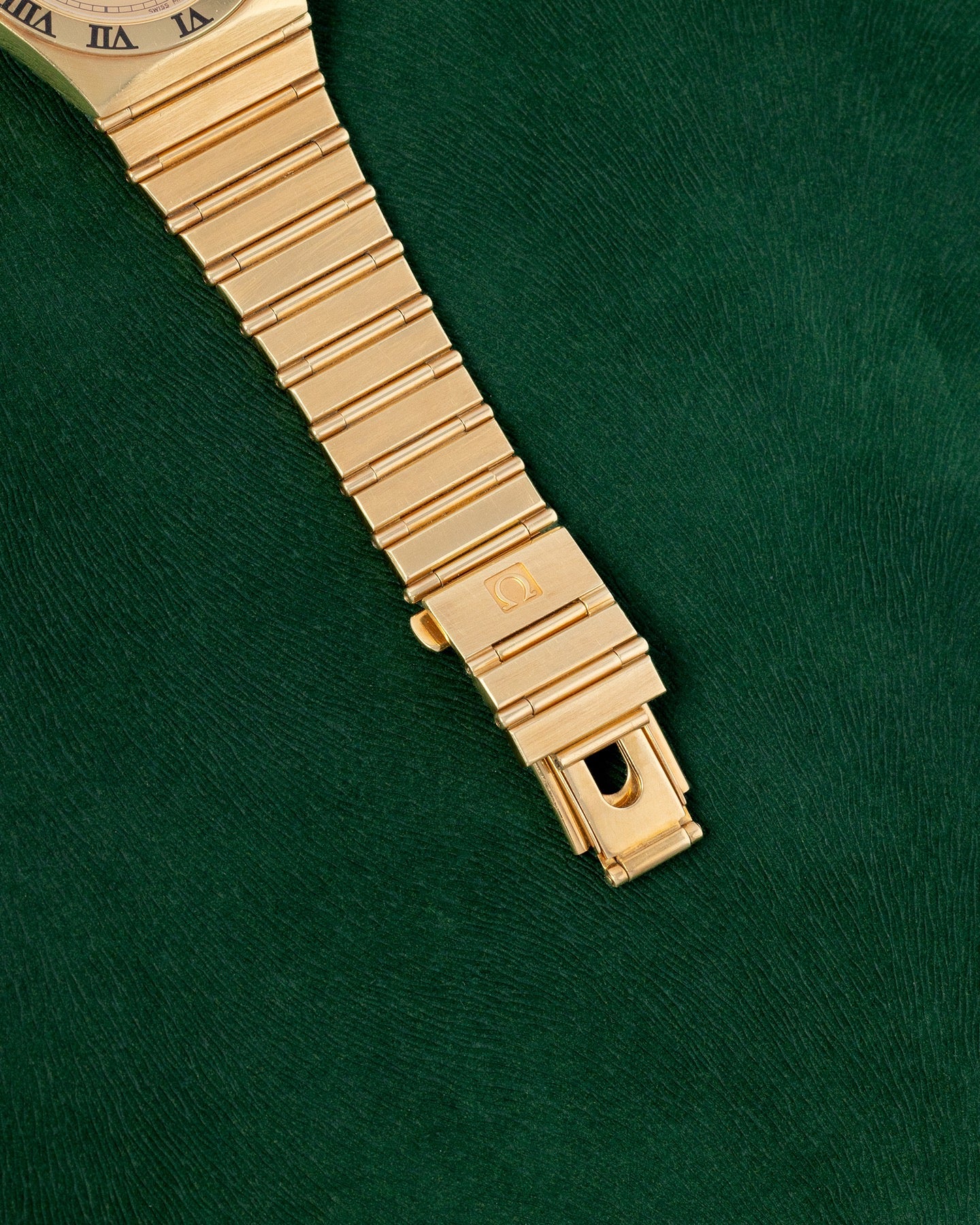
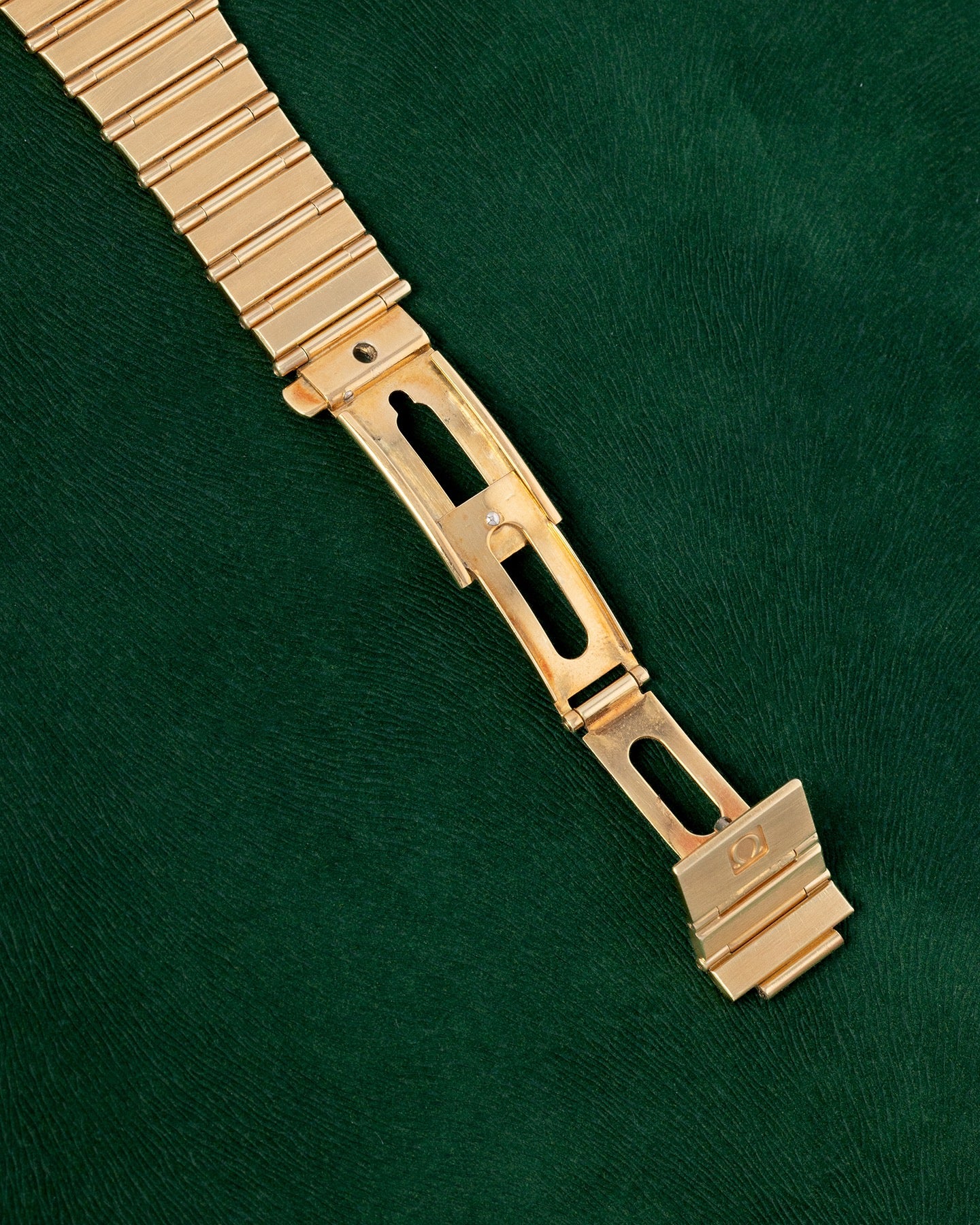

Omega Constellation 13110286060002