

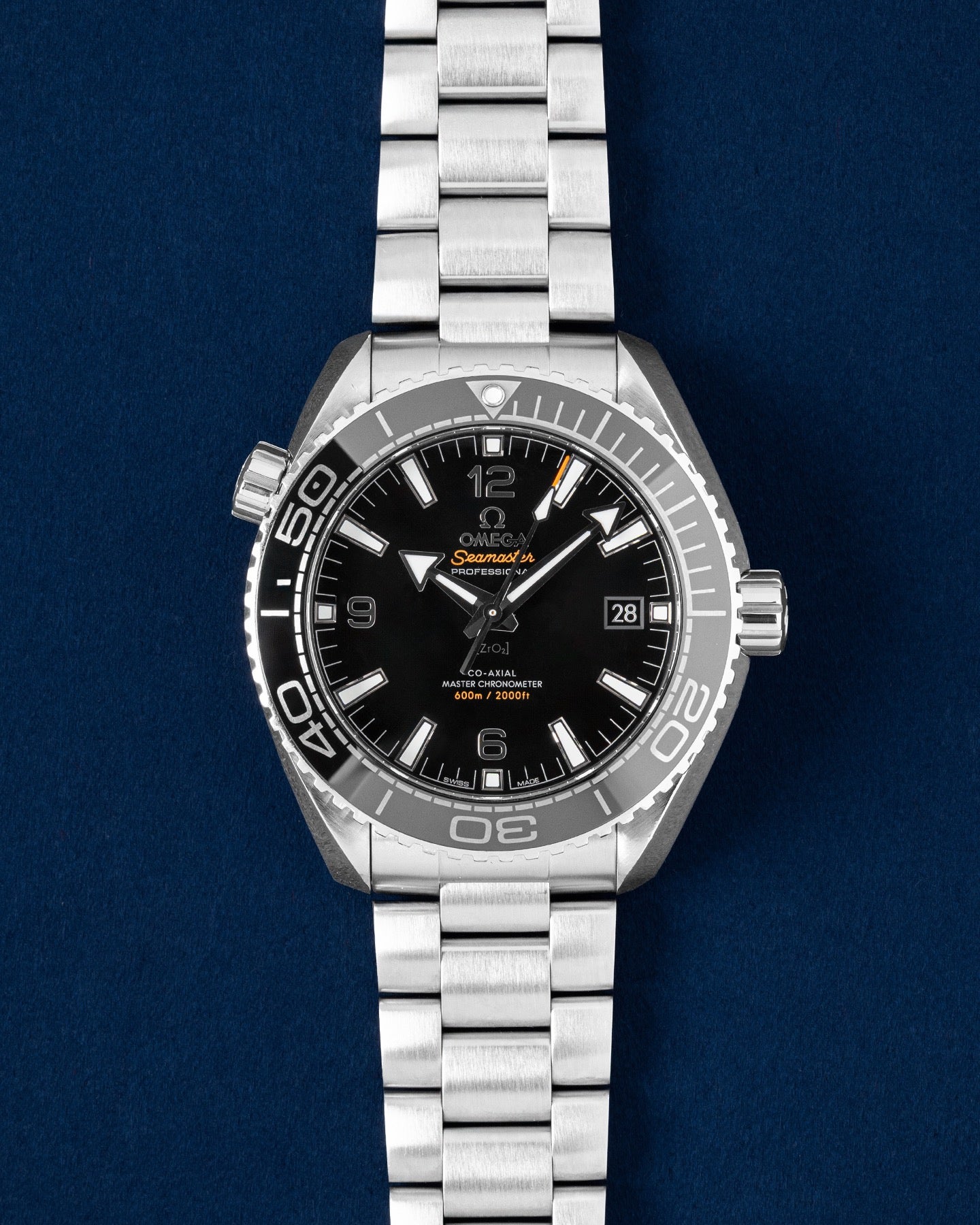
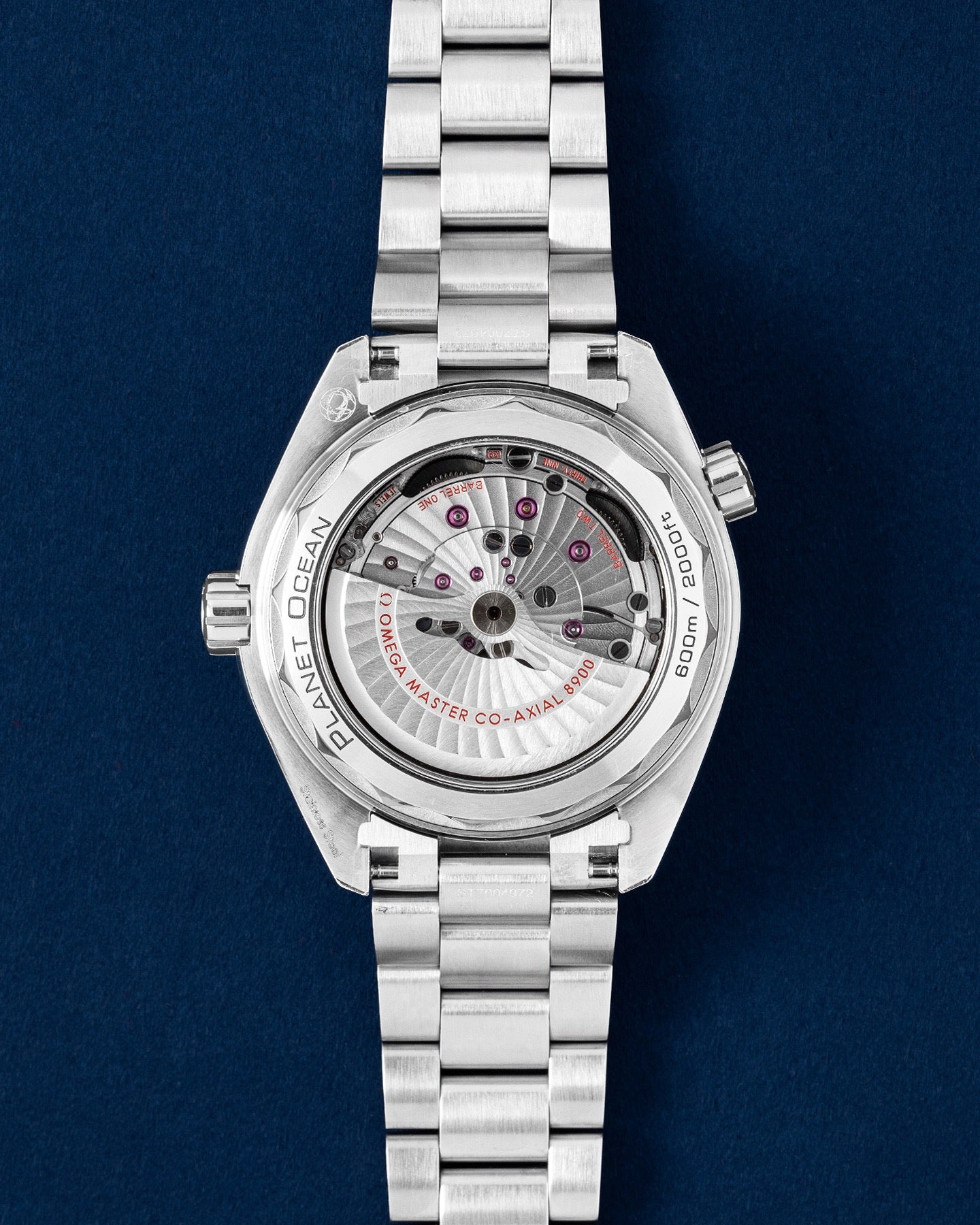


Omega Seamaster Planet Ocean 215.30.44.21.01.001
Collector's Notes
Product Details
Brand: Omega
Model: Seamaster Planet Ocean
Reference: 215.30.44.21.01.001
Case Material: Steel
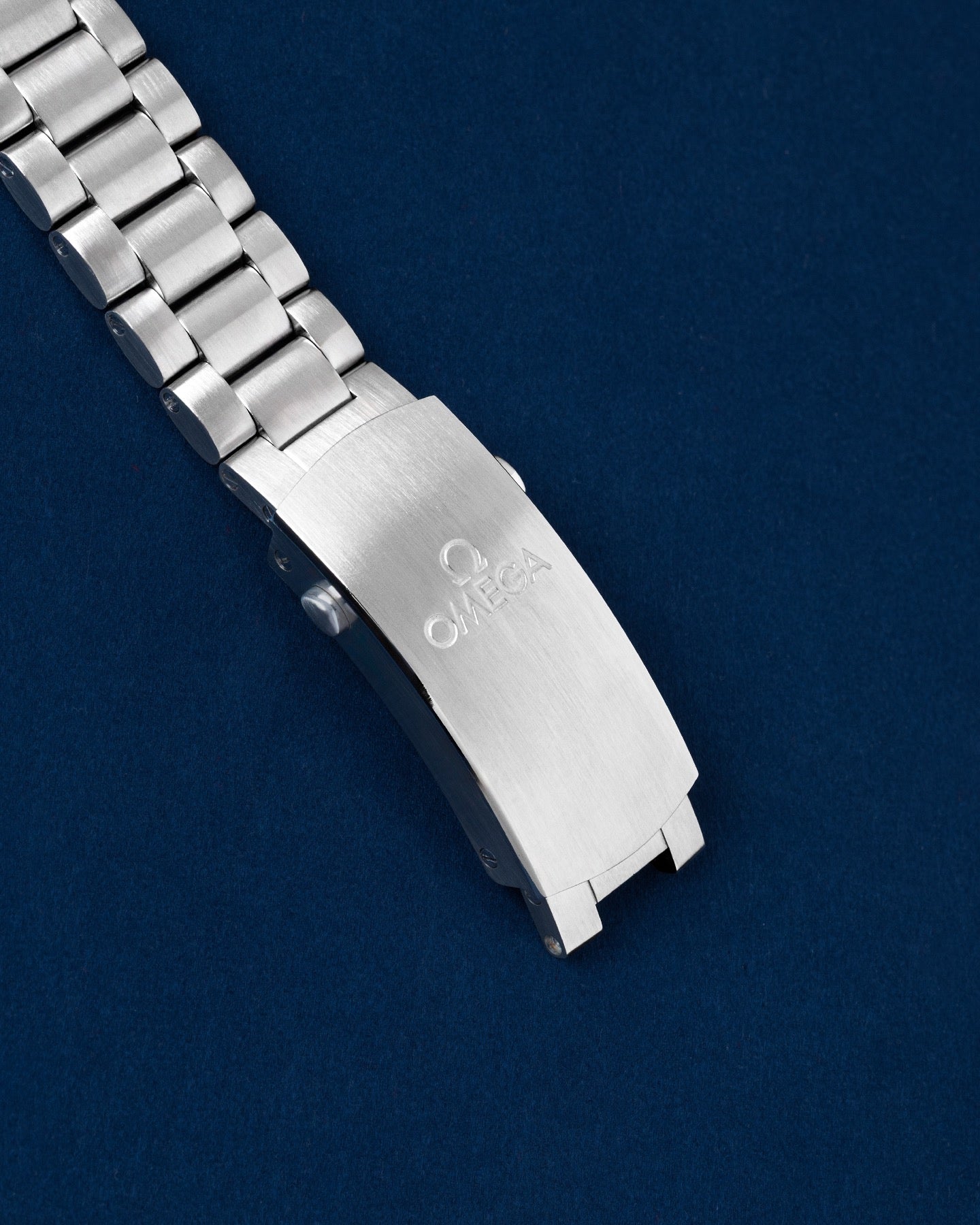
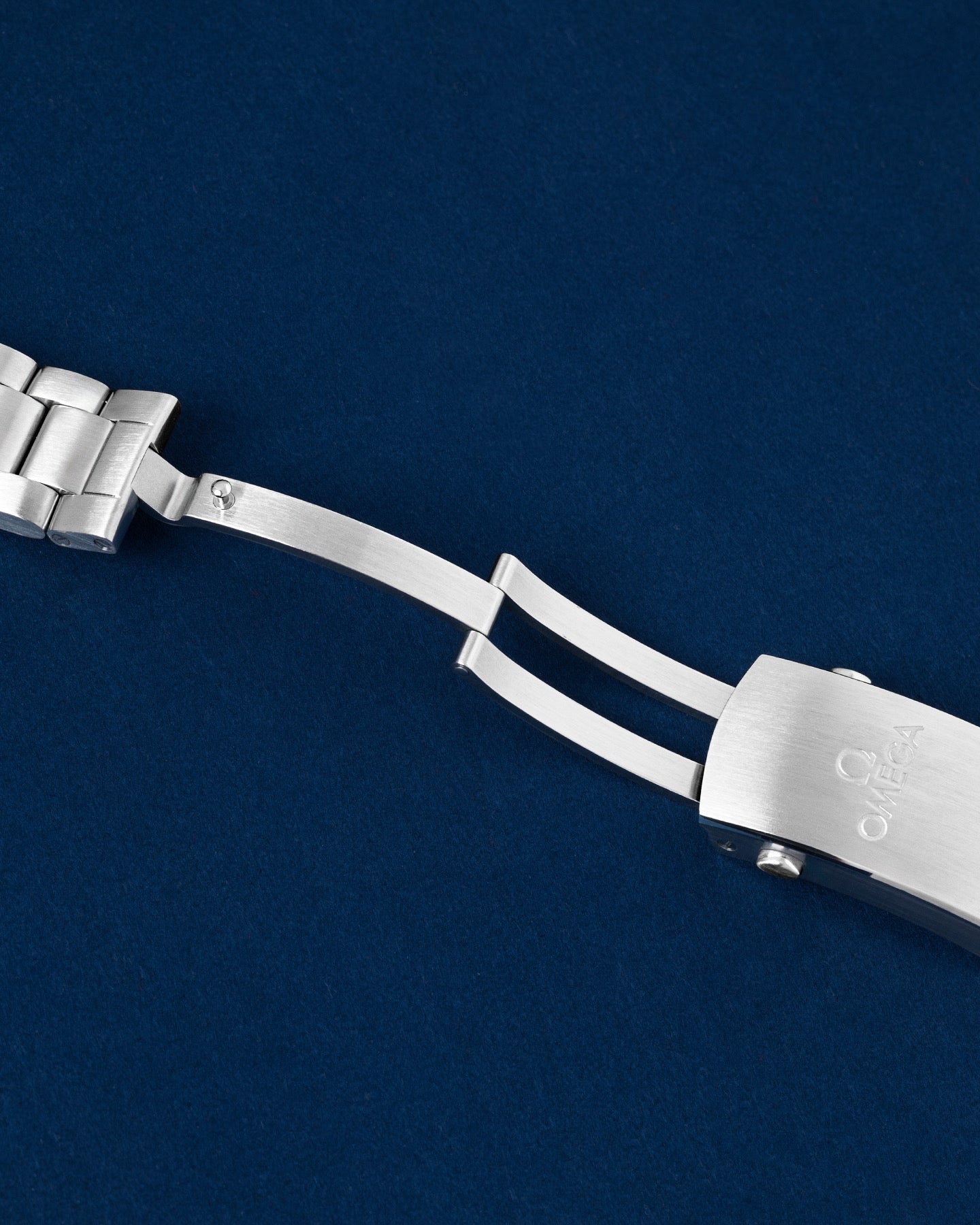
Bracelet Material: Steel
Size: 43.5mm
Dial Color: Black
Bezel Material: Ceramic
Date: 2017
Condition: Pre-Owned
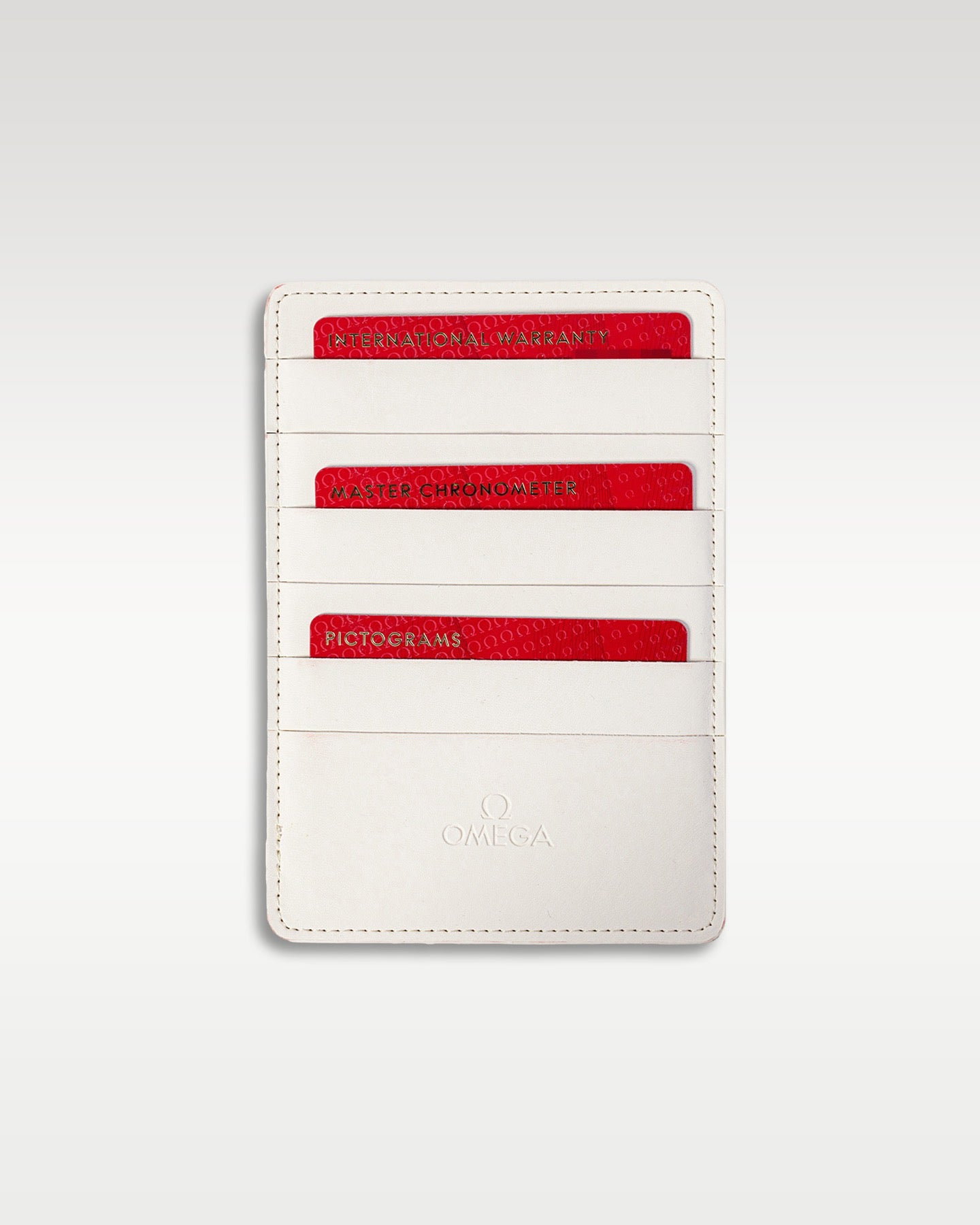
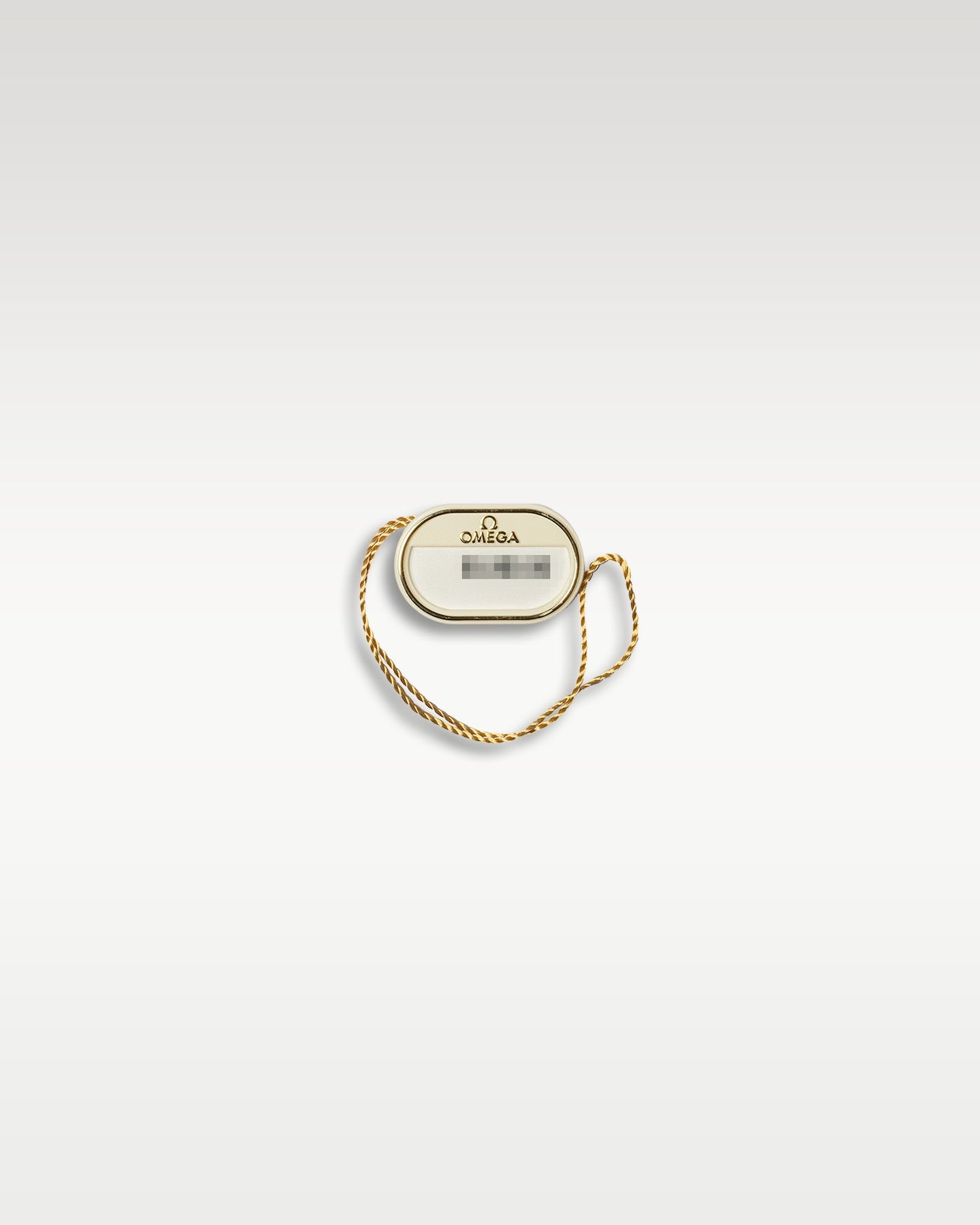
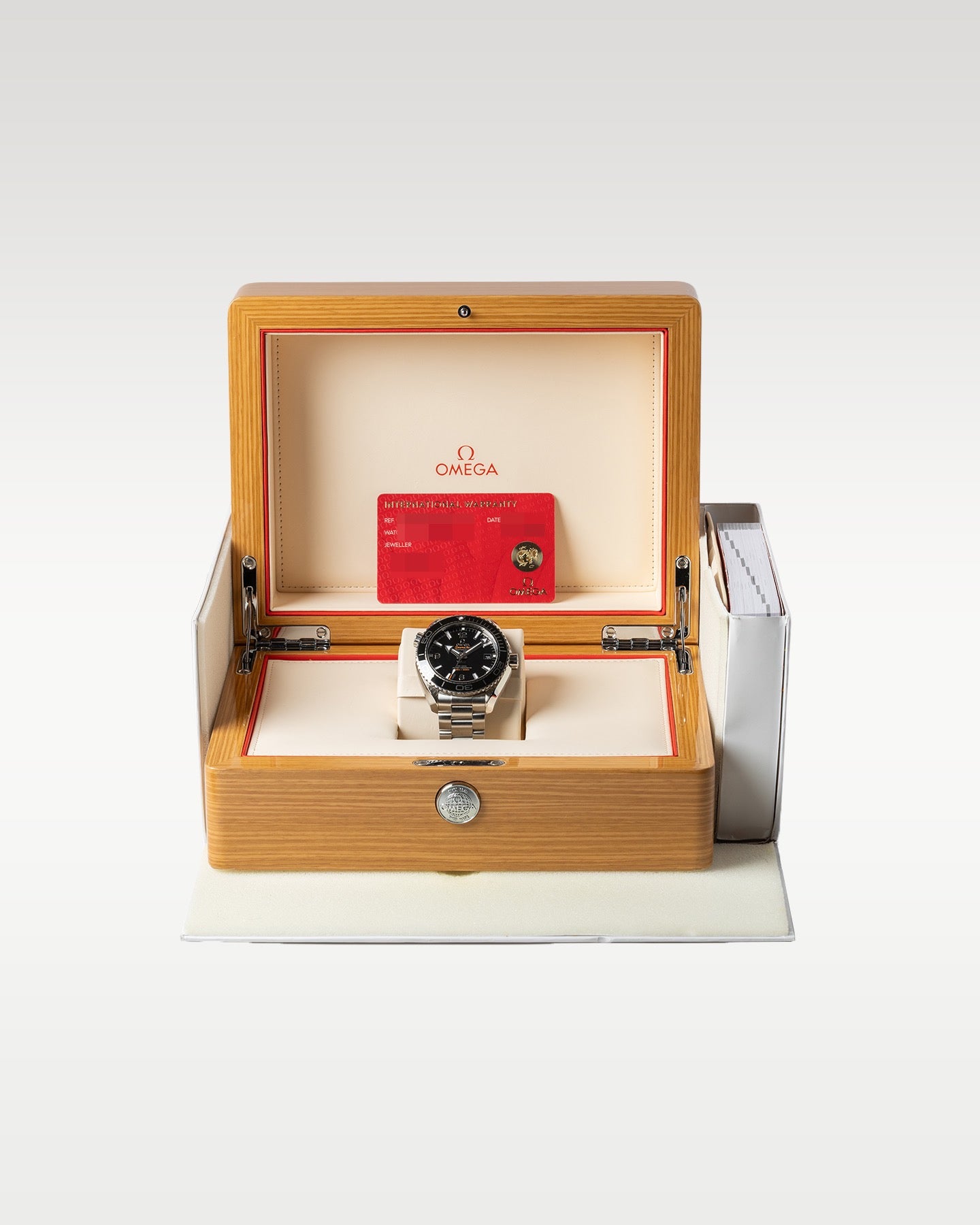
Included Items: Watch with original box and papers
Movement: Automatic
Crystal: Sapphire Crystal
Water Resistance: 60 ATM
Stock ID: 089CF
Shipping & Delivery
Grand Caliber offers free, fully insured FedEx 2-Day shipping on all domestic watch orders. Most orders ship within one business day after payment verification, with delivery to your nearest FedEx Office for secure pickup. Orders are processed Monday through Friday and may ship separately if multiple items are purchased. Delivery dates cannot be guaranteed, and shipments require a physical street address, as P.O. boxes and APO/FPO addresses are not accepted.
A Closer Look at Omega
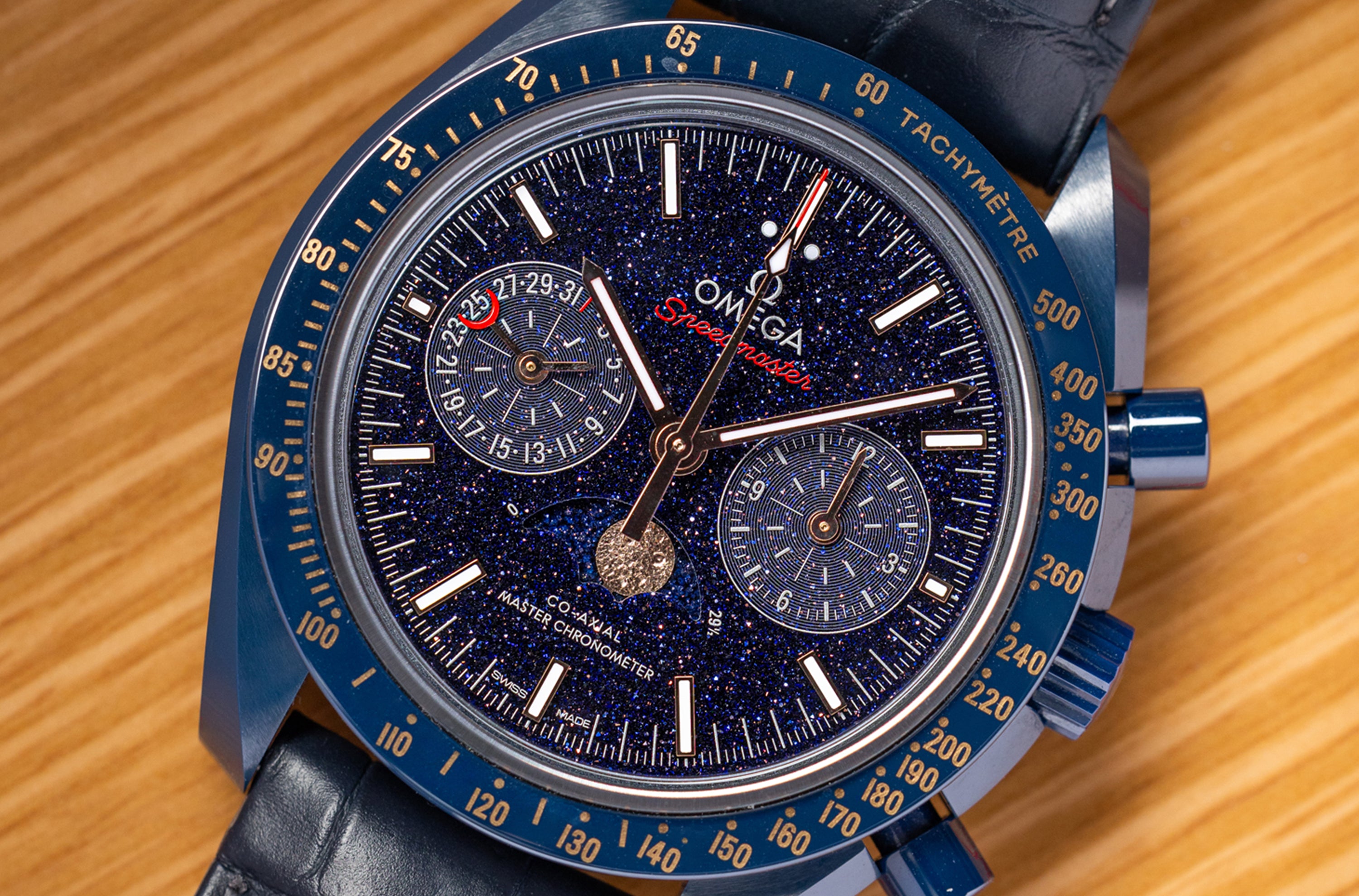
Omega is the production-scale Swiss manufacture that rebuilt its modern catalog around the Co-Axial escapement and Master Chronometer testing at METAS, so the watch in front of you was certified for accuracy, water resistance, power reserve, and 15,000 gauss of magnetic resistance before it ever left Bienne. The piece reads a lot more clearly once you can decode the reference number, recognize the caliber family, and tell the Speedmaster and Seamaster sub-lines apart, so here is what is worth knowing before you decide.
Getting to Know Omega
Most buyers arrive at Omega through one of three doors: the Speedmaster Moonwatch, the Seamaster Diver 300M, or a vintage Constellation inherited from a relative. What ties those very different watches together is a production philosophy you do not really see anywhere else at this scale. Omega licensed the Co-Axial escapement from George Daniels in 1999, industrialized it through the 2000s, and then partnered with METAS, the Swiss Federal Institute of Metrology, to launch Master Chronometer certification in 2015. Every modern reference is tested as a fully cased watch for accuracy, water resistance, power reserve, and magnetic resistance to 15,000 gauss. Knowing what that means, and how to read the rest of the watch, makes the piece in front of you much easier to evaluate against the rest of our inventory.
How an Omega Reference Number Works
Modern Omega watches built since 2007 use a 14 digit Product Information Code, written with periods in the format AAA.BB.CC.DD.EE.FFF. Once you can read it, the reference tells you most of what you need to know before you ever look at the photos. The first three digits identify the collection family: numbers starting with 1 belong to Constellation, 2 to Seamaster, 3 to Speedmaster, 4 to De Ville, and 5 to special and limited releases. Within those families, 311 and 310 mark the classic and current Speedmaster Moonwatch references, 210 and 212 the Seamaster Diver 300M, 215 the Planet Ocean, 220 the Aqua Terra, 233 the Seamaster 300, and 130 the Constellation Globemaster.
The next two digits encode the case and bracelet material together: 30 is steel on a steel bracelet, 13 is steel on a non-metal strap, 60 is yellow gold, 92 covers ceramic and other technical cases on leather or rubber. The third pair gives the case diameter rounded up to the next millimeter. The fourth pair points to the movement family and complication count. The fifth indicates the dial color or finish. The final three digits are a sequence number that separates near-identical variants. A reference like 310.30.42.50.01.001 decodes cleanly once you know the system: a steel Speedmaster Moonwatch on a steel bracelet, 42 millimeters, automatic Co-Axial chronograph caliber, black dial, first sequence.
Older Omega watches use a shorter MAPICS reference such as 145.022 or 105.012, common on pre-2007 Speedmasters and vintage Seamasters, and those decode against period catalogs rather than the current system. Either way, the reference is what the dial, hands, caseback, and movement get cross-checked against during authentication.
What the Specifications Actually Tell You
Movement and Caliber
Modern Omega calibers run in two main families. The automatic 8000 and 9000 series cover most of the catalog: the time-and-date caliber 8800 and 8900 in three-handed pieces, the chronograph caliber 9300 and 9900 in the larger Speedmasters and Seamasters, and the slimmer caliber 8500 and 8520 used in earlier and dressier references. The manually wound Speedmaster Professional Moonwatch sold today carries the caliber 3861, a Co-Axial Master Chronometer evolution of the cam-actuated 1861, with a silicon balance spring that takes the Moonwatch past 15,000 gauss while keeping the historical case dimensions. A small number of current Speedmasters revive the column wheel caliber 321, hand-built in a dedicated workshop in Bienne by a single watchmaker per movement. The takeaway when you read a listing is direct: any modern Omega Co-Axial Master Chronometer should be running well inside chronometer tolerance and is serviceable on a schedule closer to ten years than five.
The Dial
Dial detail is one of the strongest authentication points on an Omega. Modern Omega pieces use Liquidmetal for ceramic bezel numerals, an amorphous alloy that bonds into the engraved channels and cools harder than the surrounding ceramic. The Seamaster Diver 300M and Planet Ocean dials carry the laser-engraved wave pattern that is now a signature of the line. On the Constellation, look at the half-moon claws at four and eight o'clock, the Roman numerals on the bezel, and the rhodium or sun-brushed center finishing. On vintage Speedmasters, the dot over ninety on the bezel, the position of the applied logo, and the print of the Professional line are the details that separate correct dials from service replacements. Any dial work is noted on the listing rather than left for you to discover later.
Case Material and Size
Omega develops more of its case alloys in house than almost any production manufacture. Sedna gold is Omega's proprietary 18 karat rose gold, blended with copper and palladium so the warm color does not fade. Moonshine gold is a paler 18 karat yellow alloy introduced for the fiftieth anniversary of the Apollo 11 landing. Canopus gold is a proprietary white gold mixed with platinum, rhodium, and palladium that holds its color without rhodium plating. Beyond the precious metals, current Omega references use stainless steel, Grade 5 titanium, polished ceramic, and the structural zirconium oxide ceramic case introduced on the Dark Side of the Moon family. Sizes run from 34 and 36 millimeter Constellations and dress De Villes through the 41 to 44 millimeter sports references. The reference number gives you the rounded size, but the exact diameter and lug-to-lug are spelled out on the listing.
Water Resistance and Crystal
Water resistance varies sharply by collection and is worth checking before you assume a piece is dive-ready. The Speedmaster Professional Moonwatch is rated to 50 meters despite its spaceflight credentials. The Aqua Terra carries 150 meters. The Seamaster Diver 300M sits at 300 meters with a manual helium escape valve. The Planet Ocean ranges from 600 up to 1,200 meters depending on the reference. The Ploprof Seamaster pushes to 1,200 meters with a locking bezel and monobloc case. Crystals on modern references are scratch-resistant sapphire with anti-reflective coating, often on both sides, and many references run a sapphire caseback so the Co-Axial caliber, Geneva waves, and decorated rotor are visible from below.
Telling the Collections Apart
Speedmaster
The Speedmaster is the chronograph line and the part of the catalog with the deepest collector following. The manually wound Moonwatch with caliber 3861 is the direct descendant of the watch flight-qualified by NASA in 1965 and worn on the lunar surface in 1969, and it remains the spec example for the family. Around it sit the Dark Side of the Moon and its Grey Side and White Side variants in zirconium oxide ceramic, the Speedmaster '57 with broad arrow hands and a sixties racing aesthetic, the Mark II reissue, and the Silver Snoopy limited editions that trade well above retail on the secondary market.
Seamaster
The Seamaster is the dive and sports family, and it splits into several sub-collections that share the name but very little else. The Diver 300M is the helium-valve daily diver with the laser-wave dial. The Planet Ocean is the deeper, larger sibling, often run in titanium or two-tone Sedna. The Aqua Terra is the everyday sports watch with the teak-pattern dial, sized for desk wear at 38 or 41 millimeters. The Seamaster 300 revives the 1957 Professional Trilogy diver in modern dimensions, and the Ploprof is the saturation diving extreme of the line.
Constellation
The Constellation is the dressier line, defined by the half-moon claws, the integrated bracelet, and an observatory chronometer pedigree that runs back to the 1931 Geneva trials. The current Globemaster, launched in 2015, was the first Omega to carry Master Chronometer certification and brings back the pie-pan dial that defined the 1950s and 1960s Constellations.
De Ville
The De Ville is the formal collection, organized around the Prestige, Hour Vision, and Trésor sub-families. The Trésor leans thinnest and most traditional, often manually wound, while the Hour Vision exposes its movement through sapphire windows on the side of the case.
Buying Your Omega from Grand Caliber
Everything on this page, from the reference to the condition, is something we confirm before a watch is ever listed. Grand Caliber is an independent dealer based at our Dallas showroom, and every Omega we sell is authenticated in house, timegraphed against factory spec, pressure tested where the model calls for it, and priced openly so you can see real market value before you decide. If you want to talk through this specific piece or you are hunting a reference we do not currently have on the floor, you can reach us at 214-225-7198 or info@grandcaliber.com, or browse the full Omega collection online.
Frequent Questions
Can I see an Omega in person before buying?
Every Omega on the site is sitting in our Dallas showroom right now, and you are welcome to come handle it before you commit. For clients buying from out of state, send a note with the reference number and we will put together a video walkthrough, plus detailed photos of the dial and movement on the specific piece you are weighing.
Are Grand Caliber's Omega watches authenticated?
Yes, and that authentication happens before the listing is ever built. The team works through the movement against factory caliber spec on a timegrapher, checks the case and dial against the period and reference number, and confirms documentation where it is part of the set. Anything that does not clear that check never gets photographed and never reaches the site.
Do your Omega watches come with box and papers?
Some do and some do not, and the listing tells you exactly what is in the set for the specific reference you are looking at. A vintage caliber 321 Moonwatch may arrive on its own without box or papers, a current Master Chronometer Seamaster may arrive as a full set with the warranty card and outer packaging, and what is present is described on the page so the answer is clear before checkout.
Can Grand Caliber source a specific Omega reference for me?
Yes. When the exact reference, dial color, or limited edition you want is not in our active inventory, we work our dealer network to locate it. That includes discontinued Sedna gold references, specific Silver Snoopy editions, vintage caliber 321 Speedmasters, and Seamasters with tritium dials from the late 1990s. Reach out at 214-225-7198 or info@grandcaliber.com with the reference you are after.
Does Grand Caliber ship Omega watches nationwide?
Use this text to answer questions in as much detail as possible for your customers.
How does Grand Caliber price its Omega watches?
Pricing is posted on the listing, no call required to get a number. Each Omega is benchmarked against active and recent sale comps for that exact reference, dial, and condition, then the figure is set openly. Make an Offer is available on every page if you want to start a conversation around the price.