

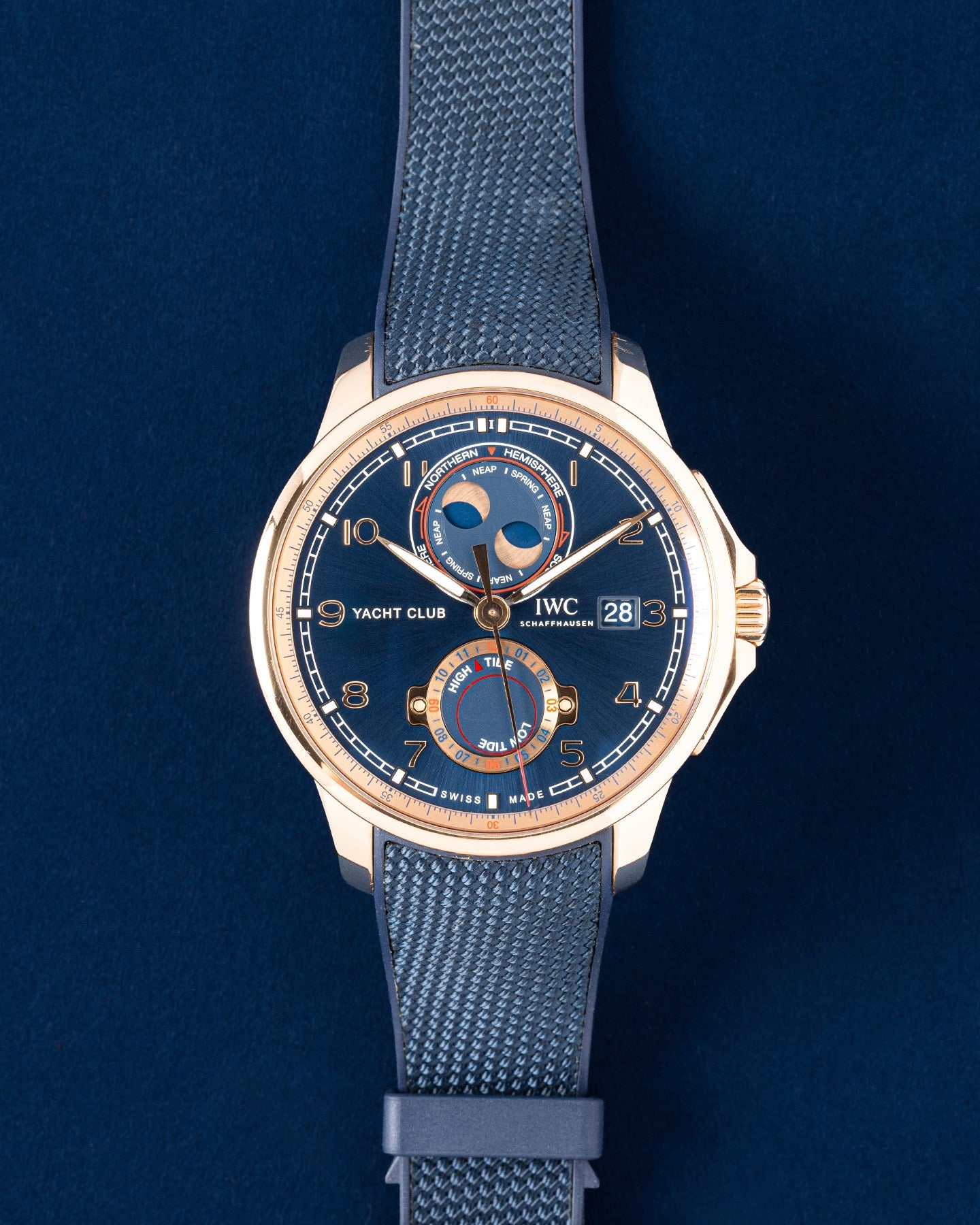
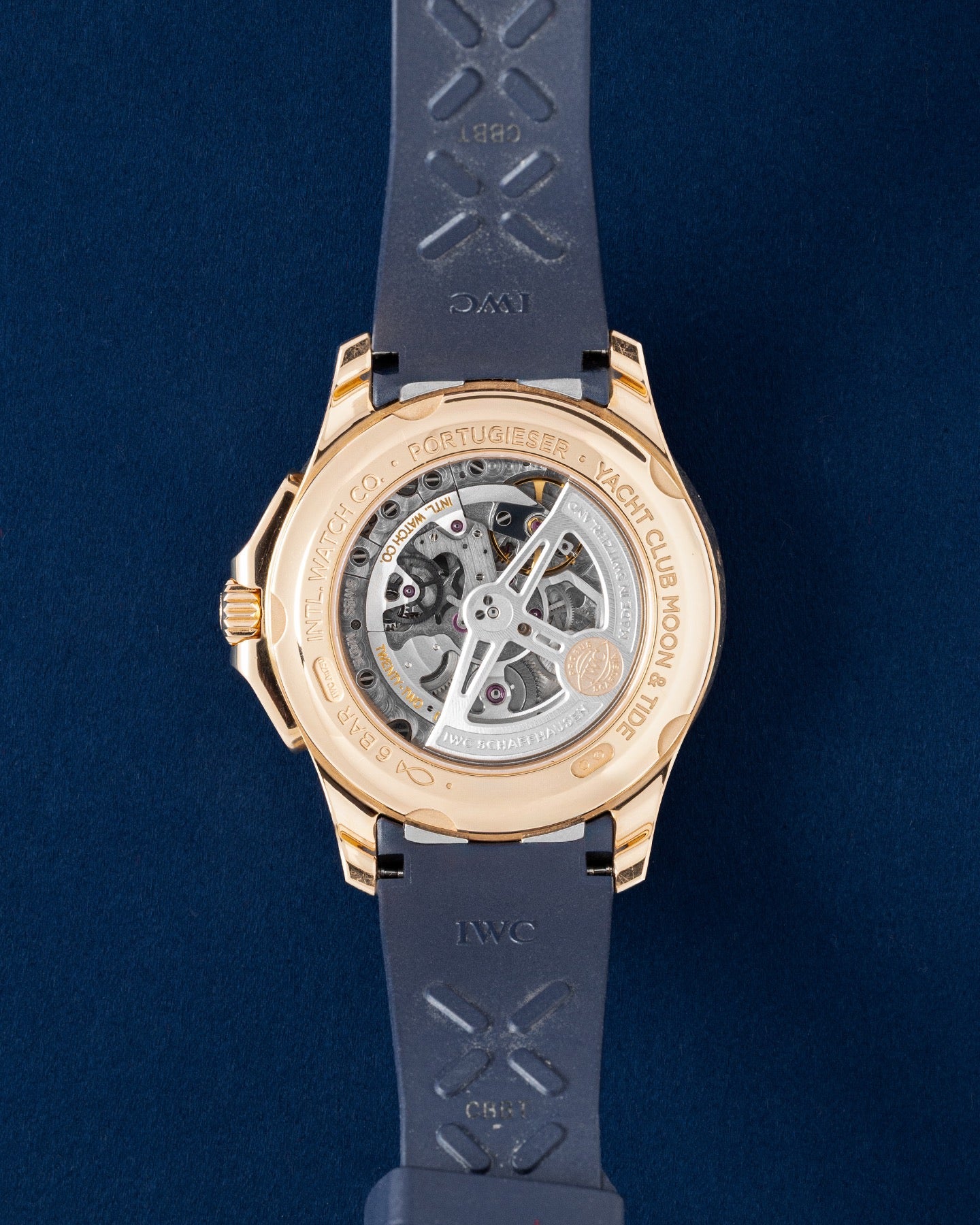
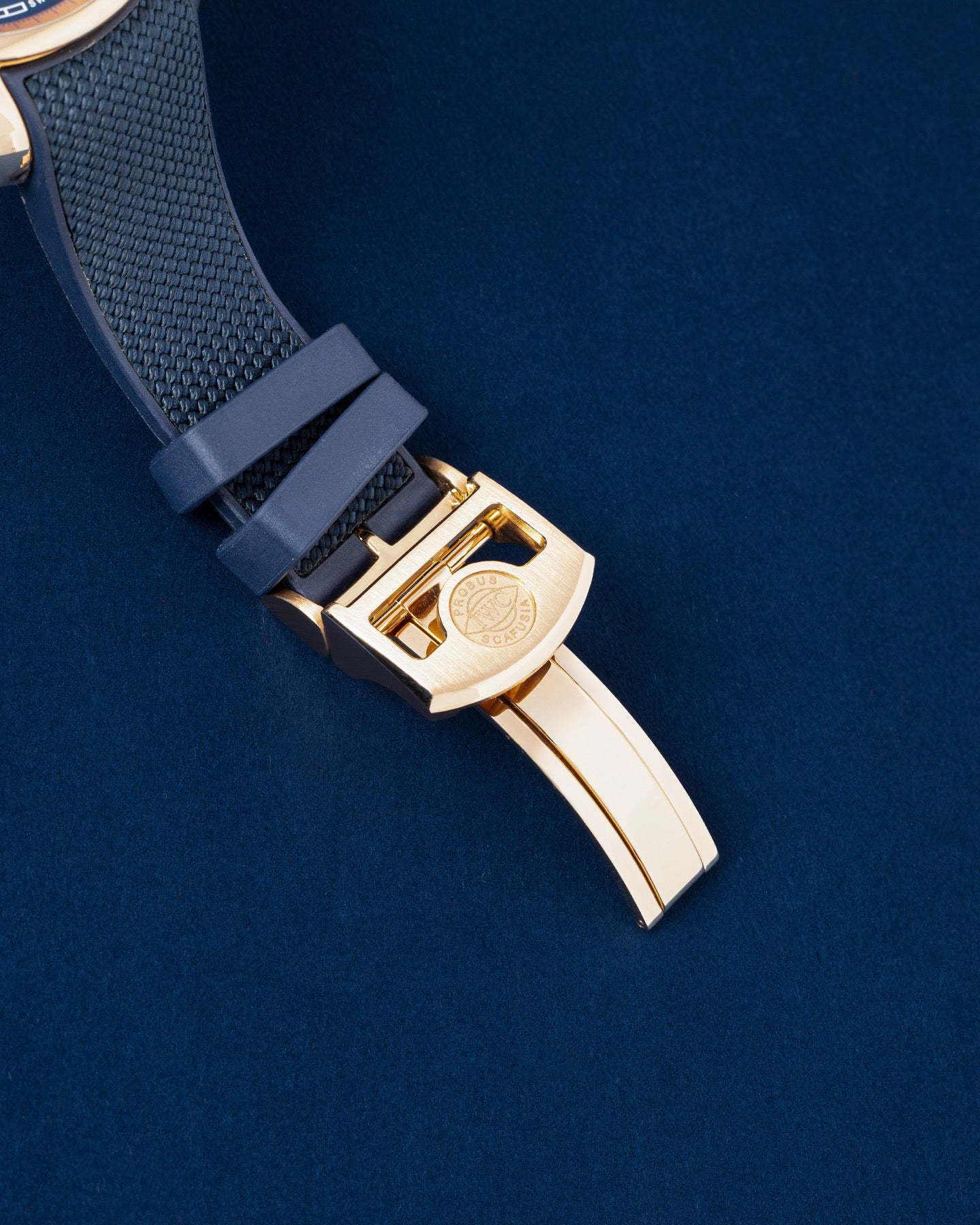
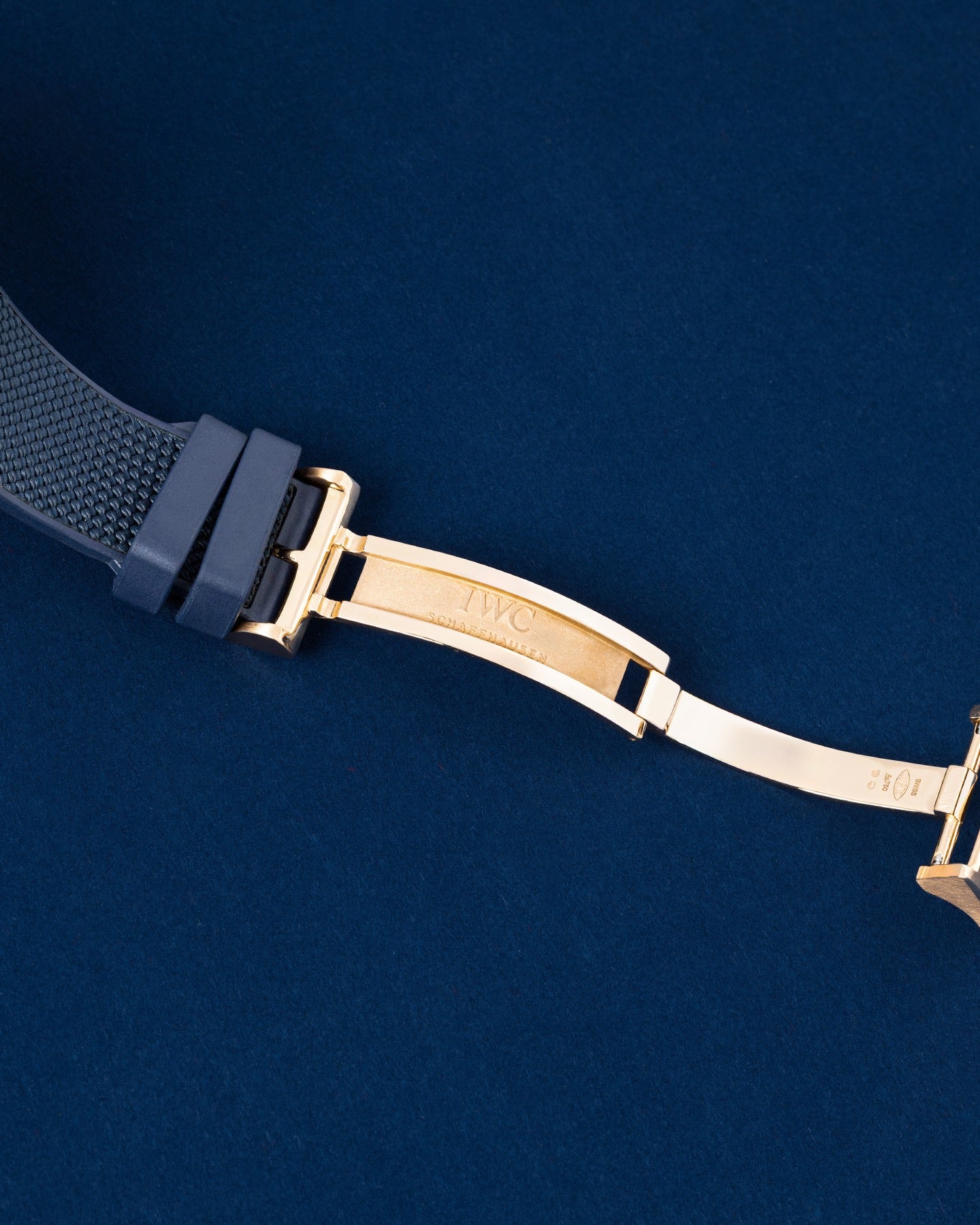

IWC Portugieser Yacht Club Moon Tide IW344001
Price on Request
Collector's Notes
Product Details
Brand: IWC
Model: Portugieser Yacht Club Moon Tide
Reference: IW344001
Case Material: Rose Gold
Bracelet Material: Rubber
Size: 44.6mm
Dial Color: Blue
Bezel Material: Rose Gold
Date: 2021
Condition: Pre-Owned
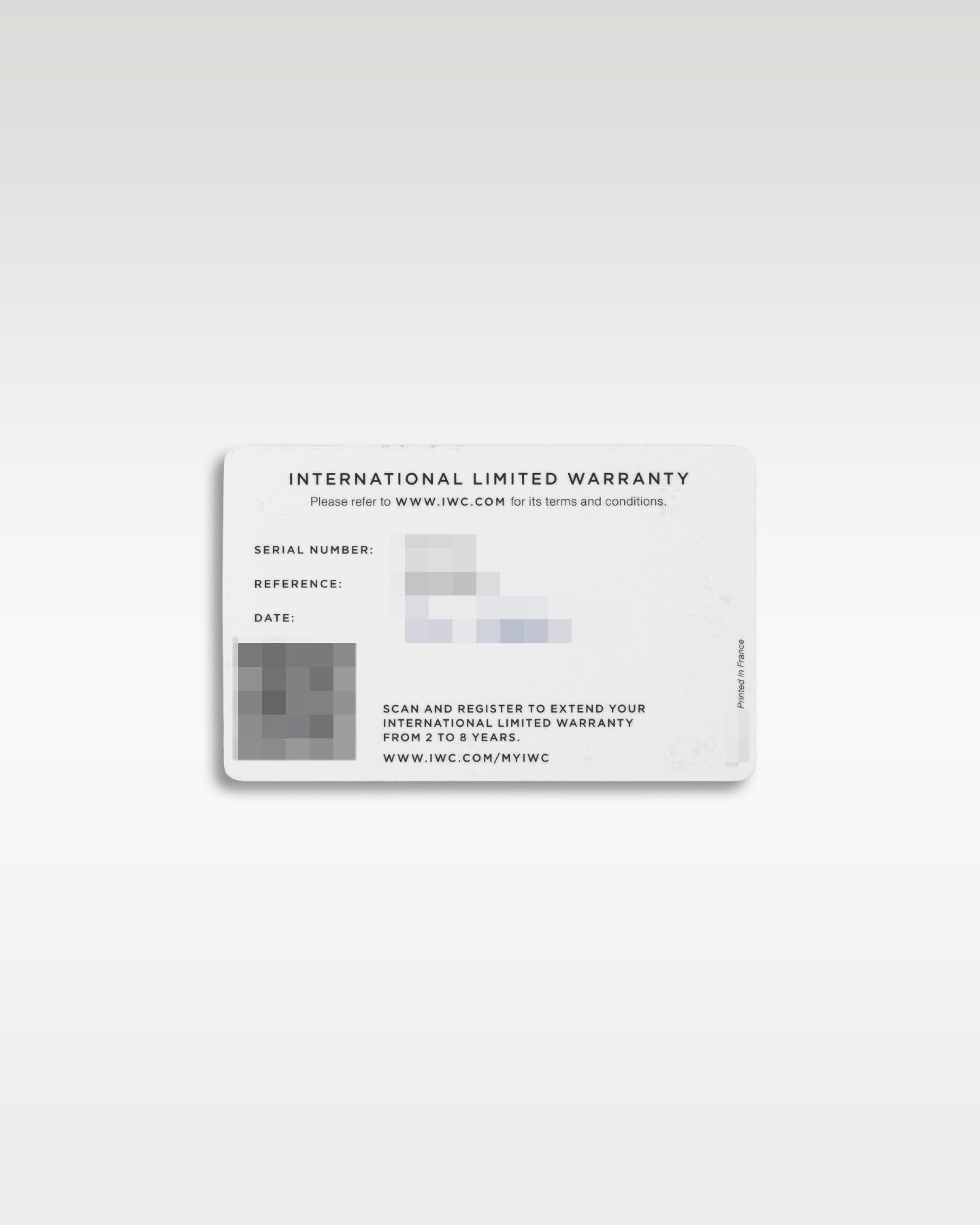
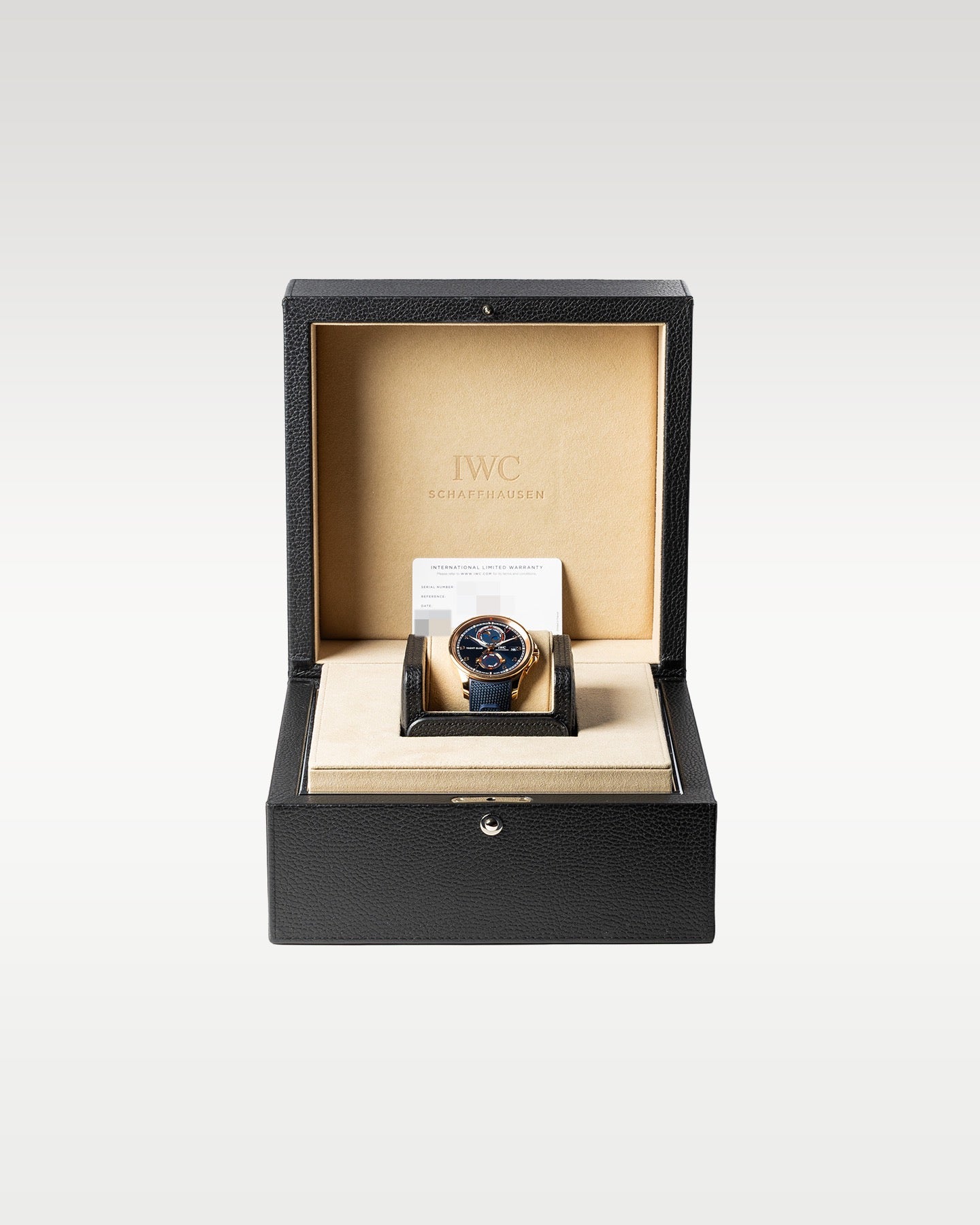
Included Items: Watch with original box and papers
Movement: Automatic
Crystal: Sapphire Crystal
Water Resistance: 6 ATM
Stock ID: 084EC
Shipping & Delivery
Grand Caliber offers free, fully insured FedEx 2-Day shipping on all domestic watch orders. Most orders ship within one business day after payment verification, with delivery to your nearest FedEx Office for secure pickup. Orders are processed Monday through Friday and may ship separately if multiple items are purchased. Delivery dates cannot be guaranteed, and shipments require a physical street address, as P.O. boxes and APO/FPO addresses are not accepted.
A Closer Look at IWC Schaffhausen
IWC Schaffhausen is the engineering brand of Swiss watchmaking, founded by an American in 1868 and shaped by names like Pellaton, Klaus, and Genta in the century that followed. If you are looking at one of our pieces and want to understand what the reference says, what is actually inside the case, and how the collections differ in purpose, here is the context worth having before you decide.
Getting to Know IWC
IWC Schaffhausen is the International Watch Company, founded in 1868 in the eastern German-speaking corner of Switzerland by an American engineer named Florentine Ariosto Jones who wanted to combine American industrial manufacturing with Swiss hand-finishing. That origin still shapes the brand today. IWC reads as the engineering-first manufacture in the Swiss landscape, less about Geneva-style decorative flourish and more about robust calibers, anti-magnetic constructions, and aviation-grade legibility. This page is here to walk through what you are actually looking at on the listing in front of you so the spec sheet stops being a list and starts being something you can read.
How an IWC Reference Number Works
Modern IWC references all follow the same simple format: IW followed by six digits. Once you can read the pattern, you can confirm exactly what configuration you are looking at without taking anyone's word for it. The first three digits after IW identify the collection and model family, and the last three digits identify the specific configuration of case material, dial color, and strap or bracelet. Take IW500401 as a worked example. The 500 prefix locates the piece in the Big Pilot 7-day family, and the 401 suffix calls out the steel case with the black dial and brown leather strap. A reference like IW371445 sits in the 371 Portugieser Chronograph family, with the 445 suffix pointing to that specific case and dial combination. Pieces from before the IW-prefixed system carry four-digit references like 3714 or 3536, which is worth knowing if you are looking at anything pre-1990s.
Worth flagging on this brand specifically: IWC runs separate sequences for the movement serial and the case serial, so the number engraved on the caseback and the number stamped on the movement plate will almost always be different. That is not a problem, a mismatch, or a sign of tampering. It is how the manufacture's records have always worked. The reference itself appears on the warranty card and on most modern casebacks; the case and movement serials are independent. For full provenance on an older piece, IWC offers a paid Certificate of Authenticity through Schaffhausen, which requires the watch to be physically examined at the manufacture.
What the Specifications Actually Tell You
Movement and Caliber
The caliber number on an IWC listing tells you most of what you need to know about the piece. The 32000 family is the modern in-house automatic that powers much of the contemporary catalog, with the 32111 in the Mark XX and the Ingenieur Automatic 40 carrying a 120-hour power reserve. The 52000 family is the larger seven-day automatic with twin mainspring barrels and the Pellaton winding system, found in the Portugieser Automatic 42 and the Big Pilot. The 69000 family, including the 69355, is the in-house column wheel chronograph that runs the current Portugieser Chronograph. The 89000 family carries the Kurt Klaus perpetual calendar module, which is the unique IWC complication that synchronizes the entire calendar through the winding crown rather than needing recessed pushers around the case. The Pellaton winding system itself, named after the IWC engineer who patented it in 1950, uses a cam-and-pawl mechanism that engages on both directions of rotor swing, which is what allows these movements to wind so efficiently from minimal wrist motion.
The Dial
Dial language varies sharply by collection, and the listing will tell you which family the piece belongs to. Pilot's Watches use a stark matte black background with oversized white Arabic numerals and the triangle flanked by two dots at twelve o'clock, which is the navigation-watch convention that lets a pilot orient the dial instantly in low light. Portugieser dials are stripped of ornamentation by design, with clean Arabic numerals on a railway minute track, slim leaf-shaped hands, and a small seconds sub-dial that traces back to the 1939 pocket-watch-movement origin of the line. The modern Ingenieur reissue carries the textured checkerboard dial Gerald Genta designed in 1976. Aquatimer dials run bold luminous indices for underwater legibility. The Portofino dress line keeps the dial clean with Roman or Arabic numerals depending on configuration.
Case Material and Size
This is where IWC's engineering instincts show most clearly on the listing. Stainless steel is the most common material and shows up across the entire current catalog. Titanium has been used here since the 1980 Porsche Design partnership and remains common in Pilot and Aquatimer pieces. Ceramic, specifically the matte black zirconium oxide that IWC was the first manufacture to use in a wristwatch case back in 1986, is core to the TOP GUN sub-line. Ceratanium is the brand's proprietary alloy fusing titanium's lightness with ceramic's scratch resistance, used for full cases, crowns, and pushers in matte black on the highest-tech Pilot chronographs. Bronze appears on certain Pilot models and develops a patina with wear. Eighteen-carat gold across red, white, and the reinforced Armor Gold alloy shows up on the high-complication Portugieser pieces. On size, expect 40mm on the Mark XX and Ingenieur Automatic, 41mm on the Portugieser Chronograph, 42.3mm on the Portugieser Automatic, 42mm on the Aquatimer, and 43mm to 46.2mm across the Big Pilot family.
Water Resistance and Crystal
Water resistance varies meaningfully by collection. Portugieser and Portofino pieces generally rate 30 or 60 meters, which is fine for daily wear but not engineered for swimming or diving. Pilot's Watches, the Mark XX, and the Ingenieur typically rate 100 meters. The Aquatimer is the dedicated dive line and rates 300 meters across the standard collection, with certain Deep variants reaching 2000 meters and integrating a mechanical depth gauge. The crystal is anti-reflective sapphire on the dial side across the catalog. Portugieser pieces in particular carry a domed sapphire that mirrors the curve of the original 1939 case profile, while the Big Pilot uses an extra-thick flat sapphire engineered to resist sudden pressure changes in unpressurized cockpits.
Telling the Collections Apart
Pilot's Watches
This is the largest and most recognizable family in the catalog, descended directly from the 1936 Spezialuhr fur Flieger and the 1940 B-Uhr navigation instrument. The collection covers the 40mm Mark XX as the entry point, the 41mm and 43mm Pilot Chronographs for everyday wear, the 43mm or 46.2mm Big Pilot 7-day as the modern flagship, and the matte black TOP GUN ceramic and Ceratanium pieces at the top of the line. The shared visual signature across the family is the high-contrast dial with the triangle marker at twelve and the oversized onion-style crown on the Big Pilot.
Portugieser
This is the dress and high-complication line, defined by the 1939 origin story of the Portuguese marine merchants who wanted wristwatches that matched marine chronometer accuracy. The collection includes the perfectly symmetrical 41mm Portugieser Chronograph, the 42.3mm Portugieser Automatic 42 with its power reserve indicator and seven-day movement, and the Portugieser Perpetual Calendar that runs the Kurt Klaus module with the four-digit year display and the dual moon phase showing both hemispheres simultaneously. This is the family for the buyer who wants serious mechanics presented in a clean, restrained dial.
Ingenieur
The Ingenieur was designed in 1955 as an anti-magnetic instrument for engineers and scientists, using a soft iron Faraday cage inside the case to deflect magnetic fields. Current production centers on the Ingenieur Automatic 40, which is the 2023 revival of the 1976 Gerald Genta integrated-bracelet design with the textured checkerboard dial and the five-hole bezel. This is IWC's answer to the integrated-bracelet sports watch category that the Royal Oak and the Nautilus defined.
Aquatimer
The dedicated dive line, originally launched in 1967 with an internal rotating bezel operated by a secondary crown at four o'clock to keep the bezel safe from sand and salt. The modern Aquatimer carries a 42mm case, 300 meters of water resistance, the SafeDive system that lets the bezel rotate only counter-clockwise, and quick-change strap mechanisms for switching between bracelet and rubber.
Portofino
The dress collection at the simpler end of the catalog, with cleaner case lines and restrained dial layouts. Available in three-hand and chronograph configurations and across both 37mm and 40mm cases. This is the IWC for the buyer who wants something quiet enough to disappear under a shirt cuff and still carries serious in-house mechanics.
Buying Your IWC from Grand Caliber
Everything on this page, from the reference to the condition, is something we confirm before a watch is ever listed. Grand Caliber is an independent dealer in Uptown Dallas, and every IWC we sell is authenticated in house and priced openly so you can see the real market value before you decide. If you want to talk through a specific piece or are hunting a reference we do not currently have, you can reach us at 214-225-7198 or info@grandcaliber.com, or browse the full IWC collection online.
Frequent Questions
Can I see an IWC in person before buying?
Yes, and we encourage it. The entire inventory is kept at our Dallas showroom, so any IWC you see on the site is available to look at, try on, and inspect in person before any decision gets made. Clients buying remotely can request additional images, video of the piece running, or specific details on the movement and case before we ship.
Are Grand Caliber's IWC watches authenticated?
Authentication happens in-house before a piece is ever listed for sale. The IWC-specific work includes inspecting the Pellaton winding system for correct ceramic pawl engagement, confirming any Kurt Klaus perpetual calendar module synchronizes through the crown as it should, verifying that the movement caliber matches the reference, and checking the Ceratanium or titanium case finishing against the brand's specifications. Both the movement serial and the case serial are recorded and cross-referenced where documentation is present. A watch that does not pass that review is not put up for sale.
Do your IWC watches come with box and papers?
Contents vary from piece to piece, and the specific inclusions are spelled out on each individual product page. A good portion of our IWC inventory arrives as full sets with the original box, warranty card, instruction booklet, and any service records. Pieces that are watch-only or partial sets are clearly labeled as such on the listing so there are no surprises at checkout.
Can Grand Caliber source a specific IWC reference for me?
Yes. If we do not currently have the specific IW reference, dial, case material, or strap configuration you are looking for, we will work to find it through our trade network and private collector channels. This includes discontinued references and configurations that are no longer in production. The fastest way to start that conversation is a call to (214) 225-7198 or an email to info@grandcaliber.com with as much detail on what you are after as you have.
Does Grand Caliber ship IWC watches nationwide?
Yes. We ship across the United States with full insurance coverage on every piece, using carriers that specialize in high-value watch transit. The same watch can be picked up in person at our Dallas showroom for any client in North Texas who would rather not have it shipped at all.
How does Grand Caliber price its IWC watches?
Every listing carries its price openly on the page, with no need to call for a number. The figure tracks the current secondary market for that exact reference, condition, and what is included with the watch. Standard production IWC pieces typically lose a meaningful percentage of retail value when they leave the boutique, which means the pre-owned market is genuinely where the value lives for this brand. Reasonable offers are welcome on every listing.